

DICGC Deposit Insurance Limit In India: Rules, Coverage And Examples



Fixed Deposits (FDs) have traditionally been considered a low-risk investment option in India. Investors looking to protect their savings while earning moderate returns, without taking on significant investment risks, often prefer FDs.
Compared to market-linked investments, FDs offer predictable interest income and are not directly exposed to stock market volatility. However, despite the strict regulatory oversight and established banking framework in India, the possibility of a bank facing financial difficulties or even failing cannot be ruled out entirely. This is where deposit insurance becomes important.
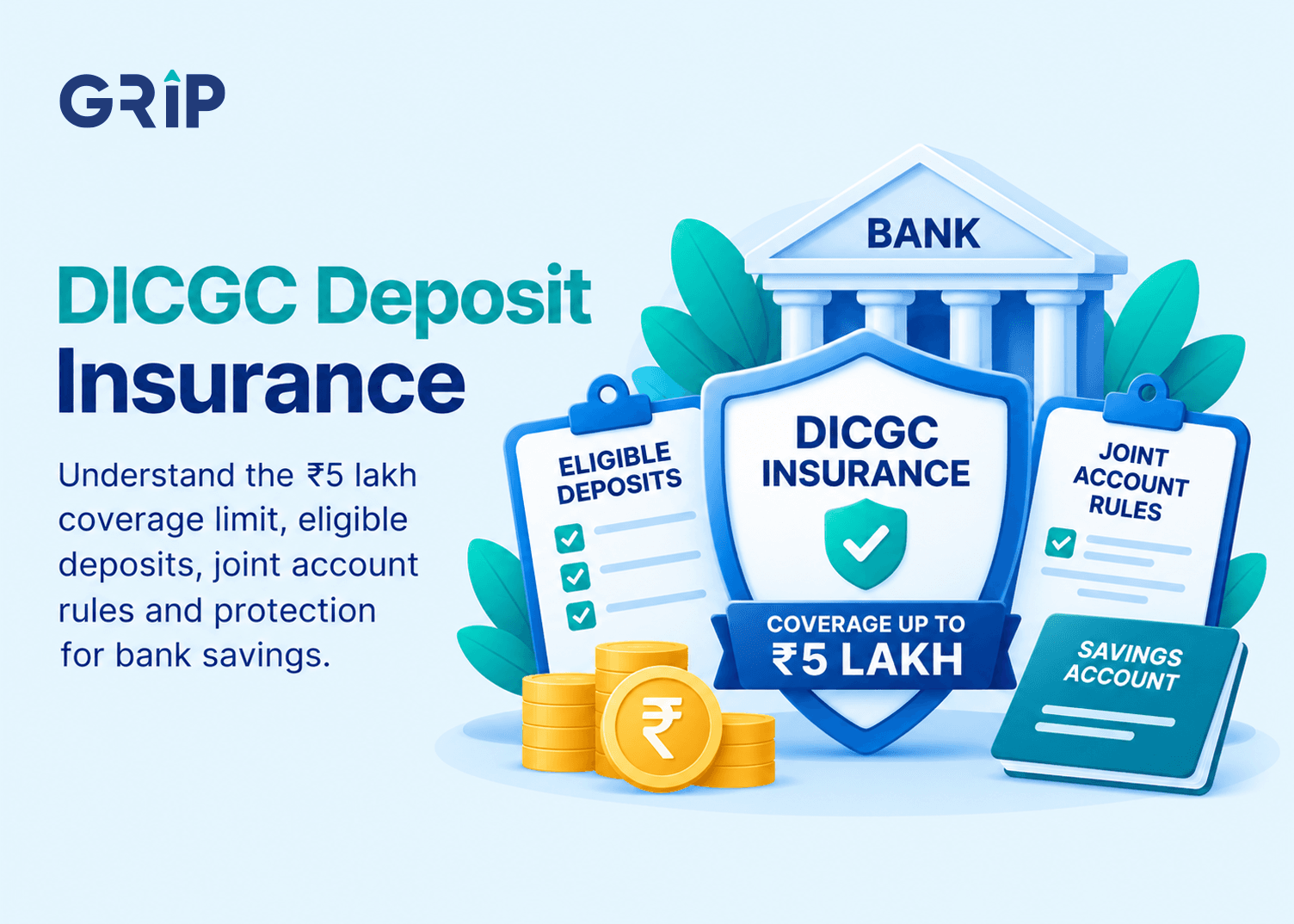
In India, the Deposit Insurance and Credit Guarantee Corporation (DICGC), a wholly owned subsidiary of the Reserve Bank of India (RBI), provides insurance protection of up to INR 5 lakh per depositor per insured bank, subject to applicable rules.
Let us understand how deposit insurance in India works, which deposits are covered, what the exclusions are, and how the insurance amount is calculated.
What Is the DICGC Deposit Insurance Limit?
The DICGC deposit insurance limit is the maximum amount that a depositor can recover under the deposit insurance scheme in case of a bank’s financial failure, or it becomes subject to qualifying regulatory restrictions.
The current DICGC insurance limit is INR 5 lakh, which came into effect on February 4, 2020, replacing the earlier limit of INR 1 lakh.1 The insurance covers both the principal deposited and the interest accrued, subject to the overall limit.
Another critical impact related to the DICGC insurance is that it is applicable per depositor, per insured bank. So, if you have two fixed deposits with ICICI Bank for INR 4.50 lakhs and INR 3.00 lakhs respectively, the total deposit insurance limit shall be INR 5 lakhs, as the same ownership capacity is considered together, rather than each account being insured separately.
The insurance scheme operates under the Deposit Insurance and Credit Guarantee Corporation Act, 1961. The insurance premium is paid by the insured bank, and depositors are not required to purchase separate insurance or pay any premium to receive this protection.
Which Bank Deposits Are Covered By DICGC?
Deposit insurance is available for eligible deposits maintained within the insured banks in India. The coverage applies to a range of bank accounts including:
- Savings accounts: Money deposited in regular savings bank accounts.
- Fixed Deposits (FDs): Principal and accrued interest on eligible bank FDs.
- Recurring Deposits (RDs): Deposits accumulated through regular installments.
- Current accounts: Balances maintained in current accounts with insured banks.
The coverage is available for commercial banks, small finance banks, regional rural banks, payment banks, and cooperative banks. Branches of foreign banks operating in India are also covered under the scheme.
However, it is worth noting that the coverage is not available for certain deposit options available in India. The following are not covered:
- Deposits accepted by Non-Banking Financial Companies (NBFCs).
- Deposits with land development banks and primary cooperative societies.
- Investments in mutual funds, stocks, bonds and ETFs.
- Deposits of Central and State Governments, foreign governments and other banks.
- Deposits received outside India and deposits specifically exempted by DICGC with prior RBI approval.
Hence, you should not directly assume that any fixed deposit or investment in a mutual fund shall be subject to coverage under the DICGC scheme. Independent verification is always critical in such cases.
How Is the INR 5 Lakh Insurance Limit Calculated?
Let us understand the limit with the following illustration:
The insurance amount is calculated by combining principal and accrued interest across all deposit categories by an investor in the same bank.
The maximum amount of coverage is INR 5 lakh, irrespective of the number of accounts or deposits. The above illustration shows that the limit applies to different deposit accounts. If an individual has eligible deposits worth INR 2 lakh or INR 5 lakh in an insured bank, the entire amount is covered. However, for deposits worth INR 7 lakh, only INR 5 lakh is insured, leaving INR 2 lakh outside the coverage.
Are Multiple Accounts or Branches Insured Separately?
If you have or plan to open multiple accounts in the same bank or in different branches, the DICGC rules state that your insurance coverage shall remain the same. All eligible deposits held by an individual in the same right and capacity across different accounts or branches in the same bank shall be subject to the INR 5 lakh limit.
For example, if you have a Fixed Deposit of INR 5 lakh at the Mayur Vihar branch of HDFC Bank, and another FD of INR 5 lakh at the Vasant Vihar branch of the same bank, the total eligible coverage as per the DICGC guidelines shall be only INR 5 lakh, and not separately for each branch.
What About Joint Accounts?
Joint accounts are treated differently depending on the names of the account holders and the order in which they appear.2
For instance, a joint account held by A and B is treated separately from an individual account held by A. Similarly, accounts held jointly by A and B, and by B and A, are considered to be held in different rights and capacities under DICGC rules.
DICGC Coverage vs Deposits Above INR 5 Lakh
A common question is whether you can have deposits above INR 5 lakh in a bank and whether any financial protection is available for deposits above INR 5 lakh. For example, if you have total deposits across eligible accounts in a bank worth INR 12 lakh, your coverage will be limited to the coverage amount, and INR 7 lakh will be uninsured.
However, does that mean there would be no recovery of the excess amount? Here, it is important to understand the difference between insurance and liquidation proceedings. If, in a hypothetical situation, your bank fails or files for bankruptcy, the uninsured amount may still be recoverable through the bank's resolution, merger or liquidation proceedings. However, such recovery is not guaranteed and may take time.
To manage this risk, depositors can consider distributing larger deposits across different DICGC-insured banks rather than concentrating their entire savings with one institution.
How Can You Check Whether Your Deposits Are Covered?
Before opening an FD or depositing a substantial amount with a bank, it is advisable to verify whether the institution is covered under DICGC deposit insurance.
You can check the insurance status of your bank through the following steps:
- Visit the official DICGC website: Go to dicgc.org.in and look for the list of insured banks.
- Search for your bank: Check whether your bank appears in the relevant category, such as commercial banks, small finance banks or cooperative banks.
- Verify with the bank: You can also ask your bank to confirm its DICGC insurance status and the eligibility of your deposits.
- Understand the coverage: Remember that insurance applies to eligible deposits up to INR 5 lakh per depositor, per insured bank, in the same right and capacity.
Checking these details can help you make informed decisions, particularly when placing large deposits across multiple financial institutions.
FAQs

Want to stay at the top of your finances?
Join the community of 22 lakh+ investors and learn more about Grip Invest, the latest financial knick-knacks, and shenanigans in the world of investing.
Happy Investing!
Disclaimer - Investments in debt securities/municipal debt securities/securitised debt instruments are subject to risks including delay and/ or default in payment. Read all the offer related documents carefully. The investor is requested to take into consideration all the risk factors before the commencement of trading.
This communication is prepared by Grip Broking Private Limited (bearing SEBI Registration No. INZ000312836 and NSE ID 90319) and/or its affiliate/ group company(ies) (together referred to as “Grip”) and the contents of this disclaimer are applicable to this document and any and all written or oral communication(s) made by Grip or its directors, employees, associates, representatives and agents. This communication does not constitute advice relating to investing or otherwise dealing in securities and is not an offer or solicitation for the purchase or sale of any securities. Grip does not guarantee or assure any return on investments and accepts no liability for consequences of any actions taken based on the information provided. For more details, please visit www.gripinvest.in
Registered Address - 106, II F, New Asiatic Building, H Block, Connaught Place, New Delhi 110001


