

List Of Perpetual Bonds In India (2026): Banks, Coupon Rates And Key Details



A bond that never matures sounds like a contradiction. But that is exactly what a perpetual bond is. You end up lending money, you collect interest, and you never know the date your principal comes back. Nobody has promised that it will.
This article covers what perpetual bonds are, how they behave, why they are issued by banks, and how to judge one before you put money in.
What Are Perpetual Bonds?
A perpetual bond is a debt security with no maturity date. A normal bond promises to repay your principal on a set day. A perpetual one makes no such promise. The issuer just keeps paying the coupon for as long as the bond stays outstanding, and the coupon can be fixed or linked to another rate.
What it usually has instead is a call option, which lets the issuer repay the principal on a chosen date. For banks, that date cannot fall earlier than five years after issue. The catch is who holds the option. It belongs to the issuer, not to you. You cannot demand your money back. Your only way out is to sell the bond in the secondary market.
Key features of these bonds:
- They have no fixed maturity date, and interest is paid indefinitely
- Callable by the issuer after a set period
- Higher coupons than comparable regular bonds
- Rank below deposits and regular debt if the issuer fails
In India, most perpetual bonds are issued by banks and are called AT1 bonds. This is short for Additional Tier 1. They count towards a bank’s core capital under Basel III norms.
This is why their rules look so different from ordinary corporate debt. Some corporates issue perpetual debt too, but this does not happen often.
How Do Perpetual Bonds Work?
In a hypothetical scenario, Bank A issues a perpetual bond. This is with an 8.5% coupon and a first call date five years out. You put in INR 10 lakh.
- Every year, Bank A pays you INR 85,000 as coupon.
- At year five, A may call the bond and hand back your INR 10 lakh.
- If A does not call, the bond just carries on.
- At no point can you force repayment.
Now the part that catches people out. Coupons on bank AT1 bonds are discretionary. If profits or capital buffers fall short, the bank can skip a payment. Skipped coupons are usually non-cumulative; this means they are gone for good and not owed to you later.
Then there is loss absorption. If a bank’s capital drops below a trigger level, the bonds can be written down or converted into equity. RBI can also order a write-down at the point of non-viability, when it decides the bank cannot survive without support.
Prices move too, which means that a true perpetuity is valued at coupons divided by yield. If market yields climb to 10%, a bond paying a 9% coupon would trade at about INR 90 per INR 100 of face value. The coupon never changed. The price did.
List Of Perpetual Bonds In India
Perpetual bonds in India are issued by banks, non-banking financial companies (NBFCs) and certain corporates to raise long-term capital. They do not have a fixed maturity date, which means investors cannot rely on a predetermined date for receiving their principal back. Some perpetual bonds provide the issuer with a call option, allowing it to redeem the bonds on specified dates, subject to the applicable terms and regulatory requirements.
Examples of perpetual bonds issued in India include:
| Issuer | Type of Perpetual Bond | Illustrative Coupon Rate |
| State Bank of India (SBI) | Additional Tier 1 (AT1) bonds | 7.73%–9.56% |
| Bank of Baroda | Additional Tier 1 (AT1) bonds | 7.95%–8.99% |
| Bank of India | Additional Tier 1 (AT1) bonds | 9.04%–10.40% |
| Canara Bank | Additional Tier 1 (AT1) bonds | 11.25% |
| IDBI Bank | Perpetual bonds | 9.40% |
Note: The coupon rates shown are examples from reported bond issues, not current investment offers or indicative returns on bonds available for purchase. Rates, credit ratings and terms vary by issue. Investors should verify the latest issue documents and rating information before investing.
Key Features To Compare Across Perpetual Bonds
The following features can help assess how different perpetual bonds compare.
1. Coupon Rate: The coupon rate indicates the interest specified in the bond's terms. However, payment may be cancelled or deferred under certain conditions, depending on the instrument. A higher coupon should be assessed alongside the risks involved.
2. Credit Rating: Check the bond's current rating and any recent changes. Ratings offer an opinion on credit risk but do not guarantee interest payments or repayment of principal.
3. Call Option: Some perpetual bonds allow the issuer to redeem them on specified dates. A call option does not guarantee redemption on that date, so investors should not treat it as a fixed maturity date.
4. Payment Frequency: Review whether interest is payable annually, semi-annually or at another specified interval. Also, check whether the coupon is cumulative or non-cumulative and whether payments can be cancelled or deferred.
5. Liquidity: Check whether the bond is actively traded and whether sufficient buyers are available. Low trading volumes may make it difficult to sell at a desired price.
6. Subordination And Loss Absorption: Some perpetual bonds, particularly bank AT1 bonds, rank below other liabilities and may be subject to loss-absorption provisions. These can affect interest payments or principal value under specified circumstances.
How To Evaluate A Perpetual Bond Before Investing
Evaluating a perpetual bond requires more than comparing its coupon rate with those of other fixed-income securities.
1. Assess The Issuer's Financial Position: Review the issuer's financial statements, profitability, capital adequacy where relevant, debt levels and ability to service its obligations. For bank-issued AT1 bonds, pay particular attention to the bank's capital position.
2. Review The Credit Rating And Risk Factors: Read the latest credit rating rationale instead of relying only on the rating symbol. Check for rating downgrades, negative outlooks and concerns about the issuer's financial performance.
3. Understand Coupon Payment Conditions: Determine whether coupon payments can be cancelled or deferred and under what circumstances. For certain perpetual bonds, receiving the stated coupon every year is not guaranteed.
4. Check The Call Option: Identify the first call date and the conditions attached to redemption. The issuer may choose not to exercise the option, leaving investors invested for longer than expected.
5. Evaluate Liquidity And Exit Options: Examine trading activity, bid-ask spreads and the availability of buyers in the secondary market. You may have to sell at a discount if you need to exit when demand is limited.
6. Match The Bond With Your Financial Goals: Consider whether you can tolerate uncertain principal repayment, potential price fluctuations and interruptions to interest income. Perpetual bonds may not suit investors who need their principal back on a specific date.
Why Do Banks Issue Perpetual Bonds?
Banks require capital to provide loans. The norms laid down under Basel III rules implemented by RBI mandate banks to maintain high-quality capital against risky assets. AT1 falls between equity and debt. It qualifies as Tier 1 capital as it has loss-absorbing capability. Banks prefer these for the following reasons:
- Earning equity dilutes equity shareholders, including the government in case of public sector banks.
- The coupon rate on such bonds is lower than the expected rate on equity shares.
- The call option provides the bank with the opportunity to repay once cheaper capital becomes available.
- Such instruments assist in meeting Tier 1 capital requirements.
Take the example of Bank A again. Issuance of INR 100 crore of equity will lead to dilution of ownership of the owners. An issuance of a perpetual bond will increase the capital without affecting the ownership of the company. In the bank's context, it will be a better buffer. In your context, it will be additional risk.
What are the risks of perpetual bonds?
The risks come from the structure, not just the credit rating. Five stand out.
- About INR 8,400 crore of Yes Bank securities were written off in 2020. Regulators wiped out $17 billion of Credit Suisse AT1 debt in 2023, and Banco Popular holders faced a similar write-down in 2017.
- Payments can stop without any formal default.
- The issuer may skip the call and leave you invested far longer than planned.
- Trading is thin, so prices can swing sharply.
- You rank below depositors and regular bondholders.
The first call date trap
There are many cases where investors equate the first call date with the maturity date. These are wrong assumptions since the issuer is not obligated to call. As highlighted in RBI’s Financial Stability Report released in July 2021, equating the call date with maturity leads to significant mispricing of risks.
Below is an illustration of the above problem in an example.
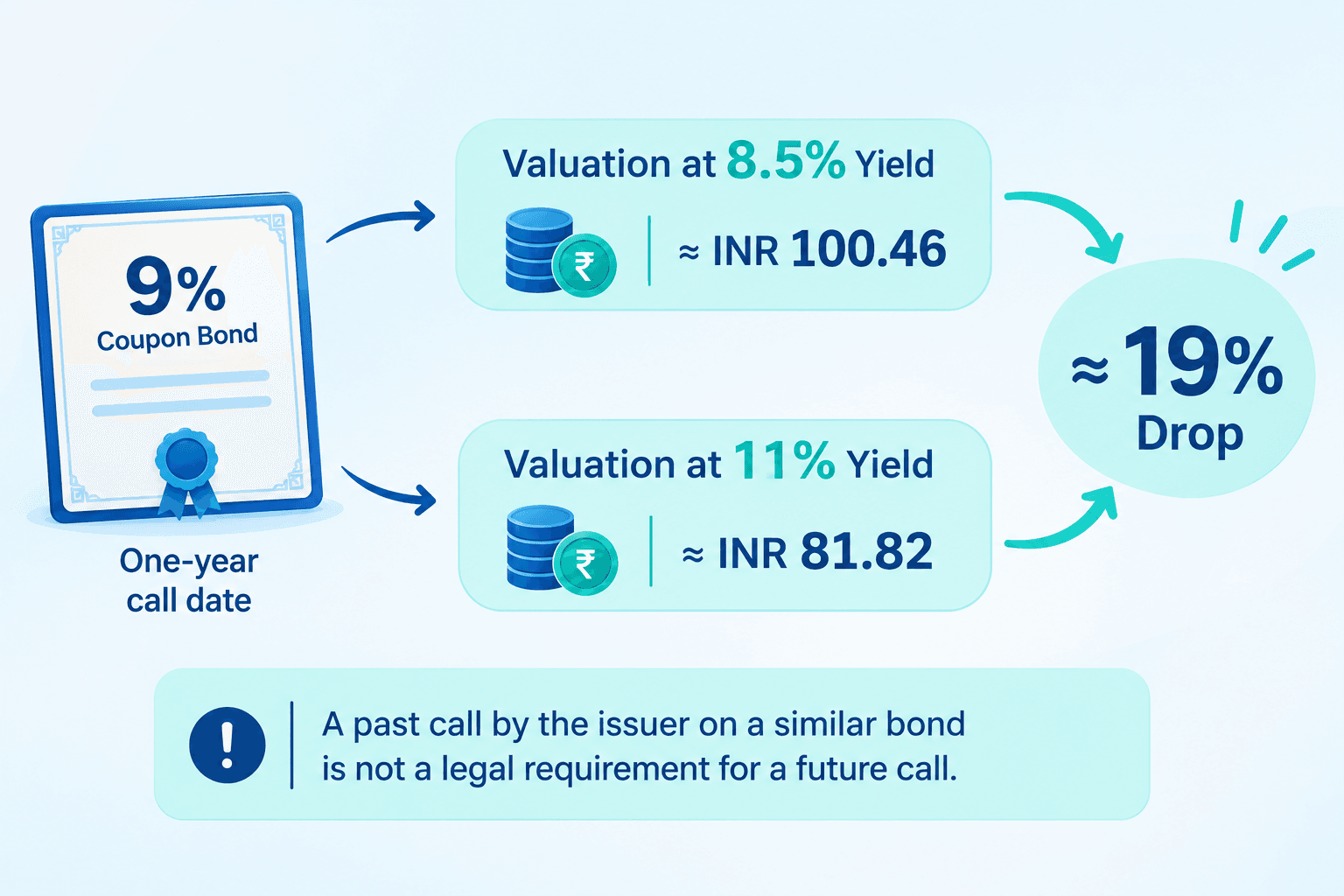
There is a 9% coupon bond whose valuation for a one-year call date is done on an 8.5% yield, leading to a valuation of about INR 100.46. The bank does not exercise the call, and the investor’s required return jumps to 11%, lowering its value to about INR 81.82. This is a reduction of almost 19%.
A past call by the issuer on a similar bond is not a legal requirement for a future call.
Perpetual Bonds Vs Corporate Bonds
The key difference between perpetual bonds and regular corporate bonds is the repayment timeline. Regular corporate bonds generally have a fixed maturity date when the issuer is due to repay the principal. Perpetual bonds have no fixed maturity date, so investors cannot rely on a predetermined date to receive their principal back.
| Feature | Perpetual Bonds | Corporate Bonds |
| Maturity | No fixed maturity; may have a call option | Fixed maturity date |
| Principal | No set repayment date | Repaid at maturity |
| Coupons | May be cancelled or deferred (e.g., AT1 bonds) | Paid as per bond terms |
| Loss Absorption | May include write-down or conversion | Depends on bond terms |
| Exit | Sell in secondary market | Hold to maturity or sell |
| Yield | Usually higher | Varies by issuer and tenure |
| Risk | Higher repayment, coupon and liquidity risk | Depends on issuer credit quality |
For example, suppose Bank A issues a perpetual bond with an 8.5% annual coupon and a regular corporate bond with a five-year tenure and a 7.5% annual coupon. On an investment of INR 10 lakh, the stated annual coupons would be INR 85,000 and INR 75,000, respectively, assuming the coupons are paid in full. The difference is INR 10,000 a year before tax.
However, the higher coupon on the perpetual bond does not automatically make it the better investment. Investors must consider the possibility of coupon cancellation, the absence of a fixed maturity date and any loss-absorption provisions. Regular corporate bonds also carry credit and liquidity risks, and principal repayment is not guaranteed if the issuer defaults.
When comparing the two, evaluate the coupon rate alongside credit quality, repayment terms, seniority, liquidity and your investment horizon.
What Should You Know Before Investing?
Read The Offer Document: Review the call dates, trigger events and coupon provisions in detail, as summaries may not cover all the relevant terms.
- Understand The Call Option: Do not assume the bond will be redeemed before maturity. Consider the possibility of holding it for a much longer period than expected, with the call option serving as an additional provision rather than a certainty.
- Check The Coupon Terms: Find out whether coupon payments are discretionary, whether they are cumulative or non-cumulative, and under what circumstances they can be suspended.
- Review Loss-Absorption Provisions: Understand when a write-down or conversion can occur and which authority or entity can trigger it.
- Match The Bond To Your Investment Horizon: Ensure the investment aligns with your financial goals, risk tolerance and expected holding period.
- Assess Your Risk Exposure: Invest only an amount you can afford to lose and limit your exposure to perpetual bonds within your overall portfolio.
- Consider The First Call Date Scenario: Ask yourself whether you would still be comfortable holding the bond if the issuer does not redeem it on the first call date.
FAQs

Want to stay at the top of your finances?
Join the community of 22 lakh+ investors and learn more about Grip Invest, the latest financial knick-knacks, and shenanigans in the world of investing.
Happy Investing!
Disclaimer - Investments in debt securities/municipal debt securities/securitised debt instruments are subject to risks including delay and/ or default in payment. Read all the offer related documents carefully. The investor is requested to take into consideration all the risk factors before the commencement of trading.
This communication is prepared by Grip Broking Private Limited (bearing SEBI Registration No. INZ000312836 and NSE ID 90319) and/or its affiliate/ group company(ies) (together referred to as “Grip”) and the contents of this disclaimer are applicable to this document and any and all written or oral communication(s) made by Grip or its directors, employees, associates, representatives and agents. This communication does not constitute advice relating to investing or otherwise dealing in securities and is not an offer or solicitation for the purchase or sale of any securities. Grip does not guarantee or assure any return on investments and accepts no liability for consequences of any actions taken based on the information provided. For more details, please visit www.gripinvest.in
Registered Address - 106, II F, New Asiatic Building, H Block, Connaught Place, New Delhi 110001


