

FD Investment Strategy: How To Plan Fixed Deposits For Your Financial Goals



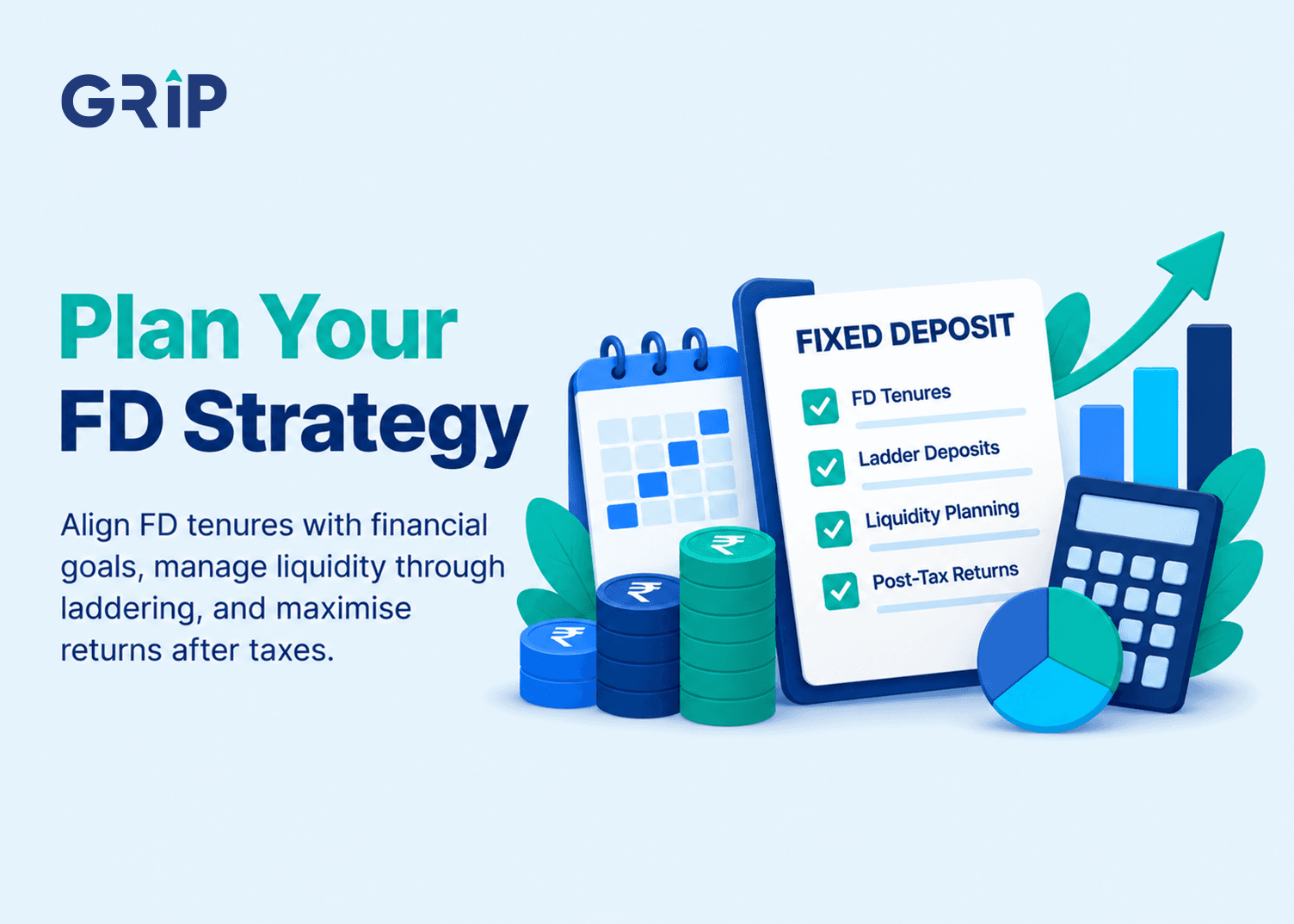
A fixed deposit is a popular way to build emergency funds for future expenses, retirement plans, or emergency situations. However, choosing an FD with a higher interest rate is not the only best approach.
A well-planned FD strategy helps investors achieve their financial goals with FD investment tenure, liquidity needs, and post-tax returns. That’s why, instead of putting all the money in one deposit, investors can spread it across different maturities to make funds available when needed.
Here is how you can plan your fixed deposit to balance predictable returns, access to money, and long-term financial needs.
What Is An FD Investment Strategy?
An FD investment strategy is a plan for investing money in a fixed deposit based on investors’ financial goals, time horizon, and cash requirements. It helps to decide how much to invest, choose tenure, and when to reinvest the maturity amount.
A good FD investment strategy considers four important factors.
- Financial goal: Know your financial goal, whether it is for a planned expense, down payment, education fees, or retirement.
- Investment tenure: Match the FD maturity with the expected time you need the money.
- Liquidity: Keep some funds accessible for emergencies and unexpected expenses.
- Post-tax returns: Consider the tax applicable to your FD interest instead of looking only at the advertised interest rates.
How To Choose The Right FD Tenure
An FD tenure is necessary to achieve your financial goals. Longer deposits offer higher rates but have less flexibility. However, shorter deposits provide earlier access for planned expenses.
Consider these factors before selecting a deposit.
1. Short-term goals: Choose a suitable short-tenure FD for expenses due within one year.
2. Medium-term goals: Match a one-to-three-year deposit with upcoming planned purchases or fees.
3. Long-term goals: Choose longer tenure for retirement or long-term plans.
4. Emergency requirement: Keep emergency savings accessible instead of locking everything away.
5. Interest rates: Compare available rates across different tenures before committing.
What Is FD Laddering And How Does It Work?
FD laddering strategy is splitting the savings across deposits with different maturity dates. Investing the entire savings in one FD can be risky. FD laddering provides a way to invest with different maturity periods.
With FD laddering, you can reassess interest rates when the deposit matures. It also provides regular opportunities to access your money.
How FD Laddering Works
Suppose you have INR 3 lakh available and you divide it into three FDs of INR 1 lakh each at an assumed 7% annual interest rate.
| Investment | Amount | Tenure |
| FD 1 | INR 1,00,000 | 1 year |
| FD 2 | INR 1,00,000 | 2 year |
| FD 3 | INR 1,00,000 | 3 year |
So, when the first FD matures in one year, you can withdraw the money or reinvest it. While the other two continue until their maturity dates. If you reinvest the first FD for another three years, the ladder continues.
FD Laddering Vs Investing In One FD
Both of these investment options can help in achieving financial goals. However, they both suit different financial needs. A single FD may be easier to manage, while laddering offers more flexibility through staggered maturities.
| Factor | FD laddering | One FD |
| Investment structure | Divided into multiple deposits | Entire amount in one deposit. |
| Access to money | Portion matures at different times | Entire amount available at maturity |
| Reinvestment | Decisions can be made at each maturity | Reinvestment decision comes at maturity |
| Management | Requires tracking multiple deposits | Simpler to manage |
| Interest rate exposure | Spread across different booking dates and tenure | Depends on the chosen deposit and tenure |
| Suitability | Multiple goals and staggered cash | One goal with fixed deadline |
How To Balance FD Returns, Liquidity And Tax
An effective FD investment strategy balances returns with access to money and tax implications. Here are some important things you should consider to balance FD returns.
1. Compare Interest Rates And Deposit Term
Compare interest rates across banks and choose a tenure that suits your needs. Review premature withdrawal penalties, interest payout frequency, and renewal conditions as well.
2. Maintain Sufficient Liquidity
Keep the emergency savings separate from the long-term deposit funds. It can help prevent unnecessary premature withdrawals. Check whether the FD permits early withdrawals, as many do not offer this facility.
3. Calculate Post-Tax Returns
FD interest is generally taxable and accrues to applicable income tax rules. Your tax slab and total taxable income affect your final returns. Compare deposits using expected post-tax returns rather than headline interest rates alone.
How To Build An FD Strategy Around Financial Goals
To build an FD investment strategy, start by identifying your goals and the deadlines. Then allocate savings based on the amount and timing of each requirement.
Follow these steps for an effective FD investment strategy.
- List all the financial goals by identifying upcoming expenses and purchases.
- Set an estimated deadline for when you will need the money.
- Protect emergency savings and keep them accessible.
- Choose a suitable tenure to align maturity dates with payment deadlines.
- Consider FD laddering for splitting the deposit into multiple tenures
- Review interest rates, taxes, and deposit terms.
- Review periodically and reassess your plan when circumstances change.
Conclusion
A good FD investment strategy starts with your financial goals. It balances tenure, liquidity, and post-tax returns. FD laddering can create staggered maturity dates and reinvestment opportunities, while a single FD may be simpler for expenses with fixed deadlines.
Before investing, compare deposit terms and understand premature withdrawal conditions. If you are exploring options beyond fixed deposits, Grip Invest, lets you explore corporate bonds and other fixed-income opportunities based on your investment goals, return expectations, and time horizon. Explore the available options on Grip Invest.
FAQs

Want to stay at the top of your finances?
Join the community of 22 lakh+ investors and learn more about Grip Invest, the latest financial knick-knacks, and shenanigans in the world of investing.
Happy Investing!
Disclaimer - Investments in debt securities/municipal debt securities/securitised debt instruments are subject to risks including delay and/ or default in payment. Read all the offer related documents carefully. The investor is requested to take into consideration all the risk factors before the commencement of trading.
This communication is prepared by Grip Broking Private Limited (bearing SEBI Registration No. INZ000312836 and NSE ID 90319) and/or its affiliate/ group company(ies) (together referred to as “Grip”) and the contents of this disclaimer are applicable to this document and any and all written or oral communication(s) made by Grip or its directors, employees, associates, representatives and agents. This communication does not constitute advice relating to investing or otherwise dealing in securities and is not an offer or solicitation for the purchase or sale of any securities. Grip does not guarantee or assure any return on investments and accepts no liability for consequences of any actions taken based on the information provided. For more details, please visit www.gripinvest.in
Registered Address - 106, II F, New Asiatic Building, H Block, Connaught Place, New Delhi 110001


