

Sovereign Gold Bonds In The Secondary Market : Price, Returns And Taxation



Sovereign Gold Bonds (SGBs) purchased in the secondary market offer investors a way to invest in gold without buying a new issue. However, the price paid, the remaining maturity and the interest payments all affect the returns an investor can earn.
The SGB market price may differ significantly from the bond's nominal value, while the 2.50% annual interest is calculated on the nominal value, and not the purchase price. Taxation also matters, as capital gains on redemption are not exempt for secondary market buyers under the rules applicable from April 2026. Understanding these factors can help investors evaluate the potential returns and tax implications before investing.
What Is Secondary Market Investment In Sovereign Gold Bonds?
Sovereign Gold Bonds Secondary Market Investment refers to buying a bond which has already been issued and traded by another person. In essence, through this act, an investor acquires the rights to future payments as well as the repayment of the face value of the bond after the original eight-year period expires.
Under the 2023–24 scheme terms, one unit represents one gram of gold. The bonds pay 2.50% annual interest on nominal value, in two installments, and redeem in rupees using IBJA’s average closing price of 999-purity gold for the preceding three working days. The applicable coupon and redemption date depend on the particular tranche, so investors should verify its original terms before purchasing.
Your decision therefore needs four inputs, i.e., purchase cost, remaining maturity, future coupon payments and applicable tax. Government backing does not protect against paying an excessive exchange price or a fall in gold prices. A discount to a reference gold price is useful only after considering these other inputs.
Unlike a new issue, a secondary market purchase does not have a fixed entry price set by the government. Its price depends on market demand, the seller's asking price and the quantity available.
How To Buy Sovereign Gold Bonds In The Secondary Market
To buy SGBs in the secondary market, use a trading account linked to a demat account through a registered broker. Select the exchange symbol and international securities identification number (ISIN). Note that similar-looking tranche names can have different repayment dates.
Sovereign Gold Bonds Secondary Market Investment Checklist
- Confirm the issue’s nominal value, coupon and redemption date.
- Check today’s bids, offers, available quantity and last-trade timestamp.
- Add brokerage and other applicable charges to your purchase cost.
- Place a limit order stating your maximum acceptable price.
- After execution, check the contract note and demat credit.
A listing on the exchange does not guarantee an instant purchase as both the buyer and seller must agree on the right price for the transaction. The National Stock Exchange (NSE) registered the SGBFEB32IV for trading on March 1, 2024, and its listing details indicate its ISIN number as IN0020230184.
Always compare the bid and ask prices rather than relying only on the last traded price. Low trading volumes can result in wider price differences, and an order may remain unexecuted if no seller is available at your chosen price.
Additionally, verify the tranche's remaining tenure before investing, as two SGBs linked to the same quantity of gold can have different maturity dates.
How Is The SGB Market Price Determined?
The SGB market price responds to the gold value, coupons left, maturity period, tax situation, and buy or sell orders in the market.
However, the price at which the last trade took place may be different from the price at which the order is executed, especially when there is not enough quantity in the order book.
Three Prices That Serve Different Purposes
For SGBFEB32IV, NSE’s listing has the nominal value mentioned as INR 6,263 and the redemption date as February 21, 2032. These are the historical terms of the identified tranche, not its current exchange price.
- Original nominal value: INR 6,263 per unit, as stated in NSE's listing.
- Secondary purchase price: INR 12,000, illustrative rather than a live quote.
- Redemption value: INR 14,000, illustrative rather than a forecast.
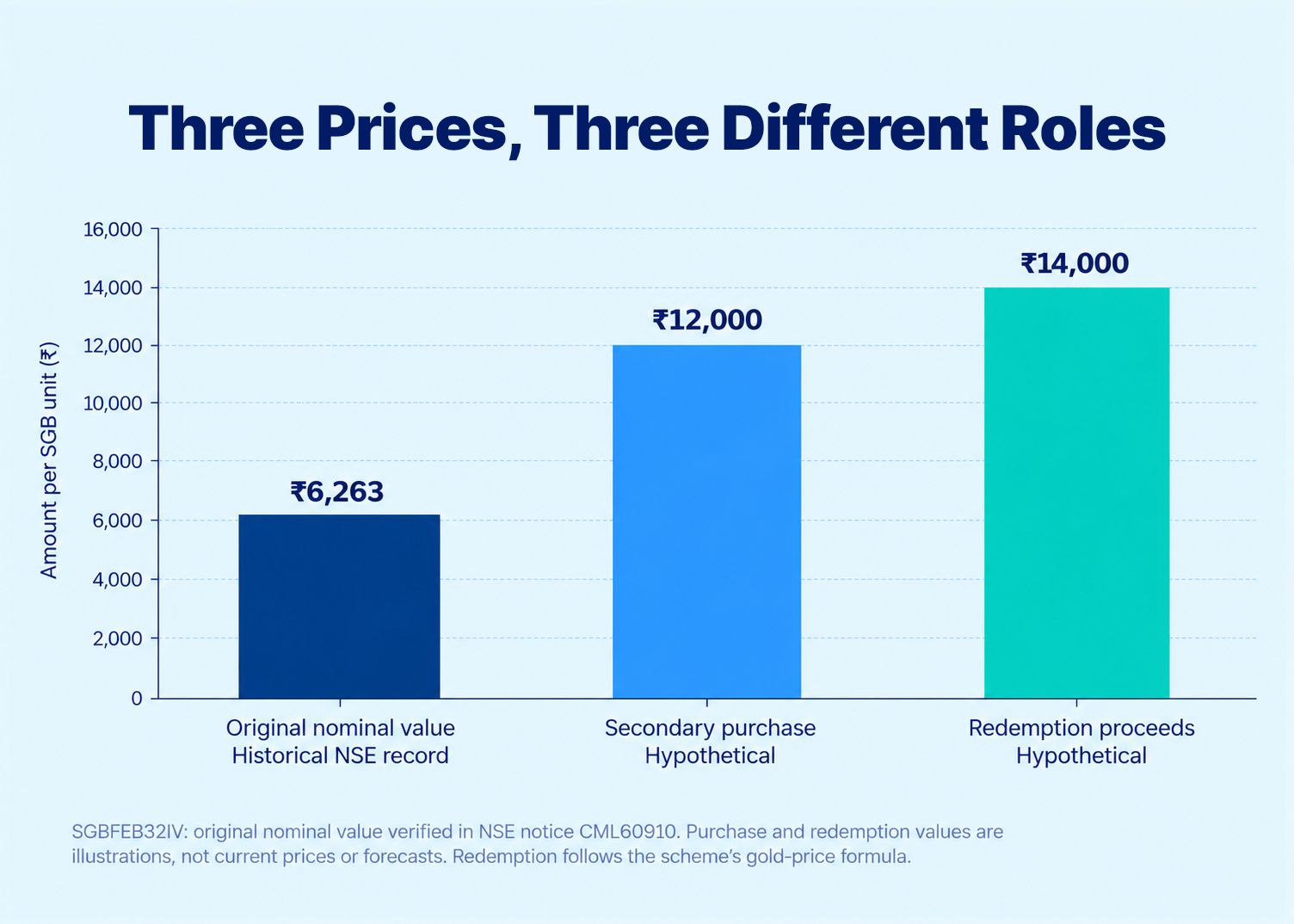
The coupon is determined by the initial value, while the purchase price determines the sum invested. The redemption depends on the way of determining the price of gold, instead of depending on how much you purchased it for. For example, an investor paying INR 12,000 for a bond with a nominal value of INR 6,263 would still receive annual interest of approximately INR 156.58 at a 2.50% coupon rate. The coupon does not increase with the secondary market purchase price.
The INR 50 historical discount on a digital subscription does not mean that you can apply the discount for purchases from other people. Make sure to compare the various tranches as per their respective reference dates.
Returns From Buying SGBs In The Secondary Market
The Sovereign Gold Bond returns comprise interest income and the difference between the sale or redemption proceeds and the purchase price. SGB interest should not be considered on the amount charged by the other investor.
For example, for INR 6,263 nominal value, 2.50% would be INR 156.58 in terms of annual interest. At a purchase price of INR 12,000 that means around 1.30% of current income before tax, instead of 2.50% expected returns.
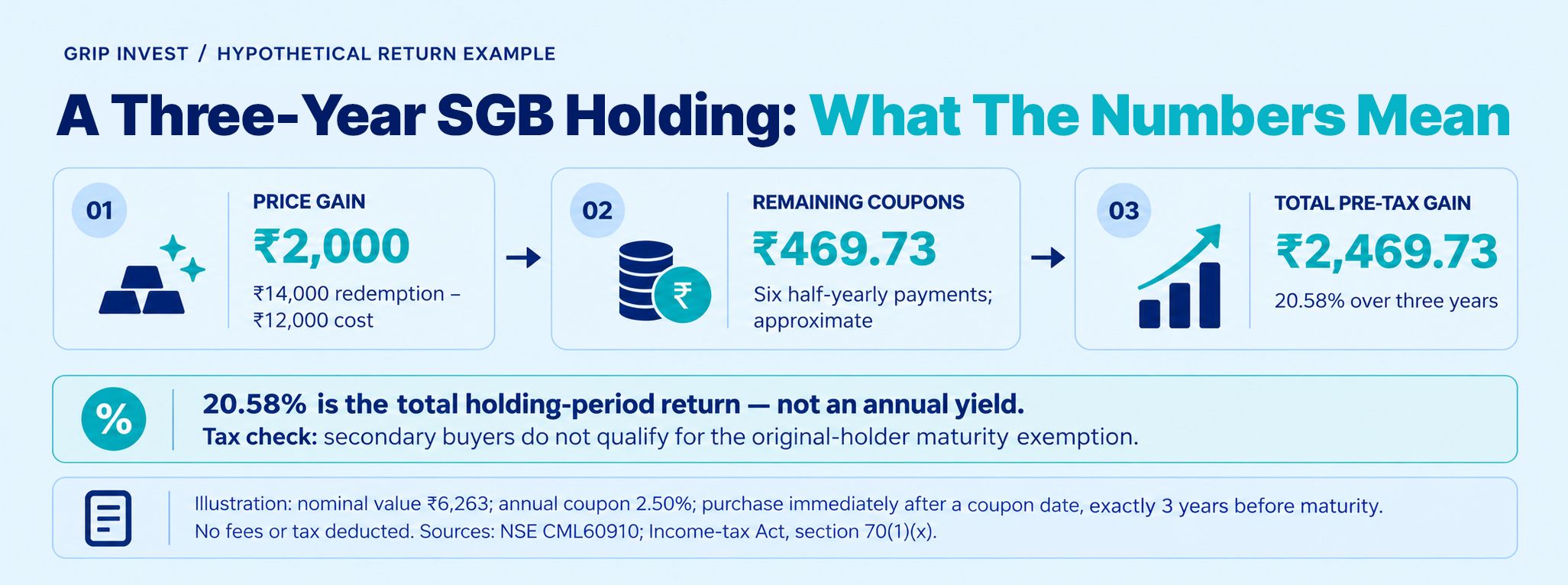
Consider a hypothetical SGB purchased for INR 12,000 and held for three years. Assume the bond has a nominal value of INR 6,263, six half-yearly coupon payments remaining and an eventual redemption value of INR 14,000. These assumptions illustrate the calculation and are not a forecast for SGBFEB32IV or any other specific tranche.
- Purchase cost: INR 12,000, excluding charges.
- Assumed redemption: INR 14,000; price gain: INR 2,000.
- Remaining coupons: approximately INR 469.73 in total.
- Total pre-tax gain: approximately INR 2,469.73, or 20.58% of the initial purchase price over three years.
This is a holding-period return and not an annualised yield. If redemption instead equals INR 10,000, the same coupons leave an approximate INR 1,530.27 pre-tax loss. Always use dated cash flows for an annualised comparison.
Note that these calculations exclude brokerage, other transaction costs and taxes. Actual returns depend on the purchase price, remaining coupon payments, eventual sale or redemption value and applicable tax treatment. A rise in gold prices does not guarantee a profit if the purchase price was too high.
Taxation Of SGBs Purchased In The Secondary Market
For tax year 2026–27, section 70(1)(x) of the Income-tax Act, 2025, as amended with effect from April 1, 2026, restricts the capital gains exemption on SGB redemption to individuals who subscribed at the original issue and held the bonds continuously until maturity.
The exemption does not apply to SGBs acquired through secondary market transactions, even if the buyer holds them until maturity. The amendment applies to all SGB series, irrespective of their original issue dates.
- Interest Income: SGB interest is generally taxable at the investor's applicable income tax rate.
- Capital Gains: Gains from selling or redeeming an SGB acquired in the secondary market are taxable under the applicable capital gains provisions. The tax rate depends on the holding period and the rules applicable to the transaction. Qualifying long-term capital gains are generally taxed at 12.5%, while short-term gains are generally taxed at the applicable slab rate. Cess and surcharge may also apply.
For instance, assuming no surcharge, no relief, and no other adjustments, a long-term gain of INR 2,000 may result in a basic tax of INR 250 plus cess of INR 10. This illustration assumes that the 12.5% long-term capital gains rate applies. Interest income is taxed separately, and the capital gain is calculated using the applicable cost of acquisition and sale or redemption proceeds.
As an investor, you should distinguish between selling an SGB on the exchange and redeeming it at maturity. For secondary market purchases, the maturity capital gains exemption is unavailable under the amended provision. Investors should also check the tax rules applicable to their transaction and individual circumstances before calculating post-tax returns.
Investment Options Beyond Sovereign Gold Bonds
Instead of presuming that all products serve as substitutes for a gold investment, compare options based on the objective of the investment:
- Gold ETFs: ETF units are representative of gold; check for expenses, trading spreads and tracking error.
- Gold Mutual Funds: Gold mutual funds are helpful for fund investments, but make sure to check the scheme's expenses, investment approach and redemption policy.
- Physical Gold: Purity, storage costs and resale deductions affect the final value. An SGB vs physical gold comparison should also account for jewellery-making charges, liquidity and differences in tax treatment.
- Corporate Bonds: Corporate bonds offer contractual interest payments and repayment terms, but carry issuer credit risk. But, unlike SGBs, their returns are not linked to gold prices. Make sure you understand the bond’s basics in India before investing.
FAQs

Want to stay at the top of your finances?
Join the community of 22 lakh+ investors and learn more about Grip Invest, the latest financial knick-knacks, and shenanigans in the world of investing.
Happy Investing!
Disclaimer - Investments in debt securities/municipal debt securities/securitised debt instruments are subject to risks including delay and/ or default in payment. Read all the offer related documents carefully. The investor is requested to take into consideration all the risk factors before the commencement of trading.
This communication is prepared by Grip Broking Private Limited (bearing SEBI Registration No. INZ000312836 and NSE ID 90319) and/or its affiliate/ group company(ies) (together referred to as “Grip”) and the contents of this disclaimer are applicable to this document and any and all written or oral communication(s) made by Grip or its directors, employees, associates, representatives and agents. This communication does not constitute advice relating to investing or otherwise dealing in securities and is not an offer or solicitation for the purchase or sale of any securities. Grip does not guarantee or assure any return on investments and accepts no liability for consequences of any actions taken based on the information provided. For more details, please visit www.gripinvest.in
Registered Address - 106, II F, New Asiatic Building, H Block, Connaught Place, New Delhi 110001


