

Indian Debt Market Reforms : Major Changes And Benefits



India debt market reforms refer to the regulatory and structural changes made by SEBI, RBI and the government to improve how bonds are issued, traded, settled and held in the country.
These changes generally cover investment size, online platforms, disclosures, foreign access and settlement systems. The reforms may widen access to bonds, although they do not remove the risks attached to a bond investment. period
What Are Debt Market Reforms?
Debt market reforms refer to changes in the rules, infrastructure and market practices that govern borrowing and lending through debt securities. The Indian debt market includes government securities (G-secs), state development loans, treasury bills, commercial paper and corporate bonds. RBI regulates government securities and the money market while SEBI regulates the corporate bond segment, including issuance, listing, disclosures and trading platforms.
The purpose of India debt market reforms is generally to help companies to raise long-term funds from investors instead of depending only on bank loans. Outstanding corporate bonds have risen to around INR 61 lakh crore from about INR 20 lakh crore in FY2015-16 as per the SEBI Chairman's statement in September 2026.
The focus has therefore shifted from issuance volume alone to liquidity, disclosure and participation. The outcome for an individual investor still depends on the specific bond selected.
Key Debt Market Reforms In India
Debt market reforms in India have been introduced in phases and not all of them are at the same stage. October 2026 alone saw three SEBI circulars on debt securities and one amendment to the listing rules. Some measures are already in force, one is notified with a later effective date and others are at the pilot or consultation stage.
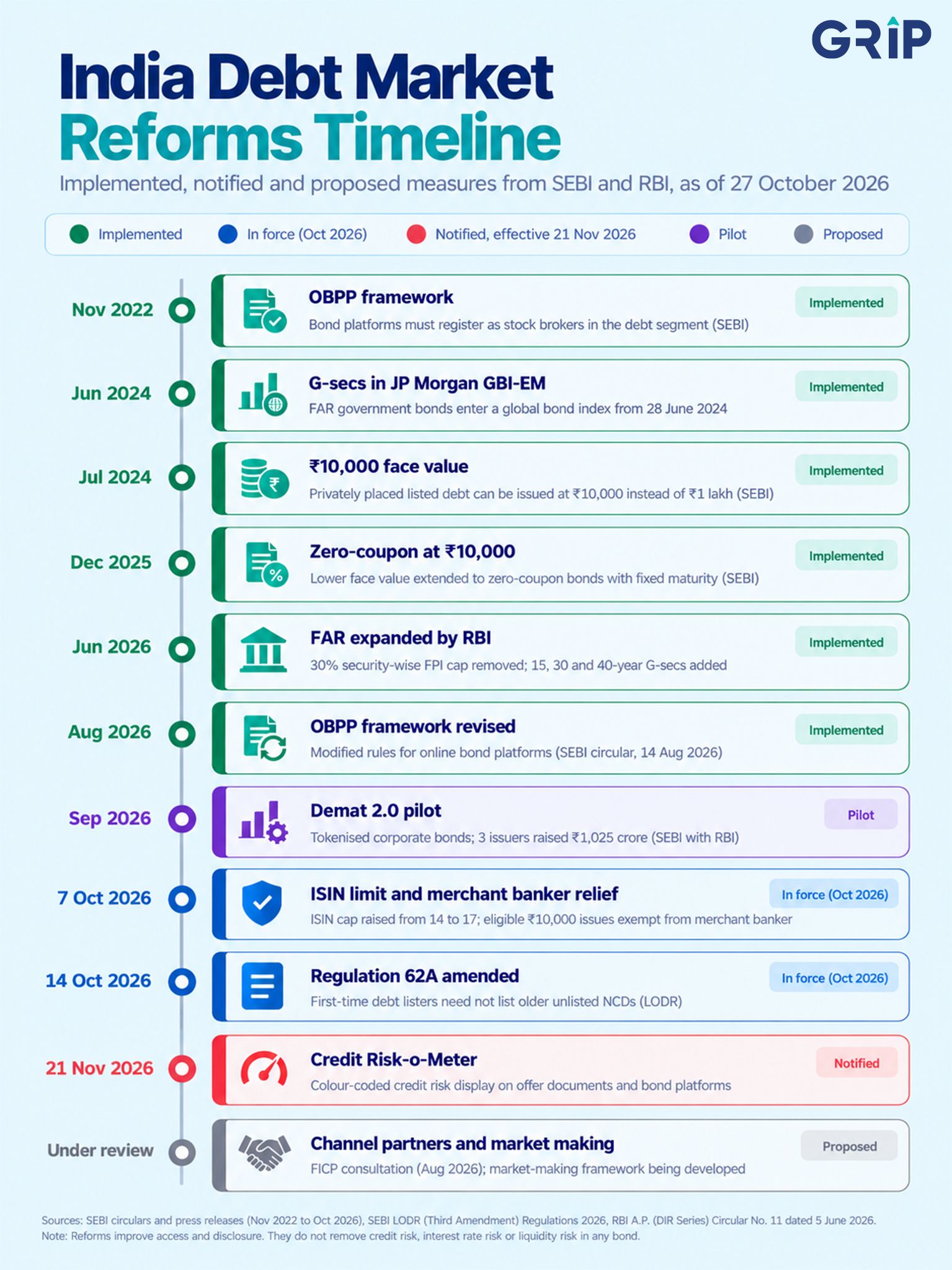
The table below helps to distinguish implemented measures from proposed changes as of 27 October 2026.
Reform | Regulator and Date | Status |
| Online Bond Platform Provider (OBPP) framework1 | SEBI, circular dated 14 November 2022 | Implemented. Platforms must register as stock brokers in the debt segment. The framework was modified on 14 August 2026. |
| Face value of privately placed listed debt reduced to INR 10,0002 | SEBI, 3 July 2024 | Implemented. Merchant banker appointment is not required for eligible issuers from 7 October 2026, such as regulated, listed issuers with no default and an AA- or higher rating. |
| Zero-coupon securities allowed at INR 10,000 | SEBI, 18 December 2025 | Implemented for securities with fixed maturity and no structured obligations |
| G-secs in JP Morgan GBI-EM index | From 28 June 2024 | Implemented. This is an index decision and not a regulation. |
| FAR expansion and removal of 30% security-wise FPI cap | RBI, 5 June 2026 | Implemented |
| Demat 2.0 pilot for tokenised corporate bonds3 | SEBI with RBI, 10 September 2026 | Pilot stage. Three issuers raised INR 1,025 crore. |
| ISIN limit for privately placed debt raised from 14 to 174 | SEBI, 7 October 2026 | In force from 7 October 2026 |
| Regulation 62A of LODR amended5 | SEBI, notified 12 October 2026 | In force from 14 October 2026 |
| Credit Risk-o-Meter for debt securities6 | SEBI, circular dated 7 October 2026 | Notified. Applies 45 days from issue, that is from 21 November 2026. |
| Fixed Income Channel Partners and market-making framework | SEBI, consultation dated 21 August 2026 | Proposed. Comments closed on 11 September 2026 and no final circular has been issued. |
How Have Debt Market Reforms Changed The Indian Bond Market?
The Indian bond market reforms of the last few years have mainly changed the scale of issuance and the routes through which investors can access bonds. Corporate bond issuance rose from INR 5.99 lakh crore in FY22 to INR 9.95 lakh crore in FY25, an increase of about 66%. Issuance then declined 8.4% to INR 9.1 lakh crore in FY26, the first contraction since FY22. Hence the growth has not been in a straight line.
The structure of the market has changed less than its size. Private placements accounted for 98.8% of corporate bond mobilisation in FY26 and mutual funds held the largest share in turnover at 32.1%. Therefore, the corporate bond market in India is larger than before but still remains largely institutional.
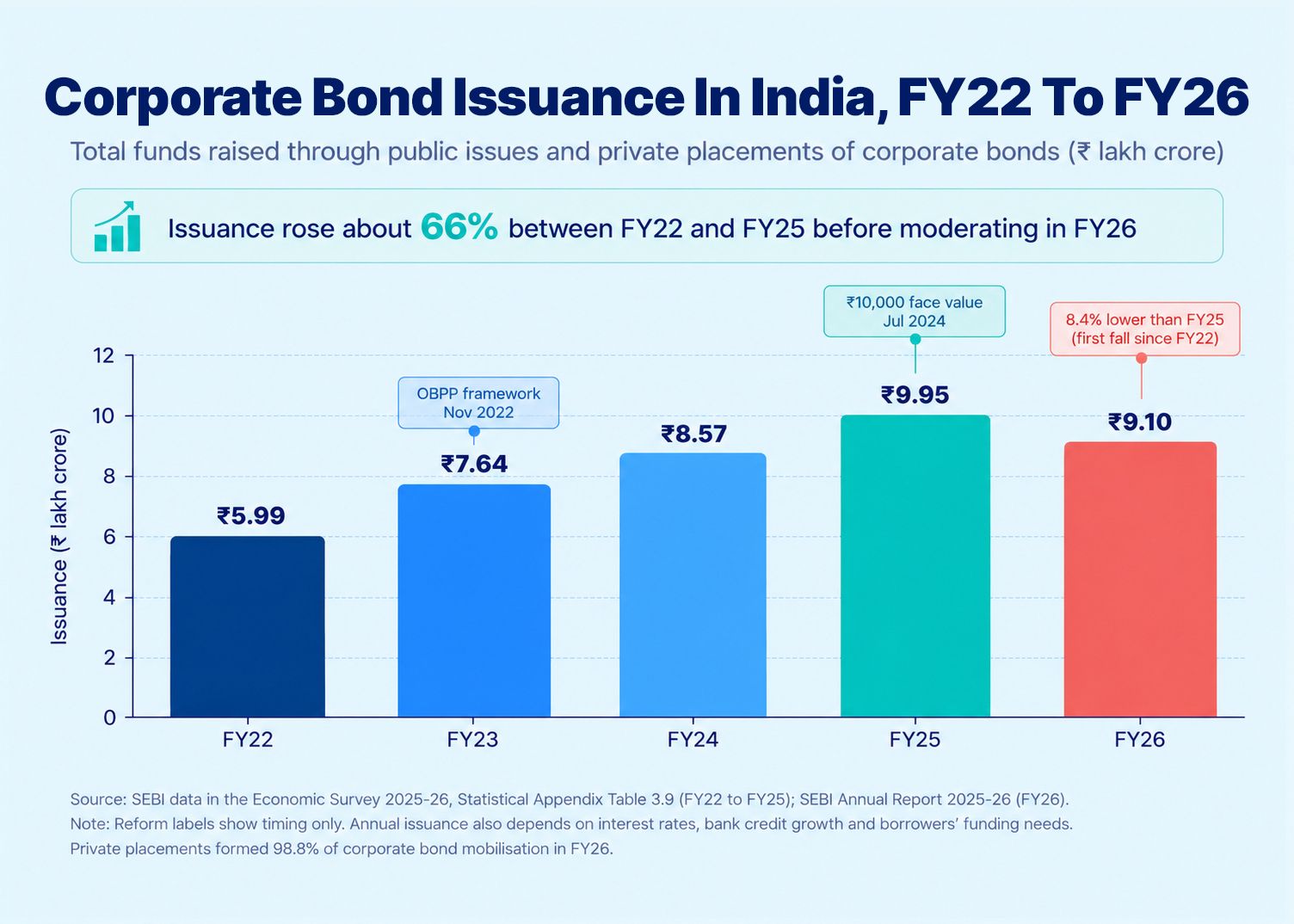
The chart above shows annual corporate bond issuance over the last five financial years, with two SEBI retail access reforms marked for timing reference. Issuance in any year also depends on interest rates, bank credit growth and borrowers' funding needs.
The chart should therefore not be read as showing that a single reform caused the change in a particular year.
Benefits Of Debt Market Reforms For Investors
The benefits of India debt market reforms for investors are mostly seen in access to bonds, the information available before buying and the way trades are settled. These can be understood as per the points given below:
1. Smaller Ticket Size: Suppose an investor has INR 50,000 to put in bonds. At the earlier face value of INR 1 lakh the investor could not have bought even one privately placed bond, whereas at INR 10,000 the same amount can go into five bonds of different issuers.
2. Regulated Platforms: Online bond platforms are registered as stock brokers under the SEBI debt market regulations and have to follow the grievance redressal process applicable to brokers.
3. Rating Shown Before Purchase: A platform will have to place the Credit Risk-o-Meter on the bond page before the investment button, and it has to use the lowest rating where a bond is rated by more than one agency.
4. Clearing Corporation Settlement: Trades between specified entities such as mutual funds go through NSCCL or ICCL, which reduces the chance of a trade failing after payment is made.
5. T+1 Cycle: Listed debt securities bought on the exchange are credited to the demat account one working day after the trade.
However the reforms do not change the risk in the bond itself. Suppose a INR 10,000 bond carries a 9% annual coupon then the interest for one year would be INR 900 (INR 10,000 × 9%). The market price of this bond may fall below INR 10,000 if yields on similar bonds go up after an event like RBI's October 2026 repo rate hike to 5.50%, even though the coupon stays at INR 900. Default risk and the risk of not finding a buyer also stay with the investor.
Challenges In India's Debt Market
The debt market in India still has gaps which the reforms so far have not been able to close. The problems are mostly related to trading activity, the route through which bonds are issued and the type of investors who buy them:
- Low Secondary Market Trading: A SEBI Whole Time Member said in September 2025 that secondary corporate bond trades come to about INR 1.4 lakh crore a month, which is roughly what the equity market trades in one day.
- Private Placement Route: Nearly all corporate bonds are first placed with institutions so individuals usually get access only after the bond is listed and offered on a platform.
- Few Individual Investors: A NITI Aayog report on the corporate bond market notes that institutions hold most of the market and retail presence is minimal.
- Listed Share Falling: SEBI's own data showed the listed portion of debt issuance falling from 80.81% to 76.55% between September 2023 and June 2026.
Hence a bond being available on a platform does not mean that it can be sold quickly. An investor who may need the money before maturity should check how often that particular bond has traded in recent months.
What Is The Future Of Debt Market In India?
The future of the debt market in India would depend on how SEBI and RBI take forward the measures which are still under discussion. SEBI has said that it is building a market-making framework covering liquidity, infrastructure and repo access. The consultation on Fixed Income Channel Partners, who would distribute bonds through online bond platforms in smaller towns and rural areas, closed on 11 September 2026 and the final circular is awaited.
For government securities, RBI debt market reforms like the June 2026 FAR changes may bring more foreign money into 15, 30 and 40-year G-secs. No dates have been announced for the pending measures so their final shape can be different from what was proposed.
Before buying a bond under the present rules, an investor may go through the following points:
- Credit rating along with the rating rationale published by the agency
- Whether the platform appears in the OBPP list on the SEBI or stock exchange website
- Secured or unsecured, and the security cover in case it is secured
- Yield to maturity, because the coupon alone does not show the actual return when a bond is bought above or below face value
- Time left to maturity compared with the period for which the money can stay invested
- Trading history of the bond on the exchange
- Tax treatment of interest and of any gain on sale
- Share of the total amount going into a single issuer or sector
Note that a bond offering a much higher yield than similar bonds usually carries higher risk and the reason for that extra yield should be understood before investing.
FAQs

Want to stay at the top of your finances?
Join the community of 22 lakh+ investors and learn more about Grip Invest, the latest financial knick-knacks, and shenanigans in the world of investing.
Happy Investing!
Disclaimer - Investments in debt securities/municipal debt securities/securitised debt instruments are subject to risks including delay and/ or default in payment. Read all the offer related documents carefully. The investor is requested to take into consideration all the risk factors before the commencement of trading.
This communication is prepared by Grip Broking Private Limited (bearing SEBI Registration No. INZ000312836 and NSE ID 90319) and/or its affiliate/ group company(ies) (together referred to as “Grip”) and the contents of this disclaimer are applicable to this document and any and all written or oral communication(s) made by Grip or its directors, employees, associates, representatives and agents. This communication does not constitute advice relating to investing or otherwise dealing in securities and is not an offer or solicitation for the purchase or sale of any securities. Grip does not guarantee or assure any return on investments and accepts no liability for consequences of any actions taken based on the information provided. For more details, please visit www.gripinvest.in
Registered Address - 106, II F, New Asiatic Building, H Block, Connaught Place, New Delhi 110001


