

Mutual Fund NAV vs Market Price: What's The Difference?



Open your mutual fund app, and you see an NAV. Open your broking app, and an ETF shows a price. So how does mutual fund NAV vs. market price actually differ, and why does it matter before you invest?
What Is Mutual Fund NAV?
Think of NAV as the price tag on one unit of a mutual fund. Work it out by taking everything the scheme owns (stocks, bonds, cash) and subtracting what it owes, including running costs. Then split what's left equally across all the units investors hold. That is the mutual fund NAV meaning.
NAV = (Total assets - Total liabilities) ÷ Units outstanding
Here's an example: A scheme holds INR 500 crore of assets and owes INR 20 crore, so its net assets come to INR 480 crore. If 10 crore units are in circulation, each one is worth INR 48.
NAV is declared once a day, after markets close. For most mutual fund schemes, purchases receive the same day's NAV if the application is submitted before the 3 pm cut-off and the funds are available for utilisation before that time.1 Redemption requests received after 3 pm generally receive the next business day's NAV. Liquid and overnight funds have different cut-off rules.
Does A Mutual Fund Have A Market Price?
A regular open-ended scheme does not. You buy from and sell to the fund house at NAV, so in the mutual fund price vs NAV question, the two are the same number.
NAV and market value are related but not identical. Market value refers to the current value of a fund's investments, while NAV represents its net assets (after deducting liabilities) per outstanding unit.
A market price comes into play when mutual fund units trade on an exchange, as with ETFs and listed closed-end funds. Closed-end fund units are generally redeemed at maturity, but investors can trade listed units on the exchange before then. Their market prices may be above or below NAV depending on supply and demand. Scale matters here too. Mutual fund industry AUM stood at INR 87,07,888 crore on 31 August 2026. ETFs are a small slice of that.2
NAV Vs Market Price: Key Differences
Here, we break down NAV vs market price in simple terms, so you know exactly what you're paying when you buy a mutual fund or an ETF.
Parameter | NAV | Market Price |
Applies to | All mutual fund units | ETFs and listed closed-end funds |
How it is set | Formula: net assets ÷ units | Demand and supply on the exchange |
Frequency | Once a day, after close | Continuously, during trading hours |
You trade with | Fund house (AMC) | Other investors through an exchange |
Relationship to portfolio value | Reflects net assets per unit | May trade at a premium or discount to NAV |
Live reference | None (end-of-day) | iNAV for ETFs, where available |
Costs involved | Scheme expenses reflected in NAV | Scheme expenses, brokerage (if applicable) and bid-ask spread |
Example | INR 48.00 | INR 48.60 (1.25% premium to INR 48 NAV) |
Premium/discount % = (Market price - NAV) ÷ NAV × 100. A positive figure means a premium and a negative one means a discount.
Why Can An ETF Market Price Differ From Its NAV?
The gap between ETF NAV vs market price exists because an ETF has two values: an end-of-day NAV and a live market price determined by buyers and sellers on the exchange. To help you judge the difference, exchanges also show iNAV, an indicative value refreshed roughly every 15 seconds during trading.
Normally, arbitrage keeps the gap small. If an ETF trades above its underlying value, an authorised participant can buy the underlying securities and create new units, which adds supply. If it trades below, the participant can buy units and redeem them, which cuts supply.
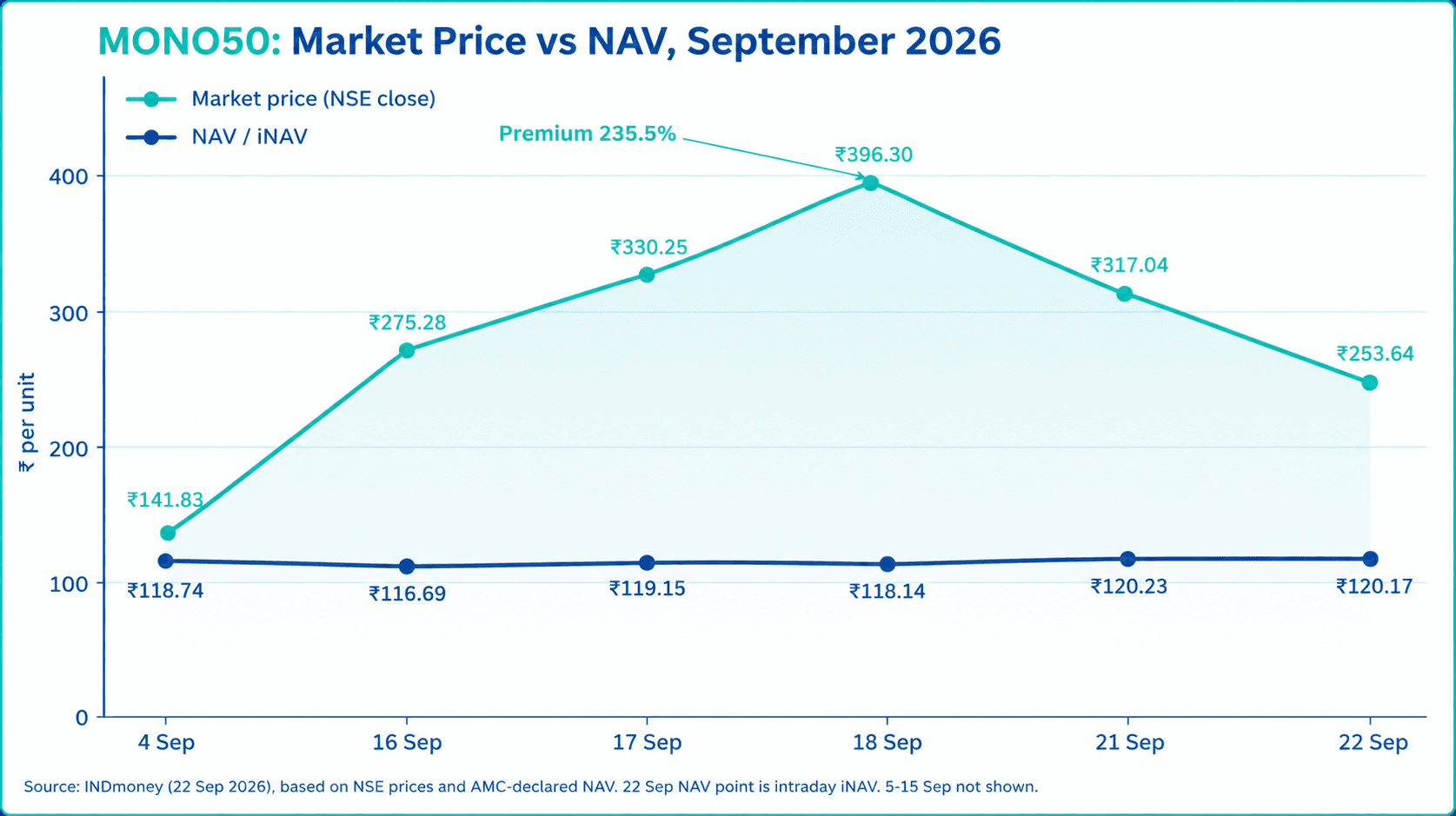
Real-life example: Motilal Oswal Nasdaq Q50 ETF (MONQ50). Between 4 and 18 September 2026, its market price rose from INR 141.93 to INR 396.30, while its NAV stayed between roughly INR 117 and INR 119. The premium widened from 19.5% to 235.5%. Analysts attribute this to restricted creation of fresh units, which weakened arbitrage.
On 21 and 22 September, the ETF's closing price fell 20% each day. Even at its INR 253.64 closing price on 22 September, it remained more than twice the reported intraday iNAV of INR 120.17.
Does A Lower NAV Mean A Mutual Fund Is Cheaper?
No. A low NAV may feel like a bargain, but it isn't necessarily one. NAV only tells you how a fund's total value is divided across its units. It says nothing about whether the portfolio itself is fairly priced.
Say Fund A has a NAV of INR 20 and Fund B has a NAV of INR 200. Put INR 10,000 into each, and you end up with 500 units of A but just 50 of B. Now suppose both portfolios gain 10%. A's NAV moves to INR 22 and B's to INR 220. Either way, your INR 10,000 has become INR 11,000.
New fund offers cause the same confusion. Units are typically offered at INR 10 each, but that's only a starting point, not a sign of value. Once the fund starts investing, NAV follows the portfolio. What decides your return is how the holdings perform and what the fund costs you, not how many units you own. ETFs are a slightly different story. An ETF trading below its iNAV may be available at a discount, but that alone doesn't make it a better investment.
How Should Investors Use NAV When Comparing Funds?
Use NAV to track growth, not to rank funds.
- Compare returns, not NAV levels: A NAV rising from INR 40 to INR 52 in three years represents a 30% absolute gain, or approximately 9.1% annualised.
- Compare like with like: Match category, plan (Direct or Regular) and option. Direct plans generally have lower expense ratios than regular plans, which can result in a higher NAV over time. IDCW payouts reduce NAV.
- Look beyond NAV: Check the expense ratio, risk, benchmark and consistency.
- For ETFs: compare the market price with the iNAV, check the bid-ask spread and volume, and use limit orders.
FAQs

Want to stay at the top of your finances?
Join the community of 22 lakh+ investors and learn more about Grip Invest, the latest financial knick-knacks, and shenanigans in the world of investing.
Happy Investing!
Disclaimer - Investments in debt securities/municipal debt securities/securitised debt instruments are subject to risks including delay and/ or default in payment. Read all the offer related documents carefully. The investor is requested to take into consideration all the risk factors before the commencement of trading.
This communication is prepared by Grip Broking Private Limited (bearing SEBI Registration No. INZ000312836 and NSE ID 90319) and/or its affiliate/ group company(ies) (together referred to as “Grip”) and the contents of this disclaimer are applicable to this document and any and all written or oral communication(s) made by Grip or its directors, employees, associates, representatives and agents. This communication does not constitute advice relating to investing or otherwise dealing in securities and is not an offer or solicitation for the purchase or sale of any securities. Grip does not guarantee or assure any return on investments and accepts no liability for consequences of any actions taken based on the information provided. For more details, please visit www.gripinvest.in
Registered Address - 106, II F, New Asiatic Building, H Block, Connaught Place, New Delhi 110001


