

Electronic Gold Receipts (EGRs): Buy Gold Like Stocks On NSE


Nearly five years after SEBI’s framework for EGRs (Electronic Gold Receipts) was proposed, the NSE has finally introduced this new segment for gold investment.1
Despite India’s gold industry already having popular investment options like Gold ETFs, Gold Mutual Funds, Gold ETF FoFs and Digital Gold, the National Stock Exchange has launched EGRs for specific reasons.
Let us first understand what these electronic gold receipts are, how they work and why they have been introduced.
What Are EGRs?
EGRs (Electronic Gold Receipts) are dematerialized securities which represent direct ownership of physical gold.2 They are issued by SEBI-regulated vault manager against the gold which is deposited with them, and are tradable on the stock exchanges like any other security.3
EGRs are also fully backed by highly pure physical gold, and each unit of EGR can be equivalent to 1 gram, 10 grams or 100 grams of gold, and so, depending on the various EGR products being offered by NSE.
Key Features Of EGRs:
1. Regulation: SEBI itself will regulate EGRs, while NSE will provide the investment platform.
2. Purity: Physical gold will be highly pure, with 99.9% or 99.5% fineness
3. Storage and Security: The physical gold is stored securely in SEBI-accredited vaults. Also, the gold receipts will be held electronically in India’s two national depositories-NSDL and CDSL, which will also carry out physical verification of the vaults in every two weeks.
4. Uniform pricing: Unlike physical gold prices that vary across states, EGRs will have unified pricing across the country.
5. Physical delivery of gold: There is no compulsion for buyers to take physical delivery of the gold. Buyer can continue to hold the EGR in demat account for further trading or opt for physical delivery of gold.
6. Easily tradable: Just like stocks, EGRs will be easily tradable on stock exchanges, and will be held in demat accounts, even with smaller denominations.
Now the big question is-why did NSE introduce this segment?
Why Did NSE Introduce Electronic Gold Receipts?
While the deeper details are awaited for this new segment, NSE’s circular had mentioned that the aim behind the introduction of EGRs is as follows:
- Create a transparent ecosystem for gold trading
- Enable efficient price discovery
- Improve market participation with a smaller entry ticket for retail investors
- Bridge the gap between physical gold and financial markets
- Enhance trust across participants like jewellers, retail investors, and refineries
NSE’s EGR Product Offerings
The NSE has already rolled out information on the list of EGRs currently available on its platform:
1. For 99.9% purity:
- EGR 999 1Kg
- EGR 999 100 grams
- EGR 999 10 grams
- EGR 999 1 gram
- EGR 999 100 Milligrams
Source: NSE4
2. For 99.5% purity:
- EGR 995 1Kg
- EGR 995 100 grams
- EGR 995 10 grams
- EGR 995 1 gram
- EGR 995 100 Milligrams
Source: NSE4
What Is The Structure Of The Transactions In EGR?
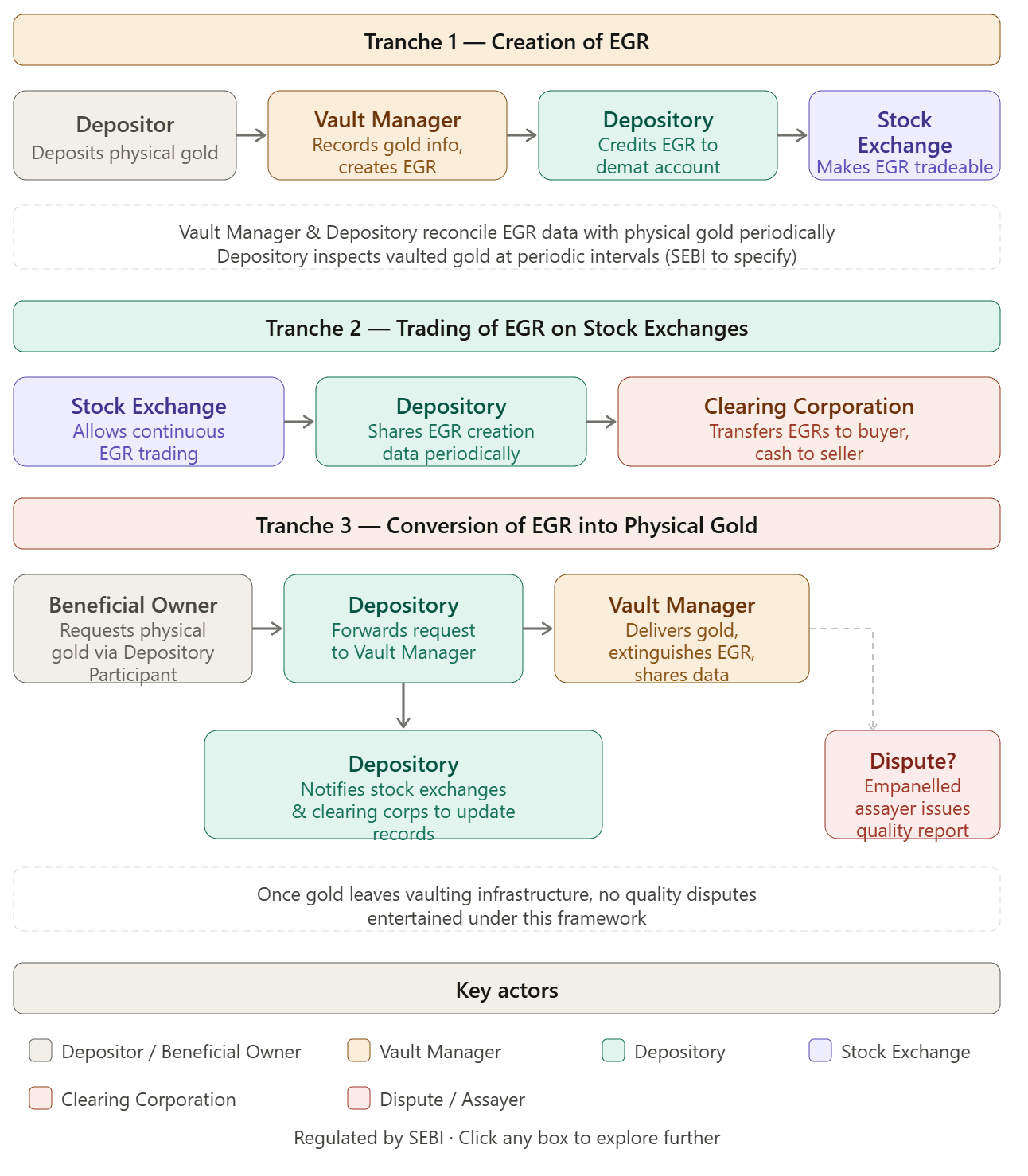
- First Tranche: Creation of EGR
- Second Tranche: Trading of EGR on stock exchanges
- Third Tranche: Conversion of EGR into Physical Gold
Additionally, the first tranche will also involve the creation of a common interface by the depositories (NSDL and CDSL) and made accessible to all of the involved entities like stock exchanges, vault managers, depositories, and clearing corporations.6
Supply And Standard Of Physical Gold
As far as supply of physical gold is concerned, it should be a fresh deposit of gold, coming into the vaults through:
- The gold entered the country through import and stored with the registered vault manager.
- The gold refined by domestic refineries, which are registered with BIS and accredited with stock exchanges.
And then, the existing gold deposit lying in the vaults, which not only meets the required criterion but has also never been out of this vaulting infrastructure, may be considered for conversion into electronic gold receipts.
Also, the gold standard should either comply with LBMA Good Delivery Standard or the India Good Delivery Standard, or any other standard specified by SEBI. Moreover, the storage and withdrawal charges (if any), shall be levied by the vault managers and be collected by the depositories NSDL and CDSL from the beneficial owner of EGRs. This fee is then paid to the vault managers, who must disclose such charges upfront to the public.
Settlement Cycle For EGRs
As per SEBI, the settlement of EGRs is expected to be done on a T+1 rolling basis.7 The trades on the stock exchange would get settled through transfer of funds to the seller and electronic gold receipts to the buyer. Remember that EGR would only be transferred into the demat account of the buyer, and it is the NSE itself who will provide a trading platform for investment in EGRs (electronic gold receipts).
Conclusion
Electronic Gold Receipts represent a structural shift in how gold can be owned and traded in India. By bringing physical gold into a regulated, transparent, and exchange-traded format, EGRs bridge the long-standing gap between traditional gold ownership and modern financial markets.
They offer investors the flexibility of trading, the assurance of purity, and the convenience of holding gold in demat form, without the operational challenges of storage and security.
While adoption may take time, EGRs have the potential to reshape gold investing by improving price discovery, increasing participation, and standardising the ecosystem across stakeholders. For investors, the key lies in understanding where EGRs fit within their broader portfolio, whether as a hedge, a diversification tool, or a long-term store of value.
As you explore new-age investment avenues like EGRs, it is equally important to balance them with stable income-generating options. Platforms like Grip Invest offer access to fixed-income opportunities that can complement your portfolio with predictable returns alongside market-linked assets.
FAQs On EGRs
 |
Author: Grip Invest Editorial Team The Grip Invest Editorial Team is a group of Chartered Accountants, MBA (Finance) graduates, and Qualified Research Analysts dedicated to helping you invest smarter. We dive deep into India's fixed income landscape to deliver content that is accurate, up-to-date, and easy to understand. Whether you're exploring bonds, fixed deposits, or other fixed income opportunities, our guides cut through the noise and give you the clarity to make better financial decisions. |
Want to stay at the top of your finances?
Join the community of 4 lakh+ investors and learn more about Grip Invest, the latest financial knick-knacks, and shenanigans in the world of investing.
Happy Investing!
Disclaimer - Investments in debt securities/municipal debt securities/securitised debt instruments are subject to risks including delay and/ or default in payment. Read all the offer related documents carefully. The investor is requested to take into consideration all the risk factors before the commencement of trading.
This communication is prepared by Grip Broking Private Limited (bearing SEBI Registration No. INZ000312836 and NSE ID 90319) and/or its affiliate/ group company(ies) (together referred to as “Grip”) and the contents of this disclaimer are applicable to this document and any and all written or oral communication(s) made by Grip or its directors, employees, associates, representatives and agents. This communication does not constitute advice relating to investing or otherwise dealing in securities and is not an offer or solicitation for the purchase or sale of any securities. Grip does not guarantee or assure any return on investments and accepts no liability for consequences of any actions taken based on the information provided. For more details, please visit www.gripinvest.in
Registered Address - 106, II F, New Asiatic Building, H Block, Connaught Place, New Delhi 110001


