

Treasury Bills vs Fixed Deposits: Which Is Better For Short-Term Investing?


When you have extra money that you won't need for a few months, the first question that often comes to our mind is: Where should I invest it safely? There are a number of Indian investors, the answer usually comes down to the comparison and that is Treasury Bills vs Fixed Deposits. While both are considered low-risk investment options, they work differently and also they cater to different financial demands.
If you are looking for a place to park surplus cash, build an emergency corpus, or earn stable returns without exposing your money to market volatility, understanding the difference between Treasury Bills and Fixed Deposits is required. Each investment has its own strengths, and choosing the right one relies on your financial goals, investment horizon, liquidity requirements, and tax considerations.
Treasury Bills vs Fixed Deposits: Understanding the Basics
Before comparing them, let's understand how each investment works.
What are Treasury Bills (T-Bills)?
Treasury Bills are short-term government securities issued by the Reserve Bank of India (RBI) on behalf of the Government of India. They are available with maturities of 91 days, 182 days, and 364 days.1
Unlike traditional investments that pay periodic interest, Treasury Bills are issued at a discount to their face value. At maturity, investors receive the full face value, and the difference becomes their return.
Let’s Understand this with an example-
Suppose you purchase a Treasury Bill with a face value of INR 1,00,000 for INR 97,800. At maturity, you receive INR 1,00,000, earning INR 2,200 as your return.
This makes Treasury Bills an attractive option for investors seeking capital preservation backed by sovereign security.
What Are Fixed Deposits (FDs)?
A Fixed Deposit is one of India's most popular investment products that is offered by banks and financial institutions. You deposit a fixed amount in the bank for a predetermined tenure and receive a fixed rate of interest.2
Interest can be paid monthly, quarterly, annually, or at maturity, depending on the selected options in the FD types.
Example:
If you invest INR 1,00,000 in a one-year Fixed Deposit offering 7% annual interest, you'll receive approximately INR 1,07,000 at maturity (before taxes).
Unlike Treasury Bills, Fixed Deposits provide predictable returns just because the interest rate remains fixed throughout the investment period.
How Do Treasury Bills and Fixed Deposits Generate Returns?
Although both investments belong to the fixed-income category, the way they generate returns differs significantly.
Feature | Treasury Bills | Fixed Deposits |
| Return Method | Purchased at a discount and redeemed at face value | Earn fixed interest |
| Issuer | Government of India | Banks & Financial Institutions |
| Interest Payments | No periodic interest | Monthly, quarterly or maturity payout |
| Risk Level | Sovereign-backed | Depends on the bank's financial strength |
| Investment Objective | Short-term liquidity and safety | Stable income and capital growth
|
This visual shows the quick understanding of the fundamental differences before diving into a detailed comparison.
In the next section, we will compare Treasury Bills vs Fixed Deposits across crucial parameters like taxation, liquidity, safety, returns, tenure, premature withdrawal, and minimum investment that can assist you to decide which investment better suits your short-term financial goals.
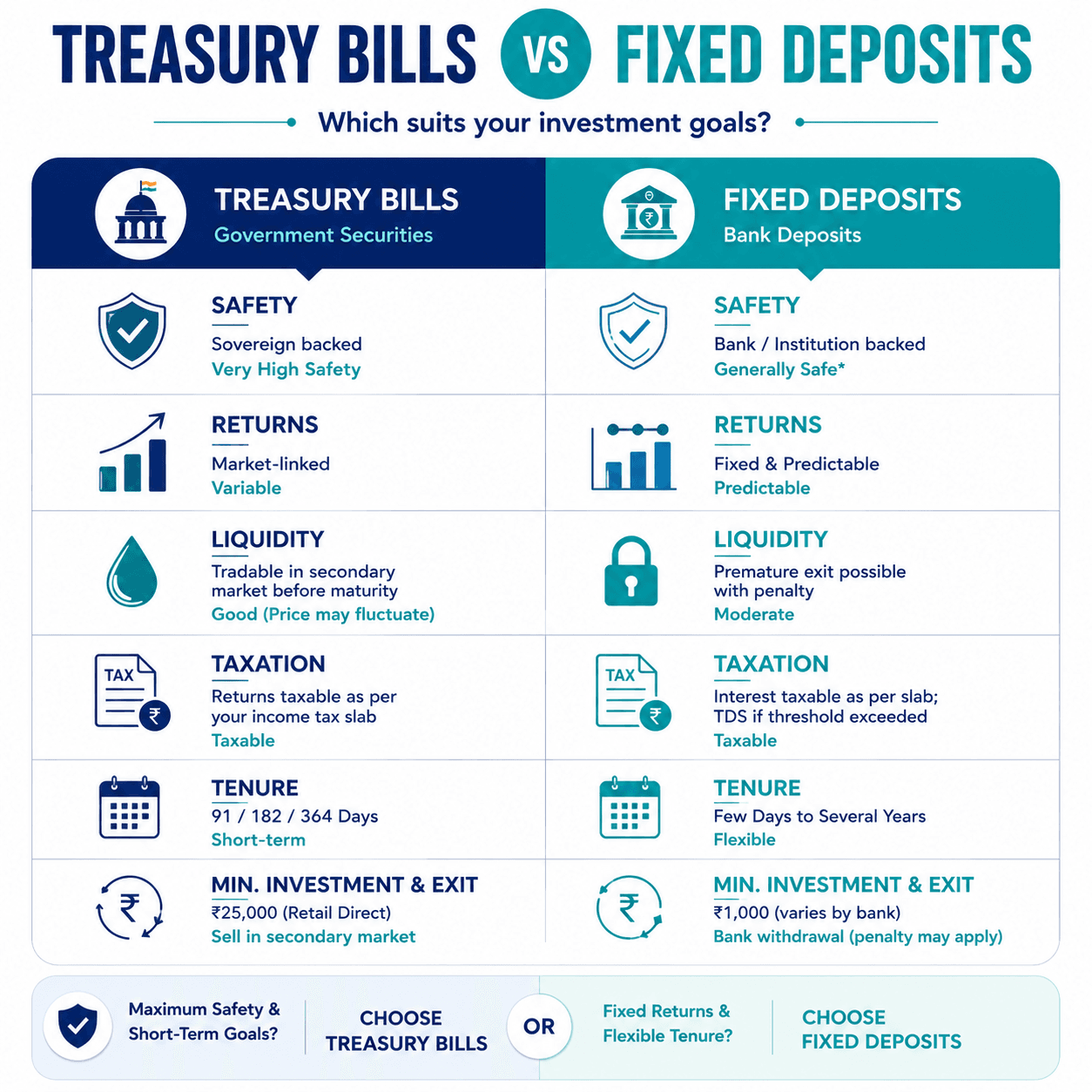
Treasury Bills vs Fixed Deposits: Head To Head Comparison
Now that you understand how Treasury Bills (T-Bills) and Fixed Deposits (FDs) work, let's compare them across the factors that matter most to investors. While both are considered relatively safe investment options, the right choice depends on your financial needs and motives, liquidity needs, and investment horizon.3
1. Safety
When it comes to safety, Treasury Bills have a clear advantage. They are issued by the Government of India and carry sovereign backing, making them virtually free from default risk.
Fixed Deposits are offered by banks and financial institutions. Although deposits with scheduled banks are generally considered safe, they are subject to the financial health of the issuing institution. Choosing a reputed bank can help reduce this risk.
Best for: Investors who prioritize maximum capital protection.
2. Returns
Treasury Bills typically offer market-linked returns that depend on auction yields. These returns can vary based on prevailing interest rates and economic conditions.
Fixed Deposits provide fixed and predictable returns, allowing investors to know exactly how much they will receive at maturity.
If your priority is predictable income, an FD may be more suitable. If you are comfortable with market-driven yields while seeking sovereign security, T-Bills can be an attractive alternative.
3. Liquidity
Liquidity is another important consideration.
Treasury Bills can generally be sold in the secondary market before maturity, although their market price may fluctuate depending on interest rate movements.
Fixed Deposits usually allow premature withdrawal, but banks often levy a penalty or reduce the applicable interest rate, which can lower your overall returns.
If you expect to need your money unexpectedly, compare the exit conditions carefully before investing.
4. Taxation
Taxation also affects your overall returns.
- The returns earned from Treasury Bills are taxable according to your applicable income tax slab.
- Interest earned from Fixed Deposits is also taxable, and banks may deduct Tax Deducted at Source (TDS) if the interest exceeds the prescribed threshold under applicable tax rules.
Since taxation impacts your post-tax earnings, investors should evaluate returns after tax rather than focusing only on the advertised yield.
5. Tenure, Minimum Investment, and Premature Exit
Treasury Bills are designed specifically for short-term investing, with maturities of 91, 182, and 364 days. Fixed Deposits, however, offer much greater flexibility, with tenures ranging from a few days to several years.4
Similarly, the minimum investment requirement and exit rules differ depending on the product and issuer.
Which Investment Should You Choose?
Instead of asking "Treasury Bills or Fixed Deposits?", a better question is "Which investment matches my financial objective?"
- Choose Treasury Bills if you want sovereign-backed safety, have a short investment horizon, and are comfortable holding the investment until maturity or participating in the government securities market.
- Choose Fixed Deposits if you prefer guaranteed returns, flexible tenures, and a simple investment process through your bank.5
Many investors don't have to choose just one. A balanced portfolio can include both Treasury Bills and Fixed Deposits using T-Bills to park short-term surplus funds and FDs to generate stable, predictable income. This diversification can help improve liquidity while maintaining overall portfolio stability.
FAQs On Treasury Bills vs Fixed Deposits

Want to stay at the top of your finances?
Join the community of 4 lakh+ investors and learn more about Grip Invest, the latest financial knick-knacks, and shenanigans in the world of investing.
Happy Investing!
Disclaimer - Investments in debt securities/municipal debt securities/securitised debt instruments are subject to risks including delay and/ or default in payment. Read all the offer related documents carefully. The investor is requested to take into consideration all the risk factors before the commencement of trading.
This communication is prepared by Grip Broking Private Limited (bearing SEBI Registration No. INZ000312836 and NSE ID 90319) and/or its affiliate/ group company(ies) (together referred to as “Grip”) and the contents of this disclaimer are applicable to this document and any and all written or oral communication(s) made by Grip or its directors, employees, associates, representatives and agents. This communication does not constitute advice relating to investing or otherwise dealing in securities and is not an offer or solicitation for the purchase or sale of any securities. Grip does not guarantee or assure any return on investments and accepts no liability for consequences of any actions taken based on the information provided. For more details, please visit www.gripinvest.in
Registered Address - 106, II F, New Asiatic Building, H Block, Connaught Place, New Delhi 110001


