

How To Buy Treasury Bills In India: Step By Step Guide For Retail Investors


One of the safest short-term investment options in India is Treasury Bills or T-Bills. These are issued by the Government of India through the Reserve Bank of India (RBI) to meet the short-term borrowing requirements of the government and provide investors a safe avenue to invest their surplus funds.
RBI T-Bills are different from other fixed income instruments as they do not pay periodic interest. Instead, they are sold at a discount and redeemed at par at maturity, the difference being the profit to the investor.
If you are wondering how to buy Treasury Bills in India, this guide explains the available investment routes, the eligibility criteria and the steps involved in investing.
How To Buy Treasury Bills In India?
Government-backed securities, such as the Treasury Bills, are now within the reach of retail investors, who can buy them through a variety of investment routes in India. You can invest in T-Bills investments either directly with the RBI or through market intermediaries, whichever is convenient to you.
Overview of available investment routes
As a retail investor, you can invest in Treasury Bills through several routes:
- You can get them through RBI Retail Direct
- You can also get the RBI T-Bills through the secondary market via recognised stock exchanges and brokers.
- Or, you can opt to go for investment platforms like Grip
Each route provides access to government securities India, although the investment process may differ slightly.
Eligibility for retail investors
Treasury Bills are not limited to banks and financial institutions. Individual retail investors are also fully eligible to invest in them. They can do it by participating in RBI auctions through the non-competitive bidding facility or by purchasing them in the secondary market. The eligibility criteria for the same is:
A. Individuals (natural persons), i.e. retail investors. To open an account, you will need to:
- Rupee savings bank account held in India.
- Permanent Account Number (PAN) issued by Income Tax Department.
- Any Officially Valid Document (OVD) for KYC purpose.
- Valid Email address.
- Mobile number registered.
B. Non-Resident retail investors eligible to invest in Government Securities under Foreign Exchange Management Act, 1999.
Minimum investment requirements
Minimum investment amount in Government of India Treasury Bills (T-Bills) is INR 10,000 (as on Nov 12, 2021). Thereafter, the investment is made in multiples. However, investors should always check the details of the relevant issue before submitting their bids, as the terms could be different.
Different Ways To Buy Treasury Bills In India
There are different methods to complete a treasury bill purchase, depending on how you wish to invest.
1. RBI Retail Direct
RBI Retail Direct enables individual investors to purchase Treasury Bills directly by participating in RBI non-competitive primary auctions through an online platform. All you have to do is open a free RBI Retail Direct account, complete KYC, bid in Treasury Bill auctions and receive maturity proceeds directly in your linked bank account.
2. Secondary market
Treasury Bills can also be purchased from the secondary market through registered brokers and recognised stock exchanges. This allows investors to buy securities that have already been issued instead of waiting for a fresh auction.
3. Grip Invest
Investors may also use platforms such as Grip that provide access to fixed-income investment opportunities. Before investing through any platform, it is important to understand the investment process, applicable charges and the products being offered.
Do You Need A Demat Account To Buy Treasury Bills?
The requirement depends on how you invest.
When investing through RBI Retail Direct, Treasury Bills are held in the Retail Direct Gilt (RDG) account maintained by RBI, so a separate Demat account is generally not required.
However, investors purchasing Treasury Bills through stock exchanges may need a Demat and trading account, depending on the broker and investment platform they use.
Before investing, investors should verify the account requirements applicable to their chosen route.
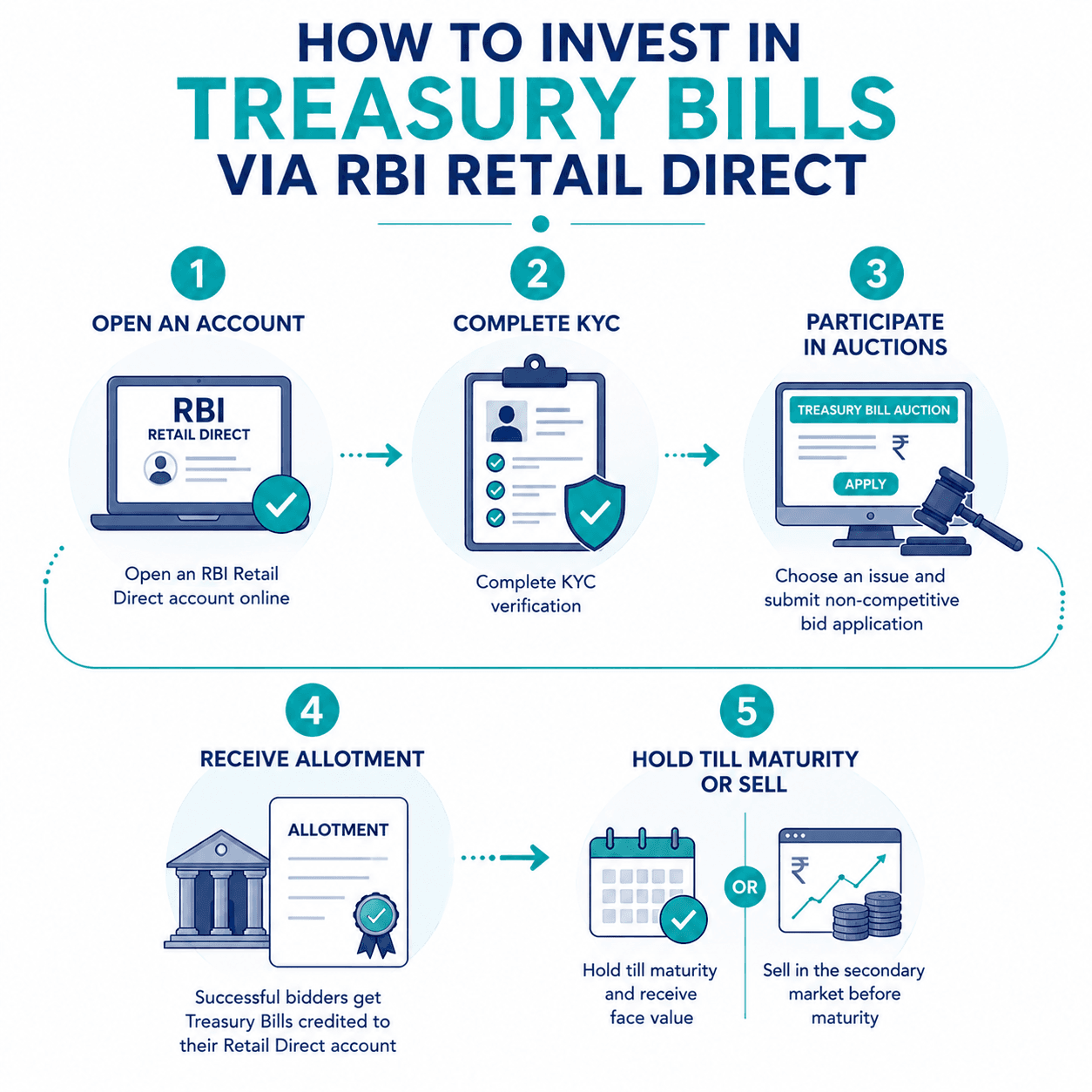
Step By Step Process To Invest Through RBI Retail Direct
Opening an account under RBI Retail Direct allows eligible retail investors to participate directly in Treasury Bill auctions.
1. Open an RBI Retail Direct account
Start by signing up for an RBI Retail Direct account through the online registration process. This account is the entry point to buy Treasury Bills India directly in the RBI.
2. Complete KYC
Once the account is created, the Know Your Customer (KYC) formalities have to be completed as required during the registration process. The account will be activated after successful verification.
3. Participate in auctions
When your account is activated, you may use it to apply for Treasury Bill auctions by choosing the issue you want to bid on, and then submitting your application using the non-competitive bid process available to retail investors.
4. Receive allotment
After the auction ends, successful bidders will have the Treasury Bills they won credited to their Retail Direct account according to the auction results.
5. Hold till maturity or sell
After allotment, investors can either hold the Treasury Bills until maturity and receive the face value or sell them in the secondary market before maturity if they require liquidity.
Buying Treasury Bills In The Secondary Market
Apart from participating in primary auctions, investors can also purchase Treasury Bills after they have been issued. The secondary market enables investors to buy existing Treasury Bills through recognised stock exchanges and brokers.
Current holders often sell their holdings before maturity. However, as these transactions occur after the original issuance, the market price may not be the same as the face value. This provides investors with flexibility if they miss an auction or don't want to wait for a new issue.
Primary Market Vs Secondary Market
Investors can purchase Treasury Bills either during RBI auctions or after issuance.
| Primary Market | Secondary Market |
| Purchase directly during RBI auction | Purchase existing Treasury Bills from other investors |
| Price determined through auction | Price depends on market demand and supply |
| Available only on auction dates | Available whenever market liquidity exists |
| Suitable for planned investments | Suitable when immediate investment is preferred |
Both methods provide access to Government securities, but investors should understand the pricing differences before investing.
Which Investment Route Is Suitable For You?
Retail investors can choose different methods to buy Treasury Bills depending on their investment preferences.
| Investment Route | Suitable For | Key Features | Minimum Investment |
| RBI Retail Direct | Investors who want to buy directly from RBI without intermediaries | Direct participation in primary auctions, no intermediary fees, holds securities in Retail Direct account | INR 10,000 (in multiples) |
| Stock Exchange / Broker | Investors who already have a trading account and prefer secondary market purchases | Buy existing T-Bills, flexible maturity options, requires demat and trading account | Market-dependent (typically INR 10,000+) |
| Investment Platforms (e.g., Grip) | Investors looking for a simplified investment experience alongside other fixed-income products | User-friendly interface, low minimum investment, access to multiple fixed-income products, curated offerings | INR 100 |
Things To Consider Before Investing
Before deciding to invest in Treasury Bills, consider the following factors:
- Treasury Bills are short-term investments with maturities of 91, 182 and 364 days.
- They do not pay periodic interest and generate returns through the difference between the purchase price and the face value received at maturity.
- They are backed by the Government of India, making them one of the lowest-risk investment options.
- Although they are highly liquid, the price may vary if sold before maturity in the secondary market.
- Returns are generally lower than those offered by higher-risk investment options.
- The returns earned on Treasury Bills are subject to applicable taxation.
Conclusion
Treasury Bills are among the safest short-term investment options available, offering capital preservation, predictable returns, and strong liquidity. Whether you're looking to park surplus funds, diversify your fixed-income portfolio, or begin investing in government securities, T-Bills can be a valuable addition to your investment strategy.
If you're exploring fixed-income investments beyond Treasury Bills, Grip Invest offers access to a curated range of investment opportunities, including corporate bonds and other fixed-income products. Compare options, understand potential risks and returns, and invest with confidence all through a seamless digital platform.
FAQs On How To Invest In T-Bills
 |
Author: Grip Invest Editorial Team The Grip Invest Editorial Team is a group of Chartered Accountants, MBA (Finance) graduates, and Qualified Research Analysts dedicated to helping you invest smarter. We dive deep into India's fixed income landscape to deliver content that is accurate, up-to-date, and easy to understand. Whether you're exploring bonds, fixed deposits, or other fixed income opportunities, our guides cut through the noise and give you the clarity to make better financial decisions. |
Want to stay at the top of your finances?
Join the community of 4 lakh+ investors and learn more about Grip Invest, the latest financial knick-knacks, and shenanigans in the world of investing.
Happy Investing!
Disclaimer - Investments in debt securities/municipal debt securities/securitised debt instruments are subject to risks including delay and/ or default in payment. Read all the offer related documents carefully. The investor is requested to take into consideration all the risk factors before the commencement of trading.
This communication is prepared by Grip Broking Private Limited (bearing SEBI Registration No. INZ000312836 and NSE ID 90319) and/or its affiliate/ group company(ies) (together referred to as “Grip”) and the contents of this disclaimer are applicable to this document and any and all written or oral communication(s) made by Grip or its directors, employees, associates, representatives and agents. This communication does not constitute advice relating to investing or otherwise dealing in securities and is not an offer or solicitation for the purchase or sale of any securities. Grip does not guarantee or assure any return on investments and accepts no liability for consequences of any actions taken based on the information provided. For more details, please visit www.gripinvest.in
Registered Address - 106, II F, New Asiatic Building, H Block, Connaught Place, New Delhi 110001


