

Bondholder Vs Bond Issuer: Key Differences Every Investor Should Know


By investing in bonds, you form a partnership with two primary parties involved. Recognising the roles of the bondholder and bond issuer enables you to choose investments wisely as well as manage expectations. Each bondholder vs bond issuer comes with clearly defined roles, rights, and risks, which determine the operation of bonds.
Bondholder Vs Bond Issuer: Understanding Their Roles
In the bond market, the bondholder is an investor, which means that they lend money to a company or government by purchasing bonds. In return for the investment, the bondholder receives periodic interest from the bond issuer and also gets back the initial investment upon maturity.
On the other hand, the bond issuer is the borrower, meaning that they receive money from investors and must repay it with interest.
Thus, the bondholder acts like a creditor while the company plays its role as a debtor. Understanding both sides can help investors to determine the safety of their investments as well as potential returns.
Hypothetical Example
Rahul purchases bonds from a manufacturing company, becoming a bondholder while the manufacturer is considered the bond issuer. He expects to receive interest from the manufacturing company while the company uses the money for expansion and pays it back later.
Rights, Responsibilities And Obligations
The rights of a bondholder involve timely receiving coupon payments and principal repayment at maturity. If the bond issuer does not meet its obligations, bondholders have preference over shareholders in terms of recovering their money. They may benefit from some protective bond covenants that limit the actions of the bond issuer.
The responsibilities of an issuer include making periodic interest payments and repaying the principal sum as agreed. In order to be able to fulfill these obligations, the issuer must maintain a good financial condition. Often, a trustee role is to oversee this process.
Bondholder Vs Bond Issuer : At A Glance
| Aspect | Bondholder (Investor) | Bond Issuer (Company/Government) |
| Role | Lender / Creditor | Borrower / Debtor |
| Primary Goal | Earn stable income and protect capital | Raise funds for growth and operations |
| Rights | Receive coupon payments and principal at maturity; priority in default recovery; protected by bond covenants | Use borrowed funds as per the bond terms; defined rights under the bond agreement |
| Obligations | None, as an investor | Pay interest on time; repay principal at maturity; maintain financial health and comply with bond terms |
| Risks | Credit risk; liquidity risk; interest rate risk; inflation risk | Refinancing risk; interest rate risk; default risk |
One must understand that the distinction between lender and shareholder is crucial. Bondholders are lenders because their claims are fixed, whereas shareholders are owners since they have residual claims after the creditors are paid.
How Do Bondholders Earn Returns?
Bondholders generally earn returns through two sources.
1. Coupon Income
Most bonds pay periodic coupon interest during the tenure.
For example, a bond carrying an 8% annual coupon pays INR 8,000 every year on an investment of INR 1 lakh, subject to its terms.
2. Capital Appreciation
If market interest rates fall, existing bonds with higher coupon rates may increase in value. Investors selling such bonds before maturity in the secondary market may realise capital gains.
However, market prices can also decline if interest rates rise.
Therefore, returns depend not only on coupon income but also on prevailing market conditions and the holding period.
What Happens During The Life Of A Bond?
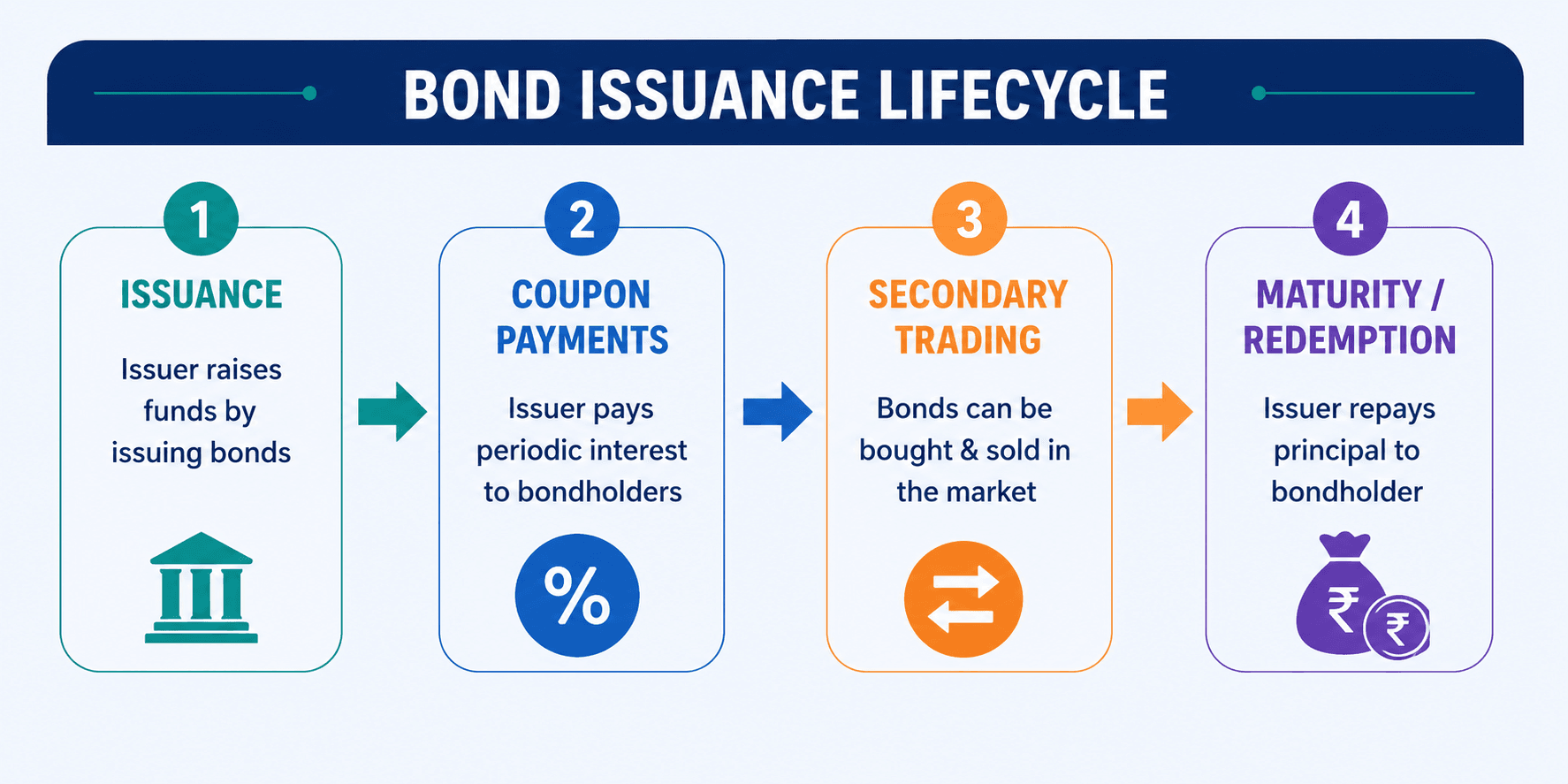
The life of a bond usually includes several stages.
- Issue: The first stage of a bond's life is the issuance, i.e., when the bond issuer gets funds from investors.
- Coupon Payments: During the tenure of the bond, the issuer pays periodic interest (coupon) to bondholders as per the agreed schedule.
- Secondary Market Trading: A bond can be bought or sold in the secondary market before its maturity. This allows investors to enter or exit their investment.
- Maturity: At maturity, the issuer repays the principal amount to the bondholder, and the bond comes to an end.
- Early Redemption: Some bonds may allow early redemption or buyback. However, this depends on their terms and conditions, thereby enabling the issuer or investor to redeem the bond before maturity.
Hypothetical Example
When a business has issued bonds in relation to a new project, clients obtain them and receive interest every half-year. However, if there is a downturn in the economy, investors can sell bonds before their maturity. Eventually, the firm returns the principal amount to its clients at maturity.
What Happens If A Bond Issuer Defaults?
A default occurs when the issuer fails to pay interest or repay the principal according to the bond terms.
Depending on the bond structure and applicable laws, several outcomes may follow:
- Bondholders may receive delayed payments.
- Secured bondholders may recover part of their investment from pledged assets.
- Insolvency proceedings may begin under applicable regulations.
- Recovery depends on the issuer's remaining assets, debt obligations and legal process.
Because of this risk, investors should review credit ratings, financial statements, collateral (where applicable) and repayment history before investing.
How To Evaluate A Bond Issuer Before Investing
Before purchasing any corporate bond, investors should evaluate the issuer rather than focusing only on the coupon rate.
Some important factors include:
- Credit rating assigned by recognised rating agencies.
- Financial performance and profitability.
- Debt servicing capability.
- Interest Coverage Ratio.
- Debt-to-equity ratio.
- Collateral available for secured bonds.
- Industry outlook.
- Previous repayment record.
Analysing these factors together provides a more complete picture of the issuer's ability to meet its repayment obligations.
Risks Faced By Both Parties
Both bond issuers and bondholders face certain risks throughout the life of a bond. Some include:
- Interest Rate Risk: Changes in market interest rates can increase or decrease the market value of the existing bonds.
- Refinancing Risk: The issuer may face difficulty refinancing its debt at favourable interest rates when existing bonds mature.
- Credit Risk: The issuer may fail to make timely interest or principal payments, eventually affecting bondholders.
- Liquidity Risk: Investors may not always be able to sell their bonds swiftly at a fair market price.
In case of default, recovery becomes extremely essential as the holder of the bond would be able to recover only a part of his investment.
Real-life Example
During an economic downturn, a company has trouble paying interest. The bondholder may not receive funds in time or may eventually lose his investment. The issuer will incur damage to its name and will pay more to borrow in the future. In some cases, protective covenants can help reduce such risks.
Investing In Corporate Bonds Wisely
Wise investors evaluate the issuing corporation accurately in terms of credit ratings, creditworthiness, industry and financial position. Credit ratings assigned by recognised rating agencies provide an independent assessment of an issuer's ability to meet its debt obligations. By diversifying among different issuers and maturities, risks are minimised. One should understand the difference between a bondholder and an issuer in order to form reasonable expectations in terms of returns and safety.
Grip Invest is one such platform that provides investors with a chance to invest in notable corporate bonds exhibiting transparent behaviors of the bond issuers.
Conclusion
Understanding the relationship between a bondholder and a bond issuer helps investors assess both the return potential and the risks involved before investing. While bondholders seek regular income and capital protection, issuers use bonds as a source of long-term funding. Evaluating the issuer's financial strength, repayment ability, and credit quality is therefore just as important as comparing coupon rates.
FAQs On Bondholder Vs Bond Issuer
 |
Author: Grip Invest Editorial Team The Grip Invest Editorial Team is a group of Chartered Accountants, MBA (Finance) graduates, and Qualified Research Analysts dedicated to helping you invest smarter. We dive deep into India's fixed income landscape to deliver content that is accurate, up-to-date, and easy to understand. Whether you're exploring bonds, fixed deposits, or other fixed income opportunities, our guides cut through the noise and give you the clarity to make better financial decisions. |
Want to stay at the top of your finances?
Join the community of 4 lakh+ investors and learn more about Grip Invest, the latest financial knick-knacks, and shenanigans in the world of investing.
Happy Investing!
Disclaimer - Investments in debt securities/municipal debt securities/securitised debt instruments are subject to risks including delay and/ or default in payment. Read all the offer related documents carefully. The investor is requested to take into consideration all the risk factors before the commencement of trading.
This communication is prepared by Grip Broking Private Limited (bearing SEBI Registration No. INZ000312836 and NSE ID 90319) and/or its affiliate/ group company(ies) (together referred to as “Grip”) and the contents of this disclaimer are applicable to this document and any and all written or oral communication(s) made by Grip or its directors, employees, associates, representatives and agents. This communication does not constitute advice relating to investing or otherwise dealing in securities and is not an offer or solicitation for the purchase or sale of any securities. Grip does not guarantee or assure any return on investments and accepts no liability for consequences of any actions taken based on the information provided. For more details, please visit www.gripinvest.in
Registered Address - 106, II F, New Asiatic Building, H Block, Connaught Place, New Delhi 110001


