

Treasury Bills (T-Bills): Meaning, Types, Features, Returns And How They Work in India


Treasury Bills (T-Bills) are short-term government securities that allow investors to park surplus funds for periods of up to one year. Issued by the Government of India, they are zero-coupon instruments that are generally sold at a discount and redeemed at face value on maturity.
The difference between the purchase price and face value represents the investor’s return.
With sovereign backing and relatively short maturities, T-Bills can be useful for investors prioritising capital preservation and liquidity.
This guide explains how Treasury Bills work, their different tenures, potential returns, key features and risks, and who may consider investing in them.
Treasury Bills: What Are They?
Treasury Bills, commonly known as T-Bills, are short-term debt instruments issued by the Government of India to meet its short-term funding requirements. They have maturities of less than one year and do not make periodic interest or coupon payments.
Instead, T-Bills are issued at a discount to their face value and redeemed at face value upon maturity. The difference between the purchase price and redemption value represents the investor’s return.
For instance, suppose a T-Bill with a face value of INR 100 is purchased for INR 98.50. If held until maturity, the investor receives INR 100, earning INR 1.50 on the investment.
Why Does the Government Issue Treasury Bills?
The Government of India issues Treasury Bills primarily to meet its short-term funding and cash-management requirements. There can be timing differences between government receipts, such as tax collections, and expenditure. T-Bills allow the government to bridge such short-term funding gaps by borrowing for periods of less than one year.
The Reserve Bank of India conducts T-Bill auctions on behalf of the Government of India. Apart from helping the government raise short-term funds, Treasury Bills also form an important part of India's money market and provide investors with access to short-term sovereign securities.
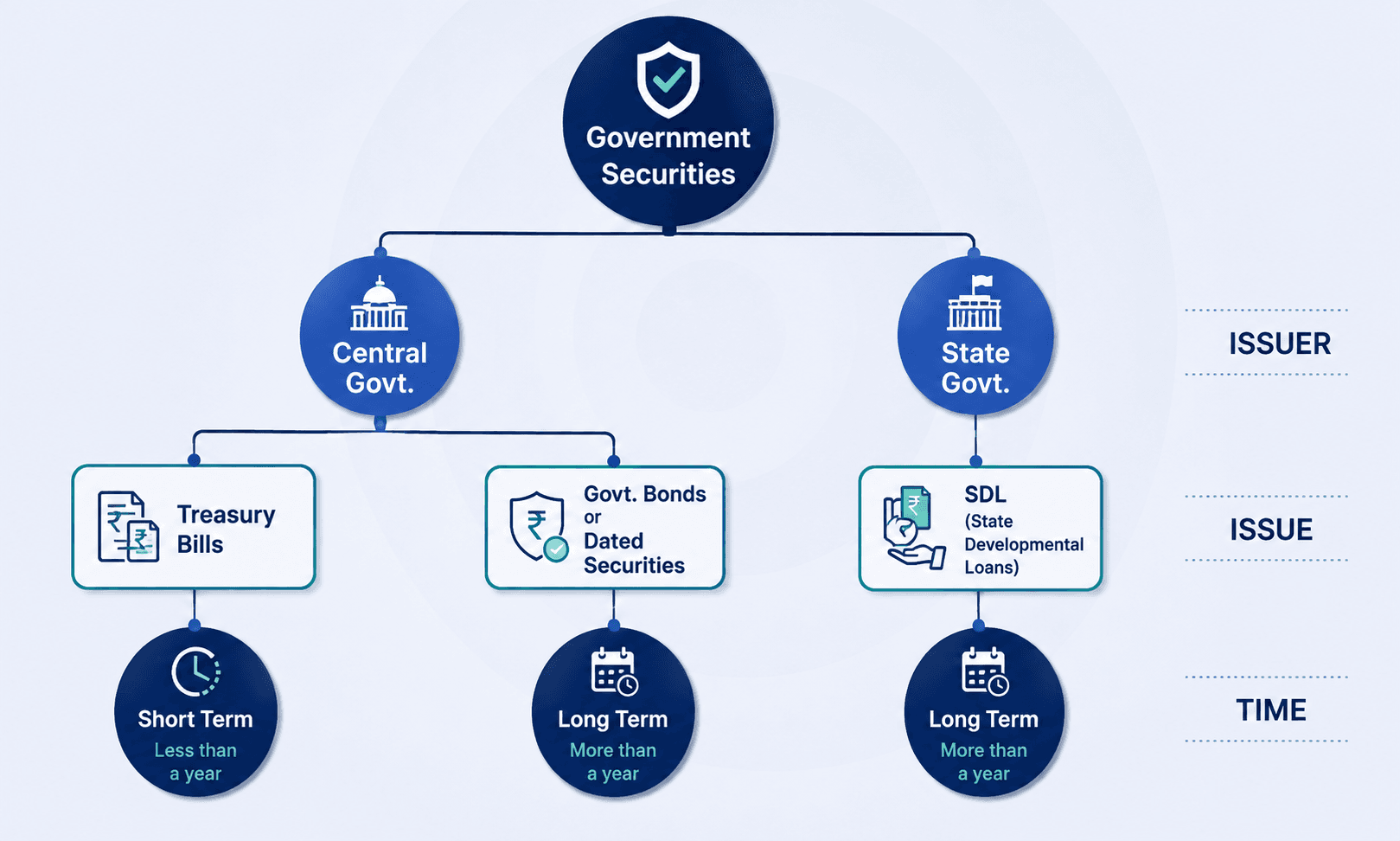
How Treasury Bills Work?
Treasury Bills follow a relatively simple investment structure.
1. Issued at a Discount
T-Bills are generally issued at a price below their face value through auctions conducted by the RBI on behalf of the Government of India. For example, a T-Bill with a face value of INR 100 may be purchased for INR 97.
2. No Periodic Interest Payments
Unlike coupon-paying bonds, T-Bills do not make periodic interest payments. Instead, the investor earns a return through the difference between the purchase price and the amount received at maturity.
3. Redemption at Face Value
Continuing the above example, an investor purchasing the T-Bill for INR 97 receives INR 100 at maturity, resulting in a return of INR 3.
4. Maturity
If the T-Bill is held until maturity, its face value is credited to the investor as per the applicable settlement process.
Types Of Treasury Bills In India
The Government of India issues Treasury Bills across three standard maturities:
1. 91-Day Treasury Bills
These mature in 91 days and may suit investors looking to park surplus funds for a relatively short period while maintaining exposure to sovereign securities.
2. 182-Day Treasury Bills
These mature in 182 days and can be considered by investors whose investment horizon extends to around six months.
3. 364-Day Treasury Bills
These mature in 364 days and have the longest maturity among the three commonly issued T-Bill categories in India. They may suit investors looking to invest surplus funds for close to one year.
Treasury Bills Comparison
| Type | Tenure | Typical Yield* | Suitable For |
| 91-Day T-Bill | 91 days | Market-linked | Short-term liquidity needs |
| 182-Day T-Bill | 182 days | Market-linked | Medium-term parking of funds |
| 364-Day T-Bill | 364 days | Market-linked | Parking funds for close to one year |
*T-Bill yields vary across auctions depending on prevailing market conditions and investor demand.
Key Features Of Treasury Bills
1. Sovereign Backing
Treasury Bills are issued by the Government of India and carry sovereign backing. As a result, they are considered to have very low credit risk.
2. Zero-Coupon Instrument
T-Bills do not make periodic coupon payments. Investors earn a return from the difference between the discounted purchase price and the face value received at maturity.
3. Short Maturity
With standard maturities of 91, 182 and 364 days, T-Bills can be used for short-term investment or cash-management requirements.
4. Liquidity
T-Bills are tradable in the secondary market, allowing investors to sell them before maturity. However, the sale price will depend on prevailing market conditions.
5. Low Credit Risk
Since T-Bills are sovereign securities issued by the Government of India, they carry minimal credit/default risk.
Benefits And Risks Of Investing In Treasury Bills
Like any investment, Treasury Bills offer both advantages and limitations.
Advantages of Treasury Bills
- Low credit risk: T-Bills carry sovereign backing as they are issued by the Government of India.
- Short investment horizon: Standard maturities of 91, 182 and 364 days make them suitable for parking short-term surplus funds.
- Liquidity: Investors can hold T-Bills until maturity or sell them in the secondary market.
- Predictable maturity value: An investor holding a T-Bill until maturity receives its face value, with the return arising from the difference between the purchase price and face value.
- Retail accessibility: Individual investors can participate in government securities through channels such as RBI Retail Direct and eligible investment platforms.
Risks and Limitations of Treasury Bills
- Inflation risk: Returns may not always be sufficient to preserve purchasing power after accounting for inflation.
- Reinvestment risk: When a T-Bill matures, prevailing yields may be lower when the investor reinvests the proceeds.
- Market price risk: Investors selling before maturity may receive a price different from their purchase price as market yields change.
- Opportunity cost: T-Bills may offer lower return potential than higher-risk investments, particularly over longer investment horizons.
Who Should Invest In Treasury Bills?
Treasury Bills may be suitable for investors whose financial requirements align with their short maturity and relatively low credit risk. They may be considered by:
1. Investors parking short-term surplus funds: T-Bills can be useful when funds are not immediately required but may be needed within the next few months to a year.
2. Conservative investors: Investors prioritising capital preservation and low credit risk over higher return potential may consider T-Bills as part of their fixed-income allocation.
3. Investors with defined short-term goals: The 91-day, 182-day and 364-day maturities can help investors align an investment with a known future cash requirement.
4. Investors diversifying their fixed-income portfolio: T-Bills can provide exposure to short-duration sovereign securities alongside other fixed-income instruments.
Conclusion
Treasury Bills can serve a specific role in an investment portfolio: parking surplus funds for a short period while maintaining exposure to a sovereign-backed security. Their 91-day, 182-day and 364-day maturities allow investors to select a tenure that aligns with their expected cash requirements.
However, T-Bills should be evaluated based on the investor’s time horizon, prevailing yields and liquidity requirements. While they carry low credit risk, investors should also consider factors such as inflation, reinvestment risk and potential price fluctuations if the security is sold before maturity.
FAQs On T-Bills
 |
Author: Grip Invest Editorial Team The Grip Invest Editorial Team is a group of Chartered Accountants, MBA (Finance) graduates, and Qualified Research Analysts dedicated to helping you invest smarter. We dive deep into India's fixed income landscape to deliver content that is accurate, up-to-date, and easy to understand. Whether you're exploring bonds, fixed deposits, or other fixed income opportunities, our guides cut through the noise and give you the clarity to make better financial decisions. |
Want to stay at the top of your finances?
Join the community of 4 lakh+ investors and learn more about Grip Invest, the latest financial knick-knacks, and shenanigans in the world of investing.
Happy Investing!
Disclaimer - Investments in debt securities/municipal debt securities/securitised debt instruments are subject to risks including delay and/ or default in payment. Read all the offer related documents carefully. The investor is requested to take into consideration all the risk factors before the commencement of trading.
This communication is prepared by Grip Broking Private Limited (bearing SEBI Registration No. INZ000312836 and NSE ID 90319) and/or its affiliate/ group company(ies) (together referred to as “Grip”) and the contents of this disclaimer are applicable to this document and any and all written or oral communication(s) made by Grip or its directors, employees, associates, representatives and agents. This communication does not constitute advice relating to investing or otherwise dealing in securities and is not an offer or solicitation for the purchase or sale of any securities. Grip does not guarantee or assure any return on investments and accepts no liability for consequences of any actions taken based on the information provided. For more details, please visit www.gripinvest.in
Registered Address - 106, II F, New Asiatic Building, H Block, Connaught Place, New Delhi 110001


