

Forex Trading In India: Rules, SEBI Brokers And Strategies


According to the Bank for International Settlements' 2025 Triennial Central Bank Survey, the average daily trade volume of the foreign exchange market was around USD 9.6 trillion. The forex market has solidified its position as the largest financial market worldwide, with sustained growth projections1. Unlike stock markets, forex trading operates without a central exchange and is available 24/7.
Simply put, investing in forex implies trading in currency derivatives in India or abroad to profit from currency rate changes.
The global reach and high liquidity of this asset class invite several investors, including Indians. However, forex trading requires understanding its unique aspects, rules, and strategies.
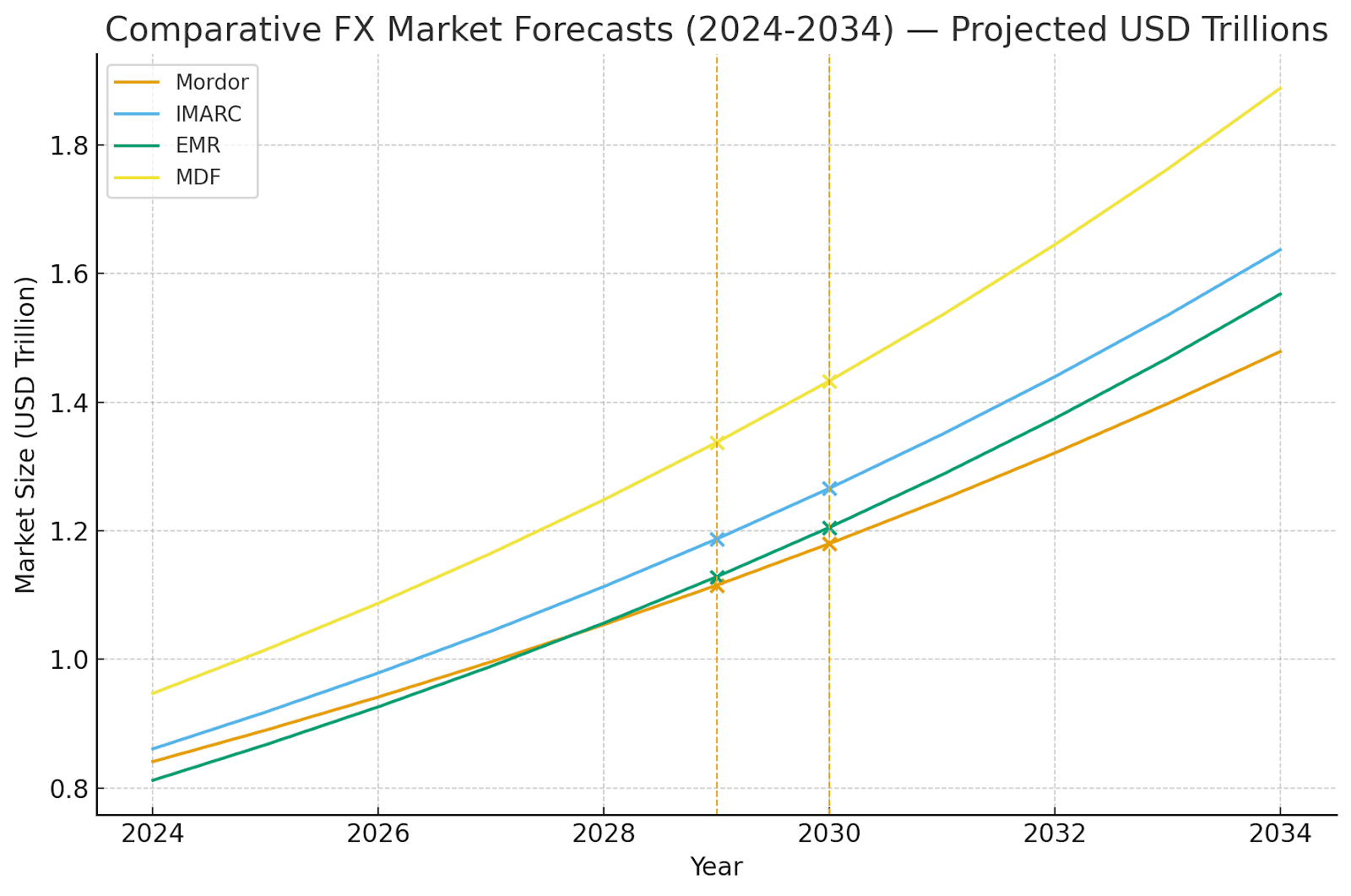
The market is expected to reach approximately USD 1.1–1.4 trillion by 2029–2030, driven by rising digital FX adoption and broader participation in the global financial market2.
This blog will provide in-depth information about forex trading in India, its governance, features, forex trading strategies, and much more.
Unlike stock markets, forex trading operates without a central exchange and is available 24/7.
Forex trading involves trading currencies and offers opportunities to profit from currency rate changes. Its global reach and high liquidity attract many traders, including those in India. Yet, trading money requires understanding the unique aspects, rules, and strategies for forex trading in India.
This blog will provide in-depth information about forex trading in India, its governance and steps and strategies to start forex trading.
What Is Forex Trading?
Buying and selling currencies at an agreed exchange rate is known as forex trading. It helps investors capitalise on exchange rate differences. For instance, traders may buy into USD/INR trading if they anticipate that the USD will appreciate relative to the INR. In contrast, they would sell USD/INR if they expect a fall in USD value.
Forex Trading in India 2026: Timing
Due to time zone variations, the global forex market is open for round-the-clock investing. Forex trading in India operates within a specific time window, as explained below.
| INR Pairs | Trading hours last eight hours, from 9:00 a.m. to 5:00 p.m. |
| Cross-Currency Pairs | Trading sessions last until 7:30 p.m. |
In forex trading, a currency pair is the quotation of two different currencies, with the value of one currency being quoted against the other. For example, in the case of USD/INR trading, the first listed currency (USD) is called the base currency, and the second listed currency (INR) is called the quote currency. In this transaction, USD is purchased, while INR is sold.
Types Of Foreign Exchange Market
Three categories classify the foreign exchange market:
Spot Market: The spot market enables immediate transactions. They involve trading currency pairs at the prevailing rate, often called the spot rate. Traders in this market are protected from the uncertainties of the forex market, which could influence the cost of a deal.
Futures Market: This market is for future transactions. It involves trading currencies in the future with payment and delivery at a pre-agreed rate, called the future rate. The rigidity of these transactions ensures that the terms are fixed. This market is favoured by traders as they conduct large forex transactions and seek a stable return on their investments.
Future contracts are traded on a central exchange. They are recognised for their standardised regulations and liquidity.
Forward Market: The forward market works similarly to the futures market. However, the primary distinction is found in their respective regulatory frameworks. Forward forex markets are illiquid and unregulated. They are not traded on a particular exchange.
Legal and Regulatory Framework of Forex Trading In India 2026
The Foreign Exchange Management Act 1999 primarily governs India's foreign exchange policy, with the RBI serving as the highest authority for approvals and regulation. Forex trading in India must be conducted through authorised individuals under FEMA. Explained below is the regulatory framework in detail.
- The RBI issues forex guidelines for certain banks and financial organisations. These are the authorised dealers. The guidelines enable them to do foreign exchange transactions.
- SEBI is the regulator of the country’s securities market. Its goal is to safeguard investors and ensure market operations are conducted with transparency. It requires forex trading service providers to be registered.
- FEMA forex rules govern all foreign exchange transactions by imposing limits and restrictions. It empowers the central government to regulate international payments.
- SEBI-approved forex brokers are permitted to provide exchange-traded currency derivatives on Indian exchanges, unlike brokers that offer limitless worldwide spot forex.
The RBI forex regulations 2024 limitation, which states that on-exchange rupee currency derivatives can only be used for hedging "contracted exposure" (not speculation), is still in effect. Due to these limitations, a large portion of the speculative and trading liquidity moved overseas, and domestic trade in on-exchange currency derivatives fell. This trend is illustrated in the graph below.
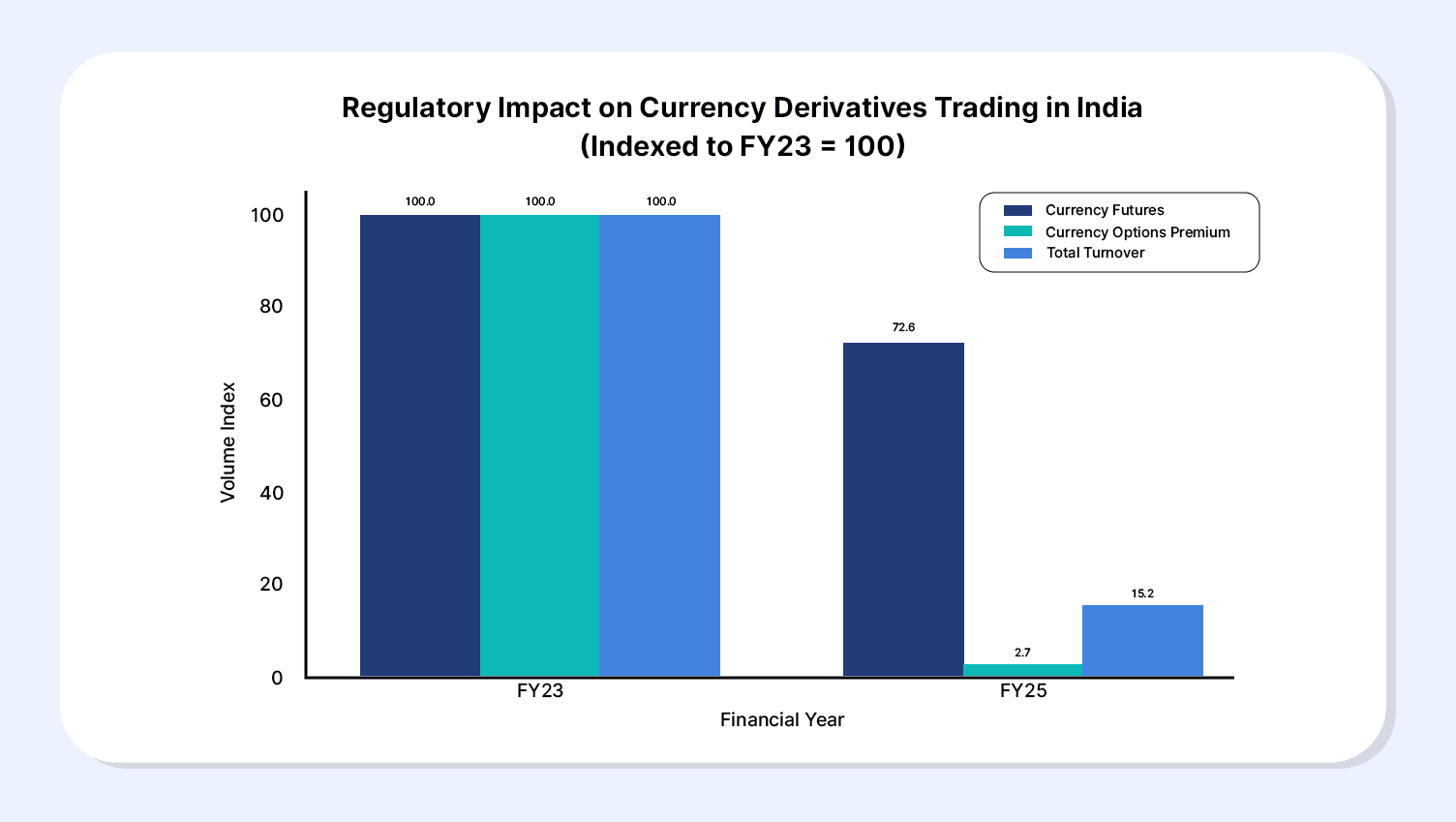
Source: SEBI data reported via Business Standard8, Reuters reporting on volume collapse after RBI circular3
However, in November 2025, speculations emerged that SEBI and RBI are in talks to possibly relax curbs on exchange-traded currency derivatives to revive domestic volume and allow more flexible participation.
Is Forex Trading In India Legal?
Residents can only conduct forex transactions with authorised entities for permitted purposes2. Doing transactions with unauthorised entities or for unpermitted purposes may lead to penalties.
Only authorised brokers on recognised stock exchanges - the National Stock Exchange (NSE), Bombay Stock Exchange (BSE), and Metropolitan Stock Exchange (MSE) - can do forex transactions.
Brokers can only offer trading in four currency pairs with the Indian Rupee (INR): EUR/INR, USD/INR, JPY/INR, and GBP/INR.
Nonetheless, Indians have the option to engage in foreign currency derivatives trading through platforms or brokers that have been approved by SEBI and RBI. They do this via centralised stock exchanges like BSE, NSE, and MSE.
Key Instruments For Indian Forex Traders
Considering the regulatory framework, here are the key instruments for forex trading in India:
Forward Contracts: These contracts are negotiated directly between parties. They lock in exchange rates for future currency delivery.
Forex Derivatives Contracts: These are exchange-traded futures and options contracts. They provide exposure to major currency pairs, like USD/INR and EUR/INR.
The central regulatory restriction introduced by the Reserve Bank of India (RBI) in 2024 — that on-exchange rupee currency derivatives be used only for hedging “contracted exposure” (not speculation) — remains the binding framework for 20254. Because of these restrictions, domestic trading in on-exchange currency derivatives plunged, and much of the speculative / trading liquidity shifted offshore5.
As of November 2025, Securities and Exchange Board of India (SEBI) together with RBI are reportedly in talks to possibly relax curbs on exchange-traded currency derivatives — to revive domestic volume and allow more flexible participation5.
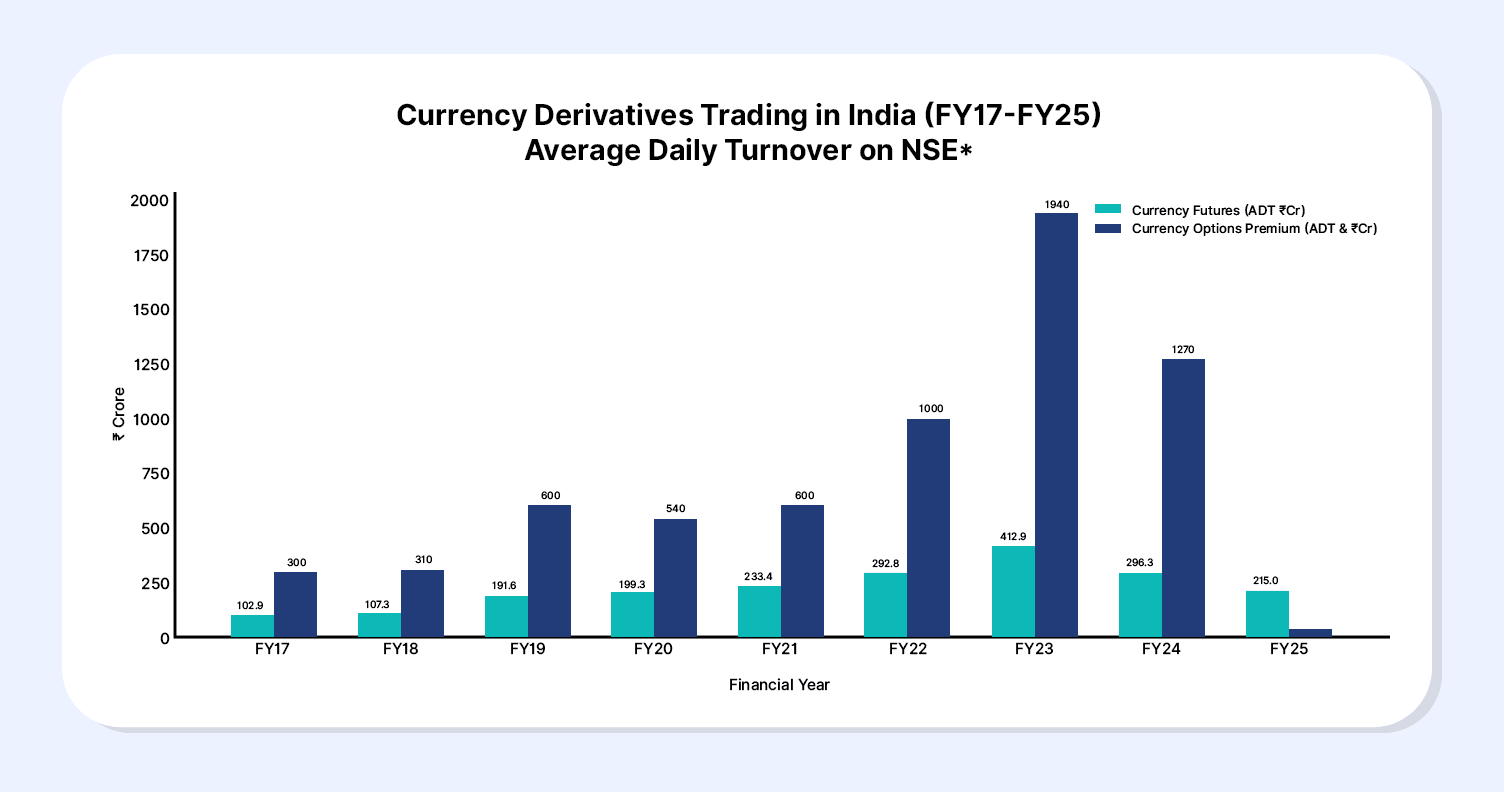
Currency Derivatives in India (FY17 to FY25)6
MCX-SX Currency Options: These are akin to NSE Nifty contracts, but MCX-SX offers options on INR pairs with other major currencies like USD, EUR, GBP, and JPY.
While forex trading offers various instruments for traders, diversifying your portfolio with stable, fixed-income investments can help manage risk and ensure steady returns.
Fixed-income securities like corporate bonds and securitised debt instruments provide a predictable income stream, making them a great complement to forex investments.
Also read: How Grip’s AMO 2.0 Makes 24/7 Investing Easier
Forex Trading In India 2026: Current and Future Outlook
The highlights that are shaping the forex trading in India in 2026 include rupee depreciation and steady expansion in onshore currency derivatives trading. The RBI seems to be permitting greater flexibility in the rupee's trading range, whilst periodically stepping in to control unprecedented market moves. Furthermore, the global uncertainty has also played a key role in shaping investor temperament. Sanjay Malhotra, the RBI Governor, disclosed that forex trading in India doubled in four years, from 32 billion to 60 billion dollars.
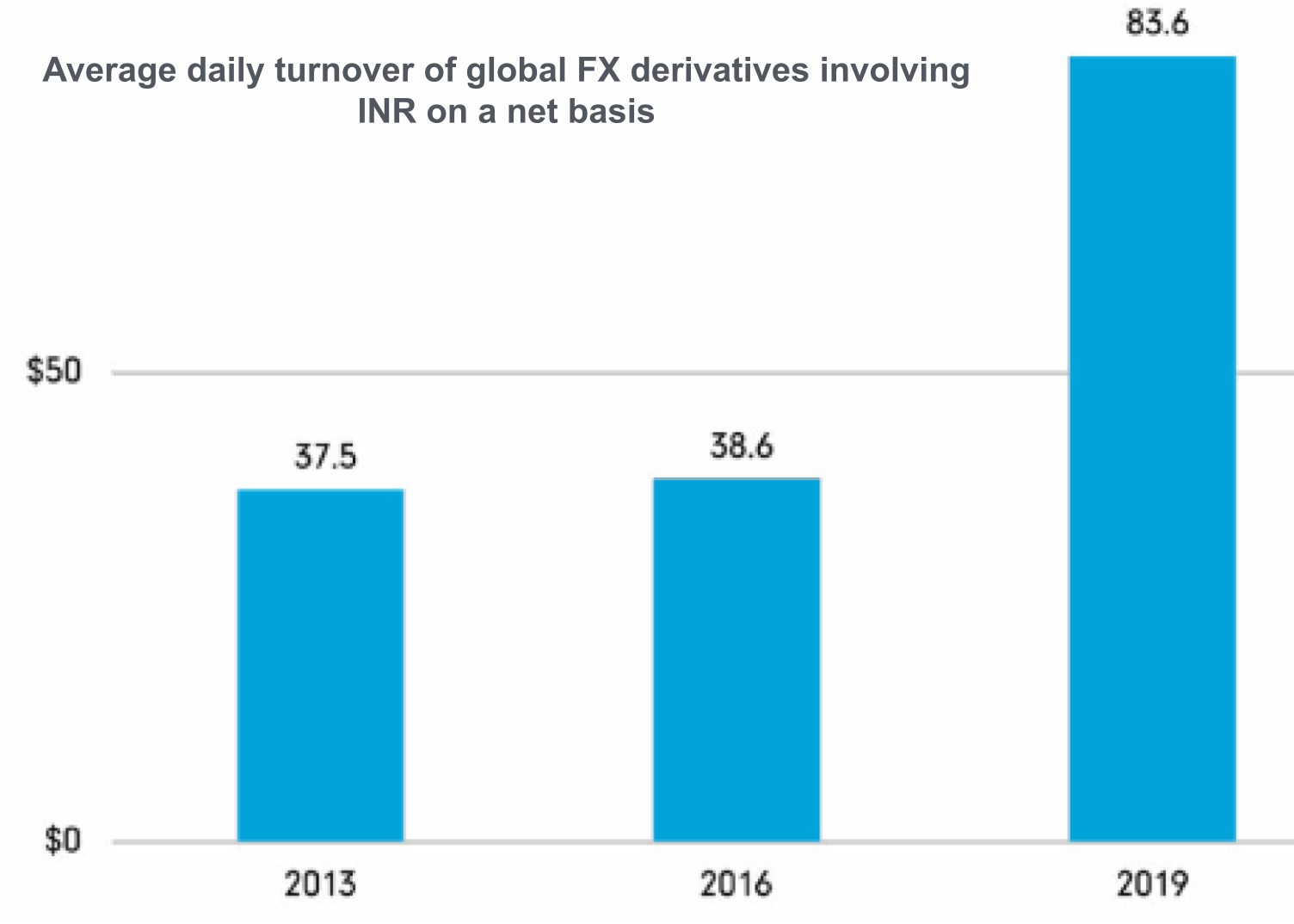
Global trade in INR-denominated forex derivatives expanded dramatically during the last decade. In April 2025, the average daily turnover increased to USD 132.1 billion from USD 37.5 billion in April 2013, indicating an increase in INR-linked hedging and trading activities across worldwide financial hubs. Between 2019 and 2022, turnover was steady, but increased significantly by 57.7% according to an April 2026 publication.
The foreign exchange market was anticipated to be worth USD 0.89 trillion in 2025 and is projected to increase at a compound annual growth rate (CAGR) of 5.37% from USD 0.94 trillion in 2026 to USD 1.22 trillion by 2031. If the depreciation of the rupee continues, traders who bought the USD/INR pair can profit.
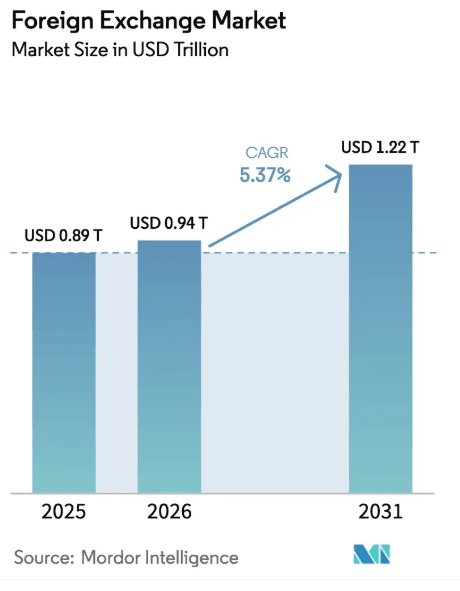
In the forex market, rupee depreciation usually results in an increase in demand for USD and might present trading chances for those who are predicting the direction of the currency.
Six Most Profitable Forex Strategies
There isn't a single strategy for forex trading in India that is always the most profitable in all market circumstances. Market dynamics, volatility, risk management, and trading discipline all affect profitability. Nonetheless, among the most popular tactics employed by profitable forex traders are the following six.
1. Trend trading: Trend trading entails determining the general direction of a currency pair and trading in that direction. Traders purchase in an upswing and sell in a downturn, sometimes utilising moving averages or trendlines to validate the trend. A trend trader may keep purchasing the USD/INR pair if it is continuously increasing until indications of a reversal appear.
2. Breakout trading: This technique focuses on initiating trades when the price breaks above a resistance level or below a support level. Breakouts can mark the beginning of a powerful new trend. Suppose the EUR/USD has fluctuated between 1.08 and 1.10 for weeks. A purchase trade can be triggered by a rise above 1.10. It is usually adopted by investors who want to profit from momentum-driven opportunities.
3. Swing trading: The goal of swing traders is to profit on short- to medium-term price changes that take place within broader trends. Usually, positions are held for a few days or weeks. For example, in an overall uptrend, a trader purchases GBP/USD following a brief decline and sells on the subsequent upswing.
4. Scalping: Under this trading mechanism, traders make many transactions throughout the day in order to profit from small price swings. Investors usually hold these trades for a few minutes or seconds. An example of this trade would be Mr A, who bought and sold USD/JPY several times during a highly liquid trading session to make small profits on each transaction.
5. Range trading: When a currency pair shifts between clearly defined levels of support and resistance, range trading is effective. Near support, traders purchase, and near resistance, they sell. For example, if EUR/GBP consistently fluctuates between two price levels, traders can profit from these repeating moves.
6. Carry trading strategy: A carry trade is when you borrow a currency with a low interest rate and invest in one with a higher return. Here, traders want to profit from the interest rate gap and future currency gain.
These strategies can be adopted along with fundamental and technical analysis. Furthermore, hedging is also crucial for forex risk management.
- Fundamental Analysis: Traders can follow central bank policies and major global events and analyse macroeconomic data. By carefully evaluating these basic factors, traders can predict where currencies will move. Then, they can position themselves for it.
- Technical Analysis: Traders can identify potential trading opportunities by using historical price charts and technical indicators. Technical analysts believe that past prices and trading patterns can offer insight. They find these insights valuable for predicting future markets.
- Hedging: Traders can use forex derivatives to hedge. These include forwards, futures, and options. They help mitigate the risk of unfavourable currency movements. Hedging is often employed by traders to safeguard their financial positions from unexpected fluctuations in exchange rates.
Steps To Start Forex Trading In India
1. Education: Begin by understanding the fundamentals of forex trading through online courses, books, and workshops.
2. Broker Selection: Choose a trustworthy broker regulated by SEBI to ensure regulatory compliance.
3. Trading Account Setup: Register and set up a trading account with a broker of your choice.
4. Practice: Use demo accounts to practise trading without risking actual money.
5. Trading Plan Development: Formulate a trading plan that details the objectives, risk acceptance, and tactics.
6. Start Small: Initiate with modest investments and progressively enhance the exposure based on expertise and self-assurance.
Risks Of Currency Trading
Forex trading, while offering significant profit opportunities, also presents various risks:
- Market Risk: The volatility of currency prices can result in losses.
- Leverage Risk: High leverage can magnify both profits and losses.
- Interest Rate Risk: Interest rate fluctuations can impact currency values.
- Liquidity Risk: Some currency pairs may have lower liquidity, making it difficult to enter or exit positions without significant price changes.
It is essential to comprehend these risks and employ solid risk management strategies, such as stop-loss orders for sustained success.
Forex Vs Corporate Bonds Comparison: Which Is Better For Indian Investors?
The table below highlights the differences between foreign exchange trading and corporate bonds.
Factors | Forex Trading | Corporate Bonds |
Risk | Very High | Low–Moderate |
Capital Stability | No capital protection | High principle safety |
Returns | Market Dependent | Market-dependent Predictable (8–12% p.a.) |
Regulation | Strict (RBI/FEMA) | Regulated by SEBI |
Best For | High-risk investors | Passive investors |
Tax treatment | Complex | Debt-taxation benefits |
Forex Trading comes with significant risks and volatility, but it also helps you benefit from high returns. This has become more prominent after the RBI’s hedging-only policy for rupee derivatives.
On the other hand, corporate bonds offer steady and predictable returns, as well as low regulatory uncertainty. The best way for Indian retail investors to handle this is by prioritising fixed-income securities while also allocating to forex.
Conclusion
In conclusion, forex trading in India offers a big earning potential. Yet, it needs an in-depth understanding of the market. It also needs strict compliance with regulations and disciplined risk management.
Equip yourself with the proper knowledge and tools. Start with basic strategies. Then, move to advanced methods. This way, you can navigate the forex market’s complexities and make informed trades.
To make your portfolio stable and balance the risk of the stock and forex market, you can consider adding fixed-income securities to your portfolio. This will help you stabilise your portfolio’s return. Explore Grip Invest for high-yield fixed-income securities including corporate bonds and securitised debt instruments.
FAQs On Forex Trading In India
 |
Author: Grip Invest Editorial Team The Grip Invest Editorial Team is a group of Chartered Accountants, MBA (Finance) graduates, and Qualified Research Analysts dedicated to helping you invest smarter. We dive deep into India's fixed income landscape to deliver content that is accurate, up-to-date, and easy to understand. Whether you're exploring bonds, fixed deposits, or other fixed income opportunities, our guides cut through the noise and give you the clarity to make better financial decisions. |
Want to stay at the top of your finances?
Join the community of 4 lakh+ investors and learn more about Grip Invest, the latest financial knick-knacks, and shenanigans in the world of investing.
Happy Investing!
Disclaimer - Investments in debt securities/municipal debt securities/securitised debt instruments are subject to risks including delay and/ or default in payment. Read all the offer related documents carefully. The investor is requested to take into consideration all the risk factors before the commencement of trading.
This communication is prepared by Grip Broking Private Limited (bearing SEBI Registration No. INZ000312836 and NSE ID 90319) and/or its affiliate/ group company(ies) (together referred to as “Grip”) and the contents of this disclaimer are applicable to this document and any and all written or oral communication(s) made by Grip or its directors, employees, associates, representatives and agents. This communication does not constitute advice relating to investing or otherwise dealing in securities and is not an offer or solicitation for the purchase or sale of any securities. Grip does not guarantee or assure any return on investments and accepts no liability for consequences of any actions taken based on the information provided. For more details, please visit www.gripinvest.in
Registered Address - 106, II F, New Asiatic Building, H Block, Connaught Place, New Delhi 110001


