

GST On Petrol Can Help Fix Rising Petrol Prices In India 2026!


The rising petrol price in India is a significant concern, but it is not a unique phenomenon limited only to India. As tensions in West Asia and the Middle East grow, fuel prices have been rising in nations across the globe.
In India, the Government had taken steps to limit the impact of this price increase on regular citizens.
However, the long drawn nature of the tensions has made economic pressure hard to ignore or avoid. In such a scenario, GST on petrol can reduce retail fuel price by enabling Input Tax Credit and eliminating the compounding tax-on-tax structure.
This blog decodes the rising petrol price in 2026 to help readers understand the nuisance of this trend and its causes, along with the role GST on petrol is capable of playing.
Petrol Prices In India In 2026: What Is Happening?
The retail petrol price in India fluctuates with the state and does not depend only on crude oil rates. Around 40-55% of the retail price consists of petrol tax in India, like VAT and Excise duty.1 Therefore, the impact of a global crude oil price rise or fall on retail consumers can be controlled by the government through a change in tax rates and duties.
Furthermore, India depends on imports to meet approximately 90% of its crude oil requirements. When the conflict in West Asia and the Middle East grew, the supply chains and oil access of countries were significantly disrupted.2
More than 120 countries witnessed a 40% rise in fuel prices, but pump prices of diesel and petrol in India remained unchanged since May 2022. It is because the Government of India and Oil Marketing Companies (OMCs) absorbed daily losses to maintain retail rates and shield consumers.3 The excise tax on petrol was lowered by the government from INR 13 to INR 3 per litre, while the tax on diesel was made nil from its prior amount of INR 10 per litre.4
However, after nearly 49 months of shielding consumers, petrol and diesel prices saw their first hike on 15 May 2026, when state-owned oil companies like HPCL, BPCL, and others increased rates by INR 3 per litre. Within a few days, a second hike followed on 19 May 2026, with prices rising by another 90 paise per litre.
A third consecutive hike was then announced on 23 May 2026, with petrol and diesel prices being raised by around 87–91 paise per litre, bringing the total increase within just 10 days to nearly INR 5 per litre.
The table below shows the petrol price in different major cities of India as of 26 May 2026
| Cities | Petrol Price (INR per Litre) |
| Ahmedabad | 101.81 |
| Delhi | 102.12 |
| Chennai | 108.01 |
| Bangalore | 110.89 |
| Mumbai | 111.21 |
| Pune | 111.71 |
| Kolkata | 113.51 |
Source: NDTV,6
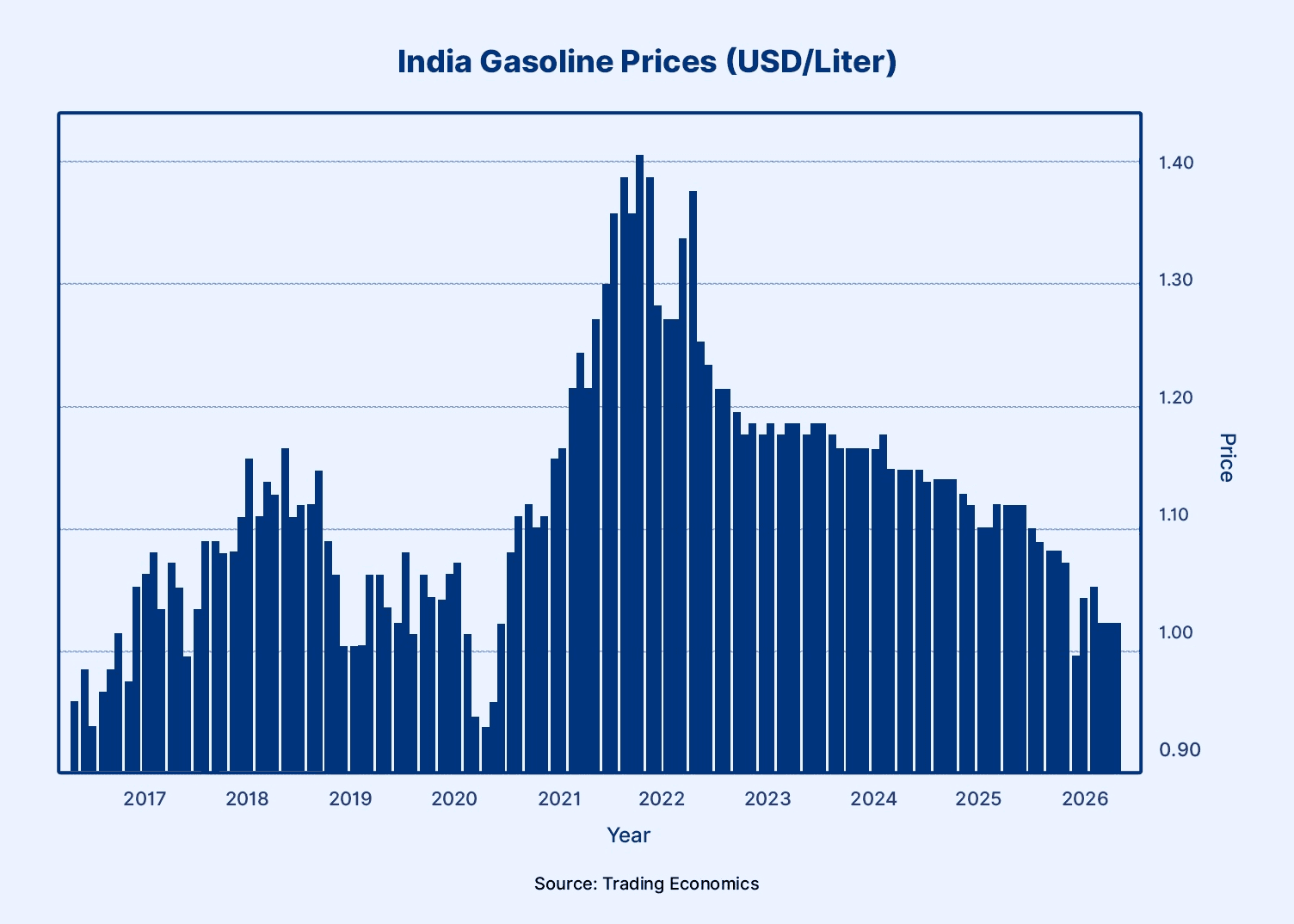
For a more microscopic understanding of why petrol prices are rising, let us take a look at the historical petrol prices in India over a longer period of time.
Also Read: List Of Oil Stocks In India
Historical Petrol Price In India: A Timeline Of Key
Since the 2000s, India's fuel prices have increased gradually, with many notable hike waves brought on by increases in the price of crude oil globally, currency devaluation, and changes in tax laws. Between 2014 and 2018, the prices for several years hovered around INR 65-80, and by 2022, fuel prices had heightened amid the Russia-Ukraine war.7
At this time, the prices varied from INR 95 to INR 110 across states. Later in 2026, global tensions rose, and the conflict between the USA, Israel, and Iran hindered major supply chains and oil networks, resulting in fuel pressure.
Why Are Petrol Prices Rising In 2026?
Before getting into the factors that impact petrol price in India, we must understand the constituents that determine the fuel price. Primarily, the petrol price is based on the cost of base crude, taxes, and the profit margin of the OMCs.
Suppose, if the price of petrol is INR 100, assuming 55% tax and duty levy (like VAT, excise, etc.), the table below shows the approximate composition of the retail price to illustrate how the fuel price is determined.
| Component | Approximate Share |
| Base fuel price | INR 35 |
| Central excise duty | INR 20 |
| State VAT | INR 35 |
| Deal or OMC Margin | INR 10 |
| Retail Price of Petrol | INR 100 |
Therefore, given that duties and taxes account for 40-55% of taxes, they form a major constituent of the retail petrol price. When global or domestic events impact any of these factors, the prevailing petrol price also witnesses a change. Discussed below are the key causes of the 2026 petrol price rise.
- Geopolitical spike in crude oil: As India imports a significant share of its crude oil needs, a rise in global oil prices causes an upward push to domestic rates.
- Delayed passthrough to consumers: The government, along with OMCs, absorbed losses to reduce the global crude price rise's impact on consumers. However, now that buffers are extinguishing, the retail petrol price in India is witnessing a rise, while global rates have remained high for a long time.
- Taxes and duties: The central and state tax rates in India are significant contributors to the retail price. Therefore, on top of high crude costs, these rates increase the retail rate by a significant margin.
- Rupee depreciation: Even if dollar-quoted prices remain consistent, the rupee cost of imported crude increases as the rupee depreciates against the dollar. The rupee has depreciated about 8% against the dollar since January 2026, and on Wednesday, 20 May 2026, it reached an all-time low of 96.90.8
In such a scenario, it is important to introspect on whether GST on petrol can reduce the impending petrol price hike.
How GST On Petrol Could Help?
Bringing petrol under GST might enhance India's petrol price structure by replacing many parallel taxes with a single, transparent rate. Below is a solution-focused analysis of how GST on petrol can help.
1. Lower retail fuel prices: Currently, taxes might reach 40–55% of the retail price of petrol due to excise, VAT, and cess. However, GST is a comprehensive solution with only two tax slabs of 5% and 18%. If petrol and diesel are brought under the GST structure, a significant constituent of the retail price can be trimmed down.
2. Uniform pricing across India: State VAT laws differ greatly under the existing system, resulting in significant differences across metropolitan areas like Delhi and Kolkata. If petrol is subjected to GST with a single, uniform rate, the price difference between states would be significantly reduced, leaving only minor local cesses or surcharges.
3. Transparent tax structure: The existing framework combines national excise, state VAT, cesses, and dealer profits, making it difficult for customers to distinguish between tax and fuel rates. GST improves price visibility of the base fuel price, as a singular, comprehensive GST rate is easier to track.
4. Lower inflation: Transportation and logistics expenses would stabilise more across states with uniform GST-driven petrol prices, minimising regional variations in cost-to-deliver. A fall in transport rates will further reduce fuel costs.
5. Business cost reduction: Manufacturing and aviation businesses that have significant fuel costs may get relief through GST on petrol. This can result in a reduced price of their products and services, increasing business potential. Furthermore, businesses that use petrol or diesel can claim input tax credit.
6. Consumer spending relief: Shift to GST can reduce the cost consumers have to bear for petrol and diesel needs. This frees up their disposable income, which translates into higher real private consumption.
However, petrol under GST can have both pros and cons.
Pros And Cons Of Bringing Petrol Under GST
Although there are significant financial and political trade offs for both the central government and state governments, bringing petrol under the GST may theoretically reduce costs and streamline India's fuel tax structure.
A brief, fair summary of the key advantages and disadvantages is provided here.
| Pros | Cons |
| It can reduce the retail petrol price at the pump. | It will cause significant revenue loss for central and state governments. |
| Uniformity of fuel taxes across states can make compliance easier. | Deciding on a uniform tax rate would require heavy negotiations between the central and state governments. Tax rate acceptable to one state might not be acceptable to another. |
| Being a two-slab uniform structure, GST can improve transparency regarding the real cost of fuel. | GST on petrol will require a major overhaul of existing invoicing, dealer-level compliance, etc. |
| Businesses that use petrol or diesel can claim input tax credit. | The state autonomy of fuel prices might diminish, which can be adverse for states that heavily rely on fuel revenue. |
| Lower fuel prices can reduce inflationary pressure. | The transition phase might cause short-term volatility. |
Conclusion
Petrol prices in India in 2026 are rising due to a combination of global crude oil pressure, rupee depreciation, sustained geopolitical tensions in West Asia, and the gradual unwinding of the government's price-shielding measures. While taxes and duties continue to form 40–55% of the retail price, structural reforms like bringing petrol under GST could offer long-term relief to consumers by simplifying the tax framework and reducing the overall burden.
As fuel costs ripple across transportation, logistics, and everyday expenses, the impact on inflation and household budgets is hard to ignore. In such an environment, building a diversified investment portfolio becomes critical to protect your purchasing power and grow wealth steadily.
Explore fixed-income investment opportunities on Grip Invest offering up to 12.5% YTM to hedge against inflation and keep your financial goals on track.
FAQs On Petrol Price Hike
 |
Author: Grip Invest Editorial Team The Grip Invest Editorial Team is a group of Chartered Accountants, MBA (Finance) graduates, and Qualified Research Analysts dedicated to helping you invest smarter. We dive deep into India's fixed income landscape to deliver content that is accurate, up-to-date, and easy to understand. Whether you're exploring bonds, fixed deposits, or other fixed income opportunities, our guides cut through the noise and give you the clarity to make better financial decisions. |
Want to stay at the top of your finances?
Join the community of 4 lakh+ investors and learn more about Grip Invest, the latest financial knick-knacks, and shenanigans in the world of investing.
Happy Investing!
Disclaimer - Investments in debt securities/municipal debt securities/securitised debt instruments are subject to risks including delay and/ or default in payment. Read all the offer related documents carefully. The investor is requested to take into consideration all the risk factors before the commencement of trading.
This communication is prepared by Grip Broking Private Limited (bearing SEBI Registration No. INZ000312836 and NSE ID 90319) and/or its affiliate/ group company(ies) (together referred to as “Grip”) and the contents of this disclaimer are applicable to this document and any and all written or oral communication(s) made by Grip or its directors, employees, associates, representatives and agents. This communication does not constitute advice relating to investing or otherwise dealing in securities and is not an offer or solicitation for the purchase or sale of any securities. Grip does not guarantee or assure any return on investments and accepts no liability for consequences of any actions taken based on the information provided. For more details, please visit www.gripinvest.in
Registered Address - 106, II F, New Asiatic Building, H Block, Connaught Place, New Delhi 110001


