

IBC Amendment Act 2026: What The New Bankruptcy Changes Mean For Investors


Introduction: Why The IBC Framework Matters For Lenders And Investors
A critical aspect of the country's overall economic activity depends on the smooth functioning of both the organized and unorganized sectors.
To ensure that the mutual trust between the transacting parties is never compromised, the government has introduced a wide range of frameworks to protect different stakeholders.
One such regulation, introduced in 2016 as the Insolvency and Bankruptcy Code (IBC), helped shift the system from a borrower-in-control model to a creditor-driven resolution model. The recent amendments to the code (Insolvency and Bankruptcy Code Amendment Act 2026) aim to protect lenders and investors, including those in fixed-income securities such as corporate bonds.
Some of the most critical areas covered by the latest amendment include addressing structural inefficiencies such as prolonged timelines, procedural delays, and value leakage.
What Is The IBC Amendment Act 2026?
The recent bankruptcy code changes under the IBC Amendment Act can be regarded as the latest overhaul in the country’s insolvency framework. The core structure of the code does not change, and the amendment aims at addressing implementation gaps observed over the past decade.
One of the key focus areas here is the NCLT admission timeline under the IBC, which has been delayed, slowing the resolution process.
As per the latest amendment in the code, there is a mandate for quicker decisions, which is further supported by strong reliance on information utility records.
Another important development is the introduction of the creditor-initiated insolvency resolution framework, also referred to as the CIIRP insolvency process, which allows faster, out-of-court restructuring with majority creditor approval.
Key Changes In The New Amendment
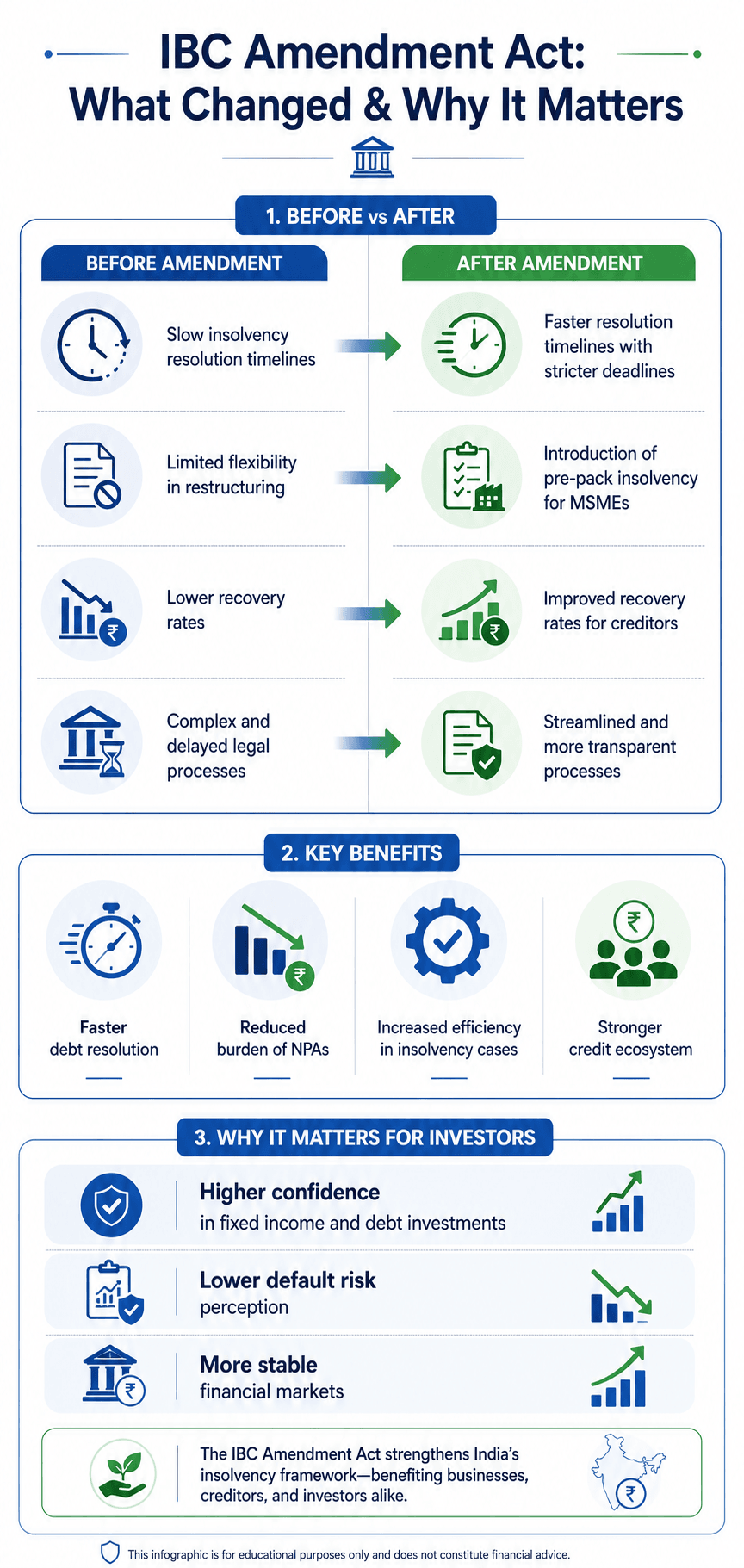
There are multiple IBC 2026 key changes, but most of them focus on improving efficiency, strengthening creditor control, and enhancing recovery outcomes. Here are the most important ones:
1. Faster Admission and Resolution Timelines
The amendment calls for stricter timelines for admitting cases and requiring decisions within 14 days when debt and default are established.
This strengthens discipline around the NCLT admission timeline IBC and reduces delays that often lead to value erosion.
2. Introduction of Creditor-Led Resolution (CIIRP)
One of the most important reforms in the code will be the introduction of CIIRP, a creditor-driven mechanism that allows resolution outside the traditional CIRP route. As per the model, creditors having majority approval can request the initiation of the restructuring process while the company continues to operate under supervision.
This change is critical because the code now aligns with global trends in creditor initiated insolvency resolution frameworks.
3. Strengthening Creditor Rights
The amendment also further enhances creditor rights India as there is clarity on voting thresholds and in the decision-making process within the CoC (Committee of Creditors). It also refines the treatment of dissenting creditors, ensuring fair minimum payouts.
4. Changes to the IBC Liquidation Process
Some of the important IBC liquidation process changes include tighter timelines (around 180 days with limited and conditional extension) along with clearer distribution priorities. Importantly, it limits the treatment of statutory dues as secured claims, thereby improving clarity of recovery for financial creditors.
5. Enabling Cross-Border and Group Insolvency Frameworks
The amendment lays the foundation for a cross-border insolvency IBC regime and a group insolvency framework India, something which was missing and was constantly demanded by the stakeholders.
This will be a major step in enabling coordinated resolution for companies with global operations.
6. Strengthened Enforcement and Penalties
The compliance is expected to be stricter, and IBC penalties 2026 will be broader to deter value diversion and fraudulent transactions.
How It Affects Investors
The Insolvency and Bankruptcy Code Amendment Act 2026 has a direct impact on a wide category of investors across asset classes. Here is how:
- Impact on Bondholders
The visibility for bondholders shall improve significantly with faster admission and resolution timelines. Bondholders have experienced reduced recoveries, leading to asset deterioration in the past. The IBC amendment 2026 aims to minimize this risk.
- Impact on Listed Companies
For equity shareholders in a distressed company, the proposed quicker resolution will help reduce uncertainty and improve price discovery and market sentiment.
- Effect on Recovery Value
The IBC liquidation process changes, along with stronger creditor rights India, can improve recovery outcomes. In addition, the provisions related to guarantor assets and avoidance transactions will help in expanding the recovery pool.
It is, however, important to note that the key changes will help strengthen the framework, but the actual recovery items shall depend on factors such as asset quality, sector conditions, and execution effectiveness.
Why It Matters For Fixed Income Investors
For fixed-income investors, these amendments will help in better credit risk assessment. With the insolvency framework strengthening, the probability of timely, higher recoveries (in the event of default) will increase.
However, any improvement in the regulatory framework does not eliminate the need to conduct fundamental analysis, assess collateral quality, and account for sector dynamics. The bankruptcy code changes reinforce the need for disciplined investing, where legal safeguards complement strong credit selection.
Conclusion
The IBC Amendment Act 2026 marks an important shift in how financial stress and corporate defaults may be handled in India. By strengthening creditor rights, tightening timelines, and introducing more flexible resolution mechanisms, the amendment aims to improve recovery outcomes and reduce long delays that often hurt investor confidence.
For fixed income investors, these changes could make credit risk assessment more transparent by creating a stronger legal framework around recoveries. While better regulations cannot remove investment risk entirely, they can make the overall investment environment more predictable.
At Grip Invest, we believe that stronger insolvency frameworks can help investors make fixed income decisions with greater clarity and confidence.
FAQs On IBC Amendment Act 2026
 |
Author: Grip Invest Editorial Team The Grip Invest Editorial Team is a group of Chartered Accountants, MBA (Finance) graduates, and Qualified Research Analysts dedicated to helping you invest smarter. We dive deep into India's fixed income landscape to deliver content that is accurate, up-to-date, and easy to understand. Whether you're exploring bonds, fixed deposits, or other fixed income opportunities, our guides cut through the noise and give you the clarity to make better financial decisions. |
Want to stay at the top of your finances?
Join the community of 4 lakh+ investors and learn more about Grip Invest, the latest financial knick-knacks, and shenanigans in the world of investing.
Happy Investing!
Disclaimer - Investments in debt securities/municipal debt securities/securitised debt instruments are subject to risks including delay and/ or default in payment. Read all the offer related documents carefully. The investor is requested to take into consideration all the risk factors before the commencement of trading.
This communication is prepared by Grip Broking Private Limited (bearing SEBI Registration No. INZ000312836 and NSE ID 90319) and/or its affiliate/ group company(ies) (together referred to as “Grip”) and the contents of this disclaimer are applicable to this document and any and all written or oral communication(s) made by Grip or its directors, employees, associates, representatives and agents. This communication does not constitute advice relating to investing or otherwise dealing in securities and is not an offer or solicitation for the purchase or sale of any securities. Grip does not guarantee or assure any return on investments and accepts no liability for consequences of any actions taken based on the information provided. For more details, please visit www.gripinvest.in
Registered Address - 106, II F, New Asiatic Building, H Block, Connaught Place, New Delhi 110001


