

ITR 1 vs ITR 4: Difference, Eligibility And Which Form To Choose


You can rest assured that filing an income tax return on time will keep you compliant and give you the opportunity to claim the refund of your contributions. However, many individual taxpayers in India are often confused when comparing simpler versions of a typical form, the comparison of ITR 1 vs. ITR 4 is one of the most confusing.
Most commonly, the majority of confusion between the two forms is between salaried persons and self-employed persons as they file their income tax returns.
Understanding ITR 1 vs ITR 4
The ITR-1 vs. ITR-4 primarily depends on the source of your income and how you earn your living. The ITR-1 (Sahaj) is the simplest ITR to file for an individual with a basic type of income. The ITR-4 (Sugam) form is designed specifically for the self-employed and/or small businesses based on their income and the method of calculating taxes. The two different forms serve a different group of the taxpayer's categories amongst the different ITR forms that can be compared to each other.
One form of choosing which ITR is relative to your income source, you will efficiently process your income tax return and reduce the possibility of being audited by the tax department. This guide on filing ITRs will help you determine which ITR form is most beneficial for you.
What Is ITR 1?
ITR-1 (Sahaj) is for residents who provide them with basic sources of income. This is appropriate for salaried individuals, pensioners, or persons with basic income sources only.
ITR 1 eligibility includes:
- Income of INR 50 lakh or less, including:
- Salary or pension
- Two (2) houses
- Other sources (interest, dividends, etc.)
- Up to INR 5,000 agricultural
- Long-term capital gains (LTCG) of up to INR 1,25,000 under section 112A
You will not be able to file an ITR-1 if you are a director of a company, have foreign assets or income, own unlisted shares, or need to carry forward losses. You will not be eligible to file an ITR-1 if you are a non-resident and/or if your income includes business income.
Hypothetical Example:
Sunil is a government employee with a salary of INR 12 lakh and rental income from one (1) flat of INR 2 lakh. He does not have any business income and will be able to file an ITR-1 without any issues.
What Is ITR 4?
ITR-4, called Sugam, is a simplified tax return for small taxpayers. It is designed for individuals, Hindu Undivided Families (HUFs), and partnership firms (but not LLPs) that have presumptive business income.
You qualify to use ITR 4 if your total income does not exceed INR 50,00,000 and any one of the following conditions is met.
Your total income comes from either:
1. Presumptive Business Income from business or profession under section 44AD, 44ADA, or 44AE,
2. Salary or pension,
3. House property,
4. Other sources of income or agricultural income totalling less than INR 5,000.
If your total income is more than the first condition (the limit), you have foreign source income or assets (or are a company director), you aren't eligible to file using ITR 4.
Hypothetical Example:
Priya's business is a small beauty parlour which has a total revenue of INR 60,00,000. She has decided to use presumptive taxation and has declared 50% of such revenue as her income. Therefore, she is permitted to file under ITR-4 without keeping complete and accurate records.
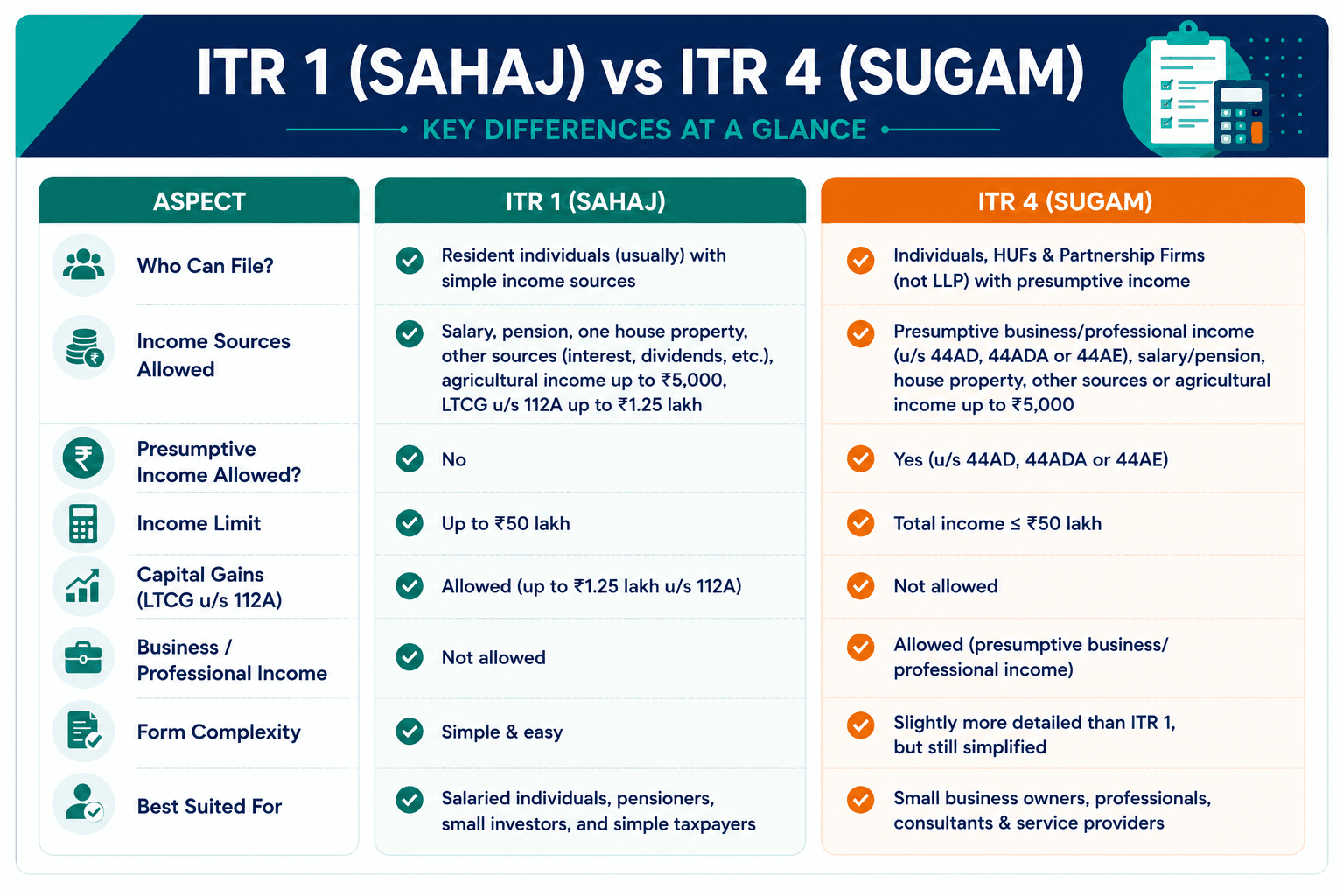
ITR 1 vs ITR 4: Key Differences
ITR forms comparison indicates that:
| Feature | ITR-1 | ITR-4 |
| Eligible taxpayer | Resident individual only | Individual, HUF, or Firm |
| Business income | Not allowed | Presumptive business income allowed |
| House property | Up to 2 house properties | Up to 2 house properties |
| Filing difficulty | Easier to file | Slightly more complicated |
| Main use case | Simple salaried or pension income cases | Business/profession cases under presumptive taxation |
Who Should File ITR 1?
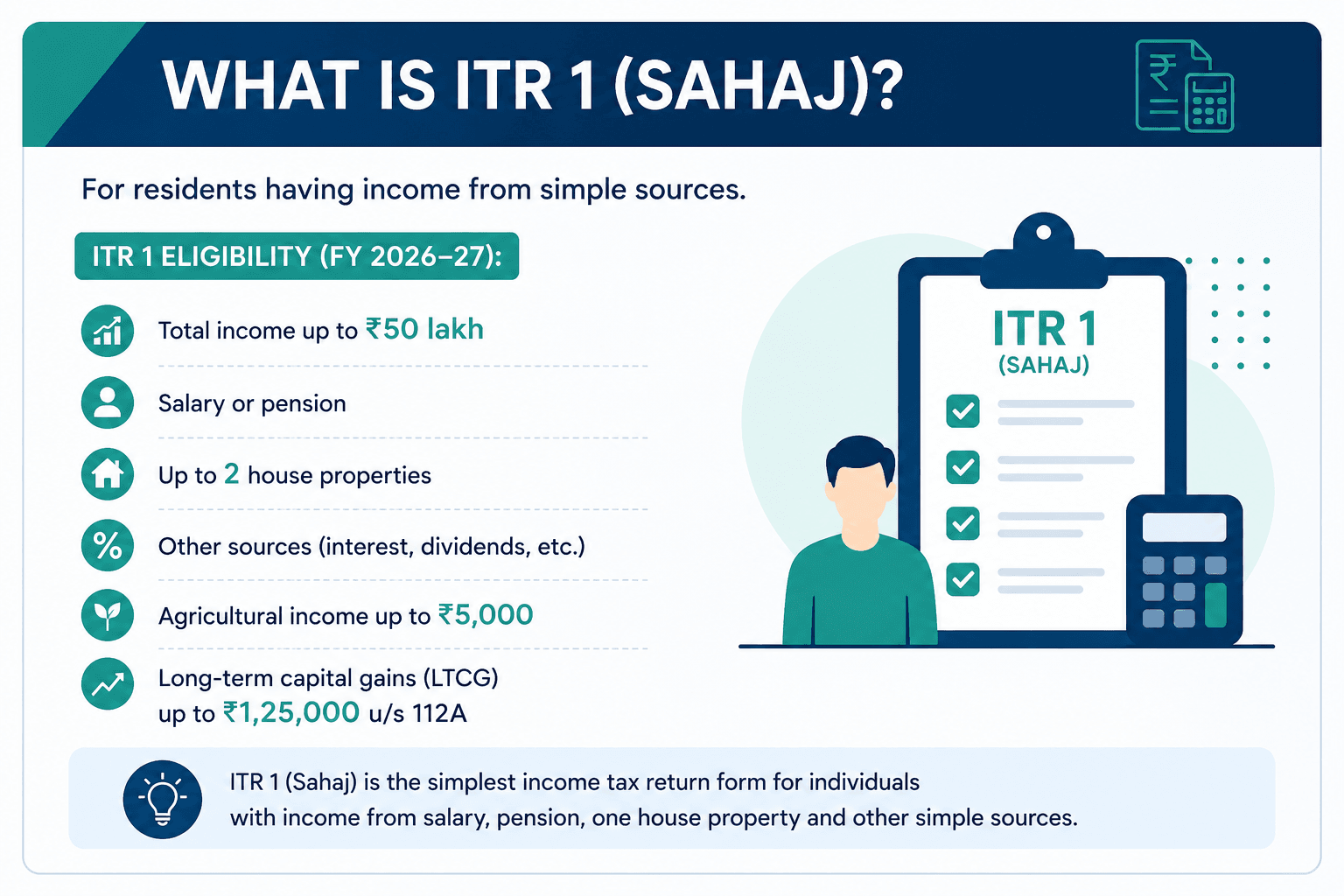
ITR-1 is suitable for resident individuals with relatively simple income sources and total income up to INR 50 lakh. It is generally the right form for salaried employees, pensioners, and senior citizens who earn income from salary, one house property, interest, or other basic sources.
You can also use ITR-1 if your income is straightforward and you do not have business income, capital gains beyond the permitted limit, foreign assets, or complicated investment holdings.
Who Should File ITR 4?
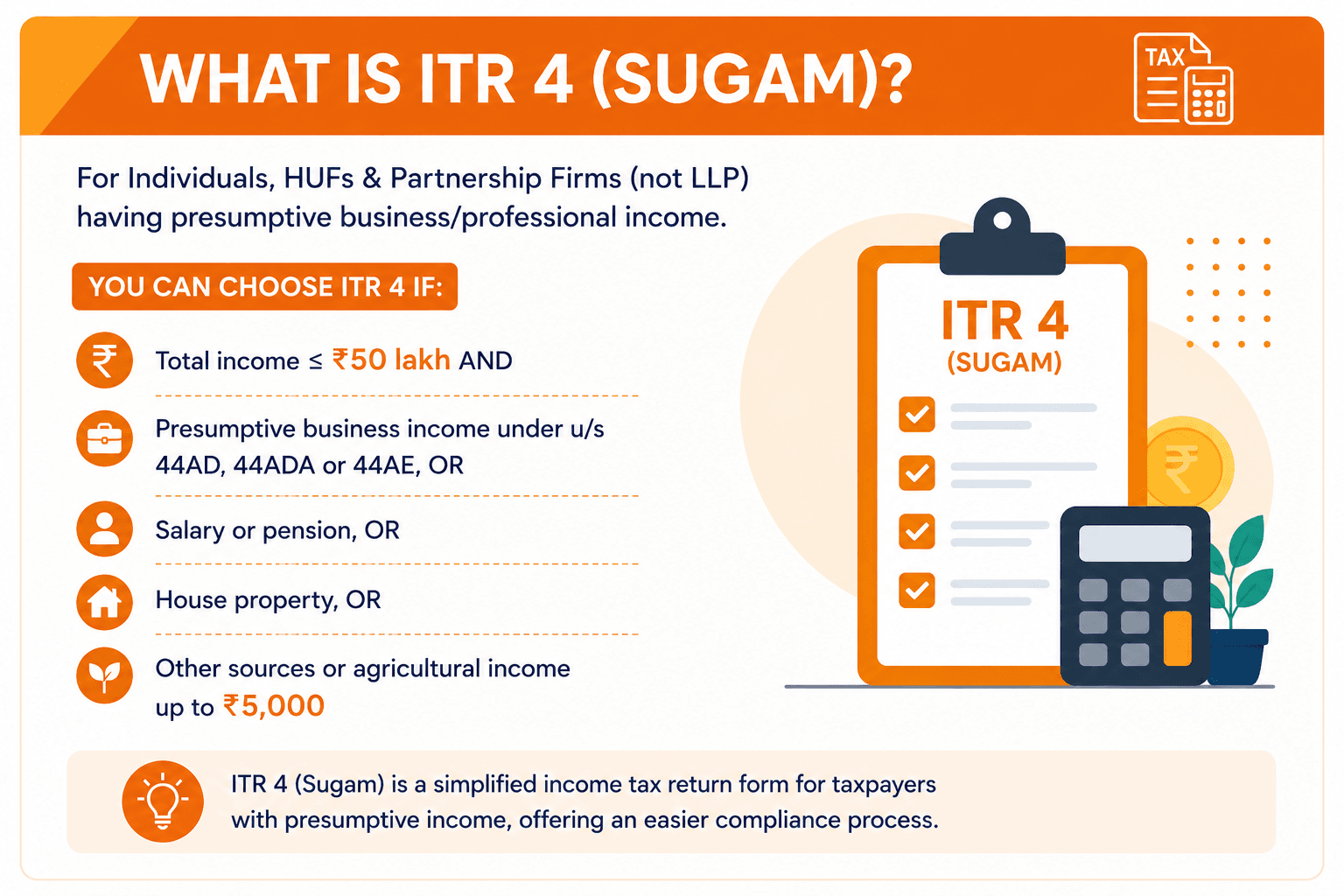
ITR-4 is meant for resident individuals, HUFs, and eligible firms that opt for the presumptive taxation scheme and have total income up to INR 50 lakh. It is commonly used by small business owners, professionals, shopkeepers, freelancers, consultants, and transporters whose income is declared under sections such as 44AD, 44ADA, or 44AE.
This form is useful if you want a simplified filing process and do not maintain detailed books of account under the presumptive scheme.
Common Mistakes While Filing ITR
Mistakes when filing income tax can occur because of oversight.
- These errors commonly occur for salaried individuals who have an additional source of income but select the wrong form (e.g., ITR-1).
- Many people also miss the upper limit on taxable income or have other reasons for being rejected by the IRS.
- Make sure you check to see whether you have foreign assets or are a director, and verify your actual turnover before completing your return.
- You should also double-check Form 26AS and Form AIS and then file your income tax return before the deadline, as interest and penalties can apply to late filings.
Additional Tips For Smooth Filing
Use the official E-Filing Website or reliable apps for your e-filing. Gather all of your documents prior to filing: PAN, Aadhaar, Form 16, bank statements, and proof of investment (if applicable). If you have any questions about verification, use an Aadhaar OTP. Review your already automatically populated data carefully. If you still have a question regarding filing, contact a tax professional for assistance.
Conclusion
When choosing between ITR 1 and 4 forms, consider your income sources and profession. If you have a simple salary, you will typically choose to file under the ITR 1 form. This is true for most salaried individuals. However, in addition to their salary, if you are a small business owner, then you typically file under the ITR 4 form.
To help your overall tax experience, utilizing the ITR filing guide for your particular ITR form will offer you the knowledge needed to successfully file on time and accurately. Always keep an eye on what is changing in the tax year and make sure that if you need to ask for help from a professional, you do so.
FAQs On ITR 1 vs ITR 4 Forms
 |
Author: Grip Invest Editorial Team The Grip Invest Editorial Team is a group of Chartered Accountants, MBA (Finance) graduates, and Qualified Research Analysts dedicated to helping you invest smarter. We dive deep into India's fixed income landscape to deliver content that is accurate, up-to-date, and easy to understand. Whether you're exploring bonds, fixed deposits, or other fixed income opportunities, our guides cut through the noise and give you the clarity to make better financial decisions. |
Want to stay at the top of your finances?
Join the community of 4 lakh+ investors and learn more about Grip Invest, the latest financial knick-knacks, and shenanigans in the world of investing.
Happy Investing!
Disclaimer - Investments in debt securities/municipal debt securities/securitised debt instruments are subject to risks including delay and/ or default in payment. Read all the offer related documents carefully. The investor is requested to take into consideration all the risk factors before the commencement of trading.
This communication is prepared by Grip Broking Private Limited (bearing SEBI Registration No. INZ000312836 and NSE ID 90319) and/or its affiliate/ group company(ies) (together referred to as “Grip”) and the contents of this disclaimer are applicable to this document and any and all written or oral communication(s) made by Grip or its directors, employees, associates, representatives and agents. This communication does not constitute advice relating to investing or otherwise dealing in securities and is not an offer or solicitation for the purchase or sale of any securities. Grip does not guarantee or assure any return on investments and accepts no liability for consequences of any actions taken based on the information provided. For more details, please visit www.gripinvest.in
Registered Address - 106, II F, New Asiatic Building, H Block, Connaught Place, New Delhi 110001


