

Jim Cramer Lessons For Investors: What To Learn (And Avoid) From His Investing Style


Jim Cramer creates a sharp divide among investors in terms of his high-energy style as an investor. Most investors either look at his bold calls as a game-changer or look down on his TV antics as a risky distraction in an increasingly complex market.
Every night, his show has the reach of millions shaping their opinions on stock prices. However, studies show that the lagging market returns from his TV tip-off's often fall well short of market performance.
Who Is Jim Cramer
Since 2005, Jim Cramer has hosted a talk show called “Mad Money” on the CNBC television network. During his show, Jim Cramer uses theatrics and props in delivery of stock advice, often laughing, hollering, and jumping from set to set while explaining his recommendations.
Jim Cramer was born in 1955, raised in Pennsylvania and graduated from Harvard. He began his career working at Goldman Sachs. He subsequently created a hedge fund that had a good track record. It outperformed the market in difficult years, such as the stock market crash of 1987 and the tech market bust of 2000.
Cramer averaged exceptionally high annual returns until he left the hedge fund world and took on a full time media career. Cramer currently co-hosts a radio show called Squawk on the Street. Cramer Wall Street lessons highlight what he has learned from his own experience about timing and perseverance.
Key Investment Strategies Jim Cramer Advocates
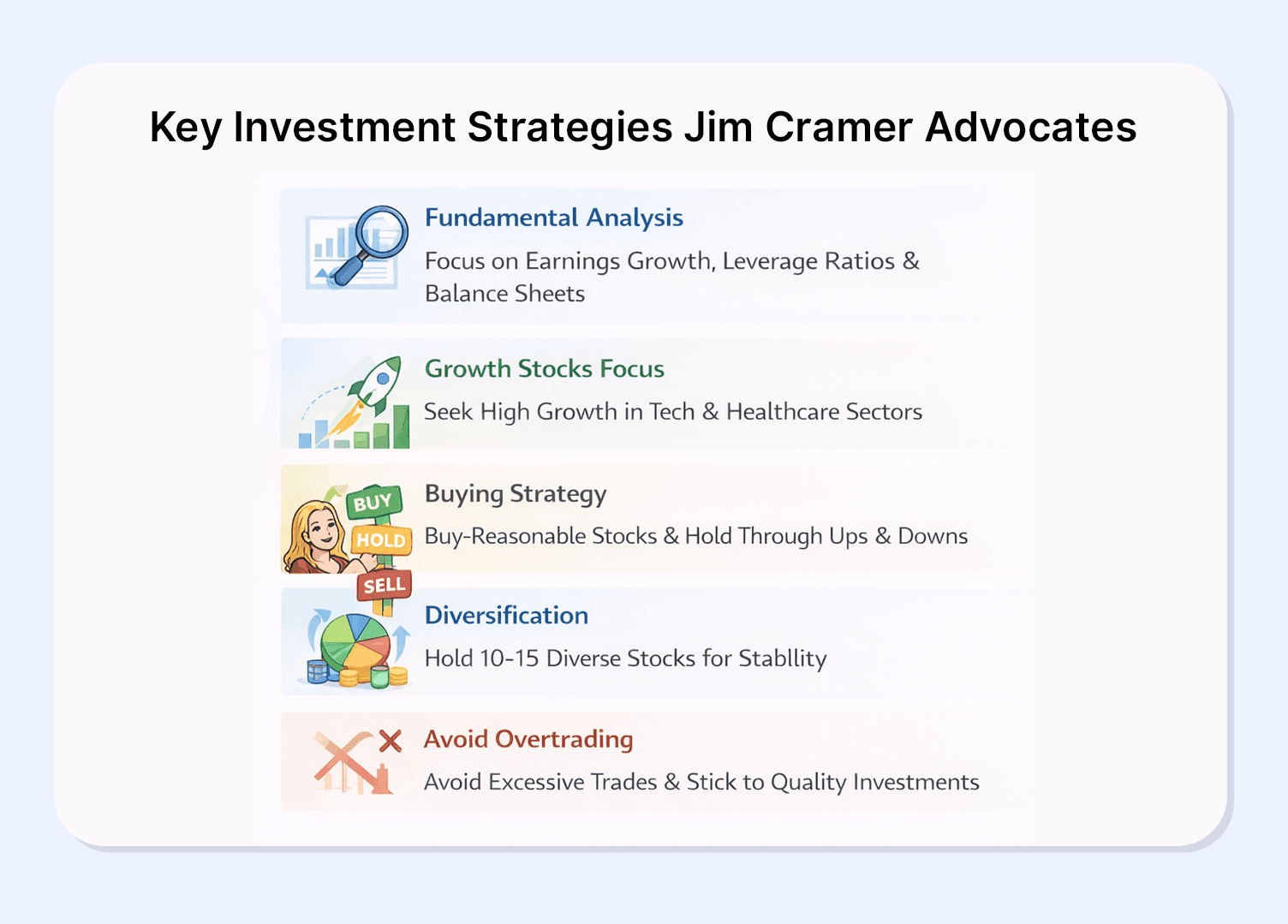
Jim Cramer investing strategy is mostly based on the idea of acquiring excellent companies at reasonable valuations.
- This includes analyzing core fundamentals, such as earnings growth and leverage ratios. This process does not believe in overhyped stocks but always relies upon having strong balance sheets.
- Cramer growth stock strategy gives greater weight to companies with high growth rates in the technology and healthcare industries.
- He has also created investment guidelines called "the Cramer method" (like holding a minimum of 10-15 stocks is critical) and believes that while some companies can go out before others fall.
- The "buy-sell-hold" segments of the Jim Cramer Mad Money tips encourage individuals to act quickly in response to catalysts. As an example, Sarah hears about Cramer's recommendation based on strong retail sales and makes a purchase. She rides through dips, and ultimately has a gain of 25% over the course of six months.
- And lastly, he has always avoided overtrading at all costs.
Investment Lessons From Jim Cramer: Example In Action
Sarah (follows Jim Cramer beginner investing strategy) saw Jim Cramer on TV and did her research based on Cramer's method (earnings beats, insider buys, etc.). After seeing his recommendation on a retailer ( $50), she purchased and held it for six months. After a 10% drop through 8% stop loss, she sold at $62 with 24% capital gains.
Compare this to Tom (Jim Cramer follower), he also buys and sells stock with no research and follows the momentum he sees on television. After purchasing a biotech that had recently been hyped by Cramer, he learned the hard way that following a false lead in the form of Cramer, he too can lose.
He went through a (30%) crash after a trial failure and learned about market timing by verifying the catalysts. Both Sarah and Tom experienced how blending lessons from Cramer mistakes with due diligence makes a complete package. Active traders are best suited for experienced traders, whereas the inexperienced need to exercise patience.
Famous Wins And Notable Misses
Jim Cramer stock picks blossomed before the Bear Stearns crash occurred.
- The last S/P of 2009 was just before the time he released the "Hold" on Apple and Amazon stocks. After receiving "Buy" ratings, followers turned $10,000 into $1 million.
- However, he's gotten things wrong as well. In 2020, Jim didn't see Tesla coming and missed a 700% return on investment when it was rated at a "Sell."
- He also made several weekly "Sell" ratings for financial stocks during the crash of 2008. From 2005-2022, Jim Cramer's stock picks outperformed the S/P 500 index 47% of the time, according to historical data.
Jim Cramer 2025 lessons are to avoid buying stocks in declining sectors. For example, old energy companies are not worth investing in. The three major advantages of investing in successful companies are patience.
What Investors Can Learn From Jim Cramer
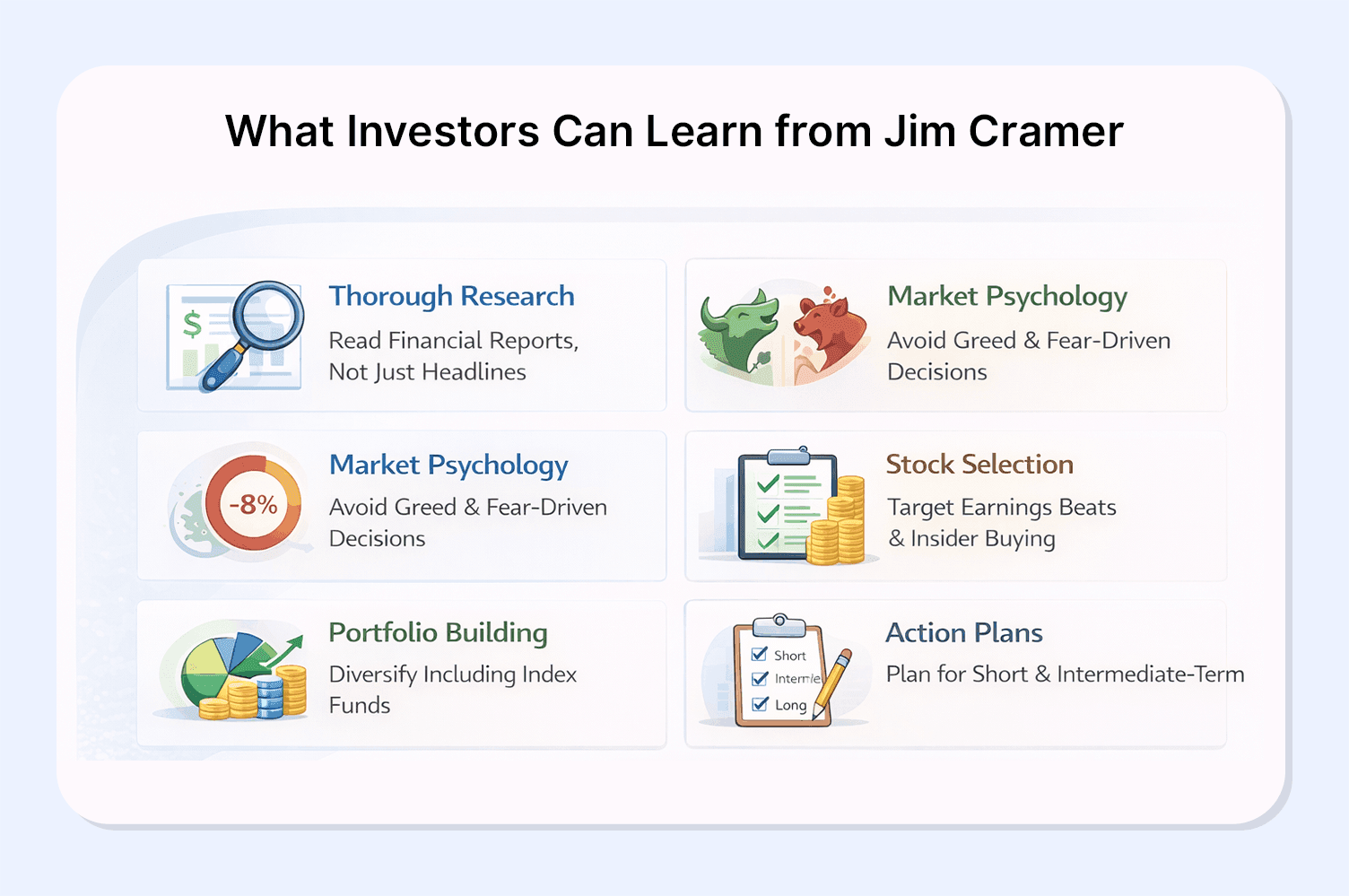
Jim Cramer teaches people to conduct thorough research before investing in anything. By reading financial statements instead of focusing on headlines, investors can identify true value and cut through the pretentious claims made by many on Wall Street.
The Cramer method of selecting stocks explains the psychology of the market. Investors buy and sell stocks, based on the fear created by the media. When greedy, investors buy stocks at inflated prices. According to Jim Cramer investment rules, risk management should consist of having stop-loss orders set at -8% on your position, or else be prepared to take a loss.
For beginners in investing, Jim Cramer offers a very simple method of finding stocks, which is to:
- Look for companies that have good earnings beats and insiders are buying the stock.
- In addition to this fundamental Cramer stock selection method process, he has provided investors with basic guidelines on putting together a portfolio. His basic idea of portfolio building, which includes investing in index funds, is the foundation of his approach to investing in a portfolio.
- His more active style is built upon short to intermediate-term price movements. He stresses the need for investors to have action plans and to manage risk according to their own style of investing.
Common Pitfalls To Avoid
Retail investors tend to purchase the same stocks as Cramer. This is because of fast-paced assessment without conducting proper due diligence and research. This can lead to substantial losses if trends reverse. These retail investors fail to base their decisions on their own investment goals.
The use of television as a reference, when not considering an individual's personal risk tolerance, can also lead to poor results in the stock market. Cramer's method, although very beneficial for professional investors, does not always work for individual investors.
Therefore, a balance of information from Jim Cramer with the wisdom of long-term investing should always be maintained.
FAQs
1. Is Jim Cramer a good investor to follow?
Jim Cramer (aka “Mad Money”) can help educate you with his set. However, the picks should still be verified directly by you. On average, Cramer has an equal amount of success and failure in his portfolio.
2. Should retail investors copy TV stock tips?
As such, retail investors should only consider Cramer’s stock recommendations as ideas, not copies. Investors should perform due diligence on the actual stock to avoid getting trapped by short-term timeframes due to a TV show or stock tip.
3. Can beginners use Jim Cramer’s investing strategy safely?
Beginners can learn basic investing concepts from Jim Cramer, such as research discipline and risk control, but should avoid frequent trading and always align decisions with their own risk tolerance.
4. Do Jim Cramer stock picks work for long-term investing?
Some of Jim Cramer’s stock picks have performed well long term, especially in strong growth companies, but his approach is better used for idea generation rather than as a complete long-term strategy.
References:
1. MSN, accessed from: https://www.msn.com/en-us/money/markets/jim-cramer-s-lessons-for-investing-in-any-market/ar-AA1SRosT?ocid=finance-verthp-feeds
2. CNBC, accessed from: https://www.cnbc.com/2025/12/29/jim-cramers-guide-to-investing-sectors-to-avoid-when-looking-for-long-term-gains.html
Want to stay at the top of your finances?
Join the community of 4 lakh+ investors and learn more about Grip Invest, the latest financial knick-knacks, and shenanigans in the world of investing.
Happy Investing!
Disclaimer - Investments in debt securities are subject to risks. Read all the offer-related documents carefully. The investor is requested to take into consideration all the risk factors before the commencement of trading. This communication is prepared by Grip Broking Private Limited (bearing SEBI Registration No. INZ000312836 and NSE ID 90319) and/or its affiliate/ group company(ies) (together referred to as “Grip Invest”) and the contents of this disclaimer are applicable to this document and any and all written or oral communication(s) made by Grip Invest or its directors, employees, associates, representatives and agents. This communication does not constitute advice relating to investing or otherwise dealing in securities and is not an offer or solicitation for the purchase or sale of any securities. Grip Invest does not guarantee or assure any return on investments and accepts no liability for the consequences of any actions taken based on the information provided. For more details, please visit https://www.gripinvest.in/.
Registered Address - 106, II F, New Asiatic Building, H Block, Connaught Place, New Delhi 110001.


