

Multi Asset Fund Taxation: How Are Multi Asset Mutual Funds Taxed In India?


Have you ever invested in a multi asset mutual fund thinking it would simplify your investments, only to realize that understanding its taxation is anything but simple?
You're not alone.
Many investors focus on returns, diversification, and risk management while overlooking one crucial factor taxation. Yet, the taxes you pay can significantly impact your actual wealth over time. The twist? Multi asset fund taxation doesn't follow a single rule. Instead, it depends on how the fund allocates its investments across equity, debt, gold, and other asset classes.1
If you've ever wondered why two seemingly similar funds are taxed differently, this guide will answer all your questions in simple language.
Why Is Multi Asset Fund Taxation So Confusing?
Unlike pure equity or debt mutual funds, multi asset funds invest in multiple asset classes. A typical portfolio may include:
- Equities
- Debt instruments
- Gold or precious metals
- REITs or InvITs
- Cash equivalents
The tax treatment depends largely on how much of the portfolio is invested in equity. This means two multi-asset funds can generate similar returns but attract different tax liabilities simply because of their asset allocation.2
Understanding this distinction helps investors avoid unpleasant surprises during redemption.
How Are Multi Asset Funds Taxed?
Let's break down the taxation of multi asset funds into simple categories.
1. Equity-Oriented Multi Asset Funds
If a multi asset fund maintains the required equity exposure under prevailing tax regulations, it may qualify as an equity-oriented mutual fund.
In such cases:
- Short-term capital gains (STCG) apply if units are sold within the prescribed holding period.
- Long-term capital gains (LTCG) apply after the qualifying holding period.
- Tax rates follow the rules applicable to equity mutual funds.3
2. Non-Equity-Oriented Multi Asset Funds
If the equity allocation remains below the required threshold, the fund is generally treated as a non-equity mutual fund for taxation purposes.
Here, capital gains on multi asset funds are taxed according to the prevailing rules for non-equity funds.
This often results in a different tax treatment compared to equity-oriented funds.
Tax Treatment Based On Different Asset Allocations
Fund Type | Primary Allocation | Tax Treatment |
Equity-Oriented Multi Asset Fund | Higher equity exposure | Equity mutual fund taxation rules |
| Non-Equity Multi Asset Fund | Higher debt, gold or other assets | Non-equity mutual fund taxation rules
|
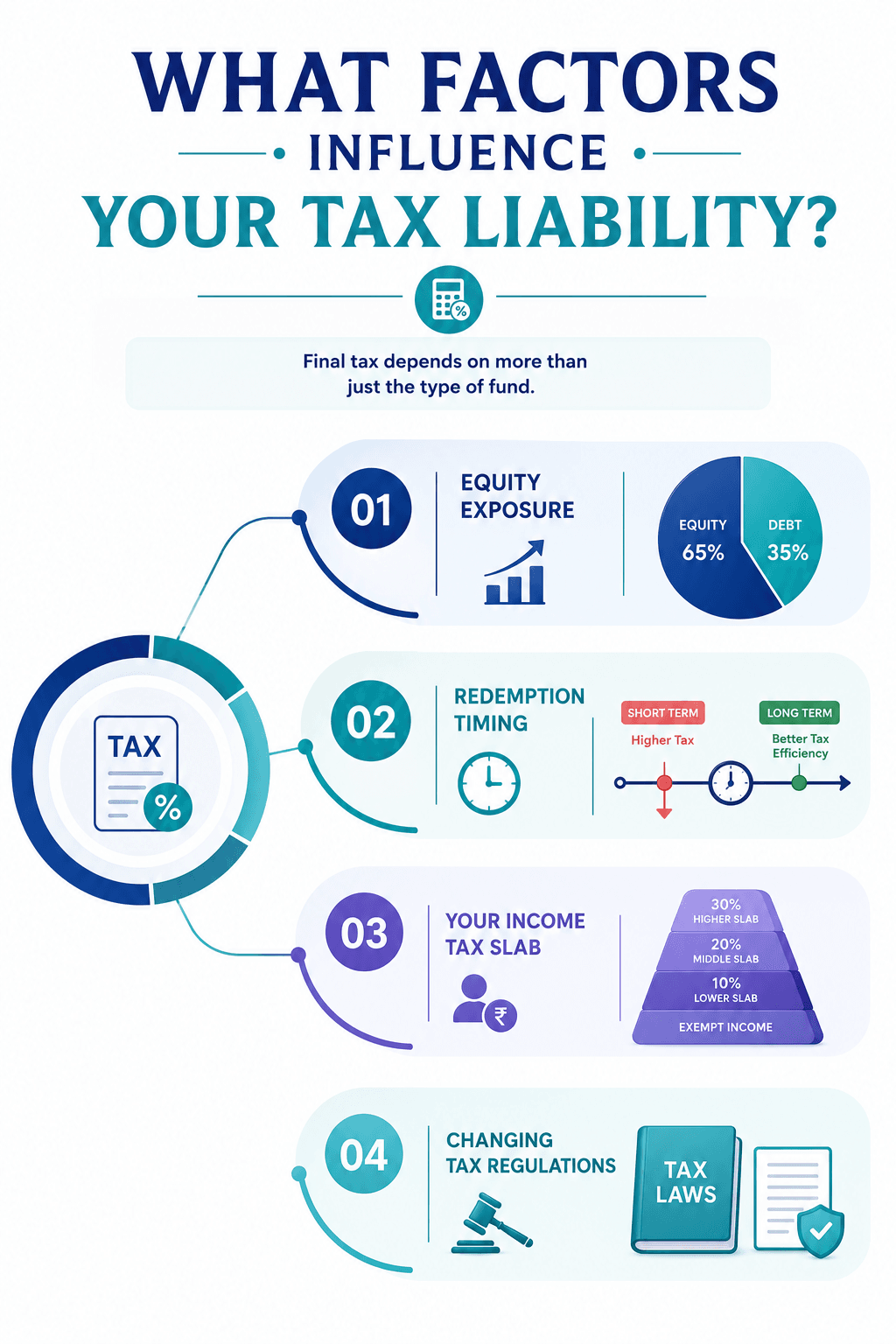
What Factors Influence Your Tax Liability?
Understanding multi asset mutual fund tax isn't only about the type of fund. Several factors affect the final amount you pay.
1. Equity Exposure
This is the biggest deciding factor.
Even a small difference in equity allocation can change how your investment is taxed.
2. Redemption Timing
Selling your investment too early may attract short-term capital gains tax.
Holding investments for longer periods may provide better tax efficiency depending on the applicable regulations.
Timing, therefore, becomes an important part of investment planning.4
3. Your Income Tax Slab
While capital gains have separate taxation rules, certain types of income from mutual funds such as IDCW (Income Distribution cum Capital Withdrawal) may have tax implications depending on your overall income and applicable provisions.
Investors should understand how these distributions affect their total taxable income.
4. Changing Tax Regulations
Tax laws evolve over time.
Government amendments may change holding periods, capital gains taxation, or other provisions affecting mutual fund investors.
Before redeeming your investments, it's always wise to review the latest tax rules.
Common Tax Planning Mistakes Investors Should Avoid
Many investors unknowingly reduce their post-tax returns by making avoidable mistakes.
1. Ignoring the Holding Period
Selling investments without checking whether they qualify for long-term taxation can increase your tax liability.
2. Assuming All Multi Asset Funds Are Taxed the Same
This is perhaps the biggest misconception.
Two funds with similar names can have completely different tax treatments because their asset allocations differ.5
3. Redeeming Without Calculating Tax Impact
Investors often focus on profits without estimating the taxes payable.
A quick tax calculation before redemption can help you plan withdrawals more efficiently.
4. Choosing IDCW Without Understanding Taxation
Many investors select IDCW because it offers periodic payouts.
However, understanding how these distributions are taxed is essential before making a decision.
Tax Planning Checklist Before Redeeming Your Multi Asset Fund
Before you redeem your investment, ask yourself:
Does my fund qualify as equity-oriented?
How long have I held the investment?
What will be my estimated capital gains?
Will redemption increase my taxable income?
Would waiting a little longer improve tax efficiency?
A simple checklist like this can help investors make more informed financial decisions.
Looking Beyond Tax Efficiency
While multi asset fund taxation is an important consideration, it should never be the only reason to choose an investment.
A good multi asset fund should also provide:
- Diversification across asset classes
- Better risk management
- Alignment with your financial goals
- A suitable investment horizon
- Stable long-term wealth creation
Investors looking to diversify beyond mutual funds may also consider fixed-income investment options such as Corporate Bonds and Corporate Fixed Deposits (FDs) available through investment platforms like Grip Invest, depending on their financial objectives.
Remember, minimizing taxes is beneficial but building a balanced portfolio is even more important.
FAQs On Multi Asset Fund Taxation
 |
Author: Grip Invest Editorial Team The Grip Invest Editorial Team is a group of Chartered Accountants, MBA (Finance) graduates, and Qualified Research Analysts dedicated to helping you invest smarter. We dive deep into India's fixed income landscape to deliver content that is accurate, up-to-date, and easy to understand. Whether you're exploring bonds, fixed deposits, or other fixed income opportunities, our guides cut through the noise and give you the clarity to make better financial decisions. |
Want to stay at the top of your finances?
Join the community of 4 lakh+ investors and learn more about Grip Invest, the latest financial knick-knacks, and shenanigans in the world of investing.
Happy Investing!
Disclaimer - Investments in debt securities/municipal debt securities/securitised debt instruments are subject to risks including delay and/ or default in payment. Read all the offer related documents carefully. The investor is requested to take into consideration all the risk factors before the commencement of trading.
This communication is prepared by Grip Broking Private Limited (bearing SEBI Registration No. INZ000312836 and NSE ID 90319) and/or its affiliate/ group company(ies) (together referred to as “Grip”) and the contents of this disclaimer are applicable to this document and any and all written or oral communication(s) made by Grip or its directors, employees, associates, representatives and agents. This communication does not constitute advice relating to investing or otherwise dealing in securities and is not an offer or solicitation for the purchase or sale of any securities. Grip does not guarantee or assure any return on investments and accepts no liability for consequences of any actions taken based on the information provided. For more details, please visit www.gripinvest.in
Registered Address - 106, II F, New Asiatic Building, H Block, Connaught Place, New Delhi 110001


