

Mutual Fund Expense Ratio: What It Means And How It Impacts


Many people invest in mutual funds, and they check past performance, star ratings, or future growth. They often miss one hidden cost in mutual funds, and that is the mutual fund expense ratio. This small cost looks harmless at first, but it slowly reduces your earnings over time.
The mutual fund expense ratio is the fee that the fund house charges to manage your money. It pays for management and administration, as well as distribution. Even a small percentage makes a big difference over many years.
Read on to know how this cost affects your wealth and how you can avoid extra hidden charges in mutual funds.
What Is The Expense Ratio In Mutual Funds?
The mutual fund expense ratio is the yearly cost that an investor pays to the fund house. It is shown as a percentage of the total money that the fund manages. This cost covers three main parts. One is the management fee that pays the fund managers. The second is the administrative cost that runs the day-to-day operations. The third is the distribution cost that goes to agents and marketing.
There is also a clear difference between the direct and regular plan expense ratios. In a regular plan, the investor pays a higher cost because agents and distributors get a commission. In a direct plan, the investor invests directly with the fund house, so the cost is lower. This is why many investors prefer direct plans as they keep more of their returns.
Also Read: What Are Flexi Cap Mutual Funds?
Impact Of Mutual Fund Expense Ratio On Returns
The mutual fund expense ratio may look very small, but over time, it makes a big difference to your wealth. Each year, the fee reduces a part of your return. This means less money stays invested, and the power of compounding becomes weaker.
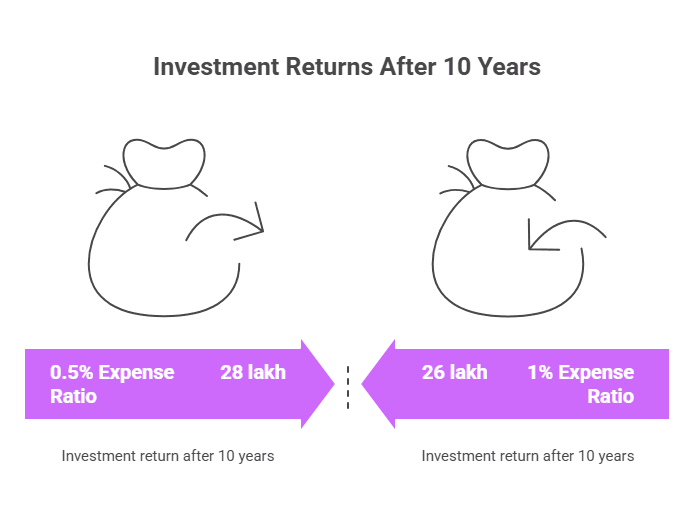
How the expense ratio affects your returns
- A high expense ratio takes away more money every year. Over ten or twenty years, this small cut grows into a large gap in your total wealth.
- A low expense ratio lets your investment work harder. More of your money stays in the fund and grows with compounding.
- For example, if you invest ten lakh rupees for ten years and the fund earns a 10 per cent yearly return, then the result will differ with costs. With a 1 per cent expense ratio, you may end up with about twenty-six lakh. With a 0.5 per cent expense ratio, you may end up with about twenty-eight lakh. That small half per cent saved almost two lakh in returns.
How To Choose Funds With Reasonable Expense Ratios
The mutual fund expense ratio differs across types of funds. Some funds charge more, and some charge less. You can improve your returns when you choose funds with a fair cost.
1. Index funds And ETFs
Index funds and ETFs often have the lowest index fund expense ratios in India. This is because they do not need active fund managers. They simply track the market index. As a result, they have fewer costs, and you get to keep more of your returns.
2. Comparing Across Categories
Different types of mutual funds have different cost levels. Active equity funds are usually higher. Debt funds are lower. Index funds and ETFs are the lowest. When you compare funds, always check the cost along with returns.
| Type of Fund | Average Expense Ratio in India |
| Active Equity Funds | 1.0% - 1.5% |
| Debt Mutual Funds | 0.5% - 1.0% |
| Index funds | 0.1% - 0.5% |
| ETFs | 0.05% - 0.3% |
In India, SEBI rules set the maximum expense that fund houses can charge. Still, the actual figure changes from one fund to another. Before you invest, always check the fact sheet on the AMC website or on portals like AMFI NSE, BSE, etc.
This shows the latest cost and makes it easy to compare across options. By doing this, you can find the lowest expense ratio mutual funds in India that match your goals.
4. Diversification Into Low-Cost Alternatives
The mutual fund expense ratio is one of the costs that matters. You can cut your total cost by adding other types of investments to your portfolio, too. This brings balance and helps you build wealth with lower risk.
5. Bonds And SDIs As Transparent, Low-Cost Options
Bonds and SDIs are easy to understand , no confusing jargon or hidden costs. You know your interest rate right from the start and exactly how much you’ll get at maturity. That’s what makes them transparent and dependable. They are a smart pick if you are looking for steady income with low risk.
And the best part? Platforms like Grip Invest make it simple to access these opportunities, helping you balance growth from mutual funds with the safety of fixed-income options, without the extra costs.
Conclusion
The mutual fund expense ratio may seem small, but over time it can significantly affect your returns. By understanding how it works, you can select better-performing funds and avoid unnecessary hidden costs. Keeping a close eye on expense ratios is key to building a stronger, more efficient portfolio.
Explore cost-efficient alternatives with Grip Invest – India’s one-stop destination for fixed-income investments.
FAQs on Mutual Fund Expense Ratio
1. What is a good expense ratio for mutual funds?
A good expense ratio depends on the fund type. In India, index funds and ETFs usually stay below 0.5 per cent. For active equity funds, anything below 1 per cent is seen as reasonable and cost-efficient.
2. Do direct funds always have lower expense ratios?
Yes, direct funds usually have lower expense ratios because they do not pay distributor commissions. You invest directly with the fund house, so the cost is less. This helps you keep more of your returns over time.
3. How does SEBI regulate expense ratios?
SEBI sets clear rules in India that limit how much fund houses can charge as expenses. The limits vary by fund size and category. These rules protect investors and fund houses, which are, henceforth, not able to charge unfairly high fees.
4. Can high-expense-ratio funds still perform well?
Some funds with a high expense ratio can still do well. This happens if the manager gives strong returns. However, the cost always cuts into your profit. Hence, it is safer to check if the extra fee is worth paying.
Want to stay at the top of your finances?
Join the community of 4 lakh+ investors and learn more about Grip Invest, the latest financial knick-knacks, and shenanigans in the world of investing.
Happy Investing!
Disclaimer - Investments in debt securities/municipal debt securities/securitised debt instruments are subject to risks, including delay and/ or default in payment. Read all the offer-related documents carefully. The investor is requested to take into consideration all the risk factors before the commencement of trading.
This communication is prepared by Grip Broking Private Limited (bearing SEBI Registration No. INZ000312836 and NSE ID 90319) and/or its affiliate/ group company(ies) (together referred to as “Grip”) and the contents of this disclaimer are applicable to this document and any and all written or oral communication(s) made by Grip or its directors, employees, associates, representatives and agents. This communication does not constitute advice relating to investing or otherwise dealing in securities and is not an offer or solicitation for the purchase or sale of any securities. Grip does not guarantee or assure any return on investments and accepts no liability for the consequences of any actions taken based on the information provided. For more details, please visit www.gripinvest.in
Registered Address - 106, II F, New Asiatic Building, H Block, Connaught Place, New Delhi 110001


