

Perpetual Bonds Taxation in India: Interest, Capital Gains And TDS



An 8% coupon on a bond may look attractive. But what if the return you actually keep after tax is significantly lower?
That is the question investors should ask before looking only at the coupon rate of a perpetual bond.
Perpetual bonds are debt instruments without a fixed maturity date. Unlike conventional bonds, they may remain outstanding indefinitely, subject to the terms of the issue. Certain banks also issue perpetual debt instruments such as Additional Tier 1 (AT1) bonds as part of their capital structure.
For investors, the tax calculation has an essential twist: the coupon you receive and the gain or loss you make when selling the bond are two different tax events.
So, how does perpetual bonds taxation work in India in the year 2026? What happens to the interest? When does capital gains tax apply? And does TDS automatically mean that your tax liability is settled?
Let us break it down.
How Are Perpetual Bonds Taxed In India?
Think of your perpetual bond investment as having two tax buckets and these are-
Bucket 1: Coupon or interest income
This is the income you receive while holding the bond. For example, if you invest INR 1 lakh in a bond carrying an 8% coupon, the annual coupon works out to INR 8,000, subject to the terms of the instrument.1
Bucket 2: Capital gain or loss
Now imagine you bought that bond for INR 1 lakh but later on you sold it for INR 1.10 lakh. The INR 10,000 difference is a potential capital gain, subject to applicable tax provisions.
These two amounts should not simply be added together and taxed as one type of income.
The actual tax treatment can vary depending on the nature of the security, its listing status, the investor's circumstances and the financial year involved.
The takeaway? Do not judge a perpetual bond's return by its coupon rate alone. The tax treatment can materially affect what you finally take home.
Tax On Interest From Perpetual Bonds
The coupon is often the first number investors notice.
An 8%, 9% or 10% coupon can look attractive when compared with other fixed-income opportunities. But the important number is not just “How much does the bond pay?” It is “How much do I retain after tax?”
Let us take a simple example.
Suppose you purchase a perpetual bond with a value of INR 1,00,000 and an annual coupon of 8%.
Annual coupon = INR 1,00,000 × 8% = INR 8,000
That INR 8,000 represents the coupon income generated by the investment. The applicable tax treatment then needs to be considered based on the security and the investor's circumstances.
This distinction matters because the coupon rate and post-tax return are not the same thing.
Investors should therefore check the issue documents, interest terms and applicable tax provisions rather than assuming that every perpetual bond will receive exactly the same tax treatment.
In simple words: the coupon tells you what the bond pays; taxation determines how much of it you keep.
Perpetual Bond TDS Rules
Here is another point that can confuse investors: TDS is not necessarily the same as your final tax liability.
Where the applicable conditions for TDS on interest are met, tax may be deducted by the payer. The exact provision and rate depend on the nature of the security, recipient and applicable financial year.
This is why investors should avoid applying one universal TDS rate to every perpetual bond.
Lets understand this with an example- the Income Tax Department provides separate provisions relating to interest on specified securities and certain listed securities. The relevant section should therefore be checked for the particular instrument.
What happens after TDS is deducted?
The amount deducted can generally be taken into account while filing the income-tax return, subject to it being correctly reflected in the taxpayer's tax records.
Therefore, investors should reconcile the TDS shown in their tax records with the interest actually received before filing the ITR.
Tax On Capital Gains From Selling Perpetual Bonds
Now comes the part investors often overlook.
What happens if you don't hold the perpetual bond forever and decide to sell it?
Suppose you:
- Buy the bond for INR 1,00,000
- Receive INR 8,000 as coupon
- Later sell it for INR 1,12,000
Your return has two components:
Coupon income = INR 8,000
Capital gain = INR 12,000
These are separate components of your investment return and need to be considered separately for tax purposes.
The tax treatment of the capital gain can depend on factors such as the security's listing status and the applicable provisions.
For transfers on or after 23 July 2024, the Income Tax Department states that long-term capital gains on listed bonds/debentures are generally subject to a 12.5% rate without indexation. Certain unlisted bonds and debentures can fall under Section 50AA and may be treated as short-term capital assets irrespective of the holding period.
This makes one thing clear: you cannot calculate capital gains tax correctly without first identifying exactly what security you own.
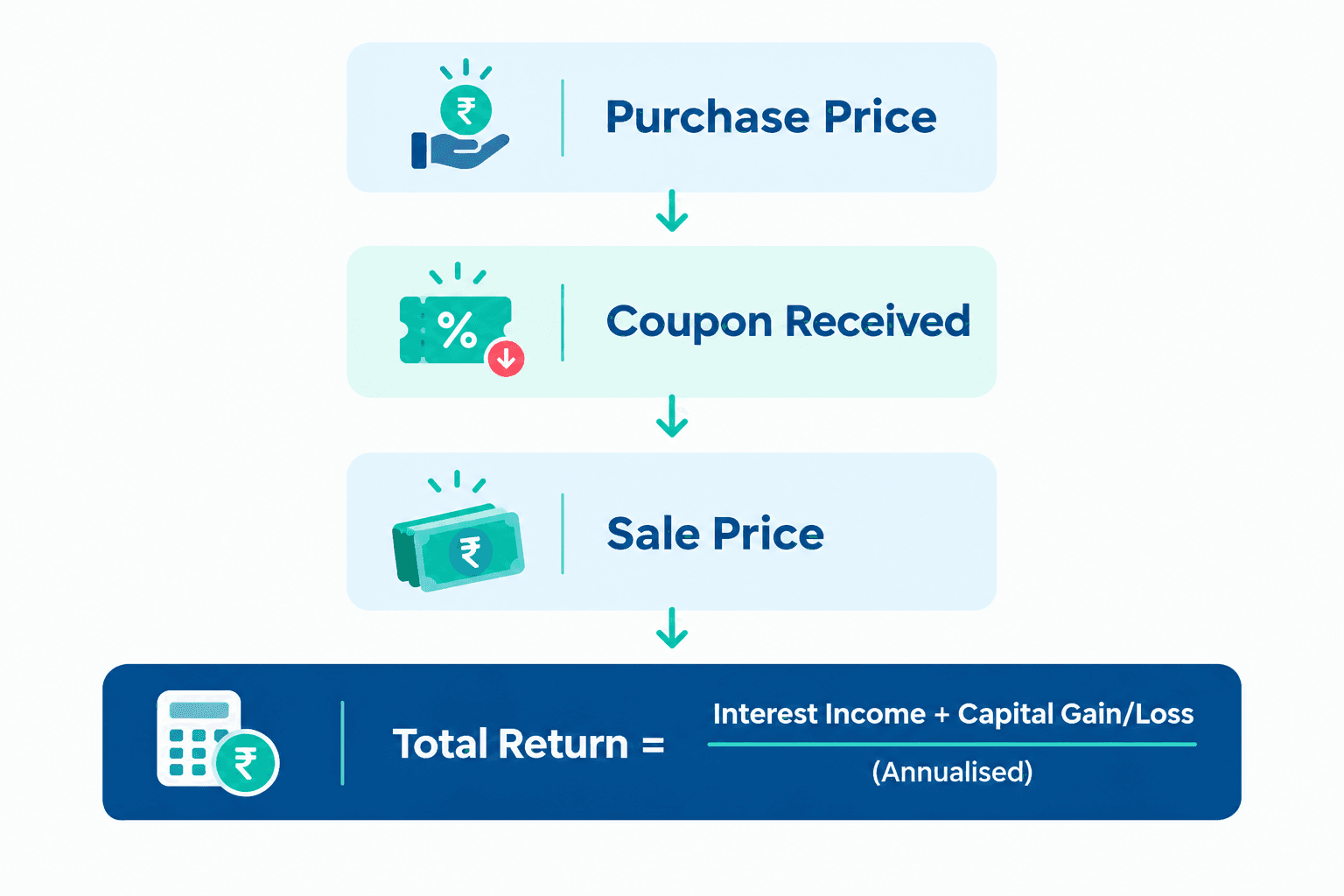
A simple flow graphic here can help readers understand that coupon income and capital gains are separate parts of the overall return.
Perpetual Bonds Taxation: Interest Vs Capital Gains
The easiest way to understand the difference is to put both side by side:
Factor | Interest/Coupon | Capital Gain/Loss |
| Source | Coupon paid by issuer | Sale/transfer of bond |
| Example | INR 8,000 coupon | INR 12,000 gain |
| When does it arise? | During the investment period | When the security is transferred |
| Tax treatment | Depends on applicable provisions | Depends on listing status and applicable provisions. |
| Key question | How much coupon do I retain after tax? | How much gain/loss is taxable?
|
This distinction can make a significant difference when calculating the actual return from a perpetual bond.
An investor could receive attractive coupons but still experience a capital loss if the bond is eventually sold below the purchase price.
How To Calculate Post-Tax Returns From Perpetual Bonds
Here's a simple way to look at the numbers.
Suppose:
Purchase price = INR 1,00,000
Coupon received = INR 8,000
Sale price = INR 1,10,000
The pre-tax gain from these two components is:
INR 8,000 + INR 10,000 = INR 18,000
But INR 18,000 is not necessarily the amount you ultimately keep.
The post-tax calculation needs to consider the applicable tax on the coupon and the applicable treatment of the capital gain.
A simplified approach is:
Post-tax return = Coupon after applicable tax + Capital gain after applicable tax ? eligible costs
This is why investors should compare bonds on their post-tax return, rather than simply choosing the security offering the highest coupon.
A bond offering a higher coupon isn't automatically the better investment if its overall risk, pricing and post-tax return do not justify the difference.
Tax Checklist Before Investing In Perpetual Bonds
Before putting money into a perpetual bond, ask these questions:
- What exactly am I buying? Check whether it is an AT1 bond, perpetual debt instrument or another security.
- Is it listed or unlisted? This can affect capital-gains treatment.
- What is the coupon structure? Check the rate, payment frequency and conditions.
- Will TDS apply? Check the applicable provision instead of assuming a standard rate.
- What happens if I sell it? Understand the potential tax treatment of the exit.
- What is my investor status? Tax treatment can vary for different categories of investors.
- Which financial year applies? Tax rules can change, so an old calculation may not be appropriate for a current investment.

Want to stay at the top of your finances?
Join the community of 22 lakh+ investors and learn more about Grip Invest, the latest financial knick-knacks, and shenanigans in the world of investing.
Happy Investing!
Disclaimer - Investments in debt securities/municipal debt securities/securitised debt instruments are subject to risks including delay and/ or default in payment. Read all the offer related documents carefully. The investor is requested to take into consideration all the risk factors before the commencement of trading.
This communication is prepared by Grip Broking Private Limited (bearing SEBI Registration No. INZ000312836 and NSE ID 90319) and/or its affiliate/ group company(ies) (together referred to as “Grip”) and the contents of this disclaimer are applicable to this document and any and all written or oral communication(s) made by Grip or its directors, employees, associates, representatives and agents. This communication does not constitute advice relating to investing or otherwise dealing in securities and is not an offer or solicitation for the purchase or sale of any securities. Grip does not guarantee or assure any return on investments and accepts no liability for consequences of any actions taken based on the information provided. For more details, please visit www.gripinvest.in
Registered Address - 106, II F, New Asiatic Building, H Block, Connaught Place, New Delhi 110001


