

Pradhan Mantri Ujjwala Yojana: Impact On Households, Subsidies, And The Economy


India is one of the most unique nations in the world. With a population of over 1.45 billion, Indian culture is quite diverse, featuring hundreds of languages and cuisines. One of the salient features of Indian cuisines is its freshness. Unlike their Western counterparts, Indian households prefer to prepare a meal from scratch almost three times a day.
This is a norm throughout the country’s wide geographical region.
In many remote and rural regions, coal, wood, and cow dung have been used as cooking fuel, making people vulnerable to breathing problems and causing serious environmental issues. With Pradhan Mantri Ujjwala Yojana (PMUY), the central government has made an effort to provide clean cooking fuel across all parts of India.
The adoption and expansion of the program has increased critically in the past few years, with over 9 crore LPG connections distributed across the country.
Given the current fuel crisis and ongoing geopolitical issues in West Asia, it will be important to understand how the program will evolve in the near and long term.
How The Scheme Works
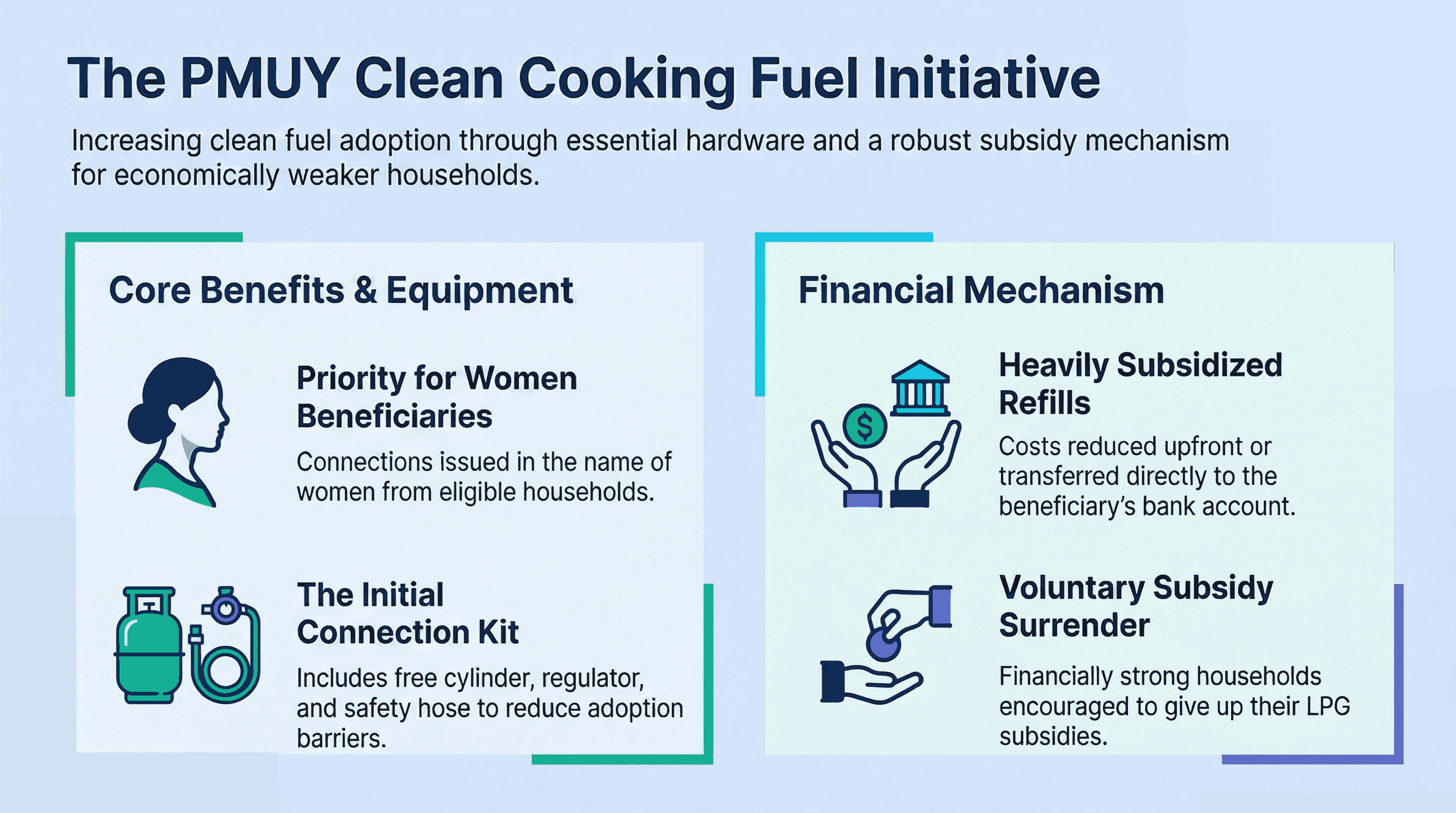
The PMUY scheme India was launched with a view to providing free LPG connections to eligible households, with preference given to women from economically weaker sections of society. Beneficiaries receive a connection in their name, which includes a cylinder, regulator, and safety hose, reducing the initial financial barrier to adoption.
In India, an LPG cylinder is a heavily subsidized commodity.
Along with launching this scheme, the central government had urged financially strong households to give up the LPG subsidy. The LPG subsidy India mechanism ensures that a portion of the refill cost is either reduced upfront or transferred directly to the beneficiary’s bank account.
The role of OMCs (Oil Marketing Companies) is critical here as they manage distribution networks, ensure last-mile delivery, and handle subsidy disbursement. The entire process is carried out while keeping in close contact with the government.
Economic Impact Of Ujjwala Yojana
There are multiple socioeconomic Ujjwala Yojana benefits, starting with the availability of LPG connections in almost all parts of the country, especially for the economically weaker section. Rural consumption of LPG has consistently increased, and households now spend little time arranging cooking fuel, which was the norm earlier. The saved time can be used in various income-generating activities.
At the same time, the program has put an extra bit of pressure on the government’s finances. Contrary to the government’s estimates, only 1.15 crore consumers in India voluntarily gave up the LPG subsidy1. In circumstances like the present, it becomes difficult for the government to control the fiscal cost of maintaining affordability.
LPG Price Volatility And Recent Supply Concerns
India imports a majority of its LPG from different parts of the world. With domestic cooking fuel demand rising, almost 40% of India’s fuel import bill is accounted for by LPG2. With the ongoing conflict between Israel, the US and Iran, the strategically important Strait of Hormuz has seen restricted passage of petroleum vessels.
Fluctuations in crude oil prices, geopolitical tensions, and supply chain disruptions have led to periodic increases in LPG cylinder prices.
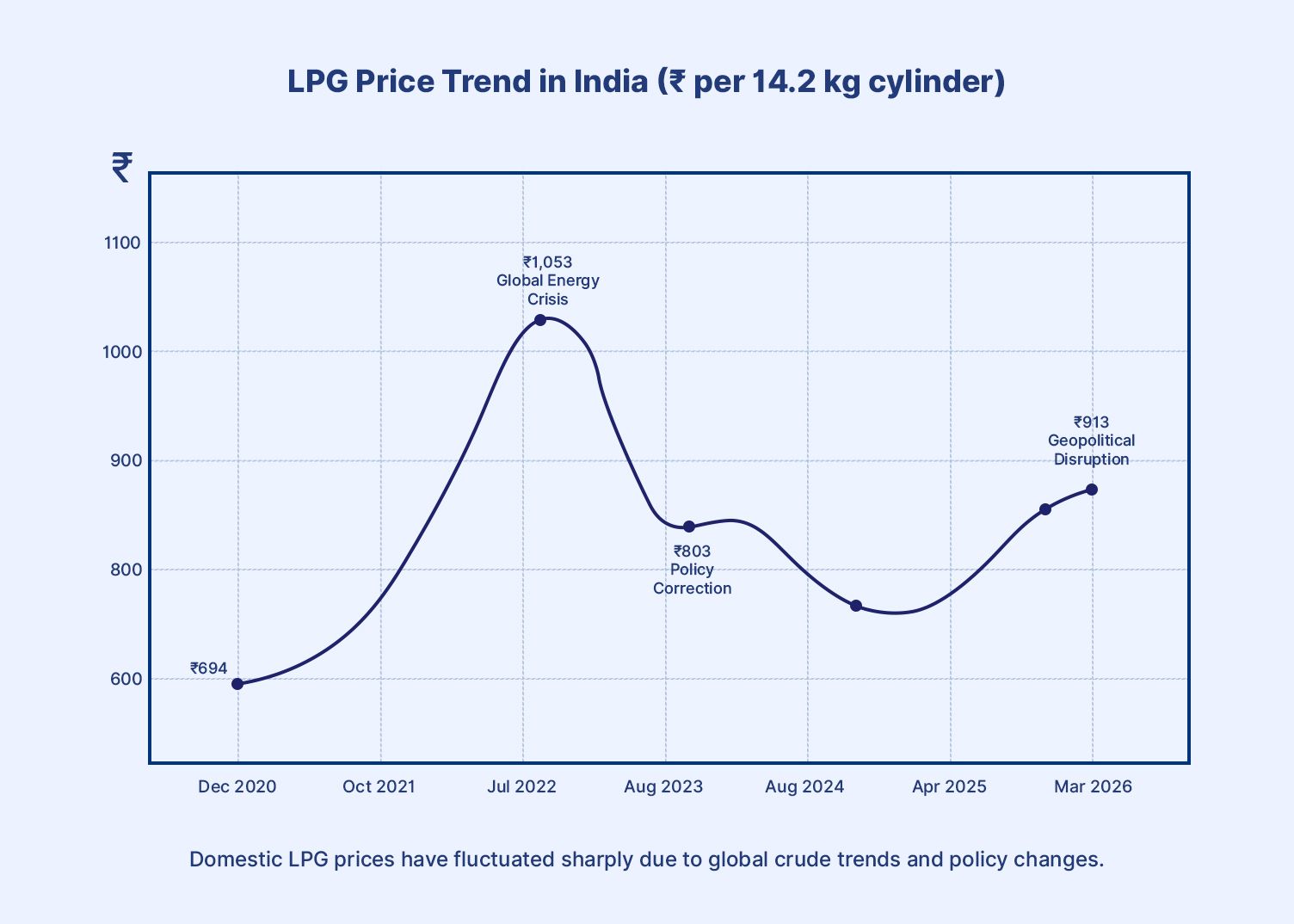
Even though the government has taken some steps to control hoarding and black marketing and prioritized domestic consumers, the impact of the limited cooking gas supply is quite visible, as waiting periods have increased and there is a virtual shortfall in commercial LPG supply.
What This Means For Investors
The Ujjwala scheme is expected to continue, despite the external challenges that the country is currently facing. For investors in OMCs, it is important to acknowledge that, with steady demand, increased LPG penetration, and higher consumption volumes, demand will remain steady in the next few months. However, there might be a direct impact on margins from government-implemented control pricing and subsidies.
Overall, this could remain a volatile period for investors, both domestically and globally. For investors, this underscores the importance of diversification. Energy-linked volatility often prompts a shift towards balancing portfolios across asset classes such as commodities and fixed-income instruments, which can offer relative stability during uncertain market conditions.
Conclusion
Irrespective of what has been going on on the geopolitical front, one cannot ignore the role of the Ujjwala Yojana in democratizing LPG supply to all parts of the country. The entire scheme has been highly successful, and despite recent issues with the supply and availability of LPG, demand for cooking gas is expected to continue to grow.
From an investor’s perspective, it is critical to understand that, regardless of the sector, no company is entirely safe from external disturbances. Hence, the stock of OMCs might stabilize in the coming months, which once again reaffirms the importance of diversifying your portfolio with fixed-income securities that offer high growth, low risk, and low volatility.
Visit Grip Invest today!
FAQs
1. What is Ujjwala Yojana?
A government scheme that provides free LPG connections to low-income households to promote clean cooking fuel and reduce dependence on traditional fuels.
2. Who is eligible for Ujjwala scheme?
Women from below-poverty-line households, identified through SECC data and other government welfare lists, are eligible under the scheme.
3. Is LPG subsidy still available?
Yes, LPG subsidy is still provided, but it varies based on government policy and global fuel prices, and is typically transferred directly to bank accounts.
4. Why are LPG prices rising?
LPG prices rise mainly due to higher global crude oil prices, supply disruptions, and changes in government subsidy levels.
References:
1. The Hindu business, accessed from: https://www.thehindubusinessline.com/economy/115-cr-consumers-have-given-up-lpg-subsidy/article69341053.ece
2. Indian Express, accessed from: https://indianexpress.com/article/explained/explained-economics/india-lpg-imports-dependence-explained-10582355/
 |
Author: Grip Invest Editorial Team The Grip Invest Editorial Team is a group of Chartered Accountants, MBA (Finance) graduates, and Qualified Research Analysts dedicated to helping you invest smarter. We dive deep into India's fixed income landscape to deliver content that is accurate, up-to-date, and easy to understand. Whether you're exploring bonds, fixed deposits, or other fixed income opportunities, our guides cut through the noise and give you the clarity to make better financial decisions. |
Want to stay at the top of your finances?
Join the community of 4 lakh+ investors and learn more about Grip Invest, the latest financial knick-knacks, and shenanigans in the world of investing.
Happy Investing!
Disclaimer - Investments in debt securities/municipal debt securities/securitised debt instruments are subject to risks including delay and/ or default in payment. Read all the offer related documents carefully. The investor is requested to take into consideration all the risk factors before the commencement of trading.
This communication is prepared by Grip Broking Private Limited (bearing SEBI Registration No. INZ000312836 and NSE ID 90319) and/or its affiliate/ group company(ies) (together referred to as “Grip”) and the contents of this disclaimer are applicable to this document and any and all written or oral communication(s) made by Grip or its directors, employees, associates, representatives and agents. This communication does not constitute advice relating to investing or otherwise dealing in securities and is not an offer or solicitation for the purchase or sale of any securities. Grip does not guarantee or assure any return on investments and accepts no liability for consequences of any actions taken based on the information provided. For more details, please visit www.gripinvest.in
Registered Address - 106, II F, New Asiatic Building, H Block, Connaught Place, New Delhi 110001


