

PSU Stocks: Best Government Owned Stocks To Watch In India


Public Sector Undertakings, or PSU stocks, are once again moving to the center of market narrative in India. After years of being seen as slow-moving giants, many government-owned companies are now benefiting from policy support.
This turning point results from the capital expenditure strategy by the government. As in the Union Budget 2026, Finance Minister Nirmala Sitharaman projected FY27 capital expenditure at INR 12.2 lakh crore, compared to around INR 10 lakh crore in FY26, reinforcing the infrastructure-led growth plan.1
The major beneficiaries of this movement include roads, railways, defence manufacturing, power transmission, logistics, and urban infrastructure.2
Additionally, PSU bank stocks have also emerged as one of the strongest-performing segments, delivering returns of up to 57% in FY26, even as the Nifty 50 declined 5% during the same period.
What Are PSU Stocks?
PSU stocks are shares of Public Sector Undertakings (PSUs), which are companies where the Indian government holds a majority stake, usually 51% or more.3 These companies operate in important sectors such as banking, power, oil & gas, defence, railways, and infrastructure, making government stocks in India linked to the economic development of the country.
PSU companies can be owned by either the central government or state governments, and many of them are listed on stock exchanges such as the NSE and BSE.
Some of the best PSU stocks in India include State Bank of India, NTPC, ONGC, and Coal India. These stocks are known for stable business models, strong government support, and regular dividend payouts.
Top PSU Stocks by Sector
Here are the 20 PSU stocks to buy by sector, based on market capitalisation:
Names | Sectors | Market cap | PE | 1Y Return |
| State Bank of India | Public Banks | 10,11,675.69 | 13.04 | 41.58 |
| NTPC Ltd | Power Generation | 3,82,872.86 | 16.35 | 15.52 |
| Oil and Natural Gas Corporation Ltd | Oil & Gas - Exploration & Production | 3,53,254.24 | 9.75 | 18.48 |
| Bharat Electronics Ltd | Electronic Equipments | 3,20,314.51 | 60.19 | 41.13 |
| Hindustan Aeronautics Ltd | Aerospace & Defense Equipments | 3,09,435.50 | 37.00 | 2.65 |
| Power Grid Corporation of India Ltd | Power Transmission & Distribution | 2,93,852.58 | 18.93 | 2.71 |
| Coal India Ltd | Mining - Coal | 2,89,771.49 | 9.32 | 24.31 |
| Indian Oil Corporation Ltd | Oil & Gas - Refining & Marketing | 2,09,290.87 | 15.39 | 2.87 |
| Power Finance Corporation Ltd | Specialised Finance | 1,53,091.72 | 6.66 | 17.32 |
| Bank of Baroda Ltd | Public Banks | 1,39,781.92 | 6.75 | 20.72 |
| Indian Railway Finance Corp Ltd | Specialised Finance | 1,39,493.23 | 21.45 | -11.32 |
| Bharat Petroleum Corporation Ltd | Oil & Gas - Refining & Marketing | 1,36,250.76 | 10.22 | 0.83 |
| Bharat Heavy Electricals Ltd | Heavy Electrical Equipments | 1,34,390.24 | 83.98 | 77.24 |
| Union Bank of India Ltd | Public Banks | 1,28,817.09 | 6.86 | 42.74 |
| Punjab National Bank | Public Banks | 1,26,629.25 | 7.44 | 16.63 |
| Canara Bank Ltd | Public Banks | 1,25,211.27 | 7.14 | 49.43 |
| Indian Bank | Public Banks | 1,16,761.57 | 10.19 | 54.39 |
| Gail (India) Ltd | Gas Distribution | 1,08,935.92 | 8.75 | -11.12 |
| Mazagon Dock Shipbuilders Ltd | Shipbuilding | 1,06,673.84 | 41.29 | -11.04 |
| REC Ltd | Specialised Finance | 94,559.07 | 5.80 | -11.27 |
This strong PSU sector performance is also visible at the index level. Over the last three years, the Nifty CPSE Index has significantly outperformed the Nifty 50, reflecting strong investor interest in CPSE stocks linked to banking, defence, power, and infrastructure. 4
Nifty CPSE vs Nifty 50 Performance Comparison
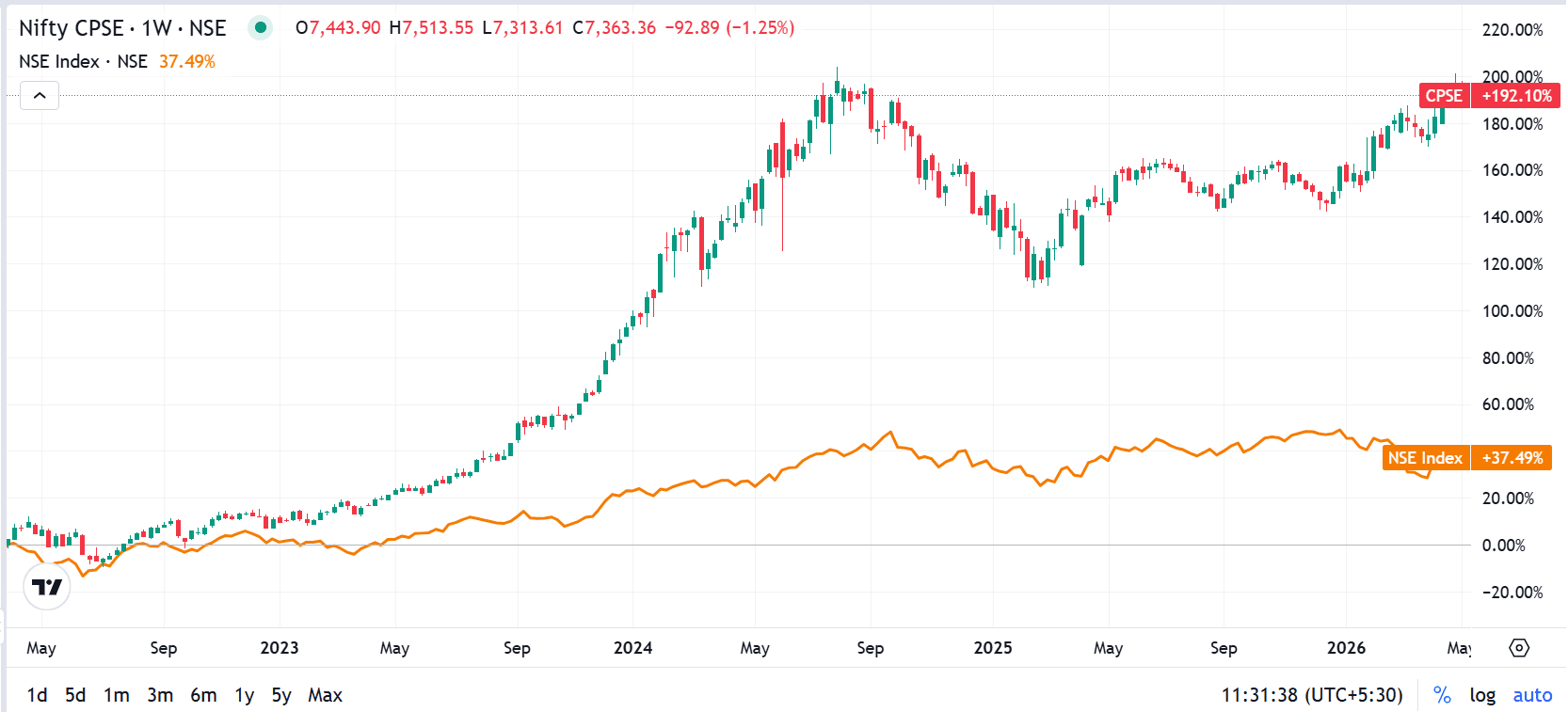
Source: TradingView data based on NSE indices5
Why PSU Stocks Are In Focus Now?
The PSU sector performance reflects strong investor attention in 2026 due to the continued infrastructure and capital expenditure push by the government to INR 12.2 lakh crore capex, keeping sectors such as railways, power, defence, and infrastructure in focus.6 With this, Steel PSU capex alone is expected to rise 44% to INR 25,125 crore in FY27, led by SAIL and NMDC expanding investment plans.7
Meanwhile, disinvestment and stake dilution plans are also contributing to market interest in PSU stocks. According to reports, disinvestment and asset monetisation receipts crossed INR 34,400 crore in FY26, exceeding revised estimates.
Additionally, dividend yield is another major reason behind PSU stock popularity. Government dividend collections from CPSEs reached nearly INR 70,577 crore in FY26, supported mainly by ONGC, Coal India, Indian Oil, BPCL, and NTPC.8 Most PSU companies offer higher dividend yields than traditional fixed-income instruments, which makes them attractive for income focused investors amid volatile market conditions.
Risks Of Investing In PSU Stocks
While PSU stocks have gained strong momentum in recent years, they still carry certain risks linked to government policies, sector cycles, and market volatility. Investors should understand these factors before investing in public sector companies:
- Government policy risk: PSU companies are influenced by government decisions, and changes in policies or disinvestment plans can affect PSU stock performance and investor confidence.
- Economic slowdown risk: PSU sectors such as banking, metals, and oil are tied to economic growth, and may struggle during weak economic conditions.
- Price volatility risk: While PSU stocks delivered strong returns, they can still witness sharp price corrections after strong rallies or market profit booking.
- Operational efficiency risk: PSU companies may face slower decision-making and delays in project execution compared to private firms, which can affect long-term profitability and competitiveness in fast-changing industries.
PSU Stocks vs PSU Bonds: Risk-Return Tradeoff
Here is a comparison of the return potential, volatility, and stability of PSU stocks vs PSU bonds.
Factors | PSU Stocks | PSU Bonds |
| Return potential | PSU stocks generate strong returns, with the BSE PSU index delivering around 20% in 1 year and 115% in 3 years. | PSU bonds generally offer fixed yields of around 7% to 8.5% for 5-10 year tenure. |
| Risk level | PSU stocks involve high risks, since these are market-linked and can witness sharp price volatility. | PSU bonds are relatively stable due to government-backed issuers. |
Source: Economic times,9,10
Read more about PSU Bonds 2026
Should You Invest In PSU Stocks?
PSU stocks can be suitable for investors who want long-term growth through sectors supported by government spending, including banking, defence, railways, and power. However, these stocks are volatile during market corrections and policy driven shifts.
Conclusion
PSU stocks have re-emerged as a major market theme in 2026, supported by strong government capex, infrastructure expansion, and improving PSU sector performance.
While these stocks offer growth and dividend potential, they also carry market volatility. Investors should balance return expectations, sector risks, and investment goals before choosing between PSU stocks and fixed-income alternatives like PSU bonds.
For investors preferring more predictable income with lower volatility, Grip offers fixed-income options such as corporate bonds and FDs, with investments starting from INR 1,000 and fixed returns reaching up to 12.5% on selected opportunities.
Visit Grip today!
FAQs PSU Stocks India
 |
Author: Grip Invest Editorial Team The Grip Invest Editorial Team is a group of Chartered Accountants, MBA (Finance) graduates, and Qualified Research Analysts dedicated to helping you invest smarter. We dive deep into India's fixed income landscape to deliver content that is accurate, up-to-date, and easy to understand. Whether you're exploring bonds, fixed deposits, or other fixed income opportunities, our guides cut through the noise and give you the clarity to make better financial decisions. |
Want to stay at the top of your finances?
Join the community of 4 lakh+ investors and learn more about Grip Invest, the latest financial knick-knacks, and shenanigans in the world of investing.
Happy Investing!
Disclaimer - Investments in debt securities/municipal debt securities/securitised debt instruments are subject to risks including delay and/ or default in payment. Read all the offer related documents carefully. The investor is requested to take into consideration all the risk factors before the commencement of trading.
This communication is prepared by Grip Broking Private Limited (bearing SEBI Registration No. INZ000312836 and NSE ID 90319) and/or its affiliate/ group company(ies) (together referred to as “Grip”) and the contents of this disclaimer are applicable to this document and any and all written or oral communication(s) made by Grip or its directors, employees, associates, representatives and agents. This communication does not constitute advice relating to investing or otherwise dealing in securities and is not an offer or solicitation for the purchase or sale of any securities. Grip does not guarantee or assure any return on investments and accepts no liability for consequences of any actions taken based on the information provided. For more details, please visit www.gripinvest.in
Registered Address - 106, II F, New Asiatic Building, H Block, Connaught Place, New Delhi 110001


