

Solar Energy Stocks India 2026: Top Stocks to Watch And How to Invest


India’s clean power transition is accelerating and solar energy is doing most of the lifting. Backed by policy clarity and rising institutional interest, the renewable segment continues to build steady momentum.
India has now passed Japan to rank third for solar generation.Global solar installations, meanwhile, are projected to reach 914 Gigawatts (GW) by 2030, nearly 57% higher than in 2024, indicating a long-term structural expansion in the sector1.
This growth story has placed solar energy stocks in India firmly on the radar of investors seeking future-ready opportunities. The following sections explore the best solar energy stocks India 2026 and how they align with the nation’s broader renewable ambitions.
India’s Renewable Energy Push
The country’s sustainable energy shift is advancing through goals like the National Solar Mission and the national goal of achieving 500 GW of non-fossil fuel capacity by 20302. The share of renewables has now exceeded half of the 485 GW installed base. That share has tripled since 20143.
Between 2017-2025, financing has also scaled. Deal volumes rose from 134 in 2017 to 230 in 2025, with value near USD 13.6 billion in 20234. At the same time, renewable energy (led by solar + wind) accounted for 83% of private equity deal volume and 89% of value.
Green energy shares continue to gain ground as domestic production scales and diversification gathers pace in areas like green hydrogen and energy efficiency. The overall renewable market is projected to expand by 12-35% annually across emerging segments.
Amid this momentum, solar energy sector growth stands out as the defining force to watch. The pace of solar generation growth is the fastest recorded in the history of electricity. It's no surprise that solar energy stocks are capturing investor attention5.

Why Solar Energy Stocks Are Booming
Solar energy stocks India are gaining steady traction as clear regulation, capital inflows, and industrial growth converge.
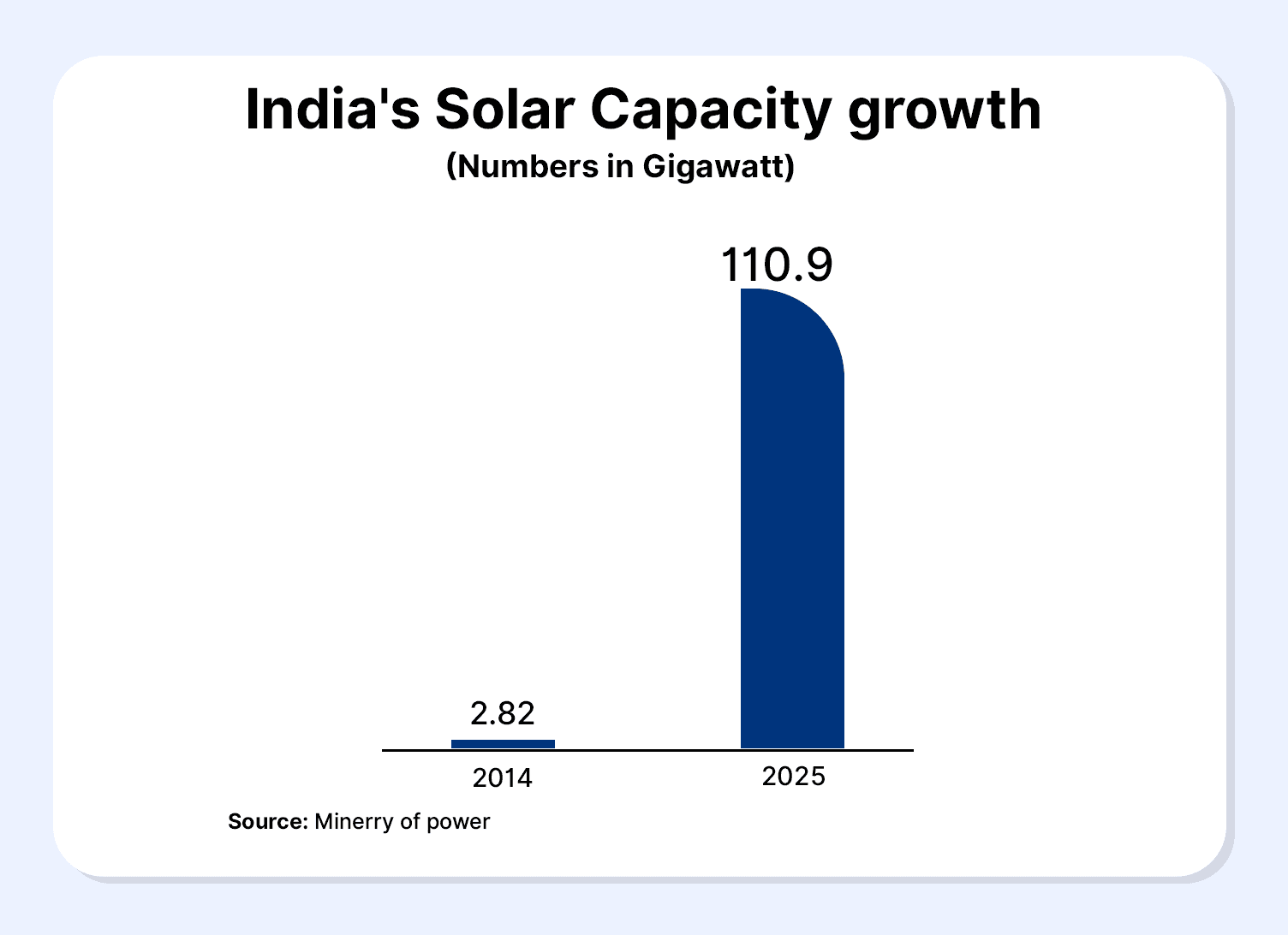
The solar capacity has grown more than 39x, from 2.82 GW in 2014 to 110.9 GW in 2025, with a record 23.83 GW added in 2024-256. Whereas solar PV module capacity went 38x from 2.3 GW to 88 GW and solar PV cell capability grew 21-fold from 1.2 GW to 25 GW7.
1. Policy Direction
Initiatives such as PM Surya Ghar Muft Bijli Yojana, PM KUSUM and the Solar Parks Scheme are expanding coverage across homes, farms, and public grids. Rooftop solar continues to scale, while decentralised generation supports rural income8.
2. Expanding Green Finance
India’s sustainable debt market has reached USD 55.9 billion shaping a domestic green yield curve9. SEBI’s BRSR- Business Responsibility and Sustainability Reporting Core, the RBI’s Green Deposit Framework, and the upcoming climate taxonomy are improving transparency and standardising disclosures. This has drawn long-term investors and deepened liquidity in solar-linked debt and equity.
3. ESG Progression
The global ESG-Environmental, Social and Governance- movement, anchored in the Paris Agreement and India’s net-zero roadmap, is redefining corporate value. ESG benchmarks now guide investor judgement and boardroom priorities. With clean energy at the centre of this paradigm, solar power stocks India reflect both corporate transition and investor conviction in a low-carbon future.
4. Global Alignment
India’s solar industry is now intertwined with global energy realignment. Exports of photovoltaic modules have risen twenty-threefold between FY22 and FY24, reflecting sharper global linkages10.Whereas imports now account for barely a quarter of total usage.
The ripple in global trade patterns, especially the US-China solar divide, is creating new openings for Indian manufacturers. Expanding production capacity and India’s engagement with initiatives such as the International Solar Alliance and One Sun One World One Grid have strengthened its international standing.
Now, in this favourable position, which are the top solar energy stocks in India leading this transformation? Let us take a closer look.
Top Listed Solar Stocks To Watch In 2026
Here are the leading solar energy stocks India based on market capitalisation as of November-11,202511.
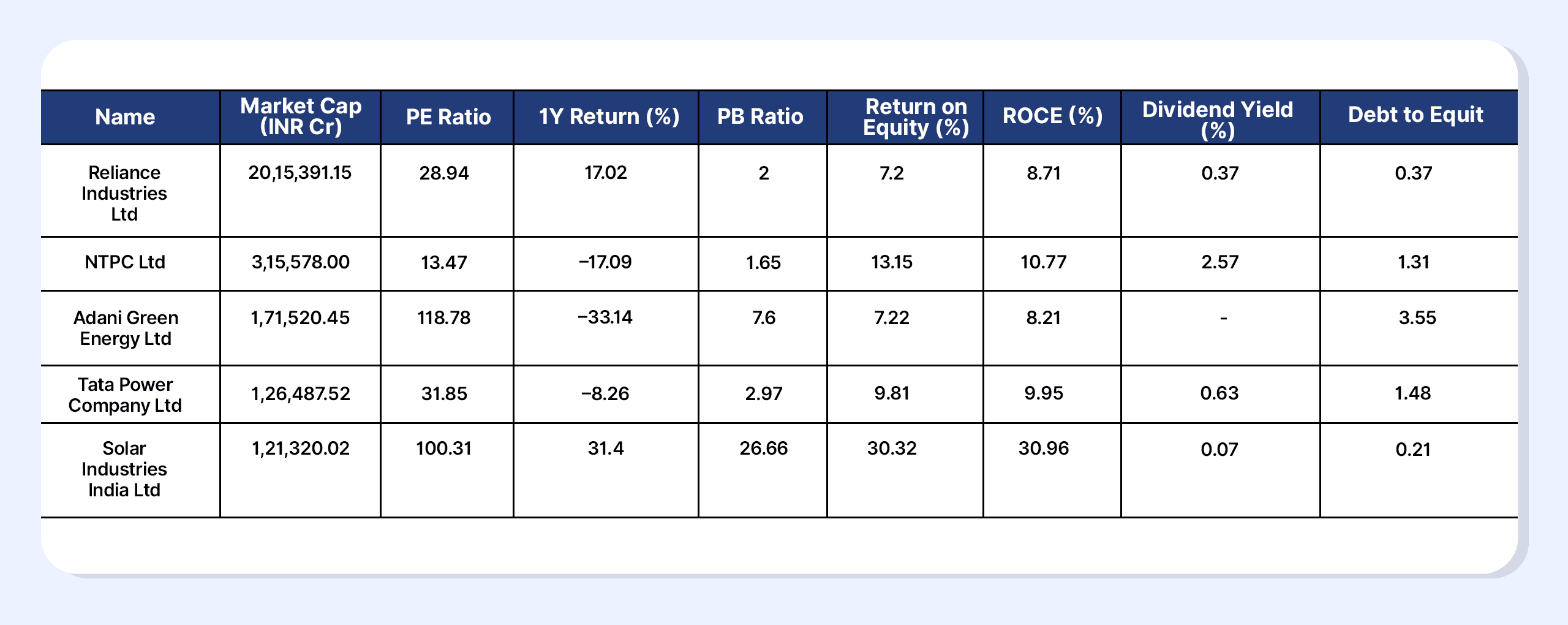
Please note market cap is a useful litmus test, providing a snapshot of company’s size and investor interest. However it is not a guarantee of future performance.
Risks And Challenges
The photovoltaic stocks India hold long term promise, though certain constraints could moderate progress.
1. High valuations show investor enthusiasm but also raise sensitivity to changes in performance or policy. Price movements may not always mirror fundamentals.
2. Regulations differ by region and uneven implementation sometimes affects timelines. Interruptions in project readiness or power evacuation can influence consistency in delivery.
3. Financing continues to define viability. Projects demand large commitments and fluctuating interest costs may test smaller developers or new entrants.
While these challenges exist, investors can still balance exposure by exploring diversified routes. You can offset portfolio risk through alternative ways to invest in clean energy beyond equities.
Alternative Ways To Invest In Clean Energy
Clean power exposure extends beyond conventional market listings. Investors can access structured avenues that balance return consistency with sustainability intent.
Green bonds have become a cornerstone for those pursuing fixed income within an environmental framework. Since early 2023, the Government of India has issued 8 sovereign tranches totalling INR 477 billion, establishing a domestic green yield curve and deepening market confidence12.
Asset-back sustainable investments offer another channel of access. Platforms such as Grip facilitate entry into secured instruments linked with operating renewable ventures.
Mufin Green, for example, issues security bonds with an 11.15% yield, A- rating, 1.15x security cover and monthly interest on a face value of INR 1,00,000, maturing on 11 December 2026.
These options enable you to diversify intelligently, balancing risk with participation in India’s clean energy story.
Solar Stocks Performance Analysis
Solar stocks have emerged as a popular investment option in the renewable energy industry. Many investors have shown interest in companies involved in solar generation, clean energy infrastructure, or equipment manufacturing. Investors can also understand the future of any solar stock by analysing its past performance.
5 Year CAGR Comparison
The solar industry is expanding all over India with the support of the Indian government and initiatives like ALMM. Here is the list of the top 5 popular solar energy stocks in India and their 5-year CAGR comparison.
Company | Market Cap (June 2026) | 5yr CAGR % |
Adani Green Energy | INR 2,44,721 Cr | 4% |
Tata Power | INR 1,25,753 Cr | 26% |
NTPC Green Energy | INR 82,856 Cr | NA |
Waaree Energies | INR 87,199 Cr | NA |
Premier Energies | INR 46,966 Cr | NA |
Quarterly Trends 2024-2026
Solar companies are changing the market trends due to policy developments and rising renewable adoption.
Period | Key Trends |
2024 Q1-Q2 | Focused on renewable infrastructure and solar manufacturing |
2024 Q3-Q4 | Many investors showed interest due to the renewable energy expansion plans |
2025 Q1-Q2 | Growth in solar projects and domestic manufacturing |
2025 Q3-Q4 | Focused on energy transition and clean power demand |
2026 | Solar energy panels are continuously growing and expanding |
How To Invest In Solar Stocks?
The solar energy stocks in India have different types of investment options. Investors can choose one depending on their risk tolerance and investment goals.
1. Direct Investment in Solar Stocks
You can purchase shares of listed power companies with a stock market account. With this, you can be directly involved in solar generation or renewable infrastructure. However, analysing a company's financial performance and debt levels before investing is very important.
2. Renewable Energy Mutual Funds & ETFs
For diversification, renewable energy mutual funds and ETFs provide better options. These allow spreading investment across multiple green stocks, which can help reduce the risk os lose in the investment, and growth chances are higher.
3. Solar Bonds & Fixed Income Options
For stable income opportunities, you can explore renewable energy-linked bonds. It provides predictable returns with fixed income and focuses on earning interest income.
Solar vs Other Renewable Sectors
Here is a comparison table between solar and other renewable sectors with their advantages and risks.
Sector | Main Focus | Advantage | Major Risk |
Solar Energy | Solar power generation and manufacturing | Lower operating cost | Policy and pricing pressure |
Wind Energy | Wind power generation | Mature technology | Location dependency |
Hybrid Energy | Solar+wind+storage | Better energy availability | Higher project complexity |
Green Hydrogen | Clean fuel production | Decarbonisation potential | High production cost |
Conclusion
Solar energy stocks in India reflect a larger structural shift that is reshaping the country’s energy and investment landscape. With rapid capacity expansion, steady policy direction, and growing global alignment, the sector sits at the intersection of sustainability and long-term value creation. While valuations and regulatory nuances require careful navigation, the broader narrative remains strong — India’s solar push is still in its early innings.
For investors, the smart approach is to balance high-growth equity exposure with stable, income-generating instruments that offer consistency through market cycles. Clean energy investments need not be limited to listed stocks; green bonds and structured renewable-backed options provide a diversified path to participate in this transition.
When you are ready to add stable, sustainability-linked fixed-income opportunities to your portfolio, explore Grip Invest’s curated list of corporate bonds offering predictable returns.
FAQs On Top Solar Energy Stocks In India
References:
 |
Author: Grip Invest Editorial Team The Grip Invest Editorial Team is a group of Chartered Accountants, MBA (Finance) graduates, and Qualified Research Analysts dedicated to helping you invest smarter. We dive deep into India's fixed income landscape to deliver content that is accurate, up-to-date, and easy to understand. Whether you're exploring bonds, fixed deposits, or other fixed income opportunities, our guides cut through the noise and give you the clarity to make better financial decisions. |
Want to stay at the top of your finances?
Join the community of 4 lakh+ investors and learn more about Grip Invest, the latest financial knick-knacks, and shenanigans in the world of investing.
Happy Investing!
Disclaimer - Investments in debt securities/municipal debt securities/securitised debt instruments are subject to risks including delay and/ or default in payment. Read all the offer related documents carefully. The investor is requested to take into consideration all the risk factors before the commencement of trading.
This communication is prepared by Grip Broking Private Limited (bearing SEBI Registration No. INZ000312836 and NSE ID 90319) and/or its affiliate/ group company(ies) (together referred to as “Grip”) and the contents of this disclaimer are applicable to this document and any and all written or oral communication(s) made by Grip or its directors, employees, associates, representatives and agents. This communication does not constitute advice relating to investing or otherwise dealing in securities and is not an offer or solicitation for the purchase or sale of any securities. Grip does not guarantee or assure any return on investments and accepts no liability for consequences of any actions taken based on the information provided. For more details, please visit www.gripinvest.in
Registered Address - 106, II F, New Asiatic Building, H Block, Connaught Place, New Delhi 110001


