

Sovereign Green Bonds In India: Should You Invest In Sustainable Wealth?


India’s journey with sovereign green bonds began in January 2023, when the government issued its first tranche worth INR 80 billion1. This issuance marked a significant step in the country’s commitment to financing climate-friendly projects. In this article, we will discover what environmentally friendly bonds are and how to invest in green bonds in India.
What Are Sovereign Green Bonds?
Sovereign green bonds are debt instruments issued by the government specifically to fund environmentally friendly projects. Unlike conventional bonds, where the funds can be utilised for any purpose, the proceeds from the RBI sovereign green bonds investment are exclusively allocated to projects that promote environmental sustainability. This includes renewable energy, clean transportation, sustainable water and waste management, energy efficiency, green buildings, biodiversity, and climate adaptation.
How Do Sovereign Green Bonds Work
When you invest in sovereign green bonds, your money goes directly into funding projects that have positive environmental impacts. These are Government-backed bonds in India, and thus the government pays regular interest to bondholders, typically semi-annually, and returns the principal amount at maturity.
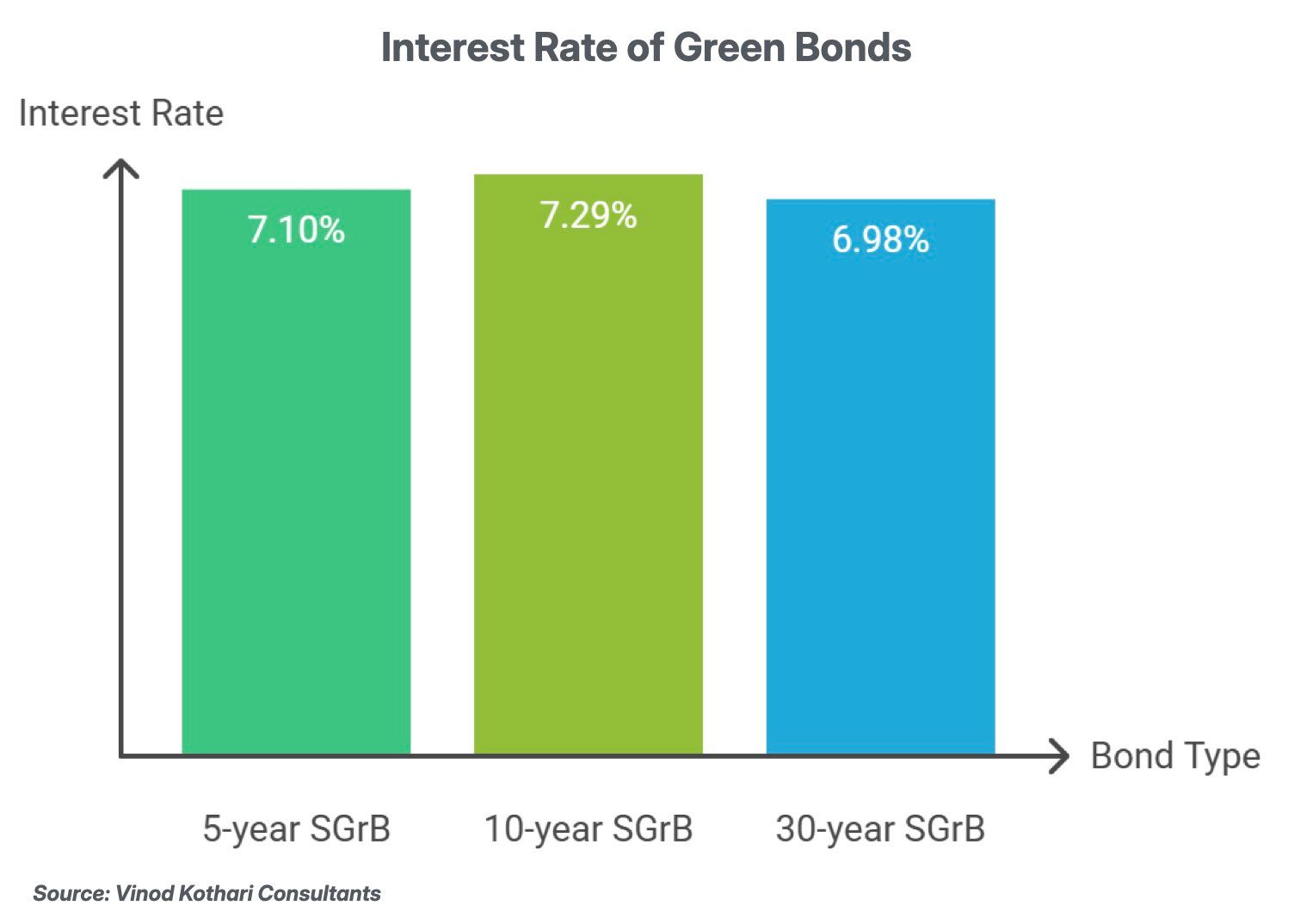
For instance, if you invest INR 10,000 in a 10-year sovereign green bond with an interest rate of 7.29%, you would receive approximately INR 364.50 every 6 months as interest. At the end of 10 years, you would get back your principal amount of INR 10,000 along with the final interest payment.
RBI’s 2025 Green Bond Issuance Overview
The latest chapter in this story of RBI green bonds unfolded in June 2025, when the Reserve Bank of India announced a re-issuance of INR 5,000 crore in 30-year sovereign green bonds with a 6.98% interest rate. This is part of a larger government securities auction totalling INR 30,000 crore2.
The government has raised INR 440 billion in green bonds since January 2024, significantly outpacing other categories of sustainable finance issuers. This showcases India’s strong commitment to climate action goals3.
Benefits Of Investing In Green Bonds
1. ESG Impact And Returns
Investing in sovereign green bonds offers a unique dual advantage: i) financial returns, ii) positive environmental impact via ESG investing. When you invest in these bonds, you contribute directly to projects that reduce carbon emissions, promote clean energy, and enhance climate resilience.
The Indian government’s green bonds have historically offered competitive returns, with interest rates ranging between 6.98% and 8.40%, depending on tenor and market conditions4. This makes them attractive while simultaneously allowing investors to align their portfolios with environmental, social, and governance (ESG) principles.
This makes sustainable investing an increasingly attractive proposition for those seeking to generate wealth responsibly.
2. Government Backing and Risk Profile
One of the most compelling advantages of sovereign green bonds is their safety profile. Backed by the full faith and credit of the Government of India, these bonds carry virtually zero credit risk. This government guarantee makes them one of the low-risk investment options in India.
For risk-averse investors seeking stability in their portfolio, government-backed bonds offer peace of mind. The sovereign guarantee ensures that, regardless of market fluctuations, your principal remains secure, and interest payments arrive on schedule.
However, the RBI had to cancel some auctions, including one in May 2024 and another in June 2025, despite receiving bids worth more than double the offered amount5. This occurred because the yields demanded by market participants exceeded the central bank’s expectations.
Performance Of India’s Green Bonds
Domestic vs Global Comparison
India’s green bond market, while growing, still represents a small fraction of the global sustainable finance landscape. Globally, green bonds worth more than $3.5 trillion have been issued by Sep 20226. The Indian green bond market size is $5.7 billion.
In India, sovereign green bonds initially commanded a modest greenium (the premium investors are willing to pay for green-labelled bonds) of 2-3 basis points, much smaller than in mature markets like Japan, where greeniums historically ranged between 7-17 basis points.
Recent global trends indicate a shifting landscape. While sustainable bonds in the Americas maintained green premiums of 1.7 basis points in Q1 2025, and Asia-Pacific nearly eliminated its discount, bonds in Europe, the Middle East, and Africa traded wider than conventional bonds. India’s experience seems to align with this latter pattern, with investors increasingly demanding higher yields rather than paying sustainability premiums.
Before investing in bonds, you can use a bonds calculator to estimate potential returns, interest payouts, and maturity value based on your investment amount and tenure.
How To Invest In Sovereign Green Bonds?
1. Availability On Exchanges And Via Platforms
Investing in sovereign green bonds has become increasingly accessible for retail investors. These bonds are listed on stock exchanges like the NSE, allowing investors to buy and sell them in the secondary market. Additionally, the RBI’s Retail Direct platform enables direct investment in these bonds during primary auctions7.
For those who prefer a more guided approach, various brokerage firms and financial institutions offer services to facilitate investment in government-backed bonds.
2. Minimum Investment And Maturity Period
Green bond maturity period varies. The initial issuances in 2023 included 5-year and 10-year options, while the most recent issue in June 2025 carries a 30-year maturity period.
This variety allows investors to choose options that align with their financial goals and time horizons. The minimum investment also varies based on the issuer and is typically decided based on an auction.
Conclusion
Sovereign green bonds offer a unique opportunity for investors to invest in green India while securing stable returns backed by government guarantees. For investors seeking to diversify their portfolios with safe, environmentally conscious options, government-backed bonds with a green focus are suitable. However, research is required to ensure long-term sustainability. To learn more about bond investing, sign up on Grip Invest today and add fixed returns to your portfolio.
Frequently Asked Questions On Sovereign Green Bonds
1. Are green bonds tax-free?
No, green bonds do not offer special tax benefits. The interest earned is taxed as “income from other sources” at the investor’s applicable income tax slab rate. Unlike some other government securities, these bonds do not provide tax exemptions under Section 10(15) of the Income Tax Act.
2. How do I invest in green bonds?
You can invest in sovereign green bonds through multiple channels. The primary methods include participating in RBI auctions via the Retail Direct Gilt Account, purchasing through brokerage firms or financial institutions, or buying from the secondary market on stock exchanges like the NSE after the initial issuance.
3. What is the return on sovereign green bonds?
The returns on sovereign green bonds are competitive and fixed at issuance. The first issuances in January 2023 offered interest rates of 7.10% for 5-year bonds and 7.29% for 10-year bonds.
References
- World Bank Blogs, accessed from: https://blogs.worldbank.org/en/climatechange/india-incorporates-green-bonds-its-climate-finance-strategy
- Power Line, accessed from: https://powerline.net.in/2025/07/16/green-yields-recent-bond-activity-in-the-renewables-space/
- Institute for Energy Economics and Financial Analysis, accessed from: https://ieefa.org/resources/disappearing-greenium-global-turbulence-and-pricing-realities-what-rbis-shelved-green
- Power Line, accessed from: https://powerline.net.in/2025/07/16/green-yields-recent-bond-activity-in-the-renewables-space/
- Institute for Energy Economics and Financial Analysis, accessed from: https://ieefa.org/resources/disappearing-greenium-global-turbulence-and-pricing-realities-what-rbis-shelved-green
- The North American Journal of Economics and Finance, accessed from: https://www.sciencedirect.com/science/article/pii/S1062940824000470
- The Economic Times, accessed from: https://economictimes.indiatimes.com/wealth/tax/nris-can-now-invest-in-sovereign-green-bonds-this-new-way-know-how-the-impact-on-taxation-of-gains/articleshow/113317486.cms?from=mdr
Want to stay at the top of your finances?
Join the community of 4 lakh+ investors and learn more about Grip Invest, the latest financial knick-knacks, and shenanigans in the world of investing.
Happy Investing!
Disclaimer - Investments in debt securities/municipal debt securities/securitised debt instruments are subject to risks including delay and/ or default in payment. Read all the offer related documents carefully. The investor is requested to take into consideration all the risk factors before the commencement of trading.
This communication is prepared by Grip Broking Private Limited (bearing SEBI Registration No. INZ000312836 and NSE ID 90319) and/or its affiliate/ group company(ies) (together referred to as “Grip”) and the contents of this disclaimer are applicable to this document and any and all written or oral communication(s) made by Grip or its directors, employees, associates, representatives and agents. This communication does not constitute advice relating to investing or otherwise dealing in securities and is not an offer or solicitation for the purchase or sale of any securities. Grip does not guarantee or assure any return on investments and accepts no liability for consequences of any actions taken based on the information provided. For more details, please visit www.gripinvest.in
Registered Address - 106, II F, New Asiatic Building, H Block, Connaught Place, New Delhi 110001


