

Invest In Bonds
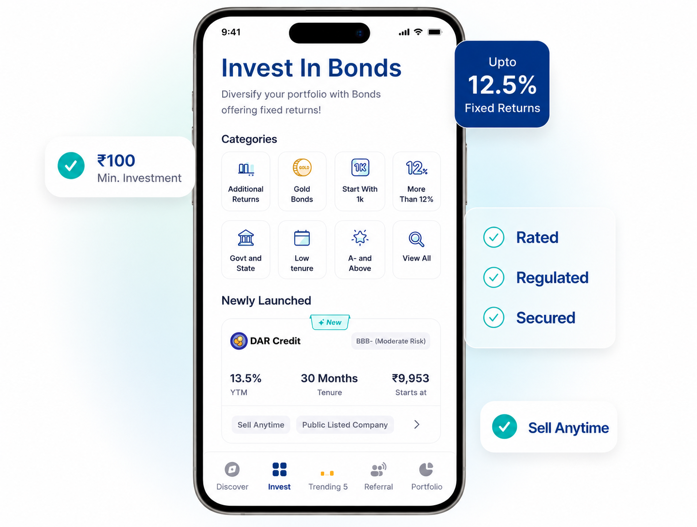
Bonds are fixed-income instruments where investors lend money to governments or companies in exchange for regular interest payments and repayment of the principal at maturity.
India’s bond universe is broad, from Treasury Bills and Government Securities to SDLs and Corporate Bonds, with tenures stretching from 91 days to 40 years.
India's bond market has expanded significantly, reaching approximately INR 255 lakh crore as of December 2025, driven by growth in G-Secs, SDLs, and Corporate Bonds.
Unlike equities, bonds prioritise capital preservation with lower default risk on high-rated issuances, backed by collateral or sovereign guarantee.
Listed bonds can also be traded before maturity in the secondary market, adding flexibility alongside periodic income for investors managing yields, prices and holding periods.


Plan your investment
Estimate your returns from bond investment in India
Calculate your potential earnings with our bond return calculator. Adjust the investment amount, tenure, YTM and coupon frequency to get an instant estimate of your bond investment maturity value.
- Add your bond investment amount
- Adjust tenure, YTM and coupon frequency
- See Total Returns and Interest instantly
Disclaimer: Please note that these calculators are for illustration only and do not represent actual returns.

REASON AND BENEFITS

Predictable Income
Bonds provide regular interest income, which suits investors looking for steady cash flows.

Higher Yield Potential
Bond investments in India offer higher yields than traditional investment options like bank FDs.

Lower Volatility
Compared with equities, bonds typically experience smaller price swings, making them useful for balance.

Low Minimum Investment
You can start investing in bonds on Grip with as low as INR 100, making it accessible to every investor.

Sell Anytime
Bond investment can be sold anytime on Grip Invest before redemption, offering investors liquidity if cash needs, yields, or portfolio priorities change.

How to Invest?


- Corporate Bonds: Issued by private companies and NBFCs to raise capital, often offering higher yields.
- Government Bonds: Issued by the Reserve Bank of India (RBI), these include G-Secs and Treasury Bills. Because they come with a sovereign guarantee, they are widely considered among the safest fixed-income options in India.
- State Guaranteed Bonds (SDLs): Issued by state governments, these bonds are backed by irrevocable guarantees from the respective state governments, offering strong safety for fixed-income investors.
- Tax-Free Bonds: Issued by government-backed entities, the interest income from tax-free bonds is exempt from income tax, making them attractive for tax-conscious investors.
- Zero-Coupon Bonds: These bonds do not pay regular interest and are usually issued at a discount to face value.
- There are several other bond types based on structure and features, such as perpetual bonds, callable bonds, and convertible bonds.

OTHER OFFERINGS
Other Secured Fixed-Income Products By Grip Invest

Corporate Bonds
- Securities issued by corporates & NBFCs
- Up to 14% pre-tax YTM
- Start investing with Rs 1,000
- Exchange listed and credit rated

InvoiceX
- Loans backed by Invoice Discounting
- Up to 14% pre-tax YTM
- Start investing with Rs 1,00,000
- SEBI/RBI complaint and credit rated

LoanX
- Diverse pool of loans from top NBFCs
- Up to 14% pre-tax
- Start investing with Rs 1,00,000
- SEBI/RBI complaint and credit rated

Baskets
- Theme based investing
- Up to 14% pre-tax YTM
- Start investing with Rs 5,000
- SEBI/RBI complaint and credit rated

Corporate FDs
- High Yield Fixed Deposit Investments
- Up to 10% pre-tax
- Start investing with Rs 1,000
- SEBI/RBI compliant and credit rated
For your knowledge
Some of our partners






Market Insights
Latest Update on Bonds Market

India set to get its first-ever ‘Blue Bonds’ issue in September 2026
In what will become a historic moment, India will soon witness its first-ever ‘blue bond’ issue by September 2026. Two govt organizations- Sagarmala Finance Corp (a state-owned maritime-focused lender) and Vadodara Municipal Corp (a local body in Gujarat) are reportedly the frontrunners to issue blue bonds. For the unversed, a ‘blue bond’ is a specialised debt instrument usually issued by governments, development banks, or corporations to raise capital specifically for ocean, marine, and water-related sustainable projects.
Read MoreInsightful Blogs
Deepen Your Knowledge On Bonds In India
Insightful Videos
Watch & Learn More About Bonds Investment In India
Can You Sell Bonds Before Maturity? The Truth Every Investor Should Know
Secured Bond vs Unsecured Bond - Which One Should You Pick?
How Are Bonds Taxed in India? | Interest & Capital Gains Explained


