

Short-Term vs Long-Term Bonds: Differences, Risks and Which To Choose?


India’s bond market is at a pivotal stage, shaped by volatile interest rate movements, global geopolitical shifts, and growing investor demand for stable, fixed-income options. With both government and corporate bonds offering distinct benefits, the challenge for investors in 2026 lies in choosing between short-term and long-term bonds.
Short-term bonds provide greater liquidity and lower interest rate risk, while long-term bonds offer the potential for higher returns but come with greater exposure to market fluctuations. Understanding the differences between these options and aligning them with your risk tolerance, return expectations, and financial goals is crucial for effective fixed-income planning.
This blog explores their features, benefits, and risks to help you make an informed choice between short-term and long-term bonds.
Short-Term And Long-Term Bonds : Key Differences
Bonds are fixed-income investments in India in which you invest to generate consistent earnings. You can receive a fixed interest income and principal amount on maturity by investing in the best bond in 2026. However, you need to consider the financial goals and liquidity needs before you start investing. Therefore, let us understand the difference between short-term and long-term bonds.
1. Tenure And Maturity Period Explained
Most short-term bonds have a maturity ranging from 1 to 3 years (e.g., T-Bills, short-duration debt funds). Long-term bonds have maturities of 10-30 years and are typically government securities or corporate bonds.
However, if you are planning to invest in short-term corporate bonds, you can find these short-term corporate bonds (3–6 months) on Online Bond Platform Providers (OBPPs) like Grip Invest. Specifically, the Marketplace on Grip Invest always has such short-term bond options. To invest in short term bonds, click the link below and register now:
2. How Interest Rates And Risks Vary By Bond Duration
Bond investment strategy in India is often based on your financial goals and risk tolerance. The shorter the maturity of a bond, the less sensitive it is to interest rate changes and therefore the less the price volatility1.
Long maturity bonds typically yield higher interest rates, but in a rising rate environment, the longer the maturity, the greater the price interest rate risk. It is advised that investors should check the credit rating of the bond before investing in it. Both short-term and long-term bonds are rated by independent credit rating agencies, providing insights about the issuer’s strength. For example, a ‘AAA’ or ‘AA’ rated short-term bond is more secure and stable than a “BBB-” rated bond.
3. Understanding The Yield Curve
The yield curve is a graphical representation of bond yields across different maturities, indicating market expectations for interest rates and economic conditions.
Let us understand the bond yield curve in India below.
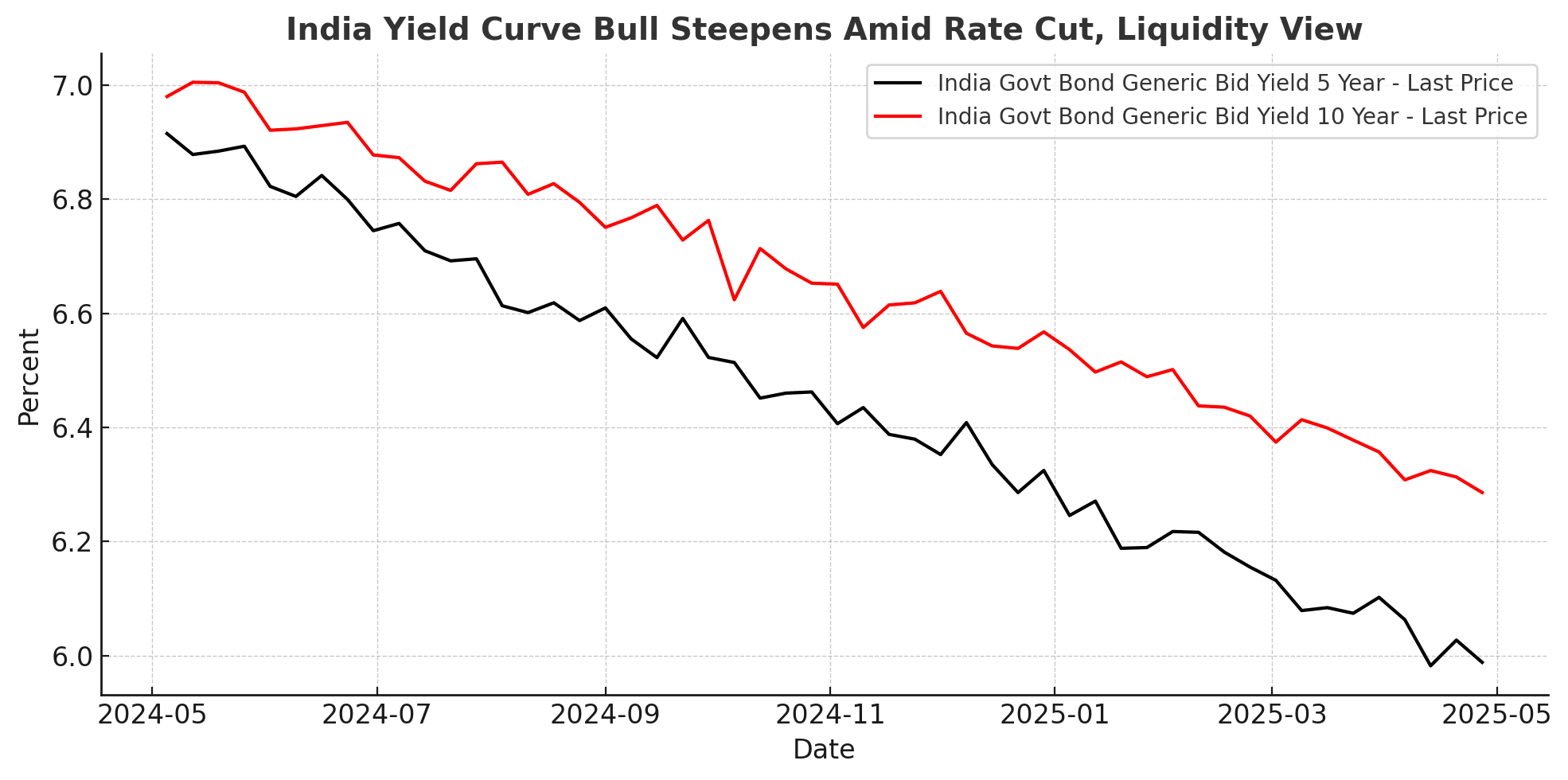
Source: Bloomberg
This chart shows India’s 5-year (black) and 10-year (red) government bond yields from May 2024 to April 2025. From mid-2024 to early 2025, yields on both 5-year and 10-year G-Secs generally softened, reflecting rate cut expectations. The drop in shorter maturities signals a bull steepening, where long-term yields fall less than short-term ones, suggesting optimism for growth recovery.
Returns: Long-Term Vs Short-Term Bond Investments
The returns received from long-term and short-term bonds depend on different parameters, such as bond ratings, issuer, current market conditions and interest rates. If you compare the returns from bonds based on maturity period, always ensure that you compare similarly rated bonds from the same category so that a clear picture of comparison is available.
1. Historical Returns Of Short-Term Vs Long-Term Bonds
In the Indian market, short-term bonds have historically delivered modest but stable returns, typically ranging between 5–6%, with lower sensitivity to interest rate changes. Long-term bonds, while offering higher average yields of 6–7%, have shown greater volatility due to rate fluctuations. Over the past decade, long-term bonds outperformed during rate-cut cycles, whereas short-term bonds excelled in rising rate environments2.
Note: The above comparison of the returns is presented for government bonds only. Please note that for corporate bonds of different ratings, the historical returns will change. For example, if you look at the historical return of ‘A’ rated corporate bonds, it ranges between 6.5% - 7.2% for a 5-year period. For a short term of 1 year, this return is around 7.5% - 8%. These figures are based on trends observed from Nifty’s Corporate Bond Indices3.
2. How Inflation Impacts Bond Returns
Interest rates typically increase due to inflation, which in turn decreases bond prices and increases bond yields. As inflation rises, new bonds issued with higher interest rates are more attractive to investors, lowering the market price of older bonds with lower yields.
3. Tax Efficiency Of Long-Term Vs Short-Term Bonds
The investor's income slab determines the tax rate on interest earned on taxable bonds. As per the July 2024 amendment, the long-term bonds held for more than 12 months are subject to LTCG tax at 12.5% without indexation, whereas short-term bonds are subject to STCG tax at the slab rate.
Which Bond Duration Matches Your Financial Goal?
The process of deciding between short-term and long-term bonds should always begin with one’s financial goals, rather than only considering returns. The maturity period of bonds determines how long your money is invested, how sensitive the bond is to shifts in interest rates, and how easily you can access it.
Knowing about bond duration will help an investor make a suitable investment that corresponds to future cash flow needs. Although the maturity of the bond indicates when the principal will be paid back, the duration forces an investor to realise how sensitive the bond price is to changes in interest rates.
Financial Goal | Recommended Bond Type | Typical Bond Maturity | Why It Fits |
| Emergency fund or short-term savings | Short-term bonds | Up to 3 years | Better liquidity and lower interest rate risk |
| Saving for a planned purchase | Short-term bonds | 2–5 years | Stable returns with easier access to funds |
| Regular income generation | Combination of short-term and long-term bonds | Varies | Balances liquidity with consistent income |
| Retirement planning | Long-term bonds | 10 years or more | Suitable for long investment horizons and predictable income |
| Portfolio diversification | Mix of short-term and long-term bonds | Multiple maturities | Reduces overall portfolio risk through diversification |
Instead of choosing a bond based only on the corresponding yield, an investor should make a detailed analysis of the maturity period of the bonds and how that fits his/her plans. Accordingly, it is possible to achieve the correct investment duration corresponding to the investment goals.
Interest Rate Cycles And Bond Duration
The major influence on the pricing of bonds comes from interest rates. They determine the return of each investor in both short-term and long-term bonds. There is also a relationship between the changes in interest rates and some parameters of the portfolio of an investor.
1. Rising Interest Rates
If interest rates go up, the prices of short-term bonds will generally decrease relatively little. This is explained by the fact that short-term bonds have shorter maturity periods compared to long-term bonds. Therefore, long-term bonds are more sensitive to interest rates as they are fixed for a longer time than short-term bonds.
2. Falling Interest Rates
When interest rates are reduced, the situation is different. Old long-term bonds with higher interest rates become more sought-after because the new bonds offer lower rates of interest. Investors holding bonds with longer duration may profit from capital gains and receive interest income at the same time.
3. Why Long-Term Bonds Fluctuate More
The main reason for the volatility of long-term bonds is their long duration. This means that investors need to be aware of duration risk, which indicates a higher degree of volatility. Some investors like to invest in long-term bonds despite the volatility because they hope to earn more profits in the future.
4. Understanding Duration Sensitivity
Although duration and maturity of bonds are closely connected, they differ from each other. A long-maturity bond may have lower duration if it regularly pays more in coupon payments. On the other hand, low coupon bonds are more sensitive to duration risk because the investment is paid back only at maturity.
Laddering Strategy
Instead of limiting themselves to only short or long-term bonds, many knowledgeable investors create portfolios of bonds by utilising a different technique, i.e., the bond ladder. This strategy entails the purchase of bonds of varying maturities, thus ensuring someone’s finances will be used effectively.
A bond ladder is an investment method that enables an investor to buy bonds with differing maturity dates as opposed to spending one's money on a single bond with an identical maturity period.
1. Bond Ladder
The investor places his money into several bonds characterised by different maturity dates in case of using this investment method.
For instance, instead of buying a single 10-year bond, an investor might choose to buy a 1-year and a longer bond. The funds from this maturing bond can be reinvested into newer bonds with the best market conditions.
In a way, an investor can gain benefits from both short and long-term bonds.
2. Staggered Maturities
One of the most prominent benefits of laddering is its ability to provide diversification through the usage of different time horizons of bonds.
Since bonds have different maturities, investors reduce the exposure of their portfolio to the fluctuations of interest rates. Some bonds mature faster than others and allow investors to reinvest at the current levels of interest rates while other investments keep generating regular income.
3. Managing Reinvestment Risk
Reinvestment risk arises when the bonds reach maturity and have to be reinvested in the period of low interest rates.
Laddering reduces this problem as only a part of the portfolio matures at one particular moment in time. Thus, investors do not tie their funds to the one particular interest rate environment, making their portfolio more flexible in shifting market conditions.
4. Better Liquidity
The laddering technique also increases liquidity. Thanks to staggered maturity, clients have a chance to access cash when the bonds reach maturity without the necessity of selling the bonds at the secondary market.
Rather than selecting only short-term bonds or only long-term bonds, a laddered portfolio provides a practical balance between liquidity, stable income, and interest-rate management.
Risks To Know Before Investing
Bonds generally carry lower risk sensitivity as they are debt instruments, often backed by collateral. However, long-term bonds tend to be more vulnerable to interest rate fluctuations. If the RBI maintains its recent neutral stance, market volatility could persist. Since interest rates and bond prices move inversely, rising rates push prices down, while falling rates lift them. Investors must be mindful of timing.
Liquidity and credit risks also play a role, as short-term corporate bonds may offer attractive yields but carry credit risk. A balanced perspective can be achieved by assessing current interest rate dynamics and comparing returns through platforms like the Grip Invest.
Conclusion
Bonds are fixed-income instruments that bring stability to your portfolio. There is a risk in bond investing, but they are less risky than shares as they are non-market-linked and offer predictable returns. The decision on whether to invest in short-term or long-term bonds is to be made according to the needs of your income, your tolerance for risk investing, and your opinion on the market prospects in 2026.
A flattened yield curve in India suggests a conservative approach, offering short-term stability, long-term growth potential, and tax benefits. You should focus on maximising your returns and effectively managing your investments. By balancing duration and diversifying between government and corporate bonds, investors can achieve stability and higher returns. To explore such opportunities, sign up on Grip Invest today and start earning fixed returns of up to 14%.
FAQs On Short and Long Term Bonds
References:
- Reuters, accessed from: https://www.reuters.com/world/india/indian-companies-rush-sell-short-term-debt-rbi-monetary-boost-lowers-rates-2025-05-28/?utm_source=chatgpt.com
- Economic Times, accessed from: https://economictimes.indiatimes.com/markets/bonds/rbis-50-bps-rate-cut-sparks-short-term-bond-rally-long-term-yields-stay-subdued-whats-ahead/articleshow/121672419.cms?utm_source=chatgpt.com
- Nifty Indices, accessed from: https://niftyindices.com/indices/fixed-income/corporate-bond-indices
 |
Author: Grip Invest Editorial Team The Grip Invest Editorial Team is a group of Chartered Accountants, MBA (Finance) graduates, and Qualified Research Analysts dedicated to helping you invest smarter. We dive deep into India's fixed income landscape to deliver content that is accurate, up-to-date, and easy to understand. Whether you're exploring bonds, fixed deposits, or other fixed income opportunities, our guides cut through the noise and give you the clarity to make better financial decisions. |
Want to stay at the top of your finances?
Join the community of 4 lakh+ investors and learn more about Grip Invest, the latest financial knick-knacks, and shenanigans in the world of investing.
Happy Investing!
Disclaimer - Investments in debt securities/municipal debt securities/securitised debt instruments are subject to risks including delay and/ or default in payment. Read all the offer related documents carefully. The investor is requested to take into consideration all the risk factors before the commencement of trading.
This communication is prepared by Grip Broking Private Limited (bearing SEBI Registration No. INZ000312836 and NSE ID 90319) and/or its affiliate/ group company(ies) (together referred to as “Grip”) and the contents of this disclaimer are applicable to this document and any and all written or oral communication(s) made by Grip or its directors, employees, associates, representatives and agents. This communication does not constitute advice relating to investing or otherwise dealing in securities and is not an offer or solicitation for the purchase or sale of any securities. Grip does not guarantee or assure any return on investments and accepts no liability for consequences of any actions taken based on the information provided. For more details, please visit www.gripinvest.in
Registered Address - 106, II F, New Asiatic Building, H Block, Connaught Place, New Delhi 110001


