

Raghuram Rajan: Economic Views, RBI Reforms And Impact On Indian Markets


In his autobiography, ‘I do what I do’, the economist and former RBI governor, Dr. Raghuram G. Rajan, underlines how he received too much press attention during his speeches related to monetary policy. He termed press attention as a double-edged sword. Irrespective of how one evaluates his term as the RBI’s governor, he remains one of the most popular leaders of India’s central bank till date.
He remains one of the most discussed economists in India’s modern financial history, even a decade after his tenure. He made key reforms during his tenure, including debates on inflation, banking reform, and growth strategy. His views continue to shape policy conversations and investor thinking.
Who Is Raghuram Rajan?
Raghuram Rajan was the 23rd Governor of the Reserve Bank of India (RBI), India’s central bank, serving from September 4, 2013, to September 4, 2016. He succeeded D. Subbarao and handed over the office to Urjit Patel.
- Role as RBI Governor
Raghuram Rajan RBI tenure stretched from September 2013 to September 2016. His tenure came at a challenging time, when India was already facing high inflation, a weakening rupee, and global uncertainty triggered by the U.S. Federal Reserve’s announcement of tapering.
During these difficult times, Rajan focused on restoring India’s macroeconomic stability by prioritizing tools like inflation targeting India, currency stabilisation, and rebuilding investor confidence. His clear communication style and firm monetary stance helped steady markets amid volatility.
- Academic background
Raghuram Rajan’s RBI career was built on a solid academic career. He was a scholar throughout his academic years. He studied engineering at IIT Delhi, followed by management studies at IIM Ahmedabad, and earned a PhD from MIT.
He later became a Professor of Finance at the University of Chicago Booth School of Business. His research focused on economic factors, including financial systems, banking risks, and economic development, themes that later influenced his central banking policies.
- Global recognition
Even before his RBI tenure, Rajan gained international recognition as the Chief Economist and Director of Research at the International Monetary Fund (IMF). Notably, he warned about risks in the global financial system before the 2008 crisis, which later enhanced his credibility.
He also authored a book, Fault Lines, which won the Financial Times/Goldman Sachs Business Book of the Year award and examined structural weaknesses in the global economy. These achievements strengthened his reputation as a serious and independent economic thinker.
Major Reforms During His RBI Tenure
Raghuram Rajan’s tenure is well remembered for several influential RBI reforms India. Some of the key reforms he brought about during his tenure include:
1. Inflation Targeting Framework
One of the most significant RBI reforms in India during Rajan’s leadership was the move toward a formal inflation targeting framework. Instead of loosely defined monetary objectives, the RBI began focusing clearly on controlling consumer price inflation.
This shift toward inflation targeting India improved policy predictability and strengthened the credibility of the central bank. Stable inflation helped anchor expectations and improve long-term investment confidence.
2. Banking Sector Cleanup (Asset Quality Review)
Rajan initiated a comprehensive Asset Quality Review (AQR) to address the growing problem of non-performing assets (NPAs) in Indian banks. Rather than allowing hidden stress to accumulate, the RBI pushed banks to recognise bad loans transparently. Though this led to short-term pain in the banking sector, it improved long-term financial discipline and transparency.
3. Monetary Policy Discipline and Repo Rate Management
During Raghuram Rajan’s RBI tenure, repo rate decisions were closely aligned with inflation control goals. Initially, rates were kept tight to fight inflation. Once inflation showed signs of moderation, gradual cuts followed.
Economic Views And Public Statements
Raghuram Rajan's economic views have been reformative, which has been evident in his policies and public statements. Some of the most noteworthy statements made by him include:
- He has consistently emphasised that sustainable economic growth depends on strong institutions, disciplined financial systems, and investment in human capital.
- His statements have also cautioned against relying too heavily on any single growth strategy, particularly manufacturing-led expansion without parallel improvements in education and productivity.
- Rajan has also stressed the importance of central bank independence and credible monetary policy to maintain inflation control.
- In his public commentary, he has also often highlighted the risks of ignoring structural weaknesses in pursuit of rapid growth, arguing that long-term stability matters more than short-term economic headlines.
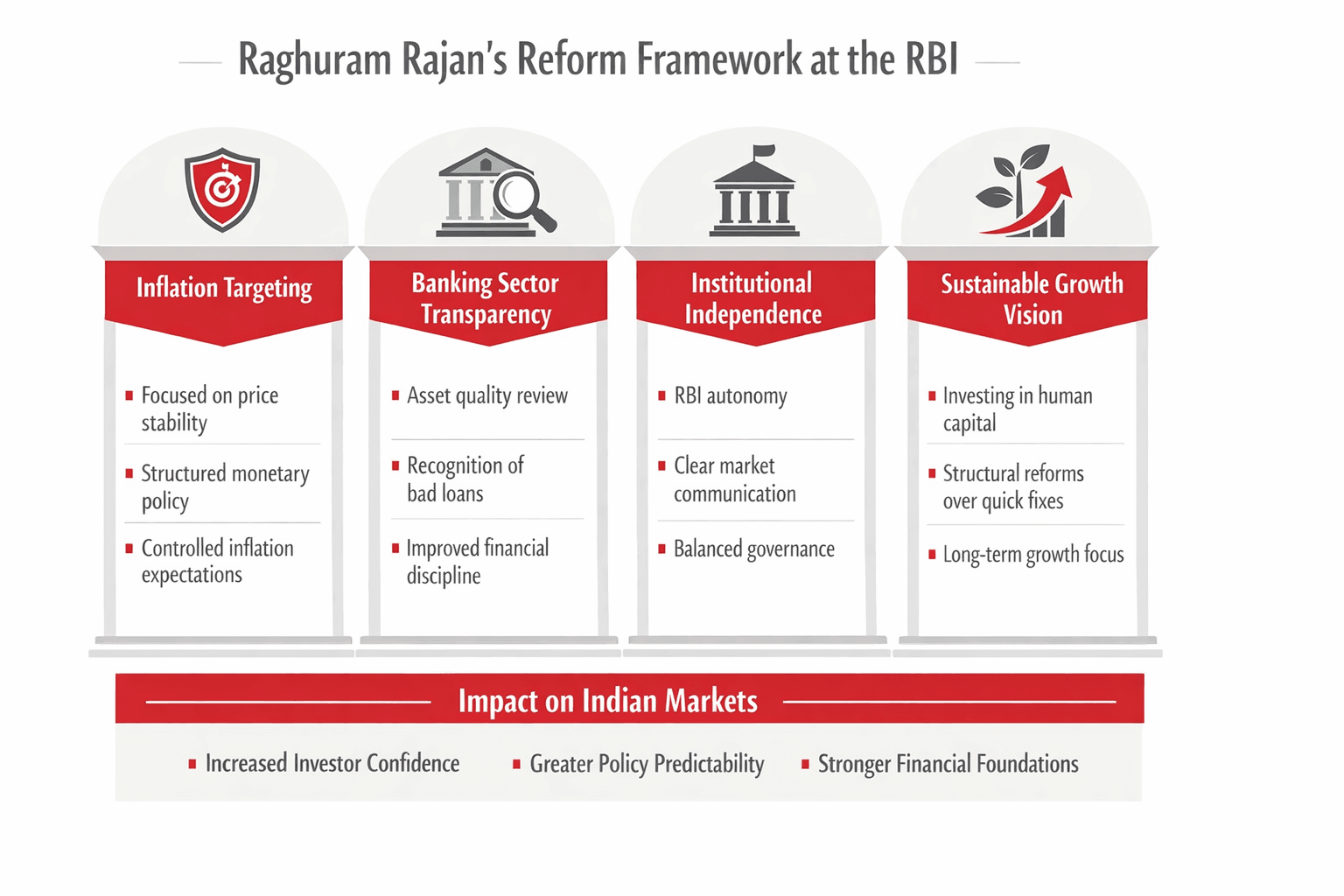
What Investors Can Learn from Rajan’s Policies
Rajan’s policies have been an example of how stability-focused decision-making and institutional discipline can strengthen long-term economic foundations.
1. Policy credibility is important:
Rajan showed that policy credibility is important during his tenure in office. His clear ideas, along with constant communication, reduced economic uncertainty. This is a clear lesson that when investors trust institutions, risk premiums go down, and long-term capital flows become steadier.
2. Controlling inflation is important:
Rajan put price stability first, making it clear that high inflation and long-term growth cannot coexist. It showed that regulated inflation protects people's buying power, stabilizes currency movements, and makes stock and bond markets more predictable.
3. Markets are stronger when they are open:
His push for banking changes to recognise problematic loans showed that dealing with financial difficulties early on makes you stronger in the long run. Short-term volatility may go up, but in the long run, open systems make investors more confident and asset values more accurate.
4. Structural reforms are better than quick fixes:
Ranjan's strategy teaches us another important lesson: long-term repairs work better than short-term ones. His policies showed that major institutional changes lead to long-term stability. Quick stimulation may make people feel better for a short while, but for the market to stay strong, there needs to be strict regulation, good banking practices, and reliable monetary frameworks.
Conclusion
Raghuram Rajan’s tenure at the RBI was defined by discipline over drama. At a time of high inflation, currency pressure, and global uncertainty, he chose credibility, transparency, and structural reform over short-term comfort. His push for inflation targeting, banking cleanup, and stronger monetary frameworks did more than steady markets — it reshaped how India thinks about macroeconomic stability.
What this really means is simple: sustainable growth depends on sound institutions, controlled inflation, and financial transparency. Markets reward credibility over noise, and long-term capital flows where policy is predictable.
For investors today, that lesson still holds. Platforms like Grip Invest operate within the broader financial ecosystem shaped by such reforms — where disciplined regulation, transparent risk assessment, and stable monetary policy create a more structured environment for fixed-income and alternative investments. In the end, strong central banking and informed investing go hand in hand, building confidence not just for markets, but for investors planning their financial future.
FAQs
1. When was Raghuram Rajan RBI Governor?
Raghuram Rajan served as the 23rd Governor of the Reserve Bank of India. His tenure started in September 2013 and ended in September 2016. His tenure was marked by high inflation and currency volatility in India.
2. What reforms did he introduce?
Raghuram Rajan introduced several major RBI reforms in India, including inflation targeting, banking sector cleanup through the Asset Quality Review, and disciplined monetary policy aligned with inflation control.
3. What are his views on Indian economy?
Raghuram Rajan emphasizes structural reforms, strong institutions, financial discipline, and human capital development as essential drivers of sustainable economic growth.
Want to stay at the top of your finances?
Join the community of 4 lakh+ investors and learn more about Grip Invest, the latest financial knick-knacks, and shenanigans in the world of investing.
Happy Investing!
Disclaimer - Investments in debt securities/municipal debt securities/securitised debt instruments are subject to risks including delay and/ or default in payment. Read all the offer related documents carefully. The investor is requested to take into consideration all the risk factors before the commencement of trading.
This communication is prepared by Grip Broking Private Limited (bearing SEBI Registration No. INZ000312836 and NSE ID 90319) and/or its affiliate/ group company(ies) (together referred to as “Grip”) and the contents of this disclaimer are applicable to this document and any and all written or oral communication(s) made by Grip or its directors, employees, associates, representatives and agents. This communication does not constitute advice relating to investing or otherwise dealing in securities and is not an offer or solicitation for the purchase or sale of any securities. Grip does not guarantee or assure any return on investments and accepts no liability for consequences of any actions taken based on the information provided. For more details, please visit www.gripinvest.in
Registered Address - 106, II F, New Asiatic Building, H Block, Connaught Place, New Delhi 110001


