

Open Market Operations: Meaning, Working And Impact On Bond Yields



What Are Open Market Operations?
Open Market Operations (OMOs) are transactions through which the Reserve Bank of India (RBI) buys or sells government securities in the open market to manage liquidity in the banking system. These transactions influence the amount of money available to banks and other market participants, which can affect interest rates and bond market conditions.
The OMO meaning in a given situation would depend on the direction of the transaction. When the RBI purchases government securities, it injects liquidity into the banking system. On the other hand, when it sells these securities, it absorbs liquidity. The aim behind it is to address changes in liquidity conditions without relying solely on policy-rate adjustments.
OMOs can influence demand for government bonds, affecting bond prices and yields. However, their impact depends on the size of the operation, the securities involved and prevailing market conditions. This usually involves outright purchases and sales or transactions that are designed to influence yields across different maturities.
How Do RBI Open Market Operations Work?
RBI open market operations work by transferring funds between the central bank and market participants through government securities transactions. The direction of the transaction determines whether liquidity enters or leaves the banking system.
OMO purchase
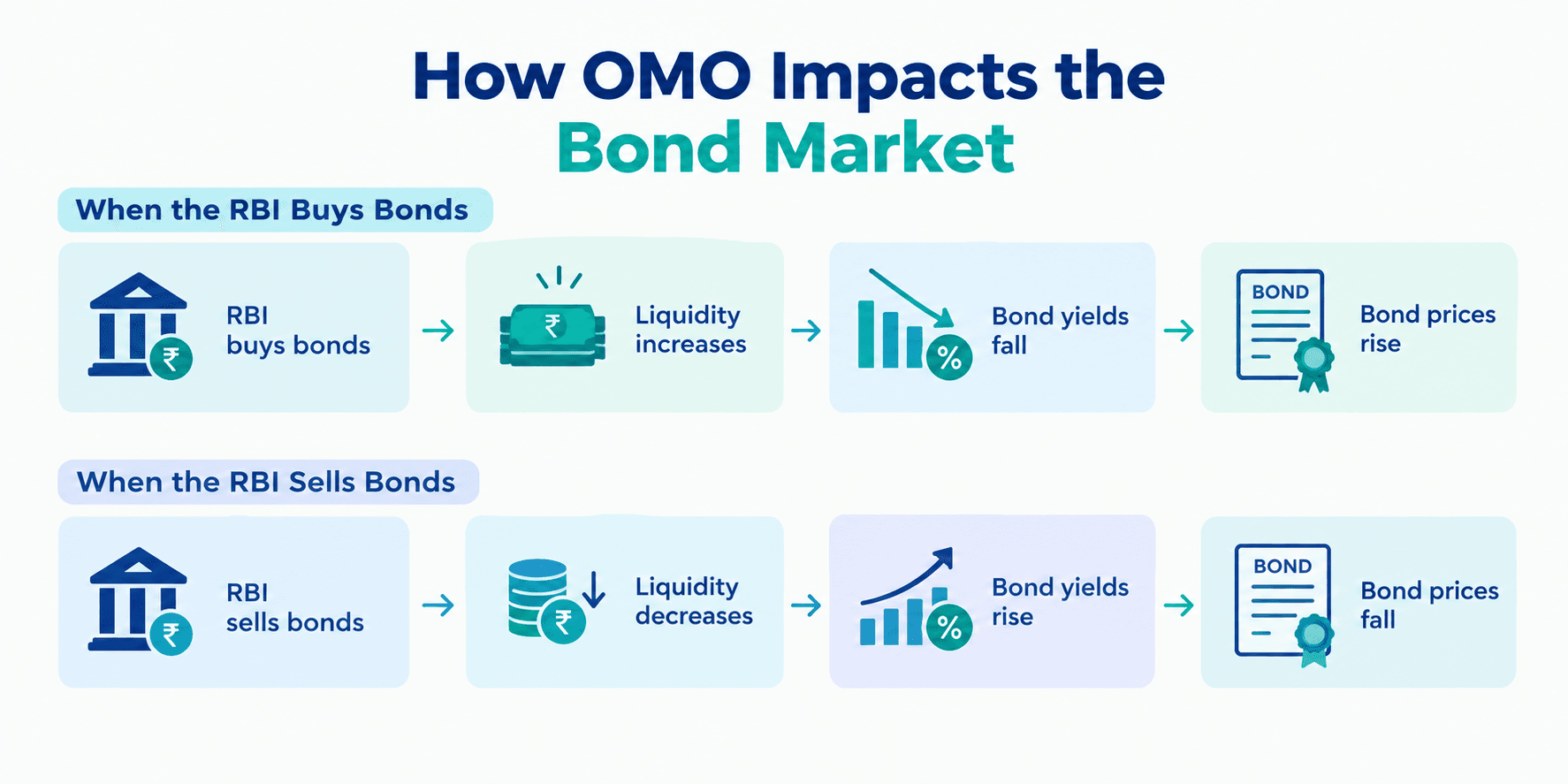
When RBI buys government securities from market participants, it is an OMO purchase. The payment made by the RBI for the securities adds funds to the banking system, increasing available liquidity. Greater demand for government bonds may also support bond prices and put downward pressure on yields.
OMO sale
In an OMO sale, the RBI sells government securities to market participants. Buyers pay for the securities, reducing the funds available in the banking system and absorbing liquidity. Depending on market conditions, this can put upward pressure on bond yields.
These purchases and sales can be done by RBI through auctions:
- RBI announces the securities and auction details.
- Eligible participants submit their bids through the e-Kuber platform.
- Bids accepted are settled under the terms of the auction.
Operation Twist
Apart from outright purchases and sales, the RBI can conduct Special OMOs. Also known as Operation Twist, these involve buying longer-term government securities while selling shorter-term securities to influence the yield curve.
Why Does RBI Conduct Open Market Operations?
The RBI conducts open market operations primarily to manage liquidity in the banking system. Changes in liquidity can influence short-term interest rates, bond market demand and borrowing conditions. OMOs allow the central bank to respond by injecting or absorbing funds through government securities transactions.
1. Manage Liquidity
OMO purchases can inject funds into the system when liquidity is insufficient. Managing liquidity usually boosts lending activity and eases market conditions. Conversely, when liquidity is in excess, OMO sales can drain funds. This helps prevent excess liquidity and avoid downward pressure on short-term rates.
2. Bond Market
Open market operations and liquidity also link through their effects on bond markets. Demand for government securities can increase because of purchases, which in turn can push prices up and yields down. Whereas, sales can increase the supply of securities available to the market, which can bring lower prices and higher yields.
3. Influence Yield Curve
RBI may also undertake transactions in securities of different maturities for influencing the yield curve. These operations may help in reducing the discrepancies in borrowing costs across maturities.
However, these are potential effects, not guaranteed outcomes. The effects are not automatic. Market conditions, banking system participation and the broader economic environment influence how much an OMO changes liquidity, the bond market and yields.
How Do OMOs Affect Bond Prices And Yields?
Open market operations by the RBI can influence bond prices and yields by changing liquidity and demand for government securities. This happens because bond prices and yields generally move in opposite directions. So, when a bond’s price rises, its yield falls, and when its price falls, its yield rises.
What happens when RBI purchases government securities?
When the RBI purchases government securities, it increases demand for those securities. As the demand increases, it pushes bond prices up and yields down. This may also influence yields on other debt securities as market participants respond to changing borrowing conditions.
What happens when RBI sells government securities?
When the RBI sells government securities, it absorbs liquidity and increases the supply of securities available to market participants. If demand does not rise accordingly, bond prices may decline, and yields may increase.
But the effect can differ by maturity. Further, OMO buying does not always reduce yields, and OMO selling does not always increase them. The end result depends on market expectations, the size of the transaction and the current economic conditions.
So, a longer-term bond can act differently than a shorter-term bond. For instance, in an Operation Twist, RBI buys longer-term securities while selling shorter-term securities to influence the yield curve.
What Do OMO Decisions Mean for Bond Investors?
Understanding OMO decisions gives bond investors the context of changes happening in market yields. As OMO decisions can influence bond prices, yields and the broader conditions in which debt securities are traded, they are one of the factors that investors should consider alongside individual bond characteristics and other prevailing market conditions
Demand and Pressure
When the RBI purchases government securities, the demand increases, pushing the yields down. This means that the existing bonds with higher coupon rates may become more valuable. Conversely, OMO sales can push the yields upward, potentially reducing the market value and demand of existing bonds.
Yield to Maturity
Investors who evaluate debt securities can consider yield to maturity (YTM). It reflects the annualised return implied by a bond’s price and promised payments if held until maturity, subject to the assumptions involved. Maturity and credit risk are also relevant when assessing corporate bonds.
However, the impact varies according to a bond’s maturity, duration and credit risk. Longer-duration bonds are generally more sensitive to yield changes. On the other hand, corporate bonds may respond differently from government securities because their yields also reflect credit risk. Investors must keep such factors in mind while evaluating the impact of OMO decisions.
Recent OMO Activity And What Investors Should Watch In 2026
RBI’s OMO activity in 2026 has showcased how the central bank can change the direction of its operations as liquidity conditions change. Early in the year, tight banking system liquidity and high state government borrowing led to large OMO purchases aimed at injecting funds into the banking system.
This included a INR 1 lakh crore purchase programme split into two tranches in late January and early February, followed by another INR 1 lakh crore plan through INR 50,000 crore purchases on March 9 and March 13.
By September, the liquidity position had shifted, with surplus durable rupee liquidity prompting the RBI to use OMOs for liquidity absorption. A INR 1 lakh crore OMO sale programme was conducted in three tranches: INR 50,000 crore on September 17, INR 25,000 crore on September 21 and INR 25,000 crore on September 28.1,2
For investors, the key point to watch is the direction of open market operations India. Purchases can add liquidity and potentially put downward pressure on bond yields, while sales can reduce liquidity and potentially put upward pressure on yields. The size, timing and securities involved can also provide context for movements in bond prices and yields.
FAQs

Want to stay at the top of your finances?
Join the community of 22 lakh+ investors and learn more about Grip Invest, the latest financial knick-knacks, and shenanigans in the world of investing.
Happy Investing!
Disclaimer - Investments in debt securities/municipal debt securities/securitised debt instruments are subject to risks including delay and/ or default in payment. Read all the offer related documents carefully. The investor is requested to take into consideration all the risk factors before the commencement of trading.
This communication is prepared by Grip Broking Private Limited (bearing SEBI Registration No. INZ000312836 and NSE ID 90319) and/or its affiliate/ group company(ies) (together referred to as “Grip”) and the contents of this disclaimer are applicable to this document and any and all written or oral communication(s) made by Grip or its directors, employees, associates, representatives and agents. This communication does not constitute advice relating to investing or otherwise dealing in securities and is not an offer or solicitation for the purchase or sale of any securities. Grip does not guarantee or assure any return on investments and accepts no liability for consequences of any actions taken based on the information provided. For more details, please visit www.gripinvest.in
Registered Address - 106, II F, New Asiatic Building, H Block, Connaught Place, New Delhi 110001


