

Reliance Communications Share Price Analysis - What Investors Should Know In 2026


Introduction To Reliance Communications
Reliance Communications Ltd. (RCom), established by Anil Ambani, was a major player in India’s telecom boom, becoming a leading operator in the early 2000s. At its height, it held over 20% of the market, symbolizing innovation and connectivity for millions.
Monitoring RCom’s stock price is valuable for retail investors, as it serves as a stark example of the risks tied to aggressive debt-driven growth and industry upheaval, key lessons for navigating fast-changing sectors like telecom.
Current Snapshot Of Reliance Communications
As of September 2025, RCom is mired in bankruptcy proceedings, with its operations nearly at a standstill. The company’s stock price is hovering near historic lows, trading between Rs 1.35 and Rs 1.44 on the NSE, a far cry from its peak above Rs 800 in prior years.
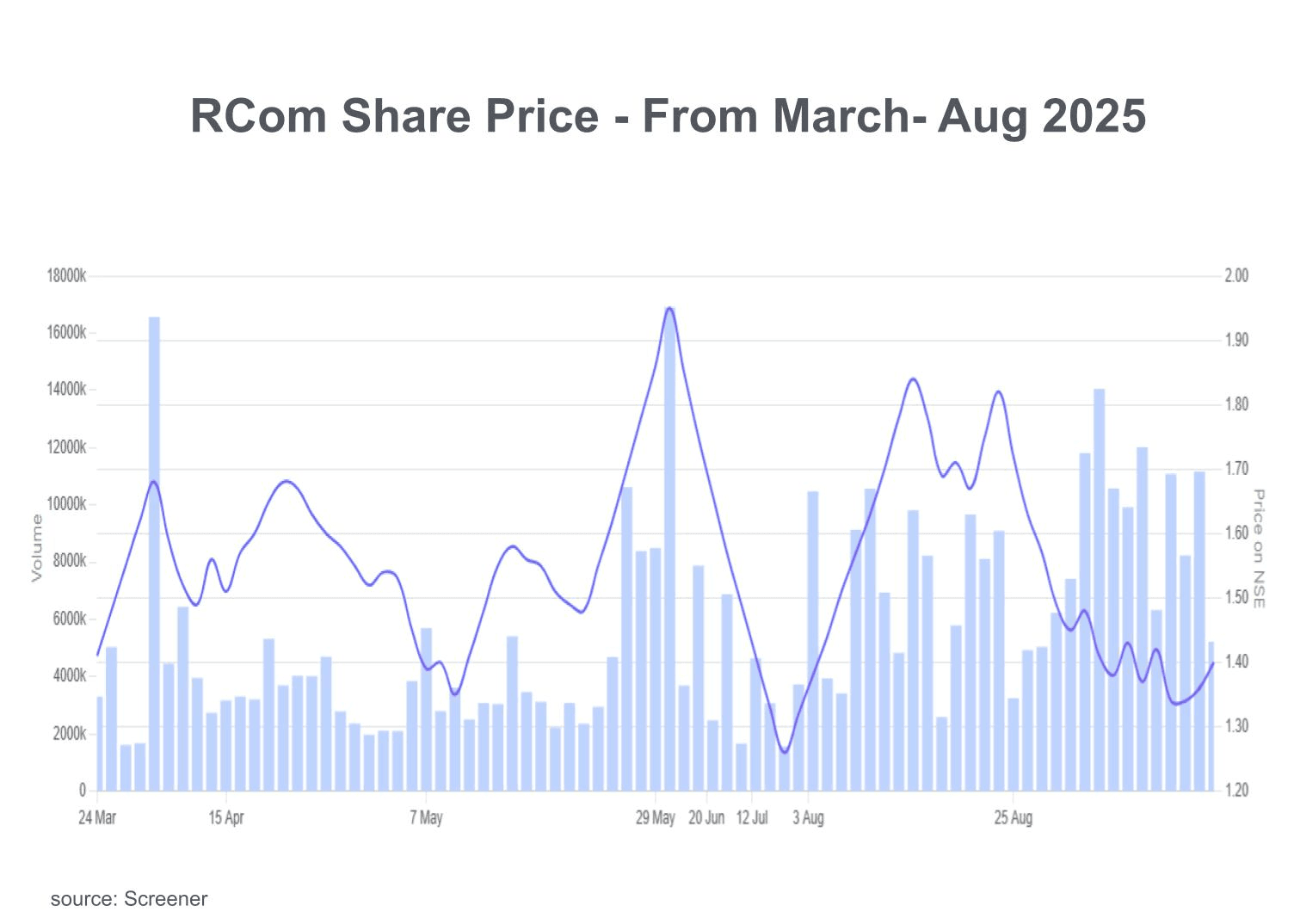
Investor confidence has plummeted, eroded by recent fraud declarations from major banks and persistent insolvency battles, leaving little hope for the stock’s recovery.1
Also Read: Unitech Share Price Analysis
Why Did Reliance Communications Crash?
RCom’s dramatic collapse provides critical lessons for investors:
Massive Debt and Overexpansion: RCom amassed over Rs 45,000 crore in debt to finance spectrum purchases and network expansions. Misguided capital decisions and overly ambitious growth led to a severe cash flow crisis, ultimately triggering insolvency2
Disruptive Price Wars: The entry of Mukesh Ambani’s Reliance Jio sparked intense price competition, slashing margins across the telecom sector. Unable to compete with Jio’s low-cost offerings, RCom rapidly lost its market position.
Governance Issues and Legal Troubles: The company faced accusations of poor corporate governance, unsuccessful asset sales, and legal battles, including contempt petitions against Anil Ambani, further damaging its reputation3
Regulatory Pressures: High spectrum auction costs, accumulating AGR dues, and evolving regulatory policies added significant financial strain.
What Happened After The Crash?
Investors suffered massive losses as RCom’s value plummeted following its 2019 insolvency filing under the NCLT. Efforts to restructure debt faltered, and asset sales fell short of generating needed funds. With liabilities still under dispute, retail shareholders are left with little hope for recovery, prioritized last in the process4.
How Does RCom Compare With Its Surviving Peers?
| Company | Market Cap (Cr) | Subscribers (Cr) | Debt (Cr) | Current Status |
| Reliance Comm. | <100 | Virtually Nil | 45,000+ | Bankrupt, insolvent |
| Airtel | 600,000+ | 35+ | 150,000+ | Growing, resilient |
| Vodafone Idea | 18,000+ | 22+ | 194,900+ | High stress, unresolved |
| Jio | 700,000+ | 46+ | Moderate | Dominant, profitable |
Key Learnings For Retail Investors
1. Do Not Ignore Red Flags: Massive debt, persistent losses, negative news flow, and regulatory troubles are clear signs to tread cautiously.
2. Blue-Chip Names Are Not Always Safe: RCom was a leading player, yet poor strategy and new competition led to its downfall.
3. Diversification Is Essential: Relying heavily on volatile stocks, especially in sectors undergoing disruption can destroy portfolios.
Investing in safer fixed-income options like bonds, SDIs, and corporate FDs can stabilize returns. Bonds provide regular income, reduce portfolio volatility, and ensure creditors (not equity investors) are paid first in insolvency cases.
Why Invest In Bonds Alongside Equities?
Bonds are a critical safety net during equity crashes; their low correlation with stocks adds stability and reduces losses when markets turn volatile. Platforms like Grip Invest enable retail investors to access curated portfolios, listed bonds, SDIs, and FDs, with options for risk management and automatic reinvestment features for maximizing returns. This empowers investors to compound returns and safeguard their financial future, complementing equity holdings with predictable fixed-income assets.
Conclusion
The downfall of Reliance Communications highlights how excessive debt, poor governance, and rapid market shifts can wipe out even the biggest players. For investors, the key lesson is clear: never rely on brand reputation or blue-chip status alone. Building a diversified portfolio with a balance of equities, bonds, and structured debt investments (SDIs) is essential to reduce risk and secure steady returns.
Login to Grip Invest and get easier access to high-quality fixed-income products, helping investors stay resilient in uncertain markets.
References:
1. Equity Pandit, accessed from: https://www.equitypandit.com/historical-data/RCOM
2. Rediff, accessed from: https://www.rediff.com/business/report/three-major-reasons-behind-the-fall-of-anil-ambanis-rcom/20190207.htm
3. Republic World, accessed from: https://www.republicworld.com/business/from-telecom-titan-to-fraud-tag-how-anil-ambanis-rcom-went-to-bankruptcy-and-fraud-cases-from-sbi-boi-and-bob
4. NDTV, accessed from: https://www.ndtv.com/india-news/anil-ambani-reliance-communications-loan-accounts-declared-fraud-by-bank-of-baroda-9219409
Want to stay at the top of your finances?
Join the community of 4 lakh+ investors and learn more about Grip Invest, the latest financial knick-knacks, and shenanigans in the world of investing.
Happy Investing!
Disclaimer - Investments in debt securities/municipal debt securities/securitised debt instruments are subject to risks, including delay and/ or default in payment. Read all the offer-related documents carefully. The investor is requested to take into consideration all the risk factors before the commencement of trading.
This communication is prepared by Grip Broking Private Limited (bearing SEBI Registration No. INZ000312836 and NSE ID 90319) and/or its affiliate/ group company(ies) (together referred to as “Grip”) and the contents of this disclaimer are applicable to this document and any and all written or oral communication(s) made by Grip or its directors, employees, associates, representatives and agents. This communication does not constitute advice relating to investing or otherwise dealing in securities and is not an offer or solicitation for the purchase or sale of any securities. Grip does not guarantee or assure any return on investments and accepts no liability for the consequences of any actions taken based on the information provided. For more details, please visit www.gripinvest.in
Registered Address - 106, II F, New Asiatic Building, H Block, Connaught Place, New Delhi 110001


