

HDFC Bank Stock Price Analysis 2026 – Trends, Forecast & Investment View


The HDFC share price analysis has remained a focal point in the Indian financial landscape, especially after the historic merger with HDFC Ltd in 2023 that led to the bank becoming the largest private sector bank in the country.
Founded in 1994, the bank has been known for its successful business model and has been careful in taking risks.
In 2025, HDFC Bank's stock recovered from post-bonus levels and reached an all-time high of INR 1,020.50 on October 23, 2025. However, 2026 marked a sharp reversal, the stock had lost over 25% YTD by late March 2026, hitting a 52-week low of INR 770 on March 19, 2026. As of March 25, 2026, the stock was trading around INR 781–INR 782 on NSE.2
The investors are mainly holding on to the bank's reputation as one of the safest blue-chip banking stocks India has to offer; nevertheless, there are some worries about the possible credit growth rate. This situation has led the market participants to weigh up the positives against the negatives, which is a sign of the changing view towards HDFC Bank share analysis.
HDFC Bank’s Growth Story: From Consistency To Challenges
For a very long time, HDFC Bank has been well-known for its effective financial performance and the high return on equity (ROE) it achieved on a regular basis, typically maintaining an ROE between 15% and 17% for the past decade3. It declined from 17% in 2023 to 14% in 2025, indicating the challenges arising from its merger with HDFC Ltd and higher provisioning requirements.
The bank's growth strategy significantly evolved after the merger, with its augmented market strength also representing the operational difficulties.
The merger increased high-cost borrowings from 8% to 21%, raising the credit-to-deposit ratio to 110%, which stressed funding and squeezed net interest margins4.
The slower growth of deposits led to the decline of the Current Account Savings Account (CASA) ratio from 44.38% in March 2023 to 34.79% in March 2025, while net interest margins stood at 3.13% for that period5. These numbers demonstrate the effects of the higher competition for low-cost funds and the broader Indian private banks' performance pressure.
The deposit increase rate hit 16.2% for FY25, which was more than the rise in loans; nevertheless, competition and RBI impact on bank stocks still influence investor sentiment6. HDFC Bank is still concentrating on disciplined lending and making the necessary operational adjustments in order to keep the bank's leadership position in its sector. However, its market share faces pressure as private banks like ICICI and Kotak record faster asset growth, and NBFCs saw credit growth of 20% in FY25 compared to 12% for traditional banks, intensifying the competitive landscape7.
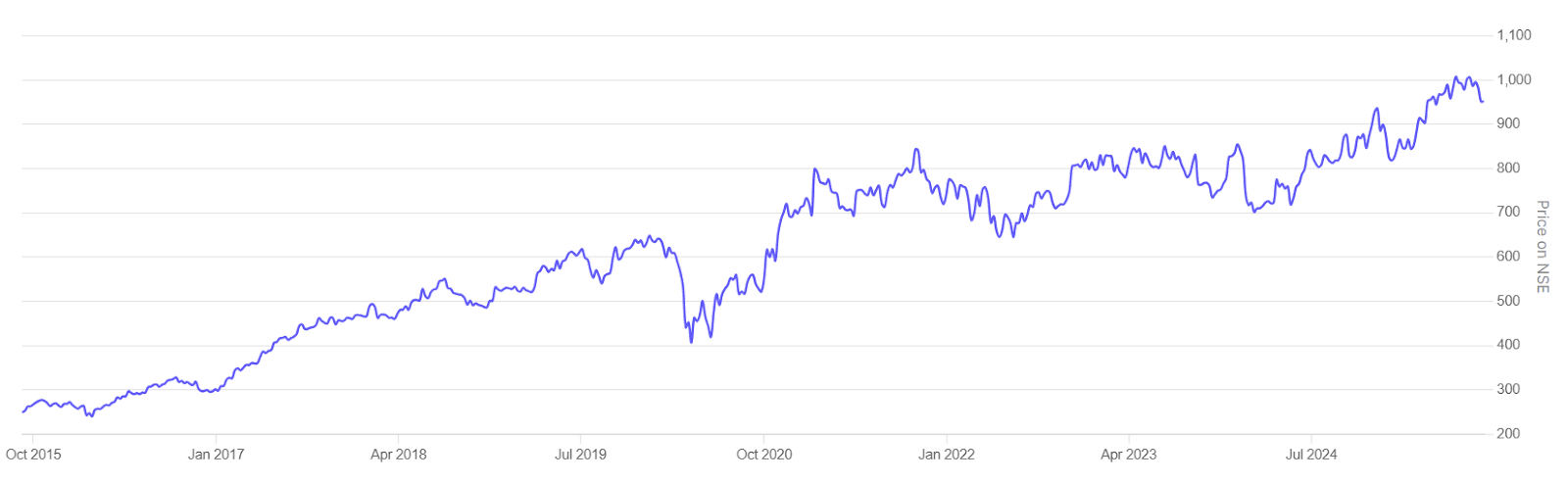
Source: Screener.in8
Building on these challenges, it is essential to delve deeper into how recent events have driven HDFC Bank’s share price performance in 2025.
Latest Updates On HDFC stock
Positive catalysts
- NIM Recovery as interest rates fall: HDFC’s profit margin (NIM) has been under pressure for a while. But RBI has been cutting interest rates, and as they fall the cost of deposits will fall faster than loan yields, directly increasing the bank’s NIM. As deposits are repriced lower following the Reserve Bank of India’s 100-basis-point rate cut, the bank anticipates further tailwinds on this front.
- ECL Provision risk negation: A major concern for investors has been RBI’s new expected credit loss provision, which may require banks to set aside large amounts of its profits as a reserve for possible bad debts. However senior management has reassured investors that it remains well placed considering its prudent provisioning policy, as well as contingent provisions, and doesn't foresee any major impact due to the new ECL norms.
- Lending growth to pick up: Over the past 2 years the bank had purposefully reduced its loan growth since its credit-deposit (CD) ratio had shot up to 110% post its merger with HDFC Ltd. To address this, the bank focussed on improving its deposit base and bringing the ratio down to a more comfortable level. Now that the balance sheet situation has improved, the management believes the bank is in a position to increase loan growth again and expand faster than the overall banking sector.
Negative catalysts
- Governance uncertainty: As discussed above, governance uncertainty due to ethical concerns spooked large investors leading to a sharp stock sell off. Until there is more clarity on board stability, large and institutional investors may continue to stay cautious.
- Issues with inherited loan book: When HDFC bank merged with HDFC Ltd. it inherited a massive home loan portfolio, one concern that could arise is the quality of the loans extended by HDFC Ltd. Since these are longer duration home loans risks may emerge over time. Even a small increase in defaults would impact HDFC bank’s profitability due to the size of the loan book (315 billion USD+). Investors are also cautious because of the uncertainty around future asset quality and return ratios. However, there is limited evidence of major stress in the mortgage portfolio.
The Recent Decline In HDFC Bank Share Price
The recent HDFC Bank share price forecast 2025 discussions have been largely shaped by the 1:1 bonus share issue in August 2025. The HDFC Bank share price on 25 August 2025 was INR 1,964.60, and by 1 September 2025, it had fallen to approximately INR 951.609.
Rising interest rates by the Reserve Bank of India have increased borrowing costs, slowed loan demand, and squeezed bank profits. HDFC Bank lowered fixed deposit and savings rates multiple times in 2025 in response. Loan growth slowed to 5.4% post-merger due to cautious lending10. Broader economic challenges and inflation further dampened investor sentiment.
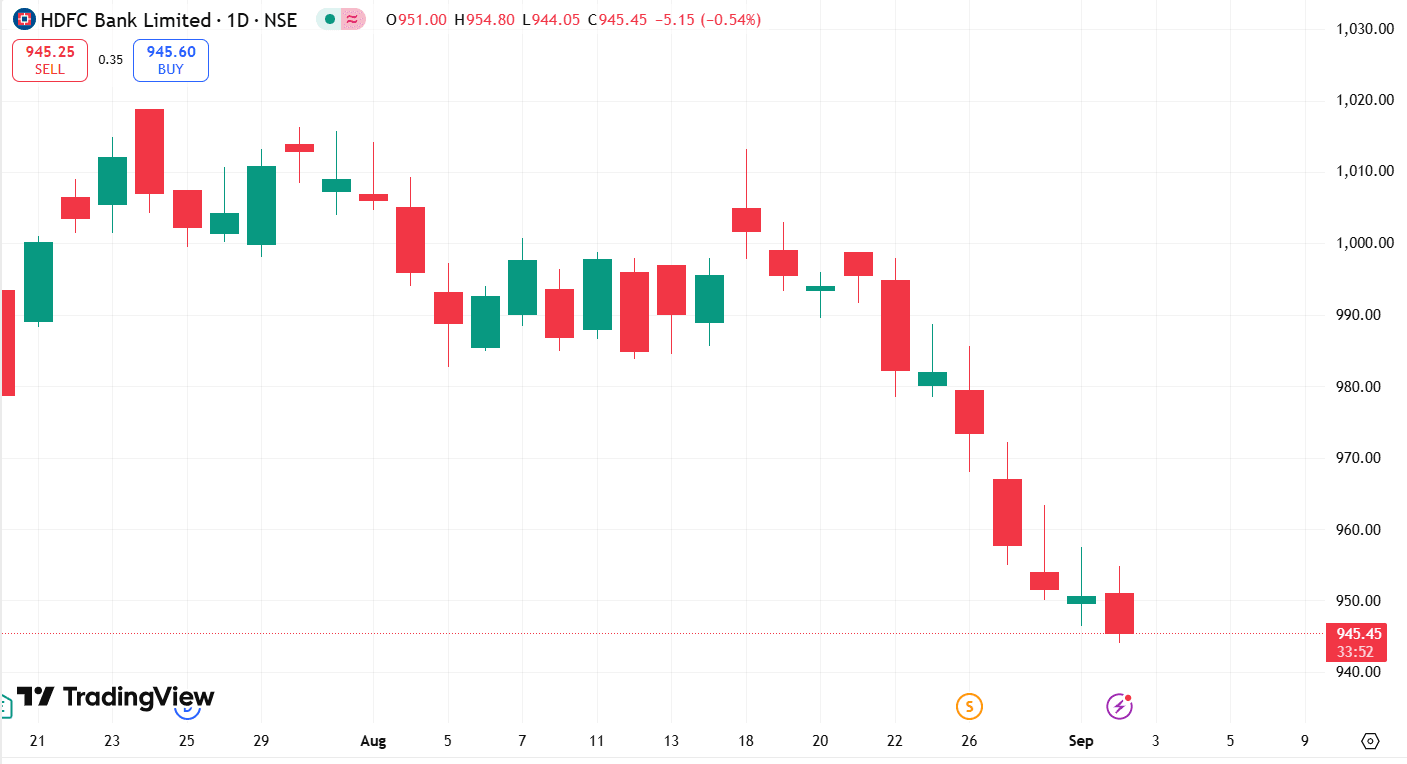
Source: Trading View11
In the face of these fluctuations in the market, the bank gave out a special dividend of INR 5 per share for the financial year 2025-26, with the record date being 25 July 2025 and the payment date 11 August 202512.
HDFC Bank is still occupying a strong position in the sector through its branch network and the operational efficiency that it has, although the competition from the market and investor expectations are there.
With rising competition and pressure on key metrics, questions are emerging about HDFC Bank’s leadership among private banks and what this could mean for retail investors looking ahead.
The 2026 Governance Crisis
On March 18, 2026, HDFC Bank's part-time chairman Atanu Chakraborty resigned with immediate effect, citing "certain happenings and practices" over the past two years that were not aligned with his personal values and ethics.
The next trading session (March 19) saw HDFC Bank shares plunge ~9%, erasing nearly INR 1 lakh crore from its market capitalisation, the steepest single-day fall since the COVID-19 crash of 2020. The stock fell from INR 887.75 to INR 770 (52-week low) in that session.
The fall continued over four consecutive sessions, with the stock dropping over 10% in that stretch. Separately, HDFC Bank terminated three senior executives, including its group head of branch banking over an internal investigation into alleged mis-selling of high-risk Credit Suisse AT-1 bonds to NRI clients through its Dubai branch, adding to investor anxiety.
The RBI subsequently approved Keki Mistry as interim chairman for three months starting March 19, 2026.
Also Read: Most Expensive Share In India: Price, History And What It Really Means For Investors
Analysis With Other Banks
| Name | EPS 12M | P/E | DIV YIELD % | 1YR RETURN % | MAR CAP RS CR |
| HDFC Bank | 49.39 | 15.36 | 1.71 | -20.37 | 1169060.01 |
| ICICI Bank | 75.71 | 16.3 | 0.9 | -13.73 | 883336.25 |
| Axis Bank | 84.89 | 14.6 | 0.08 | 3.5 | 385449.40 |
| Kotak Mah. Bank | 19.39 | 19.85 | 0.13 | -8.63 | 377368.88 |
| IDBI Bank | 8.57 | 8.46 | 2.89 | -19.1 | 78223.70 |
| Federal Bank | 17.63 | 16.16 | 0.42 | 44.63 | 70269.20 |
| IndusInd Bank | 11.41 | 77.82 | 0.17 | 14.45 | 69196.74 |
Source: Screener, *Data as on 20th May 2026
From the above data we analyse how HDFC gives higher dividend yields compared to other banks however its return over one year is the lowest due to governance issues and merger pressures.
Key Lessons For Retail Investors
Retail investors, before considering a long-term investment in HDFC Bank, should understand the following:
- Market Fluctuations And Fundamentals: Although HDFC Bank’s share performance is low, the bank’s robust fundamentals and historical consistency can potentially help it handle market fluctuations. Even blue-chip stocks face short-term variations.
- Long-term Growth And Realistic Expectations: It is still important to factor in long-term growth potential while also confronting immediate challenges, such as the changes in loan growth, risks from regulations, and competition. Investors must keep realistic expectations and avoid decisions based only on market movements.
- Importance Of Diversification: Diversification is still the rule of the game, which, by concentrating less on the holdings, even in well-established firms like HDFC Bank, can help in reducing the risk. Keeping a diversified portfolio across different sectors can be a key to withstanding economic and market changes.
- Governance Risk Is Real: The 2026 HDFC Bank episode underscores that even blue-chip stocks face sudden governance-driven sell-offs. Investors should monitor boardroom changes, regulatory filings, and management conduct, not just quarterly financials
Conclusion
The stock of HDFC Bank represents not only the history of the bank but also the difficulties it has undergone due to the merger implementation, competition, and the RBI's impact on bank stocks. Despite the situation, the bank retains its leading position among the private sector banks, and, still, the investors foresee a conservative approach, which indicates that they should carry out a thorough examination and a prudent diversification strategy. To know more about HDFC Stock Price analysis, log in to Grip Invest.
FAQs On HDFC Bank Stock Price
1. How to analyse HDFC Bank Ltd's share price?
To perform HDFC Bank share analysis, digging into the financial ratios, past price trends, sector performance, and recent news will be required. Also, taking into account broader economic indicators and comparing the key metrics of HDFC Bank with those of other peer banks will give an idea of its market position.
2. What is HDFC Bank's technical analysis?
Performing technical analysis for HDFC Bank means the investigation of past price changes, the amount of shares traded, and the use of charts to figure out the trend and find points to buy or sell. To confirm the prevailing market sentiment and the initiation of the trend, technical analysts employ tools such as moving averages, RSI, and MACD.
3. What is HDFC Bank's market capitalisation?
As of September 2nd, 2025, HDFC Bank has a market capitalisation of INR 14,58,945 Crores, which signifies that it was the largest private sector bank in India as well as a major player in the domestic banking sector13.
References:
1. Economic Times, accessed from: https://economictimes.indiatimes.com/markets/stocks/stock-liveblog/hdfc-bank-share-price-live-01-sep-2025/liveblog/123624715.cms
2. Angel One, accessed from: https://www.angelone.in/news/stocks/hdfc-bank-share-price-crashes-nearly-9-to-52-week-low-after-chairman-s-exit-nifty-slides-nearly-600-points
3. Money Control, accessed from: https://www.moneycontrol.com/financials/hdfcbank/consolidated-ratiosVI/HDF01#HDF01
4. Economic Times, accessed from: https://economictimes.indiatimes.com/industry/banking/finance/banking/hdfc-merger-continues-to-remain-a-drag-on-bank-credit-growth/articleshow/122808741.cms
5. Money Control, accessed from: https://www.moneycontrol.com/financials/hdfcbank/ratiosVI/HDF01#HDF01
6. HDFC Bank, accessed from: https://listwr.com/FqVGrw
7. Economic Times, accessed from: https://economictimes.indiatimes.com/industry/banking/finance/nbfcs-outpace-banks-in-credit-growth-in-fy25-bcg-report/articleshow/121774084.cms
8. Screener, accessed from: https://www.screener.in/company/id/1298/consolidated/
9. NSE India, accessed from: https://www.nseindia.com/get-quotes/equity?symbol=HDFCBANK
10. Times of India, accessed from: https://timesofindia.indiatimes.com/business/india-business/hdfc-duos-merger-still-looms-over-industrys-credit-growth/articleshow/122802519.cms
11. Trading View, accessed from: https://in.tradingview.com/chart/FGI1WZXn/?symbol=NSE%3ANIFTY
12. News18, accessed from: https://www.news18.com/business/markets/hdfc-bank-dividend-2025-last-date-to-buy-shares-for-cash-reward-check-payment-date-ws-l-9459624.html
13. Screener, accessed from: https://www.screener.in/company/HDFCBANK/consolidated/#ratios
Want to stay at the top of your finances?
Join the community of 4 lakh+ investors and learn more about Grip Invest, the latest financial knick-knacks, and shenanigans in the world of investing.
Happy Investing!
Disclaimer - Investments in debt securities/municipal debt securities/securitised debt instruments are subject to risks including delay and/ or default in payment. Read all the offer related documents carefully. The investor is requested to take into consideration all the risk factors before the commencement of trading.
This communication is prepared by Grip Broking Private Limited (bearing SEBI Registration No. INZ000312836 and NSE ID 90319) and/or its affiliate/ group company(ies) (together referred to as “Grip”) and the contents of this disclaimer are applicable to this document and any and all written or oral communication(s) made by Grip or its directors, employees, associates, representatives and agents. This communication does not constitute advice relating to investing or otherwise dealing in securities and is not an offer or solicitation for the purchase or sale of any securities. Grip does not guarantee or assure any return on investments and accepts no liability for consequences of any actions taken based on the information provided. For more details, please visit www.gripinvest.in
Registered Address - 106, II F, New Asiatic Building, H Block, Connaught Place, New Delhi 110001


