

Most Expensive Share In India: Price, History And What It Really Means For Investors


A high share price does not necessarily reflect a high valuation. Share prices are the applicable trading value of the stock that is used to trade on the stock exchange. Often, the share price is deemed to be the true value of a stock. When you purchase a stock, you own a minuscule portion of the company. Thus, determining the stock’s worth just by viewing the stock price is rudimentary. You must also understand the core factors shaping the stock price.
Which Is The Most Expensive Share In India Today?
The highest share price in India available for retail investors as of February 3, 2026, is MRF Ltd., trading at a price of INR 1,35,930 per share. The market capitalisation of the stock is INR 56,650 crores, trading both on NSE and BSE.
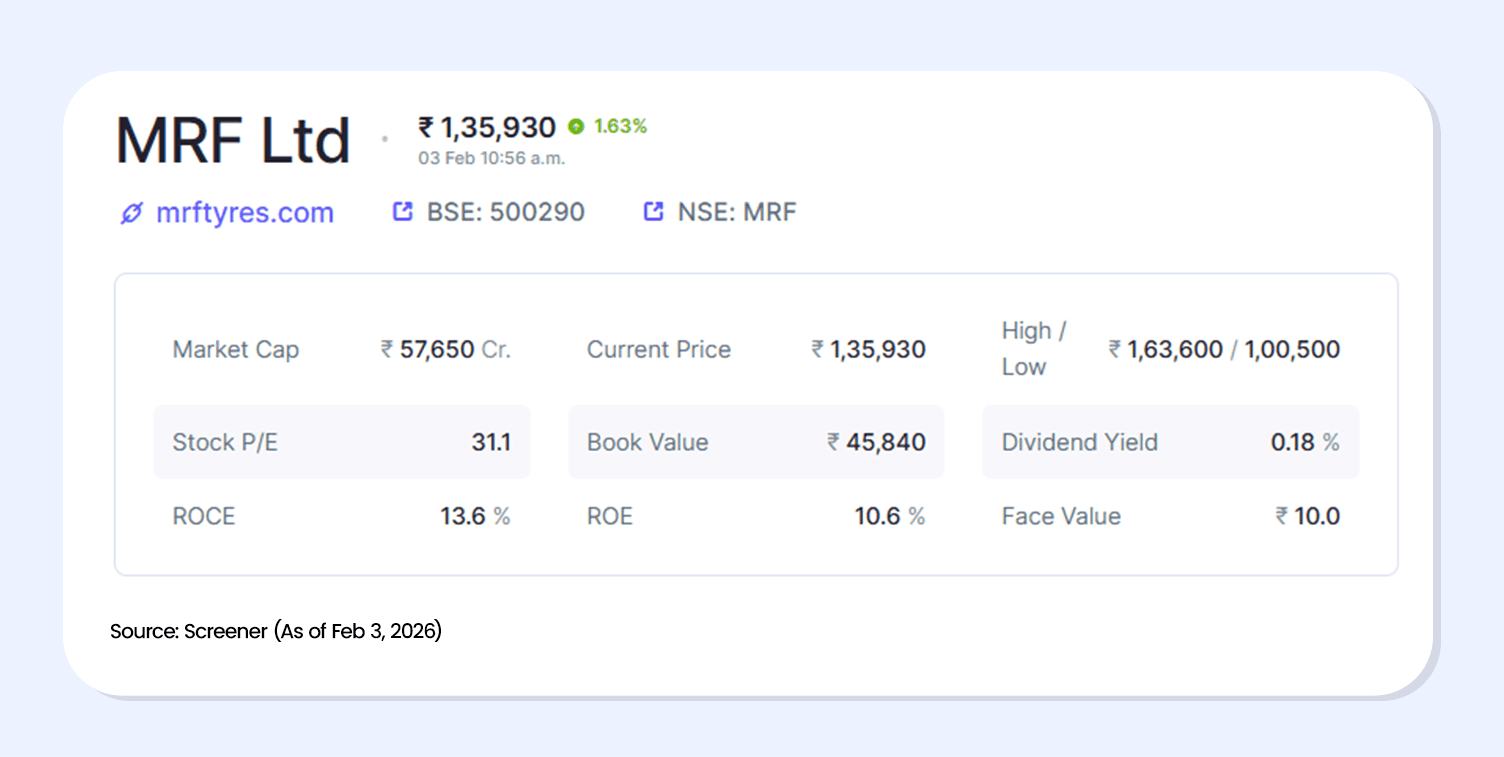
Why Some Shares Are Extremely Expensive
While exorbitant valuations in some stocks, like MRF, may seem unrealistic, these are based on structured fundamentals such as:
- Low Equity Base: A capped authorised capital for companies may limit companies to have a low equity base. If profits are similar, earnings per share (EPS = profit ÷ shares) skyrocket with fewer shares outstanding. Since the share price is typically EPS × P/E multiple, a higher EPS leads to very high prices despite comparable valuations. Promoters keep shares scarce to retain control and fund growth internally, creating premium pricing through supply scarcity.
- Stock Splits Avoided: A stock split cuts a share's price by increasing the number of outstanding shares. This happens by effectively dividing the existing stock into multiple shares. However, firms may avoid stock splits to safeguard their ‘premium’ image. This leads to a supply scarcity. With steady demand but tight supply, buyers bid up the limited shares, pushing prices higher over time.
- Long-term Compounding: As the company grows, profits expand, which further hike its valuation. Long-term compounding keeps stock prices high by letting profits build on profits over decades without adding new shares. For example, if a company earns INR 100 profit today and has 10 shares, the Earnings Per Share (EPS) is INR 10. As years pass, the profit increases to INR 200. With the same number of shares, the EPS becomes INR 20. Year after year, earnings increase, EPS surges, pulling up the price via P/E multiple.
High Share Price Vs High Market Capitalisation
A common misconception regarding high-priced stocks is that a high market capitalisation would equate to a high share price. However, this may not be true. Market capitalisation is:
Share price * Total shares
Market capitalisation showcases the total value of a company. Whereas a share price may only indicate per-share cost, often inflated due to a low equity base or avoidance of stock splits.
For instance, consider the market capitalisation and share price of MRF Ltd and ITC Ltd, as on February 3, 2026.
| Company | Share Price | Market Capitalisation |
| MRF Ltd. | INR 1,35,9303 | INR 57,650 Crores |
| ITC Ltd. | INR 3164 | INR 3,95,610 Crores |
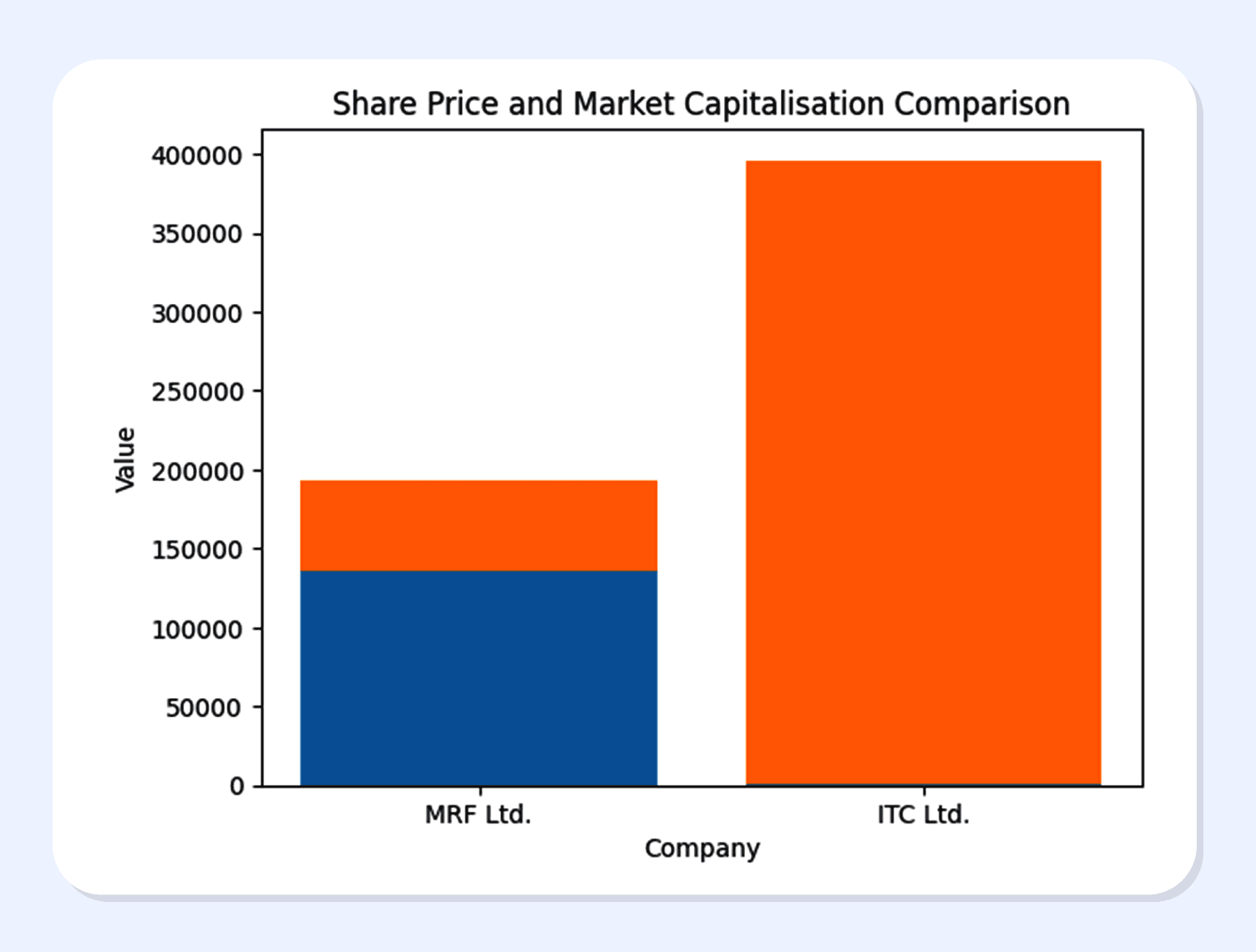
As is evident, MRF’s share price makes up a significant portion of its market capitalisation. On the contrary, ITC’s much larger market capitalisation is primarily constituted by its larger shareholder base.
High market capitalisation signals broad investor trust and stability. Whereas a high share price can signal artificial scarcity. Investors should prioritise market capitalisation alongside P/E and growth metrics over nominal price alone for an accurate assessment.
Should Retail Investors Avoid Expensive Shares?
The share price of a stock is not always a good indicator of its value or growth potential. Here are some reasons why:
- Ignores shares outstanding: While a high trading price may be attractive, the share price alone does not make up the total company size that is shown by market capitalisation. The number of shares outstanding is a key booster of market capitalisation, which is independent of the share price of the stock. For instance, an INR 1 lakh priced stock with few shares (equal to a low market cap) often underperforms an INR 100 ‘cheap’ giant (equal to a huge cap), as total returns may favor scale over high prices.
- Stock splits change the price: When a company splits its shares, the price falls, but ownership value remains the same. A lower price after a split does not mean the stock became cheaper in real terms.
- No link to returns: Price does not predict returns. Returns depend on how much the company grows, not on how expensive one share looks. An INR 100 stock can grow 10 times to INR 1,000 (900% return); an INR 10,000 stock rising 10% yields less absolute growth than the former.
Investors can suitably balance the risk-reward ratio in their portfolios by adding low-risk fixed-income options such as bonds. Platforms like Grip Invest have curated fixed-income options that are stable and less volatile than equity.
Conclusion
Deciding to invest in a stock is a comprehensive process relying on strong fundamental and technical analysis. Merely judging a stock’s worth through its trading price is a mistake that investors must avoid.
A high price can be caused by a low equity base, missing out on stock splits, or through long-term compounding of company profits. Therefore, conducting a thorough assessment of stocks using distinctive metrics and analytical tools is recommended.
FAQs On Most Expensive Share In India
1. Which is the most expensive share in India right now?
As of February 3, 2026, the most expensive share for retail investors to invest in is MRF Ltd., which is currently trading at INR 1,35,930 per share.
2. Why is the MRF share price so high?
MRF’s low equity base of 42 lakh shares, lack of history of stock splits, and long-term compounding have led to a very high stock trading price.
3. Does a high share price mean the stock is overvalued?
No, a high share price does not mean a stock is overvalued. Share price reflects per-share cost, driven by low equity base (few shares), skipped splits, and compounding. Overvaluation can be observed in company ratios such as P/E or P/B.
References:
1. MRF Tyres, accessed from: https://www.mrftyres.com/milestones
2. Motilal Oswal, accessed from: https://www.motilaloswal.com/learning-centre/2025/8/why-is-mrf-share-price-so-high
3. screener, accessed from: https://www.screener.in/company/MRF/consolidated/
4. screener, accessed from: https://www.screener.in/company/ITC/consolidated/
Want to stay at the top of your finances?
Join the community of 4 lakh+ investors and learn more about Grip Invest, the latest financial knick-knacks, and shenanigans in the world of investing.
Happy Investing!
Disclaimer - Investments in debt securities/municipal debt securities/securitised debt instruments are subject to risks including delay and/ or default in payment. Read all the offer related documents carefully. The investor is requested to take into consideration all the risk factors before the commencement of trading.
This communication is prepared by Grip Broking Private Limited (bearing SEBI Registration No. INZ000312836 and NSE ID 90319) and/or its affiliate/ group company(ies) (together referred to as “Grip”) and the contents of this disclaimer are applicable to this document and any and all written or oral communication(s) made by Grip or its directors, employees, associates, representatives and agents. This communication does not constitute advice relating to investing or otherwise dealing in securities and is not an offer or solicitation for the purchase or sale of any securities. Grip does not guarantee or assure any return on investments and accepts no liability for consequences of any actions taken based on the information provided. For more details, please visit www.gripinvest.in
Registered Address - 106, II F, New Asiatic Building, H Block, Connaught Place, New Delhi 110001


