

Rise In STT After The Budget: What The Securities Transaction Tax Hike Means For Investors


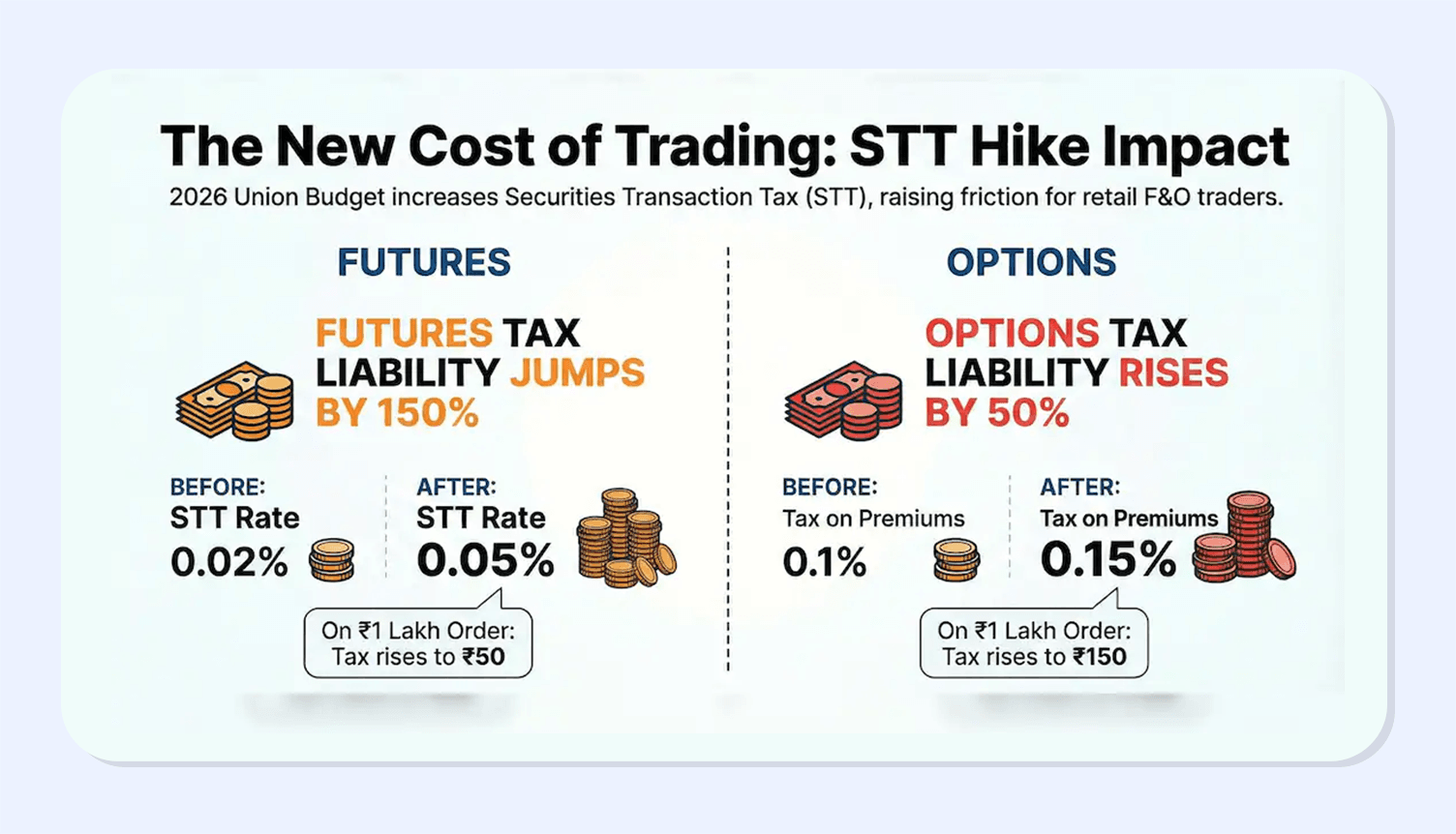
The recent budget had a very important declaration regarding the rise in STT (Securities Transaction Tax) on Futures and Options trading. The budget impact on trading costs includes raising the STT rates (on futures to 0.05%) and options to 0.15%.
With the Securities transaction tax hike, which takes effect on April 1, 2026, policymakers aim to reduce excessive speculation, especially among retail traders, and guide markets toward more sustainable participation while protecting small investors. STT is a tax applied at every point of a transaction, regardless of the outcome of the trade. For retail investors, it affects their long-term net returns, while for traders, it changes their breakeven level.
The announcement of the STT increase impacted social media and trading forums. There were discussions around the long-term impact on trade volumes and profitability. Let us find out what the STT hike means for investors.
What Is Securities Transaction Tax (STT)?
The government charges an equity transaction tax India conducted on the recognized stock exchanges. The STT applies to equities, equity derivatives, and certain fund units and is charged at the time of each transaction. Unlike the capital gains tax, which is linked to profit and the duration of ownership, STT is applied regardless of whether the transaction is profitable. It represents a fixed cost in the stock market's operation.
STT was introduced to promote tax compliance and reduce tax avoidance. Furthermore, STT has generated a consistent source of revenue for the Government of India. The budget STT changes in response to shifts in revenue needs and market participation levels. It remains a usage-based tax, meaning that as trade volume increases, so will the amount collected from the STT.
What Changed: STT Rates After The Budget
The Government of India targets various types of Securities Transaction Tax on certain equity derivative instruments traded on any recognized exchange. Notably, the increase in STT rates after the budget was not meant as a broad-based revenue boost for all participants in the financial market. Instead, the goal could be to protect investors and make derivatives trading sustainable.
The biggest changes were in the futures and options segments. The tax on regular equity delivery and most mutual fund transactions remains unchanged. However, the increased STT on derivatives will raise the cost of trading futures and options, potentially affecting liquidity, hedging strategies, and how traders trade.
Below is a comparison of pre-budget and post-budget STT rates by major asset class. It clearly illustrates the impact of the stock market tax India on trading expenses in the primary market segments:
STT Rates Before vs After the Budget Across Asset Classes
| Asset Class / Transaction Type | STT Rate Before Budget | STT Rate After Budget (Effective 1 Apr 2026) | Key Impact |
| Equity Delivery Trades | 0.10% on buy & sell | 0.10% on buy & sell | No change: long-term investing unaffected |
| Equity Intraday Trades | 0.025% (sell side) | 0.025% (sell side) | No change: intraday traders unaffected by STT hike |
| Futures (Sale) | 0.02% | 0.05% | 150% increase: higher cost for futures trading |
| Options Premium (Sale) | 0.10% | 0.15% | 50% increase: higher transaction cost on options trades |
Impact Of STT Hike On Different Market Participants
The impact of the increase in STT varies widely depending on the investor's style, holding period, and transaction frequency. Knowing how STT affects an investor can help determine how the increase will affect that investor personally.
1. Retail Investors
For many long-term equity investors, the rise in STT after budget is more structural than disruptive. Since traditional buy-and-hold strategies involve only occasional transactions, the modest increase in STT on derivatives doesn’t change the fundamentals of long-term investing. Delivery-focused equity portfolios and systematic investment plans mostly remain unaffected, as STT doesn’t apply to most delivery trades or mutual fund redemptions. However, the government has openly said the increase in STT on futures and options is intended to temper speculative behaviour and protect household savings, given that a large share of retail F&O participants historically incur losses.
2. Active Traders
Active traders, particularly those who use intraday trading and/or trade options and futures, would need to undergo a greater recast than non-active traders. The change in STT rates will increase the cost of every transaction and raise the breakeven point for frequent transactions. Both will affect scalping and high-frequency trading strategies and low-margin trades more than any other type. As a result of increased transaction and break-even costs for STT, a number of traders are reevaluating their trading volume and associated risks to maintain their profits.
What Can Investors Do Following The Increase In STT?
The rise in STT after the Budget requires significant changes to investors' approach to the equity market, especially in F&O, despite altering their portfolios. For many long-term investors, the best response will remain to continue with their long-term investing strategy. Holding investments for longer will naturally reduce the Securities transaction tax hike relative to the overall impact of compounding.
Trading frequency is another consideration for mitigating this impact. By reducing excessive trading and focusing on higher-conviction transactions, investors may be able to offset the Securities transaction tax hike. Also, investors may want to review trading strategies that rely heavily on small price movements, as the higher STT rate will make these strategies less viable.
Investors may also want to consider alternative investment options, as they may be a better approach at this time. Fixed-income investment options can provide more dependable returns but also require far fewer transactions, reducing an investor's exposure to equity transaction taxes India. Bonds and other debt-related investment options will continue to grow in popularity; therefore, investors who use platforms such as Grip may be able to diversify their portfolios without incurring the costs of repeated transactions in the open market.
Conclusion
Here’s the thing. The rise in STT after the Budget is a clear signal that policymakers want to slow down excessive speculation, especially in the futures and options segment, without disrupting long-term investing. For most equity investors, especially those focused on delivery-based investing or SIPs, the impact is limited. But for active and frequent traders, higher STT directly eats into margins and forces a rethink of high-volume, low-margin strategies.
What this really means is that investors now need to be more intentional. Trading less, holding longer, and focusing on higher-conviction positions matters more than ever. At the same time, diversifying beyond equities can help reduce the repeated friction costs that come with transaction-based taxes.
Platforms like Grip Invest fit naturally into this shift. By offering access to fixed-income investments such as bonds and other debt instruments, Grip allows investors to earn predictable returns with far fewer transactions. In a market where trading costs are rising, moving part of your portfolio to low-churn, income-focused assets can be a smarter way to protect returns and stay aligned with long-term financial goals.
Frequently Asked Questions
1. What is Securities Transaction Tax (STT) in India?
A Security Transaction Tax is a tax imposed by a government on the purchase and sale of securities traded on an official exchange. The tax applies to purchases and sales of stocks, bonds, mutual funds, exchange-traded funds, etc., regardless of whether you sell your security or exchange its value for money.
2. How much has STT increased after the Budget?
The exact increase varies by asset class, but the Budget introduced a marginal upward revision in applicable STT rates. Even small percentage increases can have a noticeable cumulative impact on frequent traders.
3. Does higher STT impact long-term investors?
Long-term investors are least affected because they trade infrequently. While the cost does increase slightly, it typically represents a very small portion of long-term returns.
Want to stay at the top of your finances?
Join the community of 4 lakh+ investors and learn more about Grip Invest, the latest financial knick-knacks, and shenanigans in the world of investing.
Happy Investing!
Disclaimer - Investments in debt securities/municipal debt securities/securitised debt instruments are subject to risks including delay and/ or default in payment. Read all the offer related documents carefully. The investor is requested to take into consideration all the risk factors before the commencement of trading.
This communication is prepared by Grip Broking Private Limited (bearing SEBI Registration No. INZ000312836 and NSE ID 90319) and/or its affiliate/ group company(ies) (together referred to as “Grip”) and the contents of this disclaimer are applicable to this document and any and all written or oral communication(s) made by Grip or its directors, employees, associates, representatives and agents. This communication does not constitute advice relating to investing or otherwise dealing in securities and is not an offer or solicitation for the purchase or sale of any securities. Grip does not guarantee or assure any return on investments and accepts no liability for consequences of any actions taken based on the information provided. For more details, please visit www.gripinvest.in
Registered Address - 106, II F, New Asiatic Building, H Block, Connaught Place, New Delhi 110001


