

Union Budget 2026 Key Highlights: Major Announcements, Tax Changes And Economic Focus


Introduction: What Makes Union Budget 2026 Important
On February 1 2026, Finance Minister Nirmala Sitharaman presented the Budget before Parliament1. It outlines how the government plans to raise funds, where it intends to spend and how much it expects to borrow in FY 2026-27.
This edition keeps capital spending at the centre and signals a cleaner tax framework, both aimed at long-term capacity building. The caution is that delivery timelines can slip, and a few measures can increase near-term costs for parts of the market.
This blog brings together the Union Budget key highlights, including both tailwinds and headwinds. The sections ahead explain what changed, what it could influence and what to watch next.
Top Key Highlights Of Union Budget 2026
Here are the Budget 2026 major announcements on taxes, capital expenditure and fiscal targets.
1. Income tax Budget highlights
- Tax slabs stay unchanged for AY 2026-27 and the Income Tax Act, 2025 starts 1 April 20262.
- TCS- Tax Collection at Source is 2% on tour packages and Liberalised Remittance Scheme/ LRS education or medical remittances above INR 10 lakh.
2. Capex Budget highlights
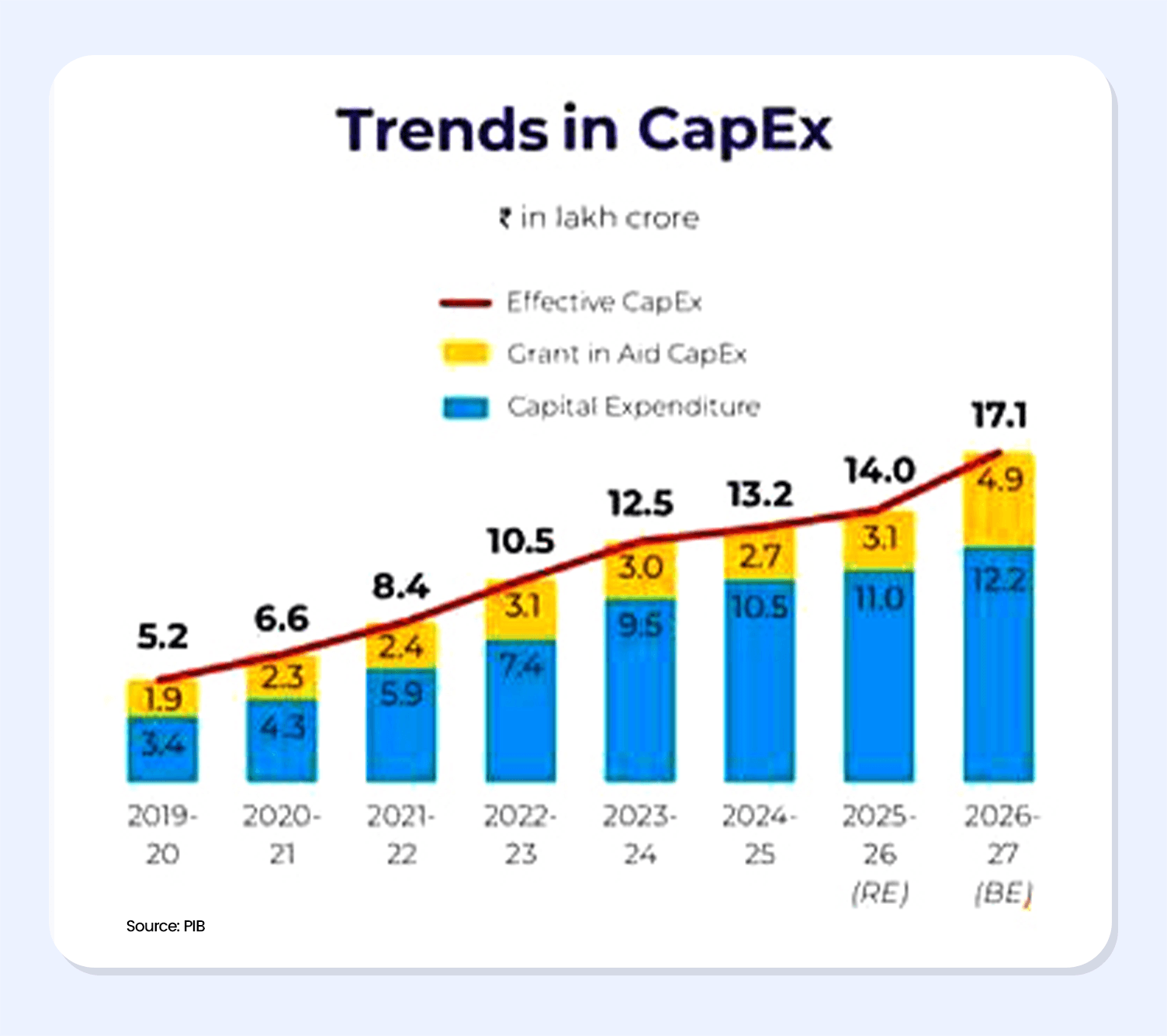
- Public capital expenditure- capex is set at INR 12.2 lakh crore, with effective capital spending of INR 17.1 lakh crore.
- An Infrastructure Risk Guarantee Fund is proposed, and CPSE assets may move into dedicated REITs.
- States get INR 1,85,000 crore as special capital expenditure loans.
3. Fiscal deficit targets
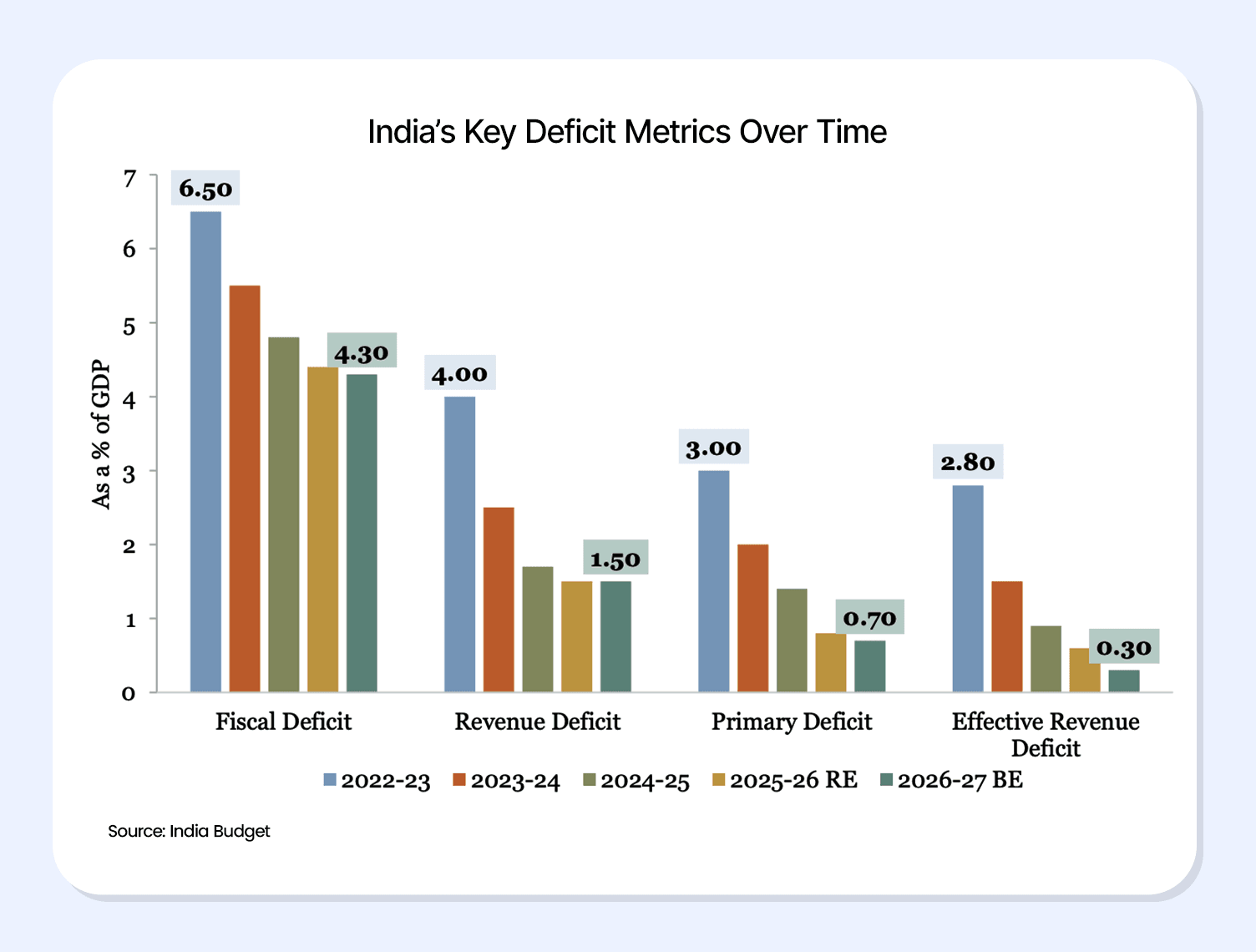
- Fiscal deficit is budgeted at 4.3% of GDP and revenue deficit stays at 1.5% of GDP.
- Total expenditure is INR 53,47,315 crore, up 7.7%, with interest at 26%; receipts are INR 36,51,547 crore, up 7.2%.
- Nominal GDP growth is pegged at 10%, with net borrowing INR11.7 lakh crore and gross INR17.2 lakh crore.
Key Highlights For Individuals And Salaried Taxpayers
The Union Budget 2026 highlights a focus on changes in day-to-day tax filing and common investing decisions5.
1. Personal income tax stays steady: Income tax rates and slabs stay unchanged under both the old and new tax regimes for Financial Year 2026-27.
2. New law and clearer compliance timelines
- The Income-tax Act, 2025, starts from 1 April 2026.
- You can revise returns up to 31 March instead of 31 December, with a small fee.
- Individuals continue to file by 31 July, while non-audit business cases and trusts file by 31 August.
3. Market and investment taxes get tighter
- STT rises on equity derivatives, raising trading costs for futures and options traders (effective from April 1 2026).
| Instrument and trigger | Base used for STT | Earlier rate | Revised rate |
Equity options sale | Option premium | 0.10% | 0.15% |
Equity options when exercised | Intrinsic value | 0.125% | 0.15% |
Equity futures sale | Traded price | 0.02% | 0.05% |
- Buybacks shift to the capital gains route for shareholders, which changes how you compute and report the tax.
4. Less scope to claim interest costs against investment income: You cannot claim interest expenditure as a deduction against dividend income or income from mutual fund units. This matters most if you borrow to invest, since the post-tax return can be reduced after this change.
5. Gold bonds and foreign assets get new conditions
- Sovereign Gold Bonds (SGBs) keep the capital gains exemption at redemption only for original subscribers who hold till maturity.
- Foreign Assets of Small Taxpayers Disclosure Scheme (FAST-DS) 2026 offers a six-month window for smaller foreign disclosures. It covers undisclosed foreign income or assets up to INR 1 crore and unreported foreign assets up to INR 5 crore despite tax payment. The relief and penalties are more defined.
6. Paperwork reduces for demat investors: From 1 April 2027, you can route no Tax Deducted at Source (TDS) declarations through your depository for demat holdings. Depositories can also route Form 15G and Form 15H, which reduces repeat submissions across issuers.
7. Non-resident participation expands in specific routes
- A Person Resident Outside India (PROI) can invest in listed Indian equities through the Portfolio Investment Scheme (PIS).
- The individual PROI limit rises from 5% to 10% and the overall limit rises from 10% to 24%.
- Non-resident experts under notified schemes get an exemption on global income for five years, subject to conditions.
Key Highlights For Businesses And MSMEs
These Union Budget key highlights focus on credit access, working capital, tax clarity and sector push for growth.
MSME credit and cash flow
- A dedicated SME Growth Fund of INR 10,000 crore is proposed to help firms scale and become “champion” SMEs.
- The Self-Reliant India Fund gets an additional INR 2,000 crore to support micro enterprises with risk capital.
- Working-capital stress is addressed through stronger invoice-finance rails, including wider use of Trade Receivables Discounting System (TReDS) in government-linked buying.
Manufacturing, clusters and exports
- The Budget pushes manufacturing through sector schemes such as Biopharma SHAKTI with INR 10,000 crore over five years.
- The Electronics Components Manufacturing Scheme outlay rises to INR 40,000 crore, alongside India Semiconductor Mission 2.0.
- A scheme to revive 200 legacy industrial clusters is aimed at upgrading infrastructure and technology in older manufacturing hubs.
Tax and compliance changes that affect businesses
- “Supply of manpower” is proposed to be treated as “work” for TDS, reducing rate confusion for businesses that hire staffing vendors.
- Small taxpayers get an option to apply electronically for lower or nil TDS certificates, which can reduce follow-ups and paperwork.
- Employee Provident Fund-EPS and Employee State Insurance (ESI) contribution deductions align to the return-filing due date, effective 1 April 2026.
Sector-Wise Budget Highlights
| Ministry | FY 2025–26 Revised Estimates (INR crore) | FY 2026–27 Budgeted Estimated (INR crore) | Change | Key points |
| Science and Technology | 3,086 | 20,091 | 551% | Builds capacity for research, clean-tech work such as carbon capture, utilisation and storage and technology-led public services. |
| MSME | 916 | 1,919 | 110% | Supports targeted competitiveness for small firms through upgrades, productivity and stronger linkages into manufacturing supply chains. |
| Communications | 24,962 | 48,524 | 94% | Expands digital infrastructure that underpins data centres, cloud adoption and export delivery for technology-driven services. |
| External Affairs | 997 | 1,413 | 42% | Strengthens overseas capacity that supports trade, investment facilitation and smoother market access for exporters. |
| Home Affairs and Police (capex combined) | 16,301 | 21,781 | 34% | Funds security capacity and modernisation, supporting implementation and protection of critical assets. |
| Health and Family Welfare | 2,439 | 2,930 | 20% | Supports health infrastructure and aligns with the broader push towards bio-pharma capability and clinical research depth. |
| Space | 5,310 | 6,376 | 20% | Sustains long-cycle mission spending that feeds navigation, earth observation and downstream digital economy applications. |
| Defence | 1,97,417 | 2,31,010 | 17% | Reinforces defence procurement and domestic production, alongside customs duty relief for aircraft parts and maintenance inputs. |
| Commerce and Industry | 4,551 | 5,166 | 14% | Links to the recalibrated Production Linked Incentive approach and customs duty rationalisation for critical manufacturing inputs. |
| Railways | 2,52,000 | 2,77,830 | 10% | Keeps freight and network expansion on track, improving logistics economics for manufacturing and export-oriented sectors. |
| Road Transport and Highways | 2,72,051 | 2,94,167 | 8% | Maintains the highways pipeline that supports capex-led growth through faster movement of goods and lower logistics friction. |
| Housing and Urban Affairs | 32,978 | 34,808 | 6% | Continues urban infrastructure funding that supports construction demand and service delivery in growing cities. |
| Transfers to States (capital) | 1,74,953 | 2,26,382 | 29% | Higher capital transfers expand room for state-led infrastructure and capex execution. |
| Atomic Energy | 12,062 | 9,966 | -17% | Lower capital outlay, even as select duty relief for key nuclear-project equipment supports cleaner long-term capacity building. |
Source: Prime Investor6
Big Economic Signals from Budget 2026
Let us now look at the macro stance:
Growth outlook
- Nominal output is assumed to rise 10%, placing GDP near INR 393 lakh crore in FY 26-277.
- The Economic Survey sees real growth at 6.8% to 7.2%, after 7.4% in FY 25-26.
- Public capex stays at INR 12.2 lakh crore, with a clear tilt towards manufacturing and clean energy.
Inflation and borrowing
- CPI inflation averaged 1.7% from April to December 2025, yet forecasts sit closer to 4.0%8.
- RBI expects 3.9% in Q1 and 4% in Q2, while IMF also prints 4% for the year.
- The deficit is pegged at 4.3% of national output, with net borrowing at INR 11.7 lakh crore.
- Gross issuance is estimated at INR 17.2 lakh crore, shaping bond supply and yield expectations.
What Budget 2026 Means For Investors
Budget 2026 keeps the growth tone intact, led by public spending and a steady fiscal plan.
- The capex push, plus the Infrastructure Risk Guarantee Fund, can support infrastructure-linked themes and companies that benefit from new project pipelines.
- From 1 April 2026 STT rises, thus reducing short-term trading.
- The proposal to tax share buybacks as capital gains changes the maths for buyback-heavy stories, so post-tax returns matter more than headline buyback announcements.
For bonds, supply is a key swing factor. The government has guided gross market borrowing at INR 17.2 lakh crore for FY 2026-27 (net borrowing ~INR 11.7 lakh crore), which can keep yields supported even as the deficit narrows.
For steadier returns, you can consider focusing on credit quality and pick maturities that fit your time horizon, because bond prices can fall when yields rise. Alternatives tied to infrastructure and real assets may see indirect tailwinds from the capex tilt, but they still react to interest-rate moves and liquidity conditions.
Platforms such as Grip may make it easier to browse and compare bonds in one place. You can explore Grip’s curated list of fixed-income opportunities offering up to 12.5% post-tax returns.
Conclusion
Union Budget 2026 reinforces the government’s long-term growth strategy, with capital expenditure, fiscal consolidation, and compliance clarity at the core. By keeping tax slabs stable, targeting a lower fiscal deficit, and sustaining a strong capex pipeline, the Budget aims to balance growth ambitions with macro stability. At the same time, tighter market-linked taxes and changes to buyback taxation signal a shift towards more disciplined capital allocation and transparency.
For investors, the message is mixed but actionable. Equity opportunities may emerge in capex-led and manufacturing-linked sectors, while bond markets will remain sensitive to borrowing levels and yield movements. In this environment, diversification and credit quality matter more than chasing momentum. Platforms like Grip Invest can help investors access curated fixed-income opportunities that complement equity exposure and add stability to portfolios.
FAQs on Union Budget 2026
1. What is the fiscal deficit target in Union Budget 2026?
The fiscal deficit is targeted at 4.3% of GDP, with the revenue deficit at 1.5%, indicating continued fiscal consolidation.
2. Were there any changes in income tax slabs in Budget 2026?
No, income tax slabs remain unchanged for AY 2026–27 under both the old and new tax regimes.
3. How does Budget 2026 impact stock market investors?
Capex-focused sectors may benefit, but higher STT on derivatives and buybacks being taxed as capital gains could affect short-term trading returns.
4. What does Budget 2026 mean for bond investors?
With gross borrowing pegged at INR 17.2 lakh crore, bond yields may stay supported, making maturity selection and credit quality crucial.
References:
1. PIB, accessed from: https://www.pib.gov.in/PressReleasePage.aspx?PRID=2221458®=3&lang=2
2. India Budget, accessed from: https://www.pib.gov.in/PressReleasePage.aspx?PRID=2221458®=3&lang=2
3. PIB, accessed from: https://www.pib.gov.in/PressReleasePage.aspx?PRID=2221458®=3&lang=2
4. India Budget, accessed from: https://www.indiabudget.gov.in/doc/bh1.pdf
5. India Budget, accessed from https://www.indiabudget.gov.in/doc/bh1.pdf
6. Prime Investor, accessed from: https://primeinvestor.in/reports/union-budget-2026/
7. India Budget, accessed from: https://www.indiabudget.gov.in/doc/Budget_at_Glance/budget_at_a_glance.pdf
8. PIB, accessed from: https://www.pib.gov.in/PressReleasePage.aspx?PRID=2220800®=3&lang=2
Want to stay at the top of your finances?
Join the community of 4 lakh+ investors and learn more about Grip Invest, the latest financial knick-knacks, and shenanigans in the world of investing.
Happy Investing!
Disclaimer - Investments in debt securities/municipal debt securities/securitised debt instruments are subject to risks including delay and/ or default in payment. Read all the offer related documents carefully. The investor is requested to take into consideration all the risk factors before the commencement of trading.
This communication is prepared by Grip Broking Private Limited (bearing SEBI Registration No. INZ000312836 and NSE ID 90319) and/or its affiliate/ group company(ies) (together referred to as “Grip”) and the contents of this disclaimer are applicable to this document and any and all written or oral communication(s) made by Grip or its directors, employees, associates, representatives and agents. This communication does not constitute advice relating to investing or otherwise dealing in securities and is not an offer or solicitation for the purchase or sale of any securities. Grip does not guarantee or assure any return on investments and accepts no liability for consequences of any actions taken based on the information provided. For more details, please visit www.gripinvest.in
Registered Address - 106, II F, New Asiatic Building, H Block, Connaught Place, New Delhi 110001


