

SEBI Eases Rules For Investment Advisers And Research Analysts


Introduction
The recent regulatory update by the Securities and Exchange Board of India (SEBI) marks a major shift in how advisers and analysts enter the market. Under the new SEBI IA RA rules 2025, eligibility criteria have been widened, and compliance burdens eased. This matters for those who offer financial advice, and for those seeking credible investing guidance in India. The update forms a crucial part of SEBI news 2025 because the changes aim to open pathways for more professionals to become advisers and analysts while maintaining minimum competency standards.
Also Read: SEBI warning against Unregistered OBPP
What Exactly Did SEBI Relax
1. Graduates of any field can now become Investment Advisors (IAs) or Research Analysts (RAs) by registering with SEBI. No longer required: undergraduate degree in finance, commerce, business management or economics.
2. Nevertheless, it is important to receive the corresponding certification. Particularly, the required candidates are required to possess a valid certification by the National Institute of Securities Markets (NISM) or a similar recognised qualification.
3. The amended framework also applies to “persons associated with investment advice,” making sure all those influencing advisory recommendations meet the new qualification benchmark.
4. Other regulatory relaxations under the broader reform proposal include easing requirements related to corporate structure, address proof, and certain compliance formalities for firms seeking registration under IA/RA regulations.
These changes are part of a wider set of regulatory updates labelled under SEBI regulatory changes 2025, aimed at enhancing participation in investment advisory and research services.
Why This Matters For Professionals And The Industry
The earlier framework restricted advisory roles to those with finance-related backgrounds. This limited the pool of potential advisers and analysts, even though many competent professionals outside finance (e.g. economists, engineers, law graduates) might have had strong analytic or market-research skills. With revised SEBI research analyst qualification and adviser eligibility norms, the talent pool grows significantly.
By mandating certification (via NISM or equivalent), SEBI balances inclusivity with competence. This ensures that even as eligibility expands, the advisory ecosystem maintains a baseline of knowledge and ethical conduct.
For advisory firms, the reforms lower barriers to registration and operation. More individuals can become a “registered investment adviser India,” which may help firms scale quickly. It may also encourage independent or boutique advisory practices, boosting competition and innovation in financial advice services.
Also Read: SEBI Mandates NISM Certification For AIF Compliance Officers
What This Means For Retail Investors In India
Retail investors now have access to a wider variety of advisory professionals. The increase in registered advisers could lead to more choices and competitive advisory fees. Since certification remains mandatory, investors can expect a minimum competency standard.
Nevertheless, investors should still verify an adviser’s credentials, as many may not come from a formal finance background. This growth will likely introduce new opportunities along with varied levels of expertise. Going forward, registered advisers may come from more diverse academic paths, provided they meet SEBI’s formal eligibility requirements.
This move can improve accessibility to qualified advice, especially for first-time or small investors. The expanded pool may lead to more adviser availability outside major cities. It supports broader distribution of professional financial advice, strengthening retail investor guidance India.
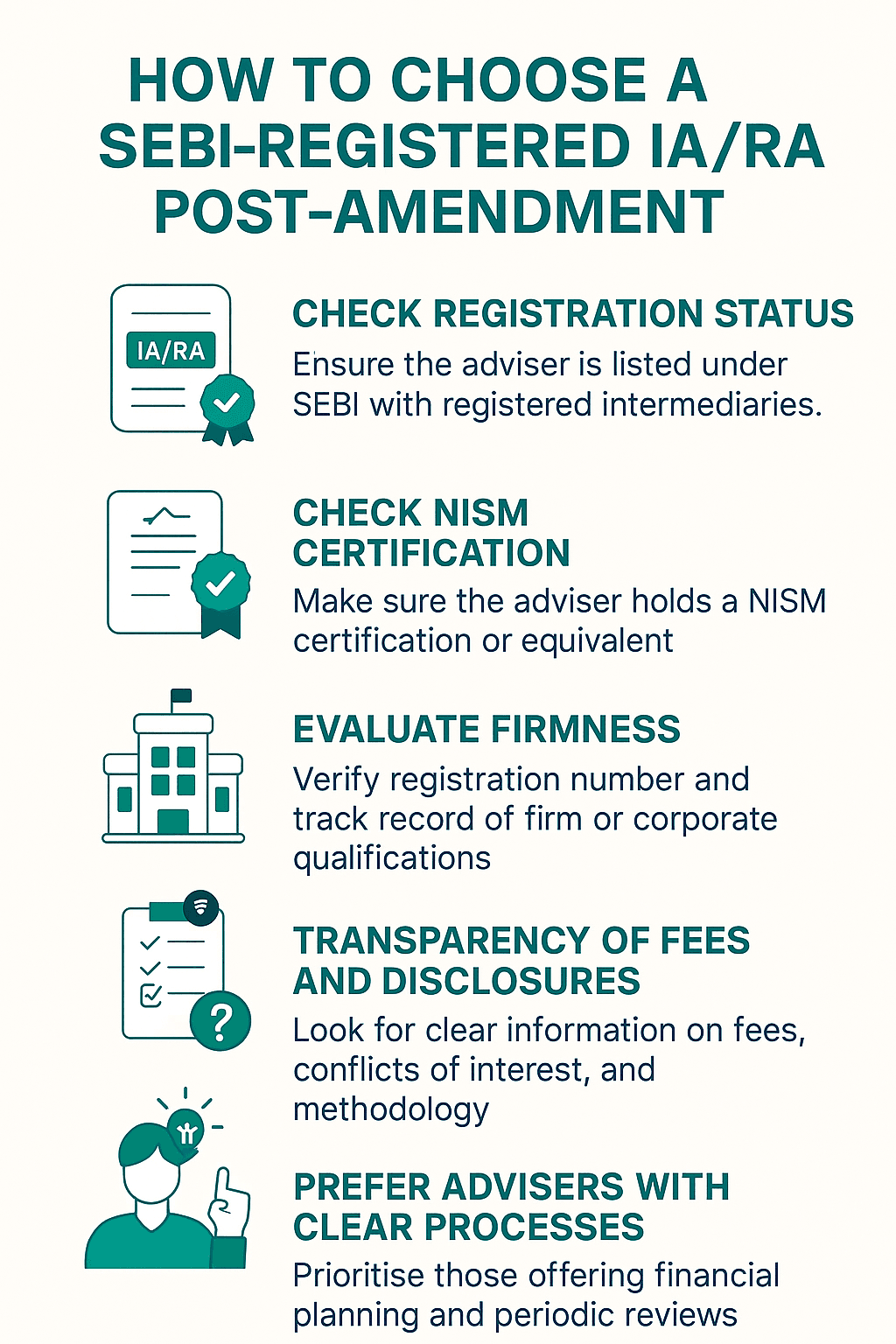
How To Choose A Sebi-Registered Ia/Ra Post-Amendment
When selecting an adviser or analyst, consider these steps:
1. Check registration status: Ensure the adviser is listed under SEBI’s registered intermediaries. Only those registered as a SEBI-registered IA RA (or firm) are authorised to give regulated advice.
2. Check NISM certification: Make sure the adviser is a NISM-certified or in any way equivalent as stipulated in the new framework. This guarantees adherence to standards of SEBI compliance for advisers.
3. Evaluate firmness or corporate qualifications: Among firms, verify registration number, compliance track record, as well as disclosures. More developed or larger firms can provide stronger compliance controls.
4. Transparency of demands in fees and disclosures: According to the investment advisory rules India, advisers are required to disclose fees, conflicts of interest, methodology and risk assessment. Favour advisors who have transparent fee plans and fee reports.
5. Prefer advisers with clear processes for advice: Those who offer personalised financial planning, risk profiling, and periodic reviews tend to be more reliable. Avoid those offering “promised returns” or speculative recommendations; good advisers focus on long-term investing advice India.
Also Read: SEBI’s New Proposal For REITs and INVITs
Hypothetical Example
Assume that a bachelor of mechanical engineering passes the corresponding NISM certification. According to the new regulations, this individual is eligible to apply to be registered as an IA. After registration, they provide services to customers who want long-term investment planning.
An investor seeking advice examines the adviser’s SEBI registration, reviews the adviser’s disclosures, confirms NISM credentials, and checks the fee structure. Such a review helps evaluate compliance with financial advice regulations India and supports safer long-term decisions. Finding all compliant and transparent, the investor engages the adviser.
This situation exemplifies how expanded eligibility, in conjunction with certification and regulatory supervision, may increase access to regulated and proper advice to retail investors. This reflects how expanded SEBI investment adviser eligibility can create more qualified advisory professionals.
Conclusion
The amended SEBI IA and RA rules 2025 mark a meaningful shift toward greater inclusivity and flexibility in India’s investment advisory ecosystem. By expanding eligibility criteria beyond traditional finance backgrounds while still ensuring minimum competency through NISM certification in India, SEBI is enabling a broader and more diverse pool of qualified advisers. These regulatory updates strengthen advisory firms, increase competition, and expand access to professional guidance for investors across the country.
For investors, the SEBI regulatory changes 2025 create more choice than ever before, but also underline the importance of due diligence when selecting advisers. Working with advisers who are SEBI-registered, compliant, and ethically aligned remains essential for safe and informed financial planning.
As India’s advisory landscape evolves, transparency and professionalism will be the foundation of trustworthy financial advice. And as investors seek clarity and stable income solutions, platforms like Grip Invest provide access to curated fixed-income opportunities that complement professional advisory support.
FAQs On SEBI Rules For Investment Advisers
1. Who can register as a SEBI Investment Adviser or Research Analyst under the new rules?
Any graduate from any academic discipline can now apply. However, a valid NISM certification or an equivalent qualification remains compulsory.
2. Do retail investors still need to verify credentials after the new eligibility updates?
Yes. Even with wider eligibility, investors should check SEBI registration details, NISM certification, disclosures, and fee structure before hiring an adviser.
3. Did SEBI completely remove compliance requirements for advisory firms?
No. SEBI has simplified some procedural requirements, but registration, certification, ethical conduct, and mandatory disclosures remain unchanged
Want to stay at the top of your finances?
Join the community of 4 lakh+ investors and learn more about Grip Invest, the latest financial knick-knacks, and shenanigans in the world of investing.
Happy Investing!
Disclaimer - Investments in debt securities/municipal debt securities/securitised debt instruments are subject to risks including delay and/ or default in payment. Read all the offer related documents carefully. The investor is requested to take into consideration all the risk factors before the commencement of trading.
This communication is prepared by Grip Broking Private Limited (bearing SEBI Registration No. INZ000312836 and NSE ID 90319) and/or its affiliate/ group company(ies) (together referred to as “Grip”) and the contents of this disclaimer are applicable to this document and any and all written or oral communication(s) made by Grip or its directors, employees, associates, representatives and agents. This communication does not constitute advice relating to investing or otherwise dealing in securities and is not an offer or solicitation for the purchase or sale of any securities. Grip does not guarantee or assure any return on investments and accepts no liability for consequences of any actions taken based on the information provided. For more details, please visit www.gripinvest.in
Registered Address - 106, II F, New Asiatic Building, H Block, Connaught Place, New Delhi 110001


