

Strait Of Hormuz Crisis Explained: Why Global Oil Prices Are On Edge


The Strait of Hormuz is a critical maritime passage in the global energy system. Carrying about 20% of the world’s traded crude oil, it is one of the most strategically important maritime passages. Located between Iran and Oman, it connects the Persian Gulf to international shipping routes, making it indispensable for major oil exporters.
Its importance has made it highly sensitive to geopolitical activities, and any tension immediately raises concerns about supply stability. Any instability can have global repercussions, influencing oil price spikes, shipping costs, and economic confidence.
Why Closure Fears Are Serious
Recent developments in the Middle East have heightened tensions and increased market uncertainty. Concerns over the Strait of Hormuz’s potential shutdown are not exaggerated; they stem from strategic realities and a long history of regional volatility. Its location at the centre of geopolitical tensions, military presence, and past confrontations makes the situation particularly fragile.
1. Iran’s strategic leverage
One of the biggest reasons for fear of closure is Iran's leverage stemming from its geographic position. Iran, due to its location, has a substantial influence over traffic passing through the Strait of Hormuz. Even though it is unlikely to completely close off the route, mainly due to global consequences, the possibility of it happening has a significant impact on the markets.
This is because a potential crude supply disruption in the Strait of Hormuz would affect exports from key producers such as Saudi Arabia, Iraq, Kuwait, and the UAE. It is especially a sensitive issue for energy-importing economies like India, as their oil supply relies heavily on uninterrupted transit.
2. Military presence of the U.S. Navy
Another factor that is fueling the fear of Strait of Hormuz crude supply disruption is the military presence of the U.S. Navy. The US Navy has been continuously deployed in the region, which highlights the strategic importance of keeping the strait open.
While naval escorts and surveillance operations ensure a safe passage for commercial tankers, their deployment signals an elevated geopolitical risk. Another issue with heavy military deployment is that in such situations, even a small misunderstanding can have devastating results.
3. Past tanker attacks and tensions
The market is also somewhat reacting to past experiences. There have been tanker attacks and regional confrontations in the region before, demonstrating how quickly tensions can escalate in the Gulf. Historically, even limited incidents have caused shipping disruptions, price volatility and negative oil market reactions.
These events reinforce fears that maritime security risks could return, raising concerns over energy flows.
Tanker Dispute Adds To Hormuz Uncertainty (Latest Update)
As per the recent reports, Iran may have sought the return of three tankers seized by India in exchange for ensuring safe passage through the Strait of Hormuz.1 The ships were reportedly detained by Indian authorities near Mumbai over allegations of identity concealment and involvement in illicit oil transfers.
The development came amid ongoing diplomatic engagements between the two countries, as India attempts to secure uninterrupted energy shipments through the region.
However, the Indian government has dismissed these claims as baseless, denying any such negotiations2. While unconfirmed, such developments highlight the fragile diplomatic environment surrounding one of the world’s most critical energy routes.
Even the possibility of conditional access or shipping restrictions can amplify market anxiety, increase risk premiums, and disrupt sentiment around global oil flows, reinforcing how sensitive the Strait of Hormuz oil impact is to geopolitical signals.
Strait Of Hormuz Reopens: What It Means For Oil Prices And Investors In 2026
- Recent developments around the Strait of Hormuz have eased concerns about global oil supply disruptions, with reports of a ceasefire and steps toward reopening the key oil transit route.
- As shipping activity resumes, crude oil prices have started cooling from earlier highs. However, markets continue to track tanker movement, security conditions, and supply recovery.
- A stable oil supply outlook could reduce pressure on fuel-dependent sectors and influence inflation, market sentiment, and energy-related investments.
Oil Price Impact Mechanism
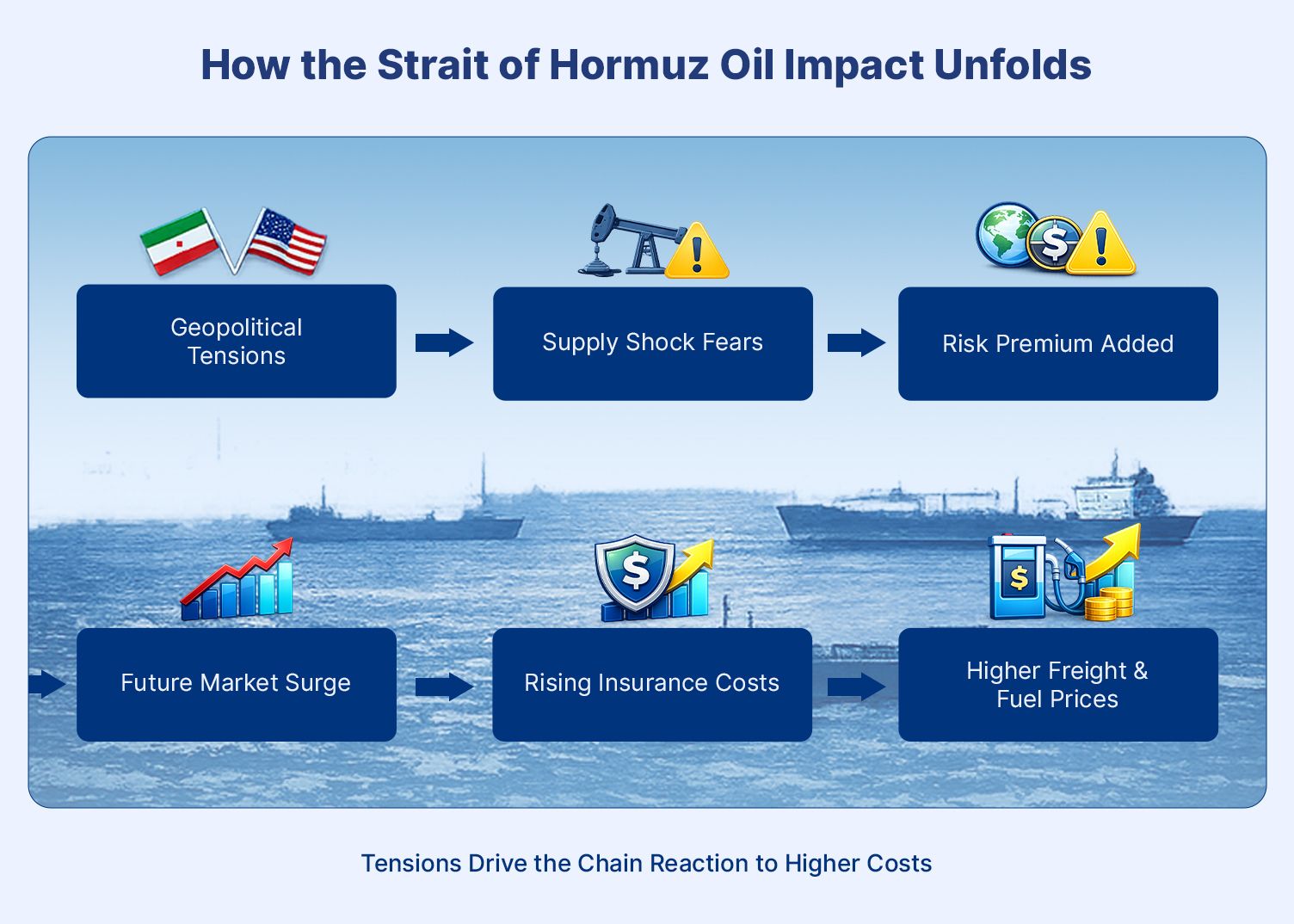
If you look closely, you will realise that the Strait of Hormuz oil impact is not random. It has a clear pattern that goes through the financial and logistical transmission chain. Usually, in such situations, markets respond in stages, starting with fear, then financial pricing, and eventually affecting real-world shipping and supply conditions.
- Supply shock - Risk premium - Futures spike
The reaction chain starts in financial markets as traders sense a possible Strait of Hormuz crude supply disruption and anticipate a supply shock. As a result, markets begin to price in the risk even before any barrels are physically blocked. A Hormuz disruption raises oil freight costs and adds a geopolitical risk premium to crude benchmarks. As risk premiums rise, traders attempt to lock in supply ahead of uncertainty, causing a surge in futures contracts.
- Shipping insurance and freight cost jump
As the chain reaches its second stage, the tension continues to rise, having a clear impact on physical trade logistics. Insurers increase their war-risk premiums for tankers operating in the region, causing a Hormuz shipping insurance premium spike. Shipping companies pass the burden on to buyers, which drives up oil freight costs. What this means is that even when the oil is flowing, transporting it becomes more expensive, causing fuel prices to rise.
- Speculation vs physical shortage
The third and final stage is when the final determination is made, whether the crisis remains financial or becomes physical. So, the initial price increase is largely driven by speculation, hedge fund positioning, and precautionary buying. However, if tensions persist or shipping lanes are actually disrupted, speculative pricing can evolve into a genuine supply shortage.
At that point, inventory levels fall and sustained oil price spikes occur. So now, instead of reacting to speculation, the market is actually undergoing a tangible global supply strain.
Impact On India And Emerging Markets
India is an energy-importing economy; therefore, the Strait of Hormuz is not just a geopolitical flashpoint for it, but also an economic pressure point. And not just India, the Strait of Hormuz oil impact is evident on several emerging markets as they remain highly exposed to any disruption, with potential consequences ranging from inflation to currency volatility.
- The first visible impact under a Hormuz closure scenario would be a rise in crude prices. It is because India imports a significant share of its crude oil through this route, and any escalation will quickly translate into a fuel price hike. Rising crude prices will also push up transportation costs, refinery expenses, and retail fuel rates, affecting economies at the macro and micro levels, with freight movement and household budgets in turmoil.
- As oil prices rise, the country's import bills will increase, pushing it towards inflation. Further, if the disruption persists, it will widen India's trade deficit. The impact will also be evident on the rupee, as it will start depreciating due to capital outflows and rising dollar demand. This would raise energy costs and put pressure on supply chains, manufacturing, and infrastructure across sectors.
- What can make the situation even worse is that the Strait of Hormuz oil impact will not be limited to crude oil. India depends on liquefied natural gas shipments from Qatar, making the Qatar LNG Hormuz route impact particularly important. Any disruption could affect LNG imports, influencing electricity generation and industrial fuel availability, and intensifying energy security concerns.
To wrap it up, even if a full closure of the route does not happen, heightened tensions are enough to fuel the initial stages of inflation, currency instability, and trade balances. For India and other emerging economies, the Strait of Hormuz's impact on oil remains structurally embedded in their energy dependence.
While diversification efforts and alternative sourcing strategies are being explored, geographic realities make complete insulation difficult. Strategic reserves may offer a temporary cushion, but prolonged instability would continue to test economic resilience.
Conclusion
The Strait of Hormuz oil impact is not just about ships and sea routes. It is about how a narrow stretch of water can influence fuel prices in Delhi, inflation trends in Mumbai, and currency stability across emerging markets. Even the fear of disruption can push up oil prices through risk premiums, higher freight costs, and speculative buying.
For India, the vulnerability is structural. Heavy import dependence means any sustained tension in the Gulf can affect fuel prices, trade balances, and overall economic stability. Strategic reserves and diversification efforts offer some protection, but they are buffers, not permanent shields.
What this really means is that geopolitical risk is now part of investment decision-making. Energy shocks ripple through equities, bonds, inflation expectations, and currency markets. Staying informed is no longer optional. Platforms like Grip Invest help investors understand how macro events such as a Hormuz disruption can influence fixed-income opportunities and broader portfolio strategies. In uncertain times, informed allocation matters more than reaction.
FAQs
1. Why is the Strait of Hormuz so important for global oil markets?
The Strait of Hormuz carries nearly 20% of the world’s traded crude oil. Major producers like Saudi Arabia, Iraq, Kuwait, and the UAE rely on this route to export energy. Even the threat of disruption can trigger an oil price spike because global supply chains depend heavily on uninterrupted transit through this narrow waterway.
2. How would a Strait of Hormuz closure affect India?
Under a Hormuz closure India impact scenario, crude prices would likely rise immediately. Since India imports a large share of its oil through this route, higher global prices could translate into fuel price hikes, increased transportation costs, higher inflation, and pressure on the rupee. LNG imports from Qatar could also face disruptions.
3. Why do oil prices rise even if the Strait is not fully closed?
Oil markets react to risk, not just actual shortages. Traders add a geopolitical risk premium when there is fear of a Strait of Hormuz crude supply disruption. This pushes futures prices higher even before physical supply is blocked. Insurance costs and freight rates also rise, increasing overall oil transportation expenses.
4. Does India have alternatives if the Strait of Hormuz is disrupted?
India has strategic petroleum reserves and is working to diversify crude sourcing. However, geographic realities make full insulation difficult. While alternate suppliers and emergency reserves can provide short-term relief, prolonged disruption in the Strait of Hormuz would still pose risks to India’s energy security and inflation outlook.
References:
1. Reuters accessed from: https://www.reuters.com/world/india/iran-has-allowed-some-indian-vessels-pass-strait-hormuz-envoy-says-2026-03-14/
2. Times of India, accessed from: https://timesofindia.indiatimes.com/india/baseless-centre-rejects-report-of-iran-seeking-return-of-3-tankers-seized-by-india-in-return-for-hormuz-safe-passage/articleshow/129614635.cms
Want to stay at the top of your finances?
Join the community of 4 lakh+ investors and learn more about Grip Invest, the latest financial knick-knacks, and shenanigans in the world of investing.
Happy Investing!
Disclaimer - Investments in debt securities/municipal debt securities/securitised debt instruments are subject to risks including delay and/ or default in payment. Read all the offer related documents carefully. The investor is requested to take into consideration all the risk factors before the commencement of trading.
This communication is prepared by Grip Broking Private Limited (bearing SEBI Registration No. INZ000312836 and NSE ID 90319) and/or its affiliate/ group company(ies) (together referred to as “Grip”) and the contents of this disclaimer are applicable to this document and any and all written or oral communication(s) made by Grip or its directors, employees, associates, representatives and agents. This communication does not constitute advice relating to investing or otherwise dealing in securities and is not an offer or solicitation for the purchase or sale of any securities. Grip does not guarantee or assure any return on investments and accepts no liability for consequences of any actions taken based on the information provided. For more details, please visit www.gripinvest.in
Registered Address - 106, II F, New Asiatic Building, H Block, Connaught Place, New Delhi 110001


