

Types Of Hybrid Funds In India For 2026


Seeking a suitable investment opportunity? The primary challenge is balancing market risks and rewards simultaneously. This is where investors can explore the types of hybrid funds ideal for their needs. Let us start with the basics.
What are Hybrid Funds? By definition, it is a type of mutual fund that brings together equity and debt instruments in a single portfolio. It offers benefits like stability and growth potential.
The initial idea of investing in hybrid funds is diversification. These avenues have a way of reducing the impact of market volatility so that investors can achieve better returns. They do this by spreading the investment across asset classes. In 2023, Morningstar global reports stated that hybrid funds had accounted for 12% of the global mutual fund market. This shows their increasing popularity worldwide1.
If you do not know much about the types of hybrid mutual funds available, read on till the end. We will discuss it further in detail in the blog below.
Types Of Hybrid Mutual Funds In India
1. Aggressive Hybrid Funds
The definition of aggressive hybrid funds is just as its name suggests. This type of hybrid fund allocates a large part of the portfolio to equity, and the rest is allocated to debt instruments. In contrast to other types of hybrid funds, these have more growth potential but also come with greater volatility.
- High equity allocation
Through high equity allocation, investors can take part in a growing stock market while also having stability via debt allocation. During market downturns, the debt allocation acts as a support that reduces the overall risk.
These types of funds are unique as they hold up to 65% to 80% in equities. The equity is shared across high-cap, mid-cap, or even small-cap stocks. This allows you to get returns while still having stability.
These funds are very suitable for investors looking for a higher growth potential while being able to handle market fluctuations over a longer investment tenure.
- Ideal for long-term growth seekers
Investors seeking steady growth of wealth are best suited for aggressive hybrid funds. Instead of chasing short-term gains, investors can place a significant portion of funds in equity over a time span of five to seven years. This leads to effective compounding and will also help in recovering from short-term market fluctuations.
2. Balanced Hybrid Funds
Comparing aggressive hybrid funds vs balanced funds, balanced funds are made in such a way that the equity and debt are in a 50:50 or 60:40 ratio. This creates a perfect balance for investors seeking significant growth while also keeping market risks under control.
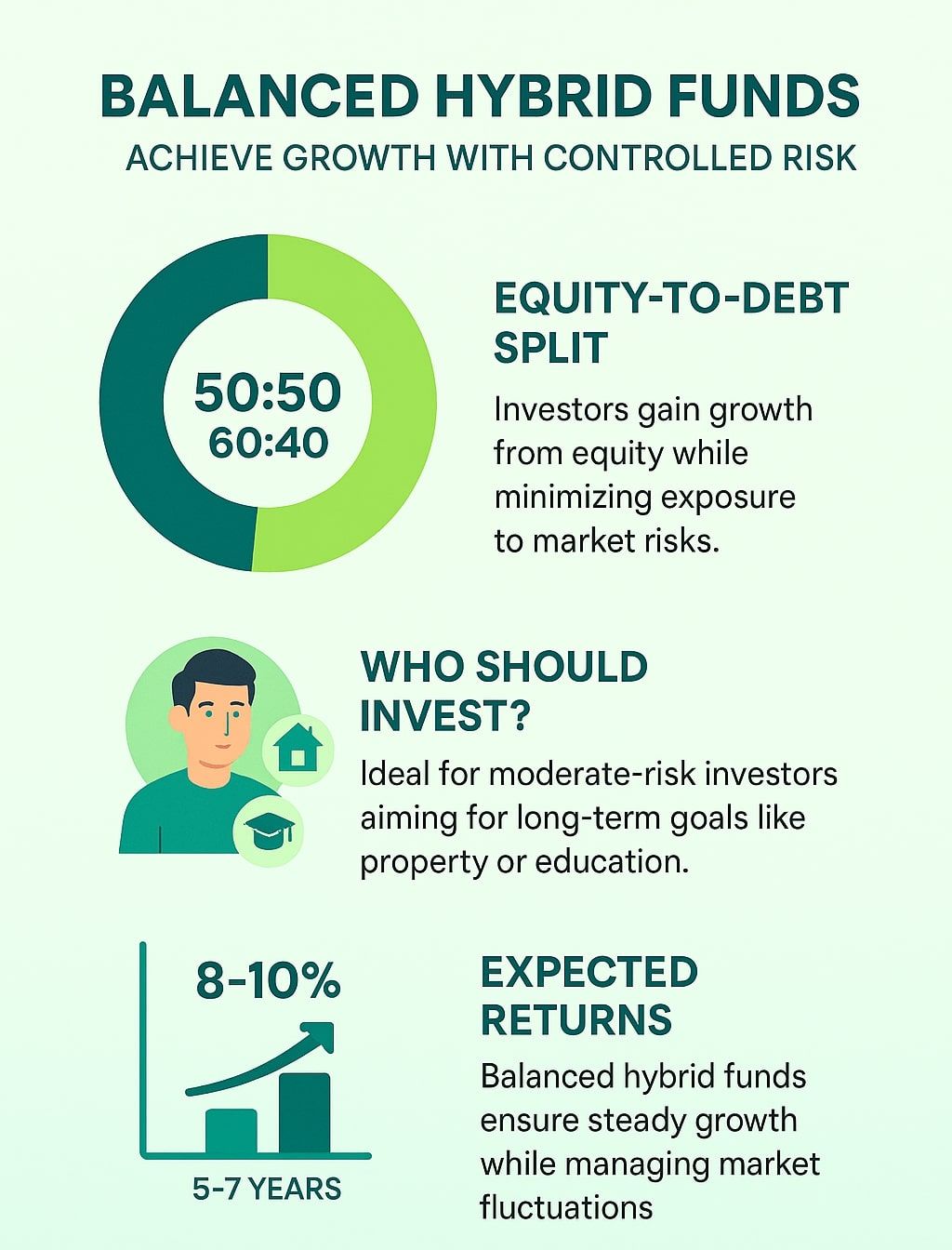
- 50:50 or 60:40 Equity-to-Debt Split
The 50:50 or 60:40 split in a balanced hybrid fund allows investors to gain equity-dependent growth while keeping minimal exposure to the volatile market risks. Let's say, for example, an investment of 7 lakhs can be split into 4 lakhs in equity and 3lakhs in bonds. In this way, while the equity investment will give a higher return in a year, the bond investment will help in managing market downturns.
- Suitable for moderate risk investors
Investors willing to take on medium risks are the most suited for balanced hybrid funds. When invested over a tenure of 5 to 7 years, investors can gain up to 8 to 10% of returns annually. For example, an investor in his mid-30s or 40s, planning on buying a property or their child’s education, can invest in balanced hybrid funds. This type of hybrid fund ensures successful growth and also protects them from small market fluctuations.
3. Conservative Hybrid Funds
Conservative hybrid funds are the opposite of balanced hybrid funds in terms of the ratio. In this type of hybrid fund, the investments are allocated more towards the debt instruments.
- Higher debt allocation for stability
In the case of conservative hybrid funds, about 75 to 90% is invested in debt instruments, while the other 10 to 25% is invested in equity. This allows more stability, regular interest, and lower volatility for the investor. Compared to pure debt funds, a smaller equity investment has a better growth potential, helping the funds to perform well.
- Best for risk-averse investors
With a return rate ranging from 6% to 8%, conservative hybrid funds have a balance between secured debt funds and a medium growth potential. These mutual funds are best suited for retired investors or new investors. It allows them to participate in investments with low market risks.
They are also a great option for creating emergency funds or when an investor is planning for the near future. Investors seeking to beat inflation and attain an equity exposure, a conservative hybrid fund is a good option.
4. Dynamic Asset Allocation Funds (Balanced Advantage Funds)
Dynamic Asset Allocation Funds, also known as Balanced Advantage Funds, actively adjust their mix of equity and debt investments based on prevailing market conditions. Fund managers use proprietary models to shift between asset classes, buying more equities in bullish phases and raising debt exposure during market uncertainty.
This flexibility aims to deliver smoother returns and effective downside protection, making these funds ideal for investors seeking adaptive risk management without the need to time the market.
5. Multi-Asset Allocation Funds
Multi-Asset Allocation Funds diversify across at least three asset classes, typically equity, debt, and commodities like gold. By maintaining a minimum allocation (often 10% or more) to each chosen asset type, these funds offer an extra layer of diversification versus standard hybrids.
They help investors spread risk across different markets and economic cycles, making them well-suited for those looking to hedge against volatility in any single asset class.
6. Arbitrage Funds
Arbitrage Funds primarily invest in equities and simultaneously take offsetting positions in the futures market to exploit short-term price differences between spot and derivatives. While they maintain at least 65% equity allocation (qualifying for equity taxation), their net market risk is low.
These funds provide stable, low-volatility returns and are popular among conservative investors seeking tax-efficient alternatives to traditional debt funds.
7. Equity Savings Funds
Equity Savings Funds are a specialized hybrid category investing in a blend of equities, debt, and equity arbitrage positions. Typically, these funds maintain around 65% overall equity exposure—spread across direct equity and arbitrage—alongside a fixed debt component. The combination aims to offer moderate growth, reduced volatility, and tax efficiency, making these funds an excellent option for those wanting a conservative equity strategy with extra downside protection
8. Monthly Income Plans (MIPs)
Commonly known as MIPs, monthly income funds are a different category of mutual funds in the list. Compared to conservative, aggressive, and balanced funds, this type of mutual fund is more dependent on debt. It allows investors to gain regular incomes rather than a lump sum return.
- Focusing on regular income
MIPs allow an investment where 70 to 90% is distributed in debt instruments and the rest in equities. MIPs allow investors to receive a steady income with modest capital appreciation. It provides the investor with a steady income via monthly, quarterly, or annual payouts.
- Tax implications
As MIPs have an equity allocation of below 65% they are taxed as debt funds. Taxation on short-term capital gains is based on your income slab, provided the investment tenure is more than 3 years. Whereas for long-term capital gains, investors are taxed at 20% with an indexation benefit. If you are looking for a steady income via mutual funds, you must first be accustomed to the tax structure as an investor.
How To Choose The Right Hybrid Fund For Your Portfolio
Selecting the right hybrid fund is crucial to match your financial goals, risk appetite, and investment horizon. Here’s a step-by-step guide to help you make an informed choice:
1. Assess Your Risk Tolerance
Your risk appetite determines whether an aggressive, balanced, or conservative hybrid fund is suitable. High-risk investors seeking growth may prefer aggressive hybrid funds, while risk-averse investors can opt for conservative funds or MIPs.
2. Define Your Investment Goals
Are you aiming for long-term wealth creation, regular income, or capital preservation? Your objective will guide the fund type. For instance, MIPs are ideal for steady income, whereas aggressive hybrid funds suit long-term growth.
3. Check Equity-Debt Allocation
Analyze the fund’s equity-to-debt ratio. Aggressive funds allocate 65–80% to equity, balanced funds maintain 50–60%, and conservative funds focus on 75–90% debt. Choose a ratio that aligns with your comfort level for market volatility.
4. Review Historical Performance
Past performance can indicate a fund’s consistency. Compare returns over multiple market cycles, but remember, historical performance is not a guaranteed predictor of future results.
5. Evaluate Fund Manager Expertise
A skilled fund manager can navigate market fluctuations and optimize returns. Check the fund manager’s track record and investment philosophy before investing.
6. Consider Tax Implications
Hybrid funds have different tax treatments based on equity allocation and investment tenure. Understanding taxation helps you estimate net returns and plan withdrawals efficiently.
7. Analyze Fees and Expenses
Look at expense ratios, entry/exit loads, and other charges. Lower costs can enhance long-term returns, especially for hybrid funds held over multiple years.
Conclusion
Hybrid mutual funds offer the flexibility of combining equity and debt in a single portfolio, catering to diverse risk profiles and investment goals. Whether you are looking for aggressive growth, balanced exposure, conservative returns, or monthly income plans (MIPs), hybrid funds can help you achieve a well-diversified investment strategy. Understanding the benefits and risks of each type is key to making informed decisions and optimizing your portfolio’s performance in India.
Login to Grip Invest, India’s one-stop destination for fixed income returns, and start building a smarter, balanced portfolio today.
FAQs On Types Of Hybrid Funds In India
Q1. Which hybrid fund type is best for conservative investors?
The most suitable choice for conservative investors is conservative hybrid funds.
It distributes a greater part of the portfolio in debt instruments. This lowers volatility and gives steady returns.
Q2. How does an aggressive hybrid fund differ from a balanced one?
Aggressive hybrid funds allocate 65 to 80% investments in equity, whereas for balanced funds, the ratio is either 50:50 or 60:40. Compared to balanced hybrid funds, aggressive hybrid funds give greater returns at higher risks.
Q3. Can hybrid funds provide regular income?
Yes, there are hybrid funds that provide a regular income. These are known as MIPs, aka Monthly Income Plans. These funds combine moderate equity growth with debt stability to provide a steady income for investors.
References:
1. Morning Star, accessed from: https://www.morningstar.com/articles/116347/global-mutual-fund-flows-show-resilience
Want to stay at the top of your finances?
Join the community of 4 lakh+ investors and learn more about Grip Invest, the latest financial knick-knacks, and shenanigans in the world of investing.
Happy Investing!
Disclaimer - Investments in debt securities/municipal debt securities/securitised debt instruments are subject to risks including delay and/ or default in payment. Read all the offer related documents carefully. The investor is requested to take into consideration all the risk factors before the commencement of trading.
This communication is prepared by Grip Broking Private Limited (bearing SEBI Registration No. INZ000312836 and NSE ID 90319) and/or its affiliate/ group company(ies) (together referred to as “Grip”) and the contents of this disclaimer are applicable to this document and any and all written or oral communication(s) made by Grip or its directors, employees, associates, representatives and agents. This communication does not constitute advice relating to investing or otherwise dealing in securities and is not an offer or solicitation for the purchase or sale of any securities. Grip does not guarantee or assure any return on investments and accepts no liability for consequences of any actions taken based on the information provided. For more details, please visit www.gripinvest.in
Registered Address - 106, II F, New Asiatic Building, H Block, Connaught Place, New Delhi 110001


