

Vakrangee Share Price Analysis: Growth Story, Risks, And Investor Outlook


Vakrangee is a leading pioneer in the fintech industry, providing a new and unique business model (franchise-based) that bridges urban digital services to rural areas of India.
This is done by means of a large and growing number of local franchisee-owned and operated businesses. This approach is fundamentally changing the face of last-mile delivery.
Vakrangee's share price performance exemplifies this extraordinary business model. As evidenced by its phenomenal peaks followed by significant declines, all of which continue to test the patience of investors over an extended period.
The Vakrangee business concept leverages the substantial existing rural last-mile retail network to provide services via e-governance, banking, and retail by combining technology with face-to-face interactions at the local level.
Investors purchasing shares of Vakrangee Ltd NSE VAKRANGEE continue to trade aggressively in this stock. Understanding the full story will assist investors' ability to make sound investment decisions in this volatile environment.
What Vakrangee Does?
The starting point for conducting an analysis of the stock performance of Vakrangee is to consider the core operations of the company. You need to understand how they are all designed to complement and enhance each other in order for them to continue growing through the use of creative, innovative, unique, and efficient methods.
The Vakrangee e-governance business is achieved via kiosks that deliver services such as Passports and Pension Payments to millions of Government Clients every day. They also enable clients to access their services, making the process easy and convenient.
The Vakrangee ATM services revenue enables the clients to access cash from their bank accounts reliably. In fact, it can be accessed no matter how remote that location is, and increase the number of successful transactions is also taking place.
Digital Service Centres (Kendras), which can also be considered as a "One-Stop Shop", provide a large variety of products and services. This includes insurance, bill payments, ticketing, and retail goods that meet the daily requirements in an efficient and convenient manner.
Vakrangee Share Price Journey
The story of the Vakrangee share price is one filled with highs and lows, much to the delight of many investors.
- Rapid Growth Period
During periods of rapid growth, the revenue for Vakrangee witnessed 19% annual increase. It also experienced growth in franchisees led prospects that led to a rocket-like response in share price and excitement from investors. As the company produced quarterly results, e-services grew dramatically, and institutions began to bet heavily on the success of the company.
- Sharp Corrections
The corrections (lower share price) that followed were a direct result of the over-excitement. During times of execution lag (for example, delays in signing up franchisees), share price valuations decreased and moved to more reasonable levels. As measured by the P/E ratio, the caution of both xPE and xPEG was apparent as the performance of the company began to materially slow down. In fact, the market began to question the industry's long-term viability.
Factors Affecting Vakrangee Stock
Monitoring of external and internal dynamics is necessary for the timely execution of trades, with a focus on keeping track of Vakrangee's share price. The company’s business model depends on network density, while regulatory risk can significantly change how the business develops as regulations affect both past and future business trends.
1. Business Model Scalability
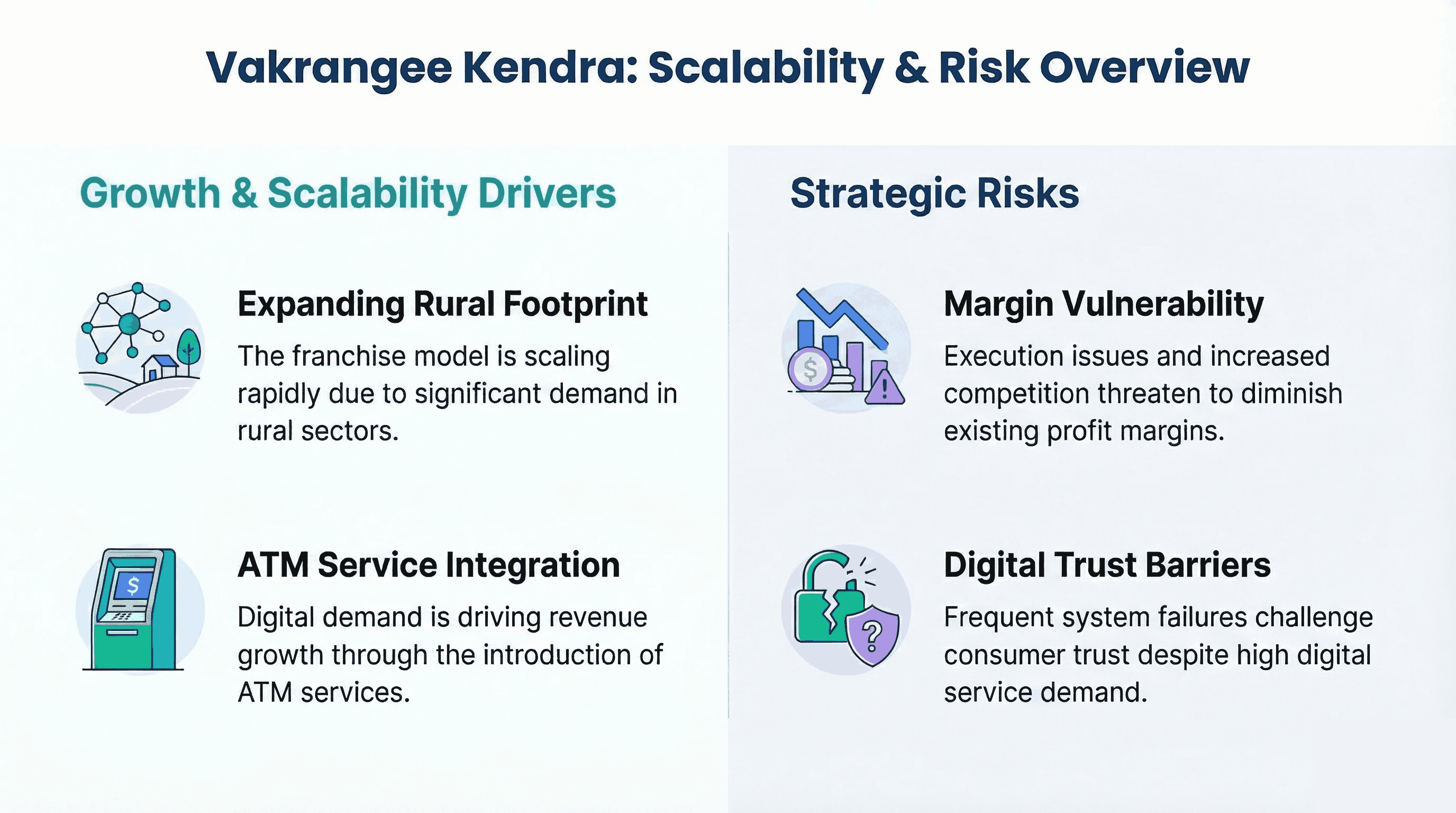
The Vakrangee Kendra franchise model continues to grow with significant rural demand, but if execution issues arise, margins will suffer due to increased competition. While the introduction of ATM services from Vakrangee is growing revenue due to digital demand, trust can be challenged due to system failures.
2. Regulatory Scrutiny
As public contract approvals for e-governance projects affect Vakrangee share price target 2026 positively, regulatory scrutiny will continue to increase as it relates to fintech. It continues to rise as the rules continue to evolve and require agility. A specific example is that winning new tenders can create a positive outlook for a water price appreciation, which will then spark short-lived rallies immediately after the tender earns acceptance. See “Fintech Regulations India.”
Should Investors Consider the Stock
An analysis of Vakrangee stock shows that there is potential for huge returns but also significant risks for investors with aggressive portfolios. The volatility of stocks can be reduced through the diversification of investments into fixed-income instruments, thus providing greater stability to long-term investors.
1. Risk vs Reward
Corporate debt ratios, such as zero, give companies like Vakrangee free rein to expand, while at the same time, execution risk is enormous when it comes to rural expansion. There is no doubt that revenues for Vakrangee have increased 19% annually, but history suggests caution.
2. Importance of Diversified Portfolio
By diversifying across many different types of asset classes, including fixed-income investments, investors can achieve a more stable investment profile than if they only held equities. For example, an investor might allocate a small portion of their portfolio to Vakrangee, riding the potential upside while maintaining an adequate cushion of bonds for downturns.
3. Quarterly Performance Insights
In the first quarter of 2026, Vakrangee reported strong results, with e-services up significantly and more stable retail operations than before. Revenue generated through e-governance contracts remains stable throughout the year, while each franchised outlet will produce consistent revenue each quarter.
4. Valuation Metrics Simplified
Since Vakrangee PE ratio is 55, it indicates that investors are paying a premium for expected growth. However, investors should also compare Vakrangee's ratios to competitors to arrive at a fair value for Vakrangee. The fact that the company has zero debt levels also shows that it operates without the burden of interest on borrowed funds, which provides more flexibility in the execution of future strategies. Long-term investors should track the estimated share price targets of Vakrangee through analyst reports to assist in making financial investments.
5. Peer Comparison and Outlook
With a strong rural focus and unique operations compared to fintech peers, Vakrangee Ltd (NSE: VAKRANGEE) has built a sustainable business model with a unique rural market focus. With a shift toward urbanisation, the potential for scalability is great over the long term. Being able to execute on that requires continuous innovation and vigilant competitors who could leapfrog Vakrangee through digital innovations.
6. Investor Strategies
Investors can use a dollar-cost averaging approach to reduce the volatility from market timing. Investors should watch for new franchisees being added and tender wins as catalysts of share price growth. It is important for investors to place stop-loss orders to protect their capital. Long-term investors should consider the potential for network effects to grow their investment over time.
Conclusion
Vakrangee’s rural fintech model and expanding Vakrangee Kendra network highlight the company’s long-term growth potential, especially as digital financial services continue reaching underserved regions of India. However, the vakrangee share price also reflects valuation concerns, execution risks, and regulatory uncertainty that investors should monitor closely. For many investors, balancing such high-growth but volatile equities with more stable investments can help manage portfolio risk. Platforms like Grip Invest allow investors to diversify into fixed-income opportunities such as corporate bonds and fixed deposits, helping create a more balanced portfolio alongside equity investments like Vakrangee.
FAQs
1. What is the business of Vakrangee?
Vakrangee provides a franchise, through its Vakrangee Kendra, for digital financial and e-governance services through rural networks.
2. What caused the fall in the share price of Vakrangee?
Overvaluation, two executive delays, and regulatory pauses have resulted in a correction of the share price from its 52-week high.
3. Is Vakrangee a good long-term investment?
The potential for a long-term return is high for Vakrangee with its rural last-mile network, but wise diversification should be considered when balancing risks.
Want to stay at the top of your finances?
Join the community of 4 lakh+ investors and learn more about Grip Invest, the latest financial knick-knacks, and shenanigans in the world of investing.
Happy Investing!
Disclaimer - Investments in debt securities/municipal debt securities/securitised debt instruments are subject to risks including delay and/ or default in payment. Read all the offer related documents carefully. The investor is requested to take into consideration all the risk factors before the commencement of trading.
This communication is prepared by Grip Broking Private Limited (bearing SEBI Registration No. INZ000312836 and NSE ID 90319) and/or its affiliate/ group company(ies) (together referred to as “Grip”) and the contents of this disclaimer are applicable to this document and any and all written or oral communication(s) made by Grip or its directors, employees, associates, representatives and agents. This communication does not constitute advice relating to investing or otherwise dealing in securities and is not an offer or solicitation for the purchase or sale of any securities. Grip does not guarantee or assure any return on investments and accepts no liability for consequences of any actions taken based on the information provided. For more details, please visit www.gripinvest.in
Registered Address - 106, II F, New Asiatic Building, H Block, Connaught Place, New Delhi 110001


