

Venture Debt Is The New Startup Money Without Giving Up Equity


If you don’t give a wedding ring to every date, why should a startup give its equity to every investor?
Introducing Venture Debt! A unique startup funding option in India that helps new ventures to raise funds through startup loans without equity dilution. Interesting right? So, let’s decode it in detail and understand how venture debt funds in India are worth your attention even if you aren’t a start-up owner.
But wait, we shouldn’t get ahead of ourselves, and let’s begin with what venture debt is.
Venture Debt: Startup Loans Without The Ownership Drama
Imagine equity like a long-term commitment. It is like the ‘till death do us part’ of the business world. When entrepreneurs raise funds through equity, they relinquish a portion of business ownership in exchange for capital.
For example, if ABC Ltd. raises INR 2 Crores for 1% stake to investor Q, then Q becomes 1% owner of the company.
However, in the case of venture debt investment, early-stage and high-growth startups that are backed by venture capital can raise the funds as a loan, upon which an interest is levied. The loan can be repaid within a particular tenure, and no equity is diluted.
For example, BharatPe has raised multiple funds through debt financing. The table below shows a list of its latest venture debts.
Venture Debt raised by BharatPe | ||
| Date | Amount raised (INR) | Number of investors |
| 6 May 2025 | 1.3 Billion | 3 |
| 11 December 2024 | 1.5 Billion | 2 |
| 30 July 2024 | 850 Million | 2 |
Source: Crunchbase1
The key difference between venture debt vs equity financing is equity dilution, but why is not diluting so important? Let’s explore the hype behind venture debt.
Venture Debt Funds In India: Why founders Are loving This Non-dilutive funding
Startup founders are digging the venture financing options. Discussed below are the reasons why.
- Control: Equity is to founders what the Iron Throne is in GOT, the seat of control. Let’s face it, making a startup work requires some tough calls, which might not sit well with investors who are usually in it for returns. Dilution of equity means giving up that control. Financing through debt, therefore, allows owners to retain the decision-making power.
- Cash Runway: Without venture debt, every financing round will keep on minimising the equity available. Moreover, debt allows businesses to achieve key milestones that can aid in achieving a high valuation in subsequent rounds.
Now, understanding venture debt vs equity financing is incomplete without exploring how venture debt works in India. So, let’s break down its key aspects.
How Venture Debt Works (Without Giving You A Headache)
We all do special things for our special people. Similarly, lenders have special rates, customised according to who approaches them. For example, a lender might feel more comfortable giving venture debt to a startup operating in a booming industry, resulting in a lower interest rate and flexible credit terms.
Therefore, venture debt interest rates, tenure, and repayment terms vary from one startup to another. But here are some key observations.
| Particulars | Description |
| Institutes that give venture debt | Specialised Venture Debt Funds like Trifecta Capital, Alteria Capital, and Nuvama; Banks with Startup Focus and Alternative Lenders |
| Loan tenure and repayment | It might vary between four and five years. Moreover, some venture debt might have an interest-only period. |
| Interest rates | While in some cases the interest might vary between 10% to 18%, in other cases it might vary between 7% to 12%. |
| Warrants | Venture debts often enjoy a future option to buy shares in the business. This sets them apart from regular lenders. |
| Other terms | Often, an upfront fee is to be paid by the business to the institute for arranging the debt. This is like a commission for the service. Similarly, a final payment fee is also levied during final settlement. |
Source: EcapLabs2
Okay, now we have all the puzzle pieces. Let’s put them together with an example.
Imagine ABC Ltd. approached the XYZ venture fund in India for venture debt. Below is the flowchart of how ABC finally secured the debt.
- The first date: XYZ asked ABC about its particulars, financials, financing needs, objectives of the debt, etc. A discussion on the terms of debt also occurs based on the information.
- The love letter: Based on the debt terms discussed in the first step, a term sheet is prepared. It is a non-binding document that offers a detailed view of terms and conditions, like interest rate, tenure, warranty, etc.
- Stalking begins: XYZ performs due diligence and verifies the information provided by ABC. If everything is in place and the terms of the debt are agreed upon, the loan disbursement ensues.
- First present: ABC pays the upfront fee. Think of it as a thank you for the loan.
Finally, the loan is disbursed to ABC. The company pays only interest for the first 6 months. Then continues paying interest plus part of the principal, till the loan is repaid.
Now, let's understand how to invest in venture debt in India.
Invest In Venture Debt Funds In India
Like we discussed before, startups approach venture debt funds in India to secure the debt. The table below shows some popular funds.
| Venture Debt Fund | Established on | Popular investments |
| Trifecta Capital | 2015 | BigBasket and BharatPe |
| Alteria Capital | 2017 | Bira91and 91Squarefeet |
| Stride Ventures | 2019 | 91Squarefeet and Ather |
Source: Trifecta capital3
Just like a mutual fund pools the investible funds of people like you and me, a venture debt fund pools the investments of institutional investors and HNIs. The pool is then used to extend debt to startups. Simply put, it's the mutual fund for the ultra-rich.
Now, because they are emerging businesses with no historic track record, there is a high risk and return. However, being debt, it is a safer investment option beyond stocks.
Moreover, venture debt funds in India are the new trend in town, with the total venture debt surging to USD 1.25 billion as of 2 April 20254. This shows a 13 times growth over 6 years. The chart below shows the total venture debt disbursed in India.
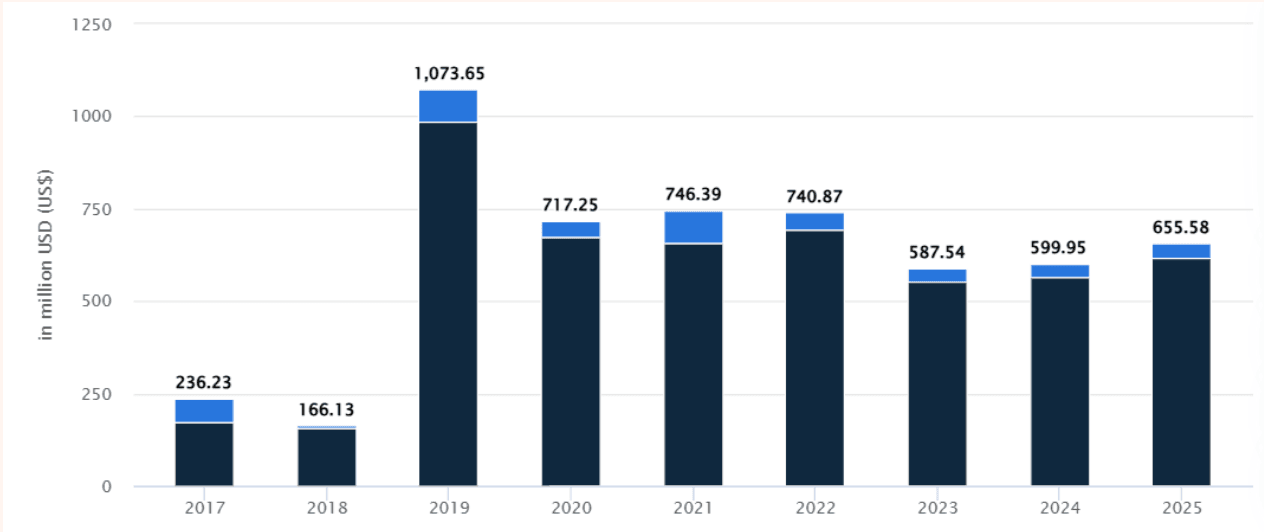
Source: Statista5
But what about you and me, we aren’t the Ambanis; how can we earn high fixed returns in India?
Where Venture Debt Fits in Your Portfolio
So what if venture debt funds are for the HNIs? Many other debt instruments exist that can give us fixed returns and capital appreciation. Take an example of Grip’s bonds vs venture debt returns.
| Grip Bond Returns | Venture Debt Interest Rate |
| 9% to 14% | 10% to 18% |
Source: Grip Invest6
Diversification isn’t just a buzzword. Like every friend group needs both a party animal and a good girl, bonds give your portfolio the stability that market-linked assets like stocks can’t. Grip doesn’t only have bonds, but also debt funds, SDIs, and many others that can give up to 14% pre-tax return.
So, are you ready for portfolio diversification with alternative assets?
Then, visit Grip Today!
FAQs On Venture Debt
1. How is venture debt different from equity funding?
In the case of equity funding, entrepreneurs have to dilute a part of their equity. But in the case of venture debt, there is no charge on equity.
2. Can retail investors invest in venture debt funds in India?
Venture debt fund investment is usually for high-net-worth individuals and institutional investors because they have a high risk and return ratio.
3. What are the risks of venture debt investing?
Venture debt is extended to new startups that don’t have any past fiscal records. Therefore, the risk of default might be high.
References:
1. Crunchbase, accessed from: https://www.crunchbase.com/organization/bharatpe#financials
2. Ecaplabse, accessed from: https://www.ecaplabs.com/blogs/venture-debt-funds-india
3. Trifecta Capital, accessed from: https://trifectacapital.in/portfolio/
4. CNBC TV, accessed from: https://www.cnbctv18.com/business/startup/venture-debt-india-growth-startups-private-equity-vc-funding-19583287.htm
5. Statista, accessed from: https://www.statista.com/outlook/fmo/capital-raising/traditional-capital-raising/venture-debt/india
6. Grip Invest, accessed from: https://www.gripinvest.in/corporate-bonds
Want to stay at the top of your finances?
Join the community of 4 lakh+ investors and learn more about Grip Invest, the latest financial knick-knacks, and shenanigans in the world of investing.
Happy Investing!
Disclaimer - Investments in debt securities/municipal debt securities/securitised debt instruments are subject to risks including delay and/ or default in payment. Read all the offer related documents carefully. The investor is requested to take into consideration all the risk factors before the commencement of trading.
This communication is prepared by Grip Broking Private Limited (bearing SEBI Registration No. INZ000312836 and NSE ID 90319) and/or its affiliate/ group company(ies) (together referred to as “Grip”) and the contents of this disclaimer are applicable to this document and any and all written or oral communication(s) made by Grip or its directors, employees, associates, representatives and agents. This communication does not constitute advice relating to investing or otherwise dealing in securities and is not an offer or solicitation for the purchase or sale of any securities. Grip does not guarantee or assure any return on investments and accepts no liability for consequences of any actions taken based on the information provided. For more details, please visit www.gripinvest.in
Registered Address - 106, II F, New Asiatic Building, H Block, Connaught Place, New Delhi 110001


