

West Bengal Election Economic Impact: What Investors Should Watch


Besides cricket, politics and elections are two other things that Indians cannot help but get interested in. Voting for the West Bengal elections was completed, and it is all over social media and in popular news outlets.
People in other parts of the country have been discussing the expected outcome of the elections, largely due to the political buzz and intensity surrounding these state elections.
For markets, election results often have a short-term impact, serving as inflexion points. In the short term, investor sentiment may shift as expectations around policy continuity, governance, and fiscal direction evolve.
West Bengal Election Results - 4th May 2026
Results from the West Bengal election are set to influence market sentiment, especially if they point to a clear lead for the BJP or the TMC. On election day, markets usually react first to expectations rather than the final tally, so a BJP lead is often read as a positive signal for policy continuity, easier Centre-state coordination, and faster execution of infrastructure and investment plans. That can support stocks linked to public spending, construction, and financial services.
The latest results show the BJP in the lead in West Bengal and Assam, while the broader market also opened on a positive note. BSE Sensex closed at INR 77,269 on 4th May, which is up by 0.46% from the previous close. Although this is not a big jump, considering the recent volatility, a clear impact is seen on the Sensex.
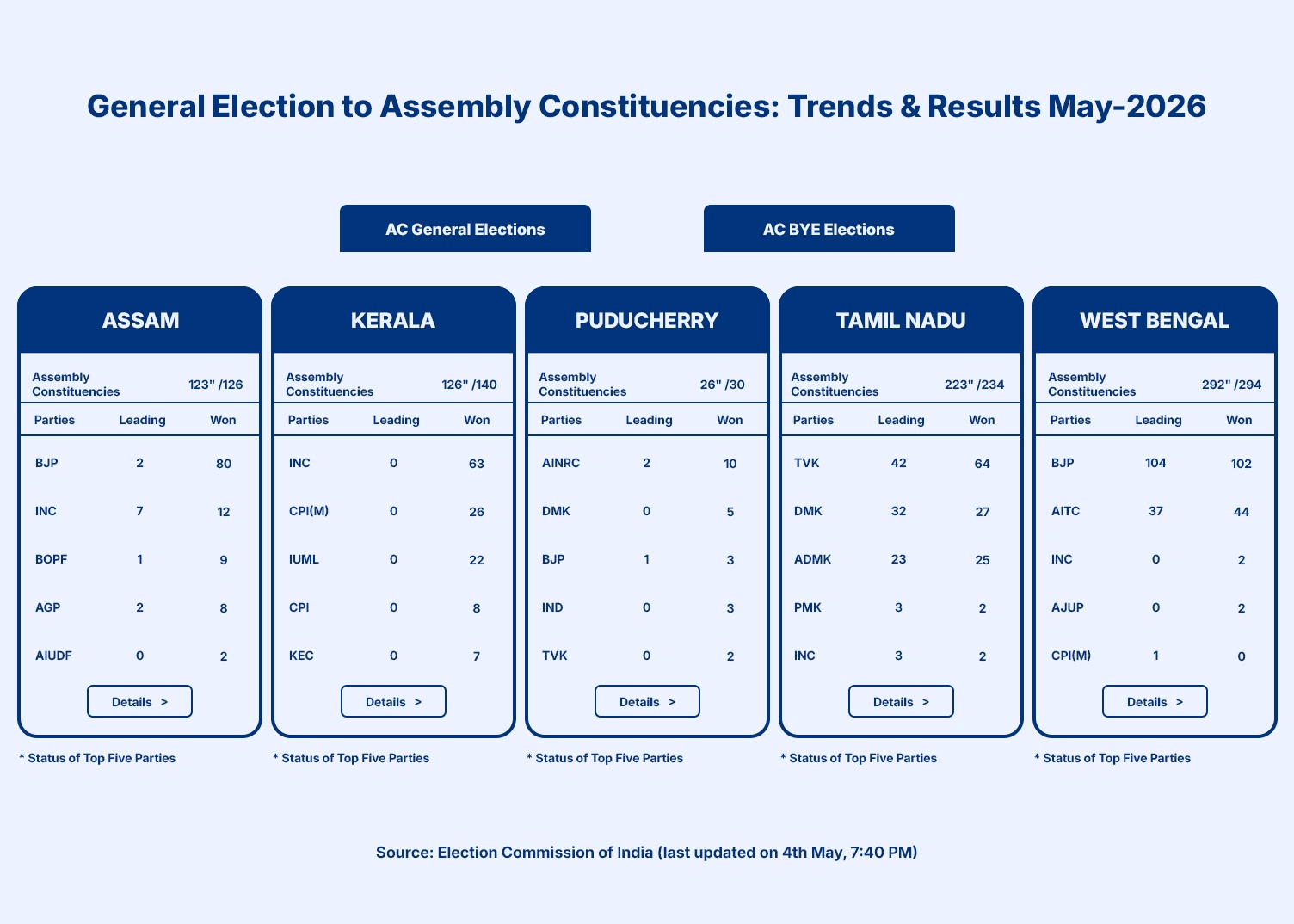
Source: Election Commission of India (last updated on 4th May, 7:40 PM)
As the home to one of the largest metropolitan areas in the country and a gateway to eastern and northeastern markets, the state plays a critical role in trade, logistics, manufacturing, and services.
Let us identify the most critical things investors should understand about the West Bengal election's economic impact.
Why Elections Often Affect Market Behaviour?
Markets generally react more to uncertainty about election outcomes than to the actual outcomes. During the run-up to elections, investors are often cautious, which can lead to higher volatility in critical sectors.
The cautious behaviour often stems from the need to evaluate any potential changes in policy direction, regulatory frameworks, and government spending priorities.
Some sectors, such as infrastructure, public sector enterprises, and banking, are closely linked with the government’s initiatives. Hence, the volatility in these sectors is even more critical.
Even though a state’s impact on the overall stock market is not particularly noticeable, there might be volatility in the sectors most likely to be affected by the outcome.
West Bengal’s Economic Importance
The state has been a major industrial hub for decades due to its strategic geographical presence. With a high literacy rate and presence of skilled workers, Kolkata has been one of the centres of national and international trade. In the 1960s, the state’s contribution to the country’s GDP was 10.5%.1 With the emergence of new trade centres in the South and Northern parts of the country, this contribution reduced to 5.6% of the total GDP in 2023-24.
As seen in the chart below, West Bengal’s share in India’s GDP has gradually declined from around 6.8% in the early 1990s to about 5.8% recently, highlighting a shift in its relative economic contribution over time.
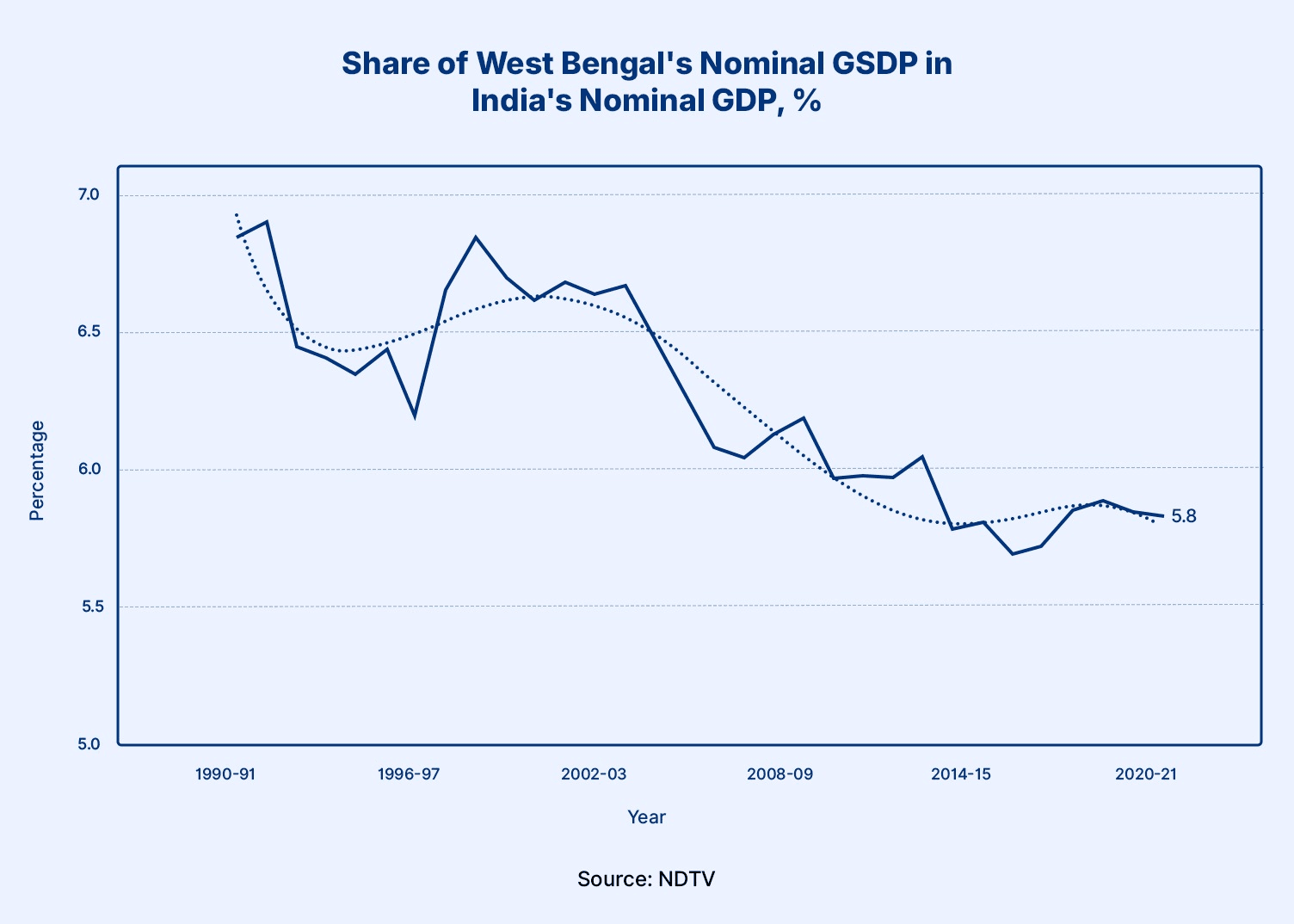
It is still the sixth-largest state in the country (economically), with a GDP of slightly more than INR 20,000 Lakh Crore and growth of more than 9.30% in the previous financial year.2 Key industries in the state include steel, tea, textiles, information technology, and logistics.
Kolkata, as a major urban centre, serves as a commercial and financial hub for eastern India. Additionally, the state’s geographic location positions it as a critical trade gateway to the Northeast and neighbouring international markets.
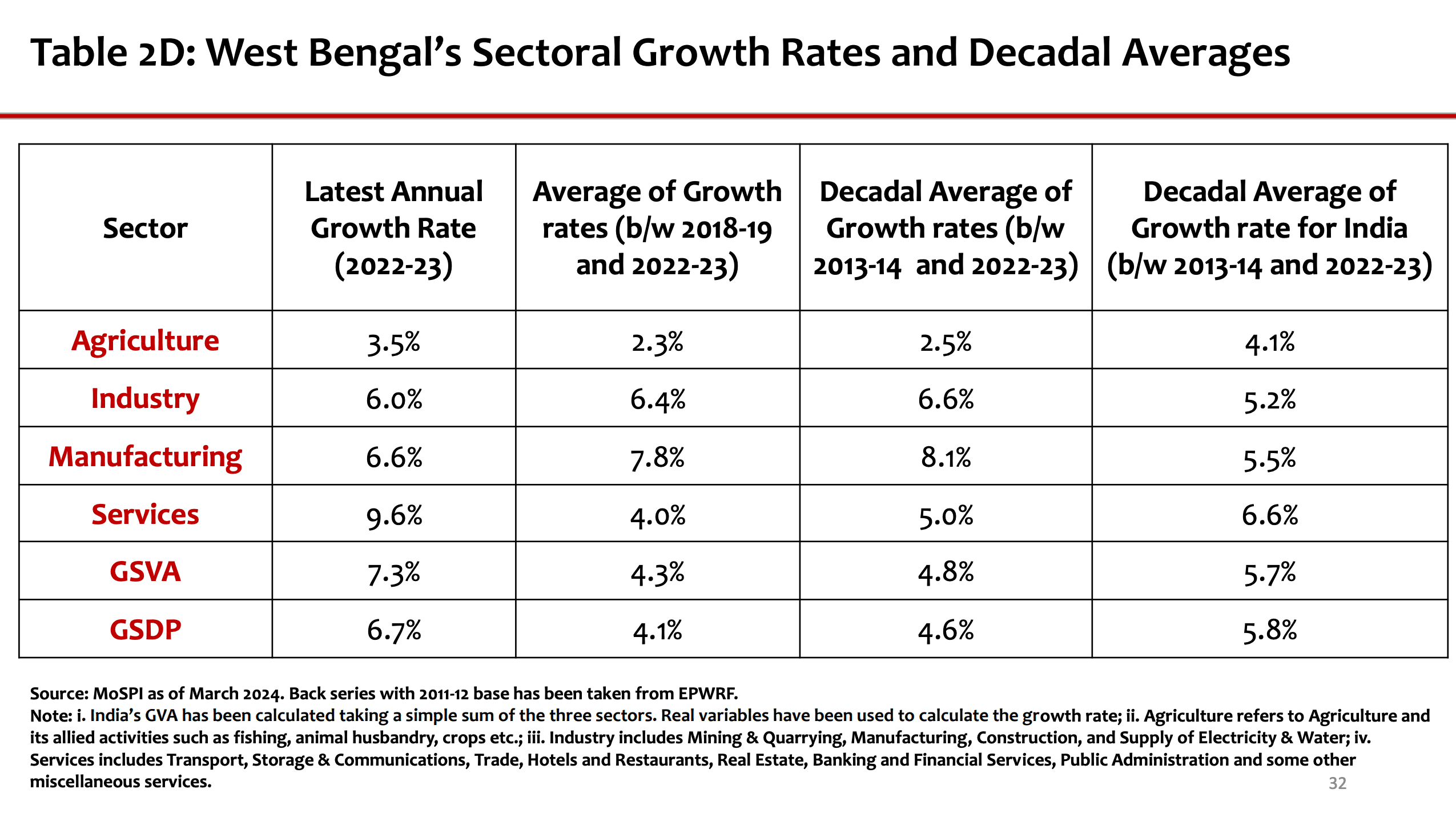
A closer look at sector-wise growth shows mixed trends across agriculture, manufacturing, and services in West Bengal over the years.
As highlighted in the table below, while manufacturing has outperformed national averages in the long term, overall GSDP growth has remained slightly below India’s average.
Possible Economic Outcomes After the Election
Since the election outcome is still unknown, it will be hard to predict the economic implications. In the case of policy continuity, there will be a positive impact on the existing infrastructure projects, industrial initiatives, and investment pipelines. Overall, investor confidence will increase, particularly in key areas such as manufacturing, logistics, and urban development.
On the other hand, there might be short-term caution amid policy uncertainty or transition. A common phenomenon is businesses delaying capital allocation until there is greater clarity on governance, leadership, and regulatory direction.
This might have a short-term impact on market sentiment. Here is quick look at West Bengal’s unemployment rate trend can also provide context on underlying economic health, as shifts in employment often reflect changes in investment activity and demand.
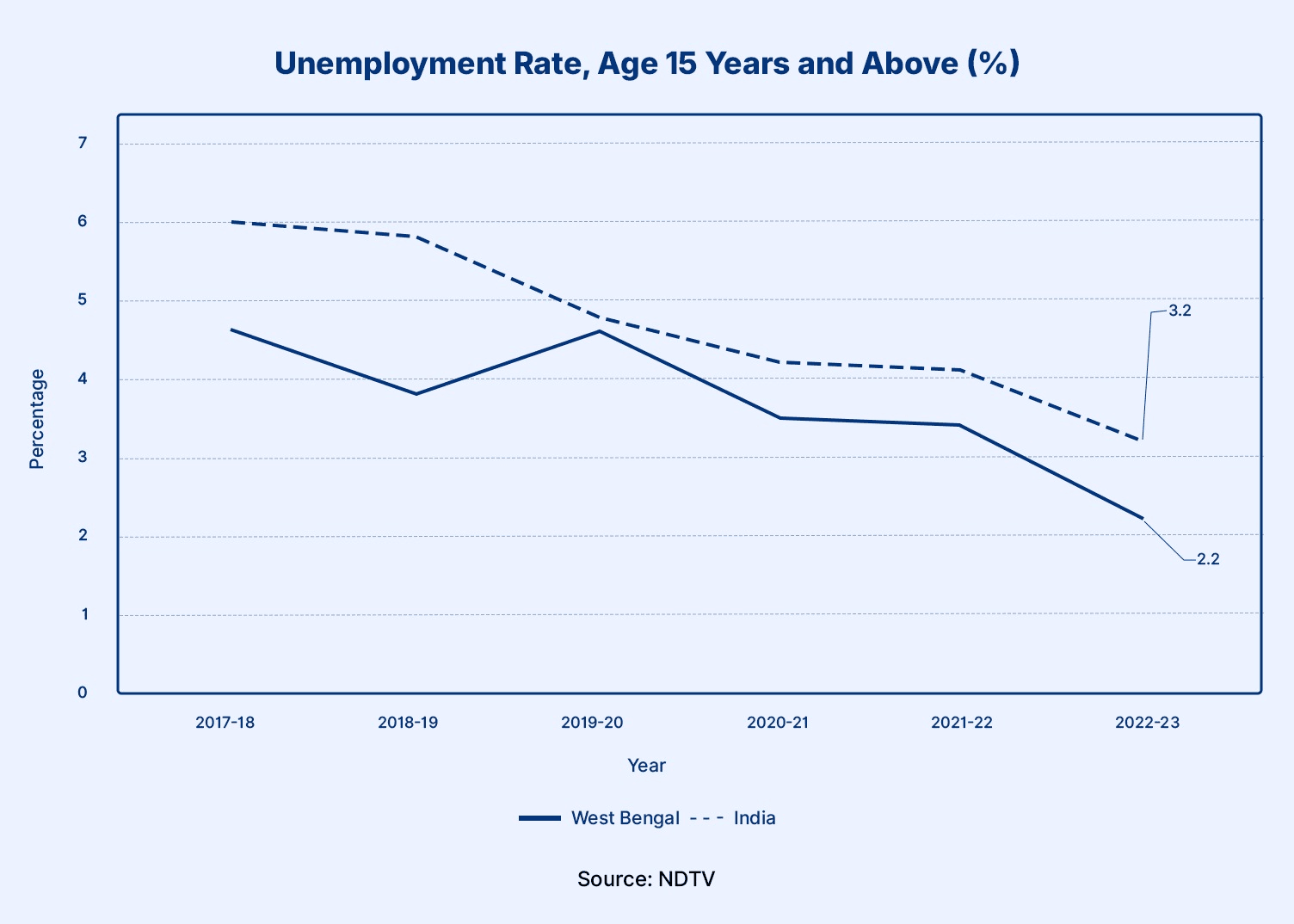
Whereas short-term market movements can be largely sentiment-driven, markets tend to respond more to clarity and execution capability than to the nature of the mandate itself. It is worth noting that three other states besides West Bengal are holding state elections.
However, experts believe that the biggest near-term market trigger can come from West Bengal.3
In 2021, the stock market slumped on the day of the result announcement but recovered the drop towards the end of the trading period.4
Sectors That Could Be Impacted
The West Bengal election market impact can be seen in the following core sectors:
1. Infrastructure and Construction
Any acceleration, delay or likelihood of change can have a direct impact on the infrastructure and construction sectors. Irrespective of which political party gains the leadership role, this sector is likely to experience significant volatility.
2. Manufacturing and Steel
West Bengal has a strong industrial base, particularly in metals and manufacturing. Policy support and ease of doing business will be key drivers.
3. Banking and NBFCs
As credit demand depends on business activity in a region, any improvement in investor sentiment can boost lending.
4. FMCG and Consumption
Welfare measures and rural income support can drive consumption, especially in semi-urban and rural markets.
5. Logistics and Ports
Given the state’s strategic location, logistics and trade-related sectors may benefit from infrastructure development and policy continuity.
It is important to note that in 2021, there was no PSU stocks election rally as some of the PSU stocks crashed by 2-3% on the results day.5
2021 vs 2026 Election Market Reaction Comparison
| Parameter | 2021 West Bengal Elections | 2026 West Bengal Elections |
| Result | TMC won third consecutive term | Result awaited (exit polls suggest BJP edge) |
| Market Reaction (Result Day) | Sensex fell sharply, partial recovery by close | To be observed |
| PSU Stocks | 2–3% decline on results day | Sector volatility expected |
| Key Market Sentiment Driver | BJP loss seen as reform setback | BJP win seen as potential policy shift |
| Recovery Timeline | Within same trading session | Analysts expect short-term volatility |
What Investors Should Watch ?
There is no doubt that there will be some short-term Bengal election stock market impact on the broader market movements. However, long-term market movements depend on several other factors, including policy announcements and infrastructure spending commitments. It will be important to note whether the current regime continues or a new one comes to power.
Private investment activity, credit growth trends, and sector-specific reforms will also provide insights into the broader economic direction. Additionally, fiscal discipline and revenue management will be important indicators of long-term sustainability.
During such periods of uncertainty, the importance of a balanced, diversified portfolio often becomes clear to investors. It is important to maintain a proportion of total investments in fixed-income securities that offer consistent returns and are not affected by stock market volatility.
Conclusion
The outcome of the West Bengal Assembly Elections may influence short-term sentiment, but experienced investors understand that markets move beyond headlines. While phases of uncertainty can trigger volatility, they also offer moments to reassess fundamentals and long-term positioning.
For investors, the real signal lies not just in who forms the government, but in how effectively policies are executed in the months that follow. Tracking developments in infrastructure spending, industrial growth, and credit expansion will provide a clearer picture of the state’s economic trajectory.
In the end, staying disciplined, diversified, and focused on long-term fundamentals remains far more important than reacting to short-term political noise.
Looking to balance market volatility? Explore fixed-income opportunities on Grip Invest with options like corporate bonds and SDIs offering up to 14% returns.
FAQs What Investors Should Know About Election Volatility
 |
Author: Grip Invest Editorial Team The Grip Invest Editorial Team is a group of Chartered Accountants, MBA (Finance) graduates, and Qualified Research Analysts dedicated to helping you invest smarter. We dive deep into India's fixed income landscape to deliver content that is accurate, up-to-date, and easy to understand. Whether you're exploring bonds, fixed deposits, or other fixed income opportunities, our guides cut through the noise and give you the clarity to make better financial decisions. |
Want to stay at the top of your finances?
Join the community of 4 lakh+ investors and learn more about Grip Invest, the latest financial knick-knacks, and shenanigans in the world of investing.
Happy Investing!
Disclaimer - Investments in debt securities/municipal debt securities/securitised debt instruments are subject to risks including delay and/ or default in payment. Read all the offer related documents carefully. The investor is requested to take into consideration all the risk factors before the commencement of trading.
This communication is prepared by Grip Broking Private Limited (bearing SEBI Registration No. INZ000312836 and NSE ID 90319) and/or its affiliate/ group company(ies) (together referred to as “Grip”) and the contents of this disclaimer are applicable to this document and any and all written or oral communication(s) made by Grip or its directors, employees, associates, representatives and agents. This communication does not constitute advice relating to investing or otherwise dealing in securities and is not an offer or solicitation for the purchase or sale of any securities. Grip does not guarantee or assure any return on investments and accepts no liability for consequences of any actions taken based on the information provided. For more details, please visit www.gripinvest.in
Registered Address - 106, II F, New Asiatic Building, H Block, Connaught Place, New Delhi 110001


