

Who Should File Income Tax Return In India: Rules Explained Clearly


When In India, when it comes to the process of completing an Income Tax Return (ITR), there is much more involved than just paying bills on time.
Many people think that ITR is only something they need to do if they owe any taxes at all. But when you understand what you can do with your tax return, you realise that there is much to be gained by completing the process correctly.
So, here we are to help you with a complete understanding of ITR filing eligibility, ITR filing deadlines, and all the other aspects about moving ahead with complete clarity.
Who Is Required To File An Income Tax Return?
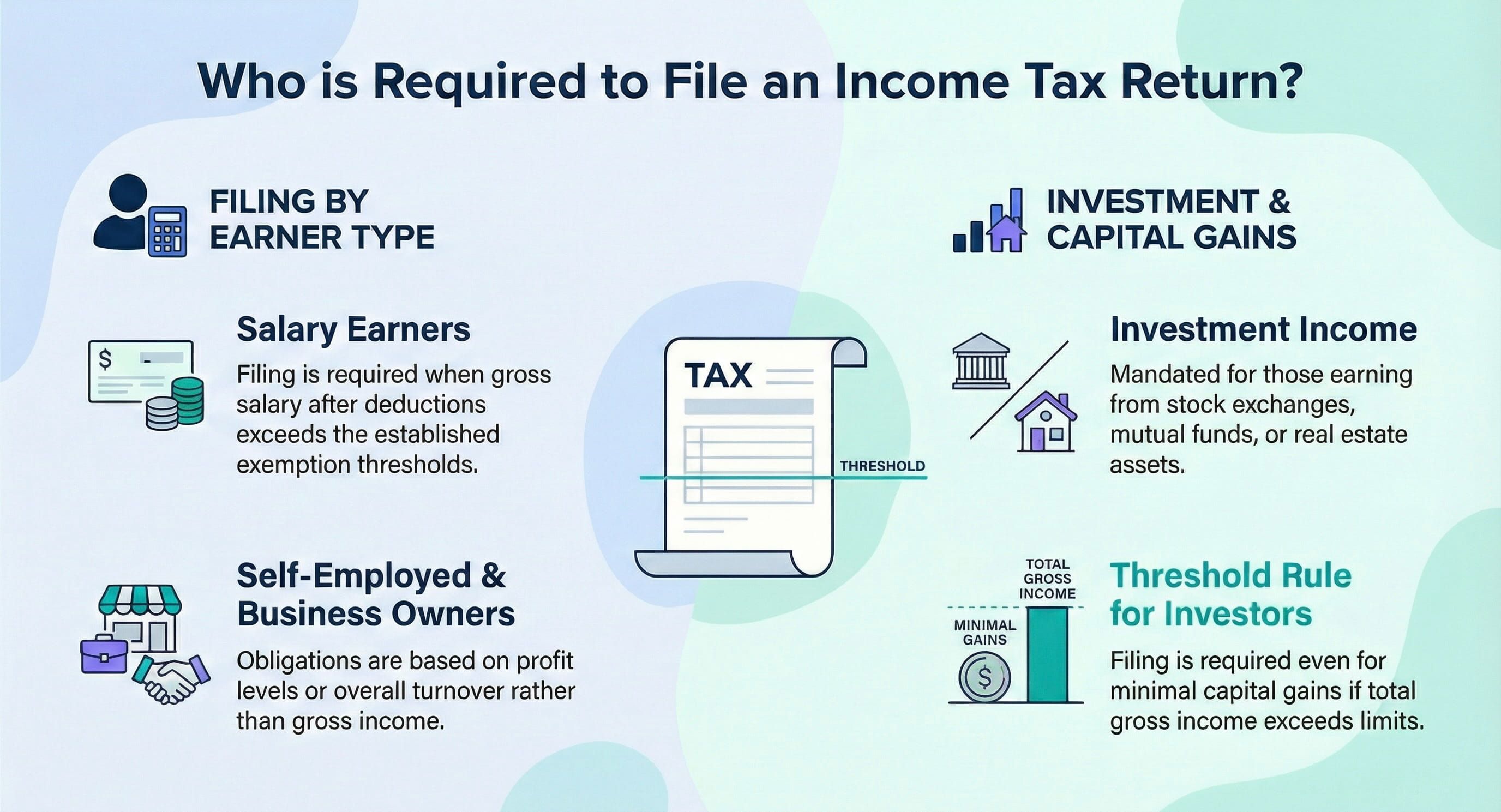
When your total income is above the income limit established under the income tax return filing rules, you are legally obligated to file an ITR.
- For salary earners, usually if their total salaries (gross) after all deductions exceed the exemption thresholds, they will be required to submit an ITR.
- For self-employed workers and business owners, it is usually determined whether they need to file an ITR based on the level of profits or their overall turnover (as opposed to their gross income).
- Finally, anyone who earns income from investments in stock exchanges, mutual funds, or real estate is required to file an ITR even if their capital gains are minimal in comparison to the overall gross income that exceeds the income thresholds previously mentioned.
Assuming a case to analyse:
Ravi is working in a marketing agency as a marketing executive, making a gross salary that exceeds the exemption threshold and would receive standard deductions such as house rent allowance. Therefore, even though his taxable income appears to be low, all people are required by law to file an income tax return.
The threshold for determining filing requirements has been developed by the government to provide fairness between various income groups based on reporting requirements. Not complying with this rule may cause an individual to receive a tax notice or penalty later.
Mandatory ITR Filing Even If Income Is Below Exemption Limit
High levels of financial activity (flag activities) require mandatory filing regardless of whether or not a person has any tax owed. If an individual deposited a large amount into their bank account, used premium credit cards or spent large amounts of money for travel outside the country, they will be expected to file a return to show proof of the receipts.
For example, if a person deposited large amounts into their current account or had a very high utility bill, they are required to file a tax return.
Hypothetical Example
In the example of Priya (freelancer), even though her billing for freelance services remains far below a normal tax liability, she may still be subject to filing ITR for any of the reasons mentioned above due to her deposit of large amounts.
The rules for filing returns for income taxes are specifically designed to prevent 'foresight' and 'evasion' of taxes through unaudited, unaccounted deposits. Properties with high worth and more than one owner are grounds for the filing requirements. All states are subject to periodic revisions to their respective thresholds. For example, it would be prudent to check the Income Tax portal to stay updated.
ITR Filing Rules For Salaried, Self-Employed, And Investors
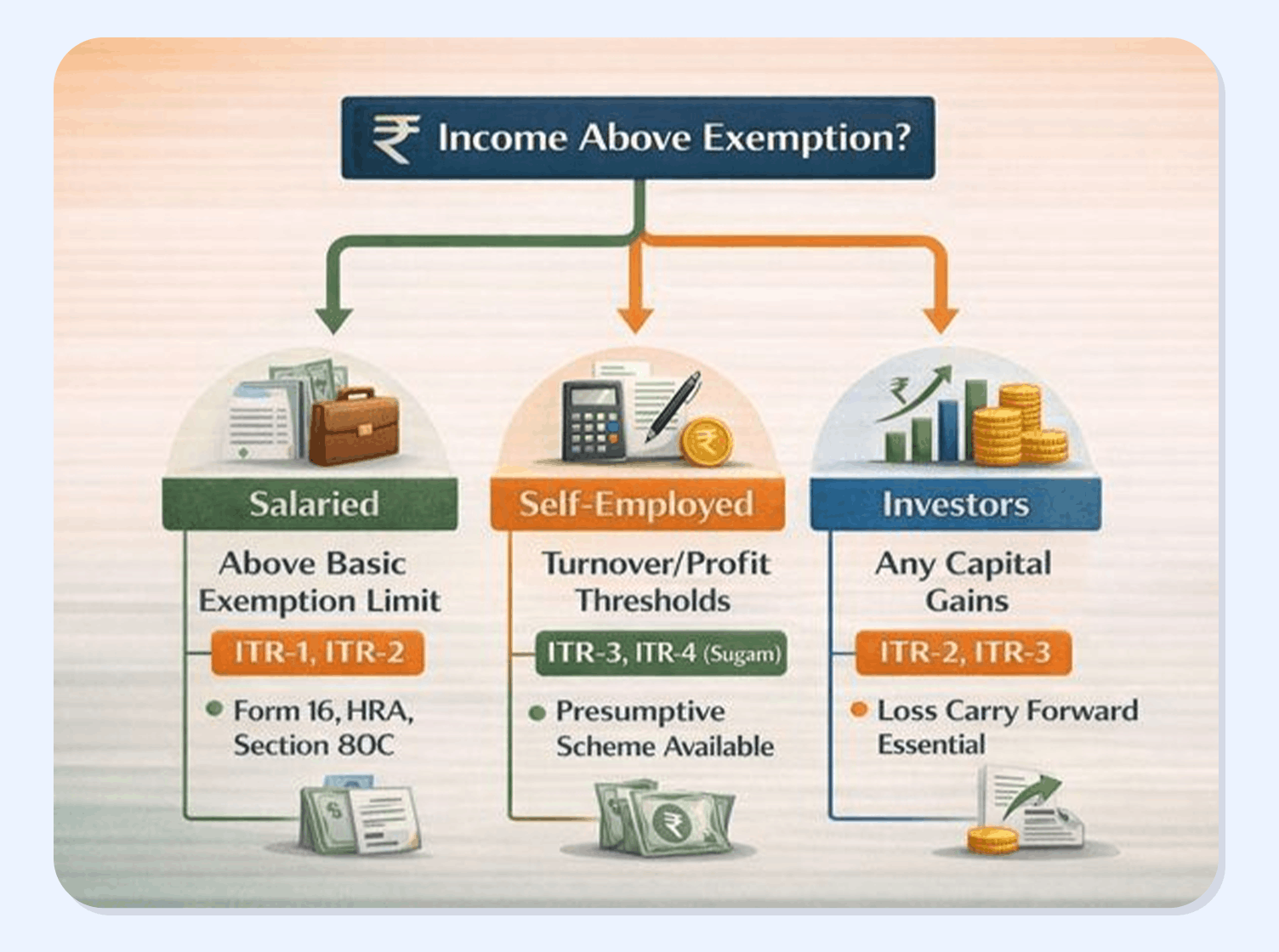
All types of income have their own specific form of ITR filing rules in India. Each employee's income will be unique to their role. For example, salaried workers must follow certain rules, whereas freelance workers have their own set of requirements, as do investors.
ITR Filing for Salaried Employees
For salaried employees, filing your ITR will start when your total gross income exceeds the basic tax exemption limit. The job your employer has given you will help simplify ITR filing by issuing you with a Form 16, which has your pre-filled TDS and deductions like interest paid on your home loan, as well as money you have invested into Section 80C.
Self-Employed Obligations
As a self-employed person, the requirement to file your ITR will depend on the income threshold (based on how much business you have done) and how much your exempt amount covers for your operations. You should only file your ITR if your business has exceeded the exemption limit or you operate under all presumptive taxation laws, which will result in less cumbersome reporting in general as compared to other businesses.
Investor Requirements
Any capital gains income (in the form of Equity, Debt Funds and Real Estate) triggers the requirement for filing ITRs in India. Short-term or long-term gains must be reported, regardless of any losses offsetting those gains, to obtain the benefit of carrying those losses forward for tax purposes.
| Income Type | Threshold for Compulsory ITR Filing | Recommended ITR Forms | Key Considerations |
| Salaried | Above basic exemption limit | ITR-1, ITR-2 | Form 16, HRA, Section 80C |
| Self-Employed | Turnover/profit thresholds | ITR-3, ITR-4 (Sugam) | Presumptive scheme available |
| Investors | Any capital gains | ITR-2, ITR-3 | Loss carry forward essential |
Due Dates And Process For 2026
The rules for filing ITR in India for the Assessment Year 2026 (FY 2025-26) will be strictly adhered to.
- For the majority of individuals, including those required to file Income Tax Returns under the normal criteria, the deadline is July 31st, 2026.
- For companies subject to an audit, the deadline is October 31st, after which time, late filing will incur a fee of Rs 5000.
- And the last date for late filing is December 31st. If you miss the filing deadline, penalties of up to Rs 5000 will be assessed.
Additional Benefits And Common Pitfalls
Filing your income tax return (ITR) does more than ensure tax compliance.
- It allows you to claim refunds, if any taxes deducted at source are greater than the actual taxes owed.
- Also, it helps expedite loan approvals, and supports your visa applications.
- Additionally, individuals in India who file an ITR have more financial visibility for claims on insurance policies as well as for employment verification purposes.
- Carrying forward losses can be optimally used in future years to help reduce taxes.
Choosing the incorrect ITR form, failing to report foreign assets, or not linking Aadhaar can lead to filing issues. Many employees also miss out on eligible deductions, making it essential to review all pre-filled details carefully and ensure every claim is accurate. In addition, ITR filing in 2026 must comply with updated rules on digital asset reporting and separate capital gains schedules.
Tools And Tips For Smooth Filing
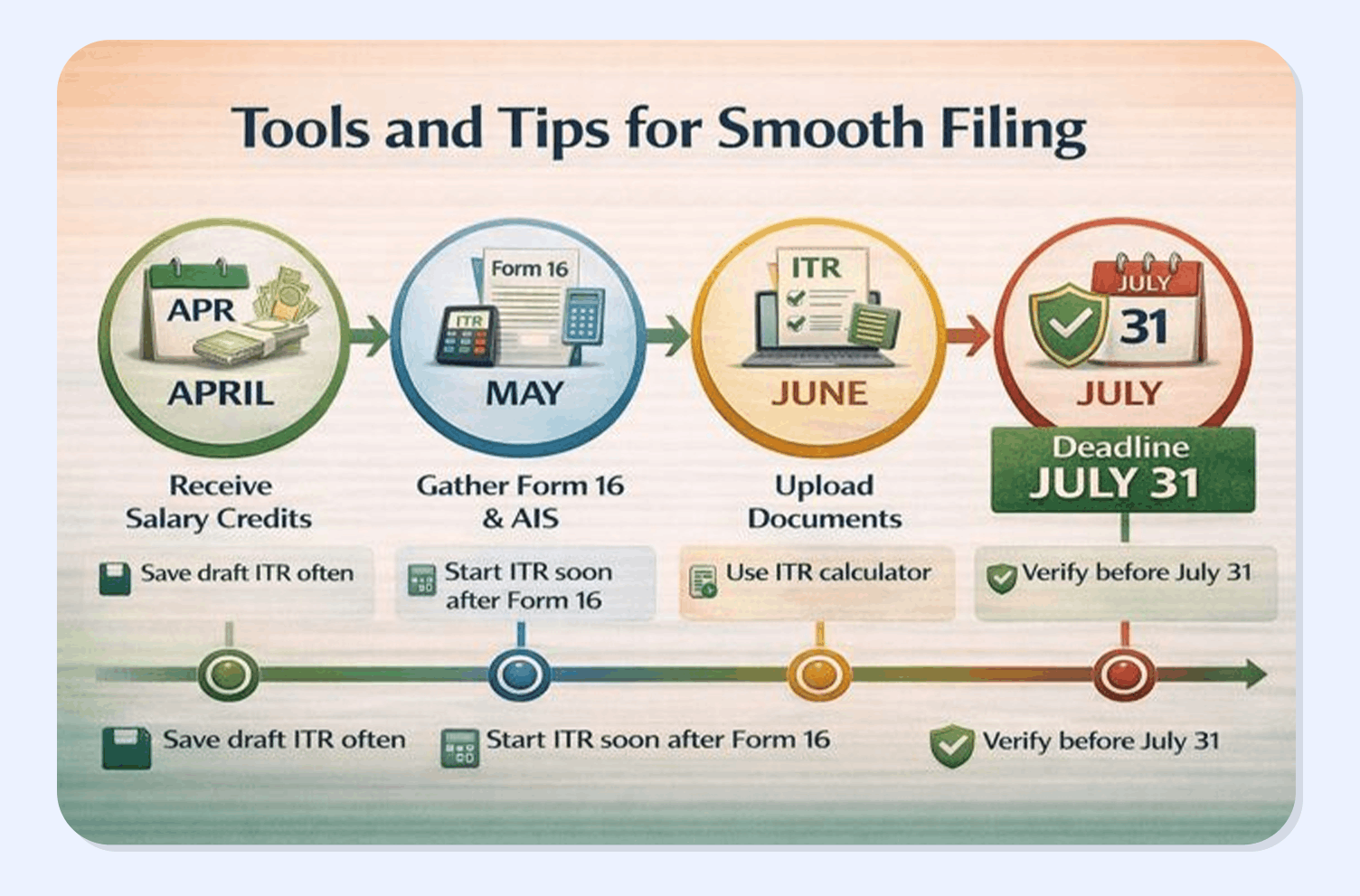
To help facilitate your income tax return (ITR) filing, there are several tools and tips that can make the process simpler for you.
- Attempt to save your draft forms as often as possible, start filing your ITR shortly after receiving your Section 16, and use your AIIS for records of your transactions.
- Additionally, if you are filing an ITR for the first time, you should use one of the ITR calculators to establish your income level for ITR filing.
- By being prepared to file your course will make the process of filing your ITR easier.
Conclusion
Understanding who should file an income tax return is not just about meeting legal requirements, but about building long-term financial discipline. Timely ITR filing helps you stay compliant, claim eligible refunds, carry forward losses, and strengthen your financial profile for loans, visas, and investments. As incomes and financial transactions become more complex, aligning tax planning with your investment strategy becomes essential.
Platforms like Grip Invest help investors go beyond traditional options by offering access to regulated fixed-income opportunities that can complement tax-efficient planning while maintaining transparency and compliance. Filing your ITR on time ensures you are financially prepared, compliant, and better positioned to grow your wealth responsibly.
FAQs
1. Who should file an income tax return in India?
Any individual whose total income exceeds the basic exemption limit must file an ITR. Additionally, people with high-value financial transactions, capital gains, foreign assets, or specific bank deposits are required to file returns even if their income is below the exemption threshold.
2. Is ITR filing mandatory if I have no tax liability?
Yes. You must file an ITR if you are eligible for a tax refund, have significant financial transactions such as large cash deposits or foreign travel expenses, or fall under compulsory ITR filing rules prescribed by the Income Tax Department.
3. Which ITR form should salaried employees use?
Most salaried employees with simple income structures can file ITR-1. However, if you have income from capital gains, multiple house properties, or foreign assets, you must file ITR-2 instead.
4. What happens if I miss the ITR filing deadline?
If you miss the July deadline, you can still file a belated return by December with a late fee. However, delayed filing may lead to penalties, interest, and loss of benefits such as carrying forward capital or business losses.
Want to stay at the top of your finances?
Join the community of 4 lakh+ investors and learn more about Grip Invest, the latest financial knick-knacks, and shenanigans in the world of investing.
Happy Investing!
Disclaimer - Investments in debt securities/municipal debt securities/securitised debt instruments are subject to risks including delay and/ or default in payment. Read all the offer related documents carefully. The investor is requested to take into consideration all the risk factors before the commencement of trading.
This communication is prepared by Grip Broking Private Limited (bearing SEBI Registration No. INZ000312836 and NSE ID 90319) and/or its affiliate/ group company(ies) (together referred to as “Grip”) and the contents of this disclaimer are applicable to this document and any and all written or oral communication(s) made by Grip or its directors, employees, associates, representatives and agents. This communication does not constitute advice relating to investing or otherwise dealing in securities and is not an offer or solicitation for the purchase or sale of any securities. Grip does not guarantee or assure any return on investments and accepts no liability for consequences of any actions taken based on the information provided. For more details, please visit www.gripinvest.in
Registered Address - 106, II F, New Asiatic Building, H Block, Connaught Place, New Delhi 110001


