

AAA Rated Bonds
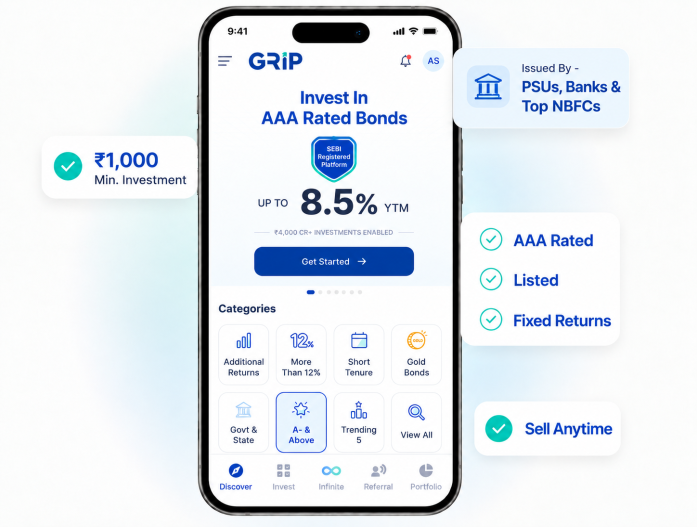
AAA rated bonds are debt securities with the highest credit rating, which means the lowest credit risk. Bonds with a AAA rating are issued by issuers with a strong ability to pay the interest and principal on time.
SEBI-registered credit rating agencies like CRISIL, ICRA, CARE and India Ratings assess the financial health, cash flows, debt levels and management information of the issuer before assigning a AAA rating.
Government-owned entities like NHAI, REC, PFC and NABARD, along with large banks, leading NBFCs and blue-chip companies with a stable track record, issue AAA rated corporate bonds.
According to RBI’s Financial Stability Report (June 2025), the corporate bond market in India reached INR 53.6 lakh crore by March 2025, with record fresh issuances of INR 9.9 lakh crore in FY25, led largely by AAA rated issuers.
Usually, these AAA bonds are listed on stock exchanges; hence, investors can earn regular interest, and if needed, they can sell them in the secondary market before maturity.


Make Plan For Your Investment
Calculate your returns from AAA rated bond investment
Use our bond calculator to estimate the returns you will receive by investing in a AAA rated bond
- Add investment amount
- Set the tenure, YTM and coupon frequency
- See the instant results
Disclaimer: This calculator is for illustration purposes only and does not guarantee or represent actual returns.

BENEFITS OF INVESTING IN AAA BOND

Highest Credit Safety
AAA bonds carry the top credit rating; hence, the issuer of these bonds has the strongest capacity to pay the interest and principal on time

Predictable Income
You earn regular fixed returns from AAA-rated bonds - monthly, quarterly or annually- which helps in better financial planning

Inflation-Beating Returns
AAA rated bonds offer returns that can easily beat inflation after tax, unlike regular bank FDs

Portfolio Stability
Fixed returns from AAA-rated corporate bonds are non-market-linked, hence adding stability to your portfolio during market volatility

Liquidity & Flexibility
AAA-rated bonds purchased on Grip Invest can be sold anytime, offering easy liquidity for your financial needs

How to Invest?


- Rating, Agency & Outlook: Identify which rating agency has assigned the rating and when it was last reviewed. Also, look for the outlook, whether it is Stable or Negative, as a recent review gives a more reliable picture.
- Rating Suffix: At times, AAA rating comes with a suffix like AAA (CE) or AAA (SO), which means “Credit Enhancement” and “Structured Obligation”. Look for these tags; they mean the rating relies on a guarantee or special structure, not the issuer’s standalone strength, so read what backs it.
- YTM, Not Just Coupon: Look for the YTM and not just the coupon rate; it tells you the yield you will get if held till maturity. If purchased at a premium price, the AAA bond will yield less than its coupon rate, and vice versa.
- Seniority & Security: Senior secured bonds are repaid ahead of subordinated debt such as Tier 2 bonds. Even within the same AAA issuer, seniority changes how much risk you carry.
- Tenure & Liquidity: Longer-tenure AAA bonds are more sensitive to interest rate changes. You should match tenure to your goals before investing in AAA bonds.

OTHER OFFERINGS
Other Secured Fixed-Income Products By Grip Invest

Corporate Bonds
- Securities issued by corporates & NBFCs
- Up to 12.5% pre-tax YTM
- Start investing with Rs 1,000
- Exchange listed and credit rated

InvoiceX
- Loans backed by Invoice Discounting
- Up to 14% pre-tax YTM
- Start investing with Rs 1,00,000
- SEBI/RBI compliant and credit rated

LoanX
- Diverse pool of loans from top NBFCs
- Up to 14% pre-tax
- Start investing with Rs 1,00,000
- SEBI/RBI compliant and credit rated

Baskets
- Theme based investing
- Up to 14% pre-tax YTM
- Start investing with Rs 5,000
- SEBI/RBI compliant and credit rated

Corporate FDs
- High Yield Fixed Deposit Investments
- Up to 10% pre-tax
- Start investing with Rs 1,000
- SEBI/RBI compliant and credit rated
For your knowledge
Some of our partners






Insightful Blogs
Following Blogs Provide Detailed Insights On Bonds
Insightful Videos
Learn more about rating of bonds through our videos
What Are Credit Rating Agencies? Role, Importance & Ratings Explained (AAA to C)
Best Bonds for Beginners & Conservative Investors in India
Can You Sell Bonds Before Maturity? The Truth Every Investor Should Know
To help you
Frequently Asked Questions
What is the credit rating scale for bonds in India?
The standard credit rating scale for bonds in India is from AAA to D. These ratings are provided by SEBI-registered credit rating agencies, with the following meanings:
- AAA: Highest safety, lowest credit risk
- AA: High safety, very low credit risk
- A: Adequate safety, low credit risk
- BBB: Moderate safety, moderate credit risk
- BB to C: Speculative grade, increasing risk of default
- D: In default or expected to default
Ratings from AA to C may carry a “+” or “–” sign to show relative standing within the category. Bonds below BBB are considered non-investment grade bonds.
Are AAA rated bonds risk-free?
Who issues AAA rated bonds in India?
What is the current yield of AAA corporate bonds?


