

10 Fixed Return Investment Plans In India: Rates, Risks And Features



A fixed return investment plan is an investment in which the interest rate or the payout schedule is decided on the day of investing, and market movement does not change it after that. Bank FDs, post office schemes, government bonds and corporate bonds all come under this. The protection behind each of them is not the same though.
A fixed rate tells the investor how much will be paid, but whether it actually gets paid depends on the borrower. So before choosing one, the rate has to be checked along with who is issuing it and how the money can be taken out early.
10 Fixed Return Investment Plans In India
The fixed return investment options in India covered here can be put into three groups based on who stands behind the money. Bank deposits, including deposits in small finance banks, are insured by DICGC up to INR 5 lakh per depositor per bank. Post office schemes, government bonds and RBI savings bonds have the backing of the Government of India. In case of corporate FDs and corporate bonds, repayment depends only on the company.
Note that a rate fixed in advance is not a promise that the money will come back.
1. Bank Fixed Deposits
A bank fixed deposit is money kept with a bank for a fixed period, at a rate that does not change till maturity. The rate is different for different tenures and senior citizens generally get around 0.50% extra. The investor can take the interest out every month or quarter, or let it get added to the deposit so that it also earns interest. Most savers in India start with a bank FD, and that is why other products are usually compared against it.
Feature | Details |
| Interest rate | SBI offers up to 6.40% for regular depositors and 7.05% for senior citizens as of November 2026. Some large private banks pay slightly more for certain tenures |
| Minimum investment | INR 1,000 at SBI, and most other banks also accept small amounts |
| Tenure | 7 days to 10 years |
| Payout frequency | Monthly, quarterly or on maturity, as selected while opening |
| Liquidity | Can be broken before maturity. The bank usually pays 0.50% to 1% less than the rate applicable for the period the deposit was held |
| Risks | Credit risk is very low up to the DICGC limit. Main concern is that the rate may fall short of inflation |
| Tax | Interest is added to income and taxed at slab rate. Bank deducts TDS when yearly interest is above INR 50,000 (INR 1 lakh for senior citizens) |
2. Corporate Fixed Deposits
A corporate FD is similar to a bank FD, the only difference being that the money is deposited with an NBFC or a housing finance company and not with a bank. Such companies lend this money onwards, and they offer a higher rate than banks to get deposits from the public. Only those companies which RBI permits can take deposits.
Every deposit scheme also has a credit rating, which is the rating agency’s view on whether the company can repay. In return for the higher rate, the depositor gives up deposit insurance.
Feature | Details |
| Interest rate |
|
| Minimum investment | INR 15,000 if invested directly with Bajaj Finance, and INR 1,000 through Grip Invest |
| Tenure | 12 to 60 months in case of NBFC deposits, as per RBI rules |
| Payout frequency | Monthly, quarterly, half-yearly, yearly or cumulative |
| Liquidity | Withdrawal is generally not allowed in the first 3 months. After that, early closure is possible but at a lower rate |
| Risks | DICGC insurance does not apply, so the company alone is responsible for repayment. Rating may be downgraded if the company’s finances weaken |
| Tax | Taxed at slab rate. TDS is deducted when interest from one company goes above INR 10,000 in a year |
Corporate FDs listed on Grip Invest are from NBFCs and small finance banks with ratings from AAA to A. Note that Grip Invest is only a distributor here, so the deposit agreement is between the investor and the company. The chart below shows bank FD and corporate FD rates next to the indicative yields of corporate bonds on Grip.
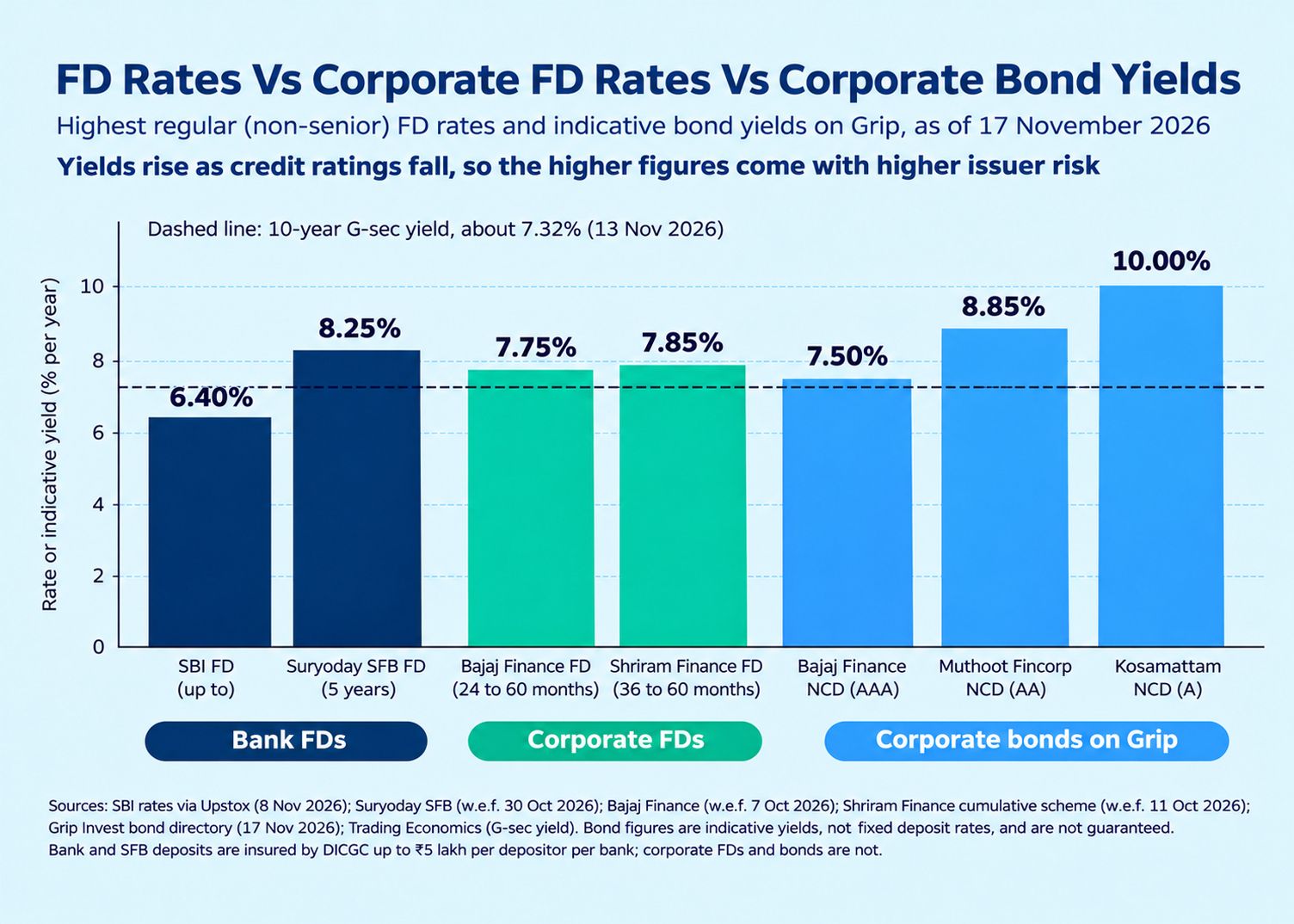
A corporate FD does not necessarily pay more than every bank. A few small finance banks are paying more than the big NBFCs, and their deposits are insured as well.
3. Small Finance Bank FDs
A small finance bank is a scheduled bank licensed by RBI to serve small businesses and lower income households. Its FDs work exactly like other bank FDs, with the same choice of tenure and payout. These banks pay higher rates as they are smaller and less known among savers, and their best rates are often on unusual tenures such as 500 or 1,000 days.
Feature | Details |
| Interest rate | Suryoday Small Finance Bank pays 8.25% to regular depositors and 8.60% to senior citizens on 5-year FDs, effective 30 October 2026 |
| Minimum investment | Small, but it varies by bank |
| Tenure | 7 days to 10 years, with the best rates often on special tenures |
| Payout frequency | Monthly, quarterly or at maturity |
| Liquidity | Early closure allowed with a penalty, as in other banks |
| Risks | DICGC cover up to INR 5 lakh; any amount above that depends on the bank's financial position |
| Tax | Taxed in the same way as other bank FDs |
Suppose an investor wants to place INR 8 lakh in small finance bank FDs then splitting it as INR 4 lakh each in two banks keeps the full amount within the insurance limit, instead of leaving INR 3 lakh uninsured in one bank.
4. Government Bonds
While bank deposits are insured only up to a limit, government securities carry the backing of the government itself. These are bonds through which the central and state governments borrow, and they pay a fixed coupon on fixed dates till maturity. Individuals can buy them at auctions or from other holders through RBI Retail Direct, and also through stock brokers. Treasury bills are the short-term version, bought below face value and repaid at full value.
Feature | Details |
| Interest rate | Fixed coupon; the 10-year G-sec yield was about 7.32% on 13 November 2026 |
| Minimum investment | INR 10,000 through RBI Retail Direct, where no brokerage is charged |
| Tenure | 91, 182 and 364 days for treasury bills; up to 40 years for dated bonds |
| Payout frequency | Half-yearly coupon; treasury bills pay no coupon and are bought at a discount |
| Liquidity | Can be sold before maturity, but the price depends on market yields and small amounts may get a lower price |
| Risks | Negligible default risk; the price falls if yields rise, which matters only if sold early |
| Tax | Interest is taxed at slab rate; gains on listed bonds held over 12 months are taxed at 12.5% |
Suppose an investor buys a INR 10,000 bond with a 7% coupon then the interest would be INR 350 every six months (INR 10,000 × 7% ÷ 2), and the INR 10,000 comes back at maturity.
5. Corporate Bonds
A corporate bond follows the same pattern as a government bond, but the borrower is a company. The company pays a higher coupon than the government because the investor takes on its credit risk, and the size of that extra yield depends on the company's rating. Listed bonds are bought through a stock broker or an online bond platform registered with SEBI and held in the investor's demat account. The yield shown depends on the price paid, so it can differ from the coupon.
Feature | Details |
| Interest rate | On the Grip bond directory as of 17 November 2026: Bajaj Finance (AAA) 7.50%, Muthoot Fincorp (AA) 8.85% and Kosamattam Finance (A) 10.00%, with some BBB rated bonds above 12% |
| Minimum investment | INR 1,000 on Grip |
| Tenure | From a few months to several years; most bonds on Grip mature within one to four years |
| Payout frequency | Monthly, quarterly or annual, as per the bond's terms |
| Liquidity | Listed bonds can be sold on the exchange if a buyer is available, at a price that may be higher or lower than the purchase price; bonds bought on Grip and held in a Grip demat account can be sold on Grip, and others after a holding period of two months |
| Risks | Default or delay by the company, rating downgrades and price changes if sold before maturity |
| Tax | Taxed in the same way as government bonds |
The higher yields on lower rated bonds are a payment for higher credit risk, as explained under secured and unsecured bonds. A 12% bond pays more only as long as the company can keep paying it.
6. Post Office Term Deposits
For investors who prefer a deposit to a bond, the post office offers a government-backed alternative to a bank FD. The account can be opened at any post office or online through India Post, singly or jointly. The rate on the date of opening applies for the full tenure, even if the government changes rates in a later quarter.
Feature | Details |
| Interest rate | 6.9% for 1 year, 7.0% for 2 years, 7.1% for 3 years and 7.5% for 5 years, for 1 October to 31 December 2026, compounded quarterly |
| Minimum investment | INR 1,000, with no upper limit |
| Tenure | 1, 2, 3 or 5 years |
| Payout frequency | Interest is paid once a year |
| Liquidity | No withdrawal in the first six months; closing before one year earns only the post office savings rate, and later closures earn a lower rate |
| Risks | Backed by the Government of India; the main risk is a low real return if inflation rises |
| Tax | Interest is taxed at slab rate; the 5-year deposit qualifies for a deduction under the old tax regime |
7. National Savings Certificates (NSC)
NSC is another post office product, but unlike a time deposit it pays nothing until maturity and the full amount comes back at the end of five years. Since interest is reinvested every year, the investor receives no income in between, which suits money that will not be needed for that period. The certificate is bought at a post office and is held in electronic form.
Feature | Details |
| Interest rate | 7.7% for 1 October to 31 December 2026, compounded yearly, so INR 10,000 grows to INR 14,490 in five years |
| Minimum investment | INR 1,000, with no upper limit |
| Tenure | 5 years |
| Payout frequency | No periodic payout; interest is added each year and paid at maturity |
| Liquidity | Cannot be closed early except on the death of the holder or by court order, though it can be pledged for a loan |
| Risks | Backed by the Government of India; money is locked in for five years |
| Tax | Interest is taxable, but the deposit qualifies for a deduction under the old tax regime |
8. Public Provident Fund (PPF)
PPF also locks money in, but over a much longer period of 15 years, and in return it offers fully tax-free interest. The account can be opened at a post office or a bank, and the investor can deposit any amount within the yearly limit in one go or in parts. Unlike NSC or a time deposit, the PPF rate is not fixed for the full tenure, as the rate for each quarter applies to the whole balance. This is why savers often compare it with FDs before deciding between the two.
Feature | Details |
| Interest rate | 7.1% for 1 October to 31 December 2026, compounded yearly; can be revised every quarter |
| Minimum investment | INR 500 a year, with a maximum of INR 1.5 lakh a year |
| Tenure | 15 years, which can be extended in blocks of 5 years |
| Payout frequency | No periodic payout; interest is added to the account each year |
| Liquidity | Partial withdrawals are allowed from the seventh year, and loans are available from the third to the sixth year |
| Risks | Backed by the Government of India; a long lock-in and a rate that can change |
| Tax | Deposits qualify for a deduction under the old tax regime, and interest and maturity amount are tax-free |
9. RBI Floating Rate Savings Bonds
Similar to PPF, this bond also does not have one rate for its full tenure. The difference is that the interest is paid out to the investor and not added to the balance.
It is a 7-year bond of the Government of India. Its rate is kept at 0.35% above the NSC rate and is reset every six months. So the payout dates and the NSC link are fixed, but the rate can go up or down.
Feature | Details |
| Interest rate | 8.05% for July to December 2026; the next reset is on 1 January 2027 |
| Minimum investment | INR 1,000, with no upper limit |
| Tenure | 7 years |
| Payout frequency | Half-yearly, on 1 January and 1 July; there is no cumulative option |
| Liquidity | Cannot be sold or transferred; early exit is allowed only to senior citizens after a lock-in of four to six years depending on age |
| Risks | Backed by the Government of India; the rate can fall at a reset |
| Tax | Interest is fully taxed at slab rate and TDS applies |
10. Recurring Deposits
All the options above need a lump sum. However, a recurring deposit suits an investor who wants to save a fixed amount every month instead, at a rate fixed on the day the account is opened.
Each instalment earns interest from the month it is paid, and the full amount with interest is paid out at maturity, which makes it useful for a planned expense such as a fee or a purchase.
Feature | Details |
| Interest rate | 6.7% for the 5-year Post Office RD for 1 October to 31 December 2026, compounded quarterly; bank RDs usually follow the bank's FD rates |
| Minimum investment | INR 100 a month at the post office and at most banks |
| Tenure | 5 years at the post office; 6 months to 10 years at banks |
| Payout frequency | Paid in full at maturity |
| Liquidity | The Post Office RD can be closed after three years, and a loan of up to half the balance is available after 12 instalments |
| Risks | Same backing as the institution; a missed instalment attracts a small penalty |
| Tax | Interest is taxed at slab rate |
Suppose an investor deposits INR 5,000 every month in the Post Office RD then the amount at maturity would be about INR 3.57 lakh against INR 3,00,000 deposited (INR 5,000 × 60).
Comparison Of Fixed Return Investment Plans
The tables above explain each option on its own, but the rates in them do not change on the same schedule. Small savings rates are reviewed every quarter, the RBI bond rate every six months, and bank, company deposit and bond rates can change on any day.
The below table puts all ten in one place with the period for which each rate applies, who sets it and what backs it:
| Plan | Latest rate or yield | Applicable period | Set by and backing |
| Bank FD | Up to 6.40% (SBI) | As reported on 8 November 2026 | Bank's rate card; DICGC insured |
| Corporate FD | 7.75% to 7.85%; up to 10% on Grip | Rates effective 7 and 11 October 2026; Grip as of 17 November 2026 | Issuer's rate card; not insured |
| Small finance bank FD | Up to 8.25% | Effective 30 October 2026 | Bank's rate card; DICGC insured |
| Government bonds | About 7.32% (10-year) | 13 November 2026 | Market yield; sovereign |
| Corporate bonds | 7.50% (AAA) to above 12% (BBB) | 17 November 2026 | Market yield on Grip; issuer credit risk |
| Post Office TD | 6.9% to 7.5% | 1 October to 31 December 2026 | Ministry of Finance; sovereign |
| NSC | 7.7% | 1 October to 31 December 2026 | Ministry of Finance; sovereign |
| PPF | 7.1% | 1 October to 31 December 2026 | Ministry of Finance; sovereign |
| RBI Floating Rate Savings Bond | 8.05% | 1 July to 31 December 2026 | RBI; sovereign |
| Post Office RD | 6.7% | 1 October to 31 December 2026 | Ministry of Finance; sovereign |
Most of these options pay between 6.5% and 8%, and only lower rated corporate bonds and FDs go clearly above that range. The next small savings review is due by the end of December 2026, and the RBI bond resets on 1 January 2027.
How To Choose The Right Fixed-Return Investment?
Since the rates sit in a narrow band, the rate alone rarely decides the choice. Choosing a fixed return investment plan generally starts with the purpose of the money, and the investor may consider the following:
- Horizon: Money needed within a year suits short FDs or treasury bills, while PPF and NSC suit goals five years or more away.
- Regular income: FDs with monthly payout, the Post Office Monthly Income Scheme at 7.4% for October to December 2026 and bonds that pay monthly can provide a steady sum every month.
- Backing: Government schemes and insured bank deposits carry less credit risk than corporate FDs and bonds.
- Exit terms: Some can be closed early with a penalty, while others have long lock-ins or depend on a buyer.
- Tax slab: An investor in the 30% slab keeps about 4.88% (7.1% × 0.688, including cess) from a 7.1% taxable deposit, while PPF at the same 7.1% is tax-free.
Suppose a retired investor places INR 5,00,000 in a monthly-payout option at 9% then the monthly income would be about INR 3,750 (INR 5,00,000 × 9% ÷ 12) before tax. The same amount at 7.4% would give about INR 3,083 a month. The extra INR 667 should be weighed against the issuer's rating and the chance of a delay.
Fixed Returns Vs Market-Linked Returns: What Is The Difference?
All 10 options discussed so far share one feature, which is that the return is known before investing. Market-linked products have no set rate, and their value changes every day with prices. The difference can be understood as per the table given below:
| Product | How return is earned | Main risk | Entry amount |
| Fixed-income products (FDs, bonds, small savings) | Interest at a rate fixed in advance | Issuer default; price change if a bond is sold early | From INR 100 to INR 15,000 depending on the product |
| Equity mutual funds | Change in NAV as share prices move | Market falls; no fixed income | From about INR 100 through SIPs |
| Debt mutual funds | Interest earned plus change in bond prices, shown in NAV | Interest rate and credit risk; NAV can fall | From about INR 100 through SIPs |
| Specialised Investment Funds (SIFs) | NAV from strategies such as long-short positions using derivatives | Higher strategy and market risk | INR 10 lakh at PAN level |
A debt mutual fund holds bonds but does not pay a fixed rate, as its NAV moves daily. SIFs are a SEBI category in force since 1 April 2025, meant for investors who can commit a large sum, and their returns are not fixed in any form.
FAQs

Want to stay at the top of your finances?
Join the community of 22 lakh+ investors and learn more about Grip Invest, the latest financial knick-knacks, and shenanigans in the world of investing.
Happy Investing!
Disclaimer - Investments in debt securities/municipal debt securities/securitised debt instruments are subject to risks including delay and/ or default in payment. Read all the offer related documents carefully. The investor is requested to take into consideration all the risk factors before the commencement of trading.
This communication is prepared by Grip Broking Private Limited (bearing SEBI Registration No. INZ000312836 and NSE ID 90319) and/or its affiliate/ group company(ies) (together referred to as “Grip”) and the contents of this disclaimer are applicable to this document and any and all written or oral communication(s) made by Grip or its directors, employees, associates, representatives and agents. This communication does not constitute advice relating to investing or otherwise dealing in securities and is not an offer or solicitation for the purchase or sale of any securities. Grip does not guarantee or assure any return on investments and accepts no liability for consequences of any actions taken based on the information provided. For more details, please visit www.gripinvest.in
Registered Address - 106, II F, New Asiatic Building, H Block, Connaught Place, New Delhi 110001


