

SIP In Bonds: Meaning, Benefits, How It Works And Risks



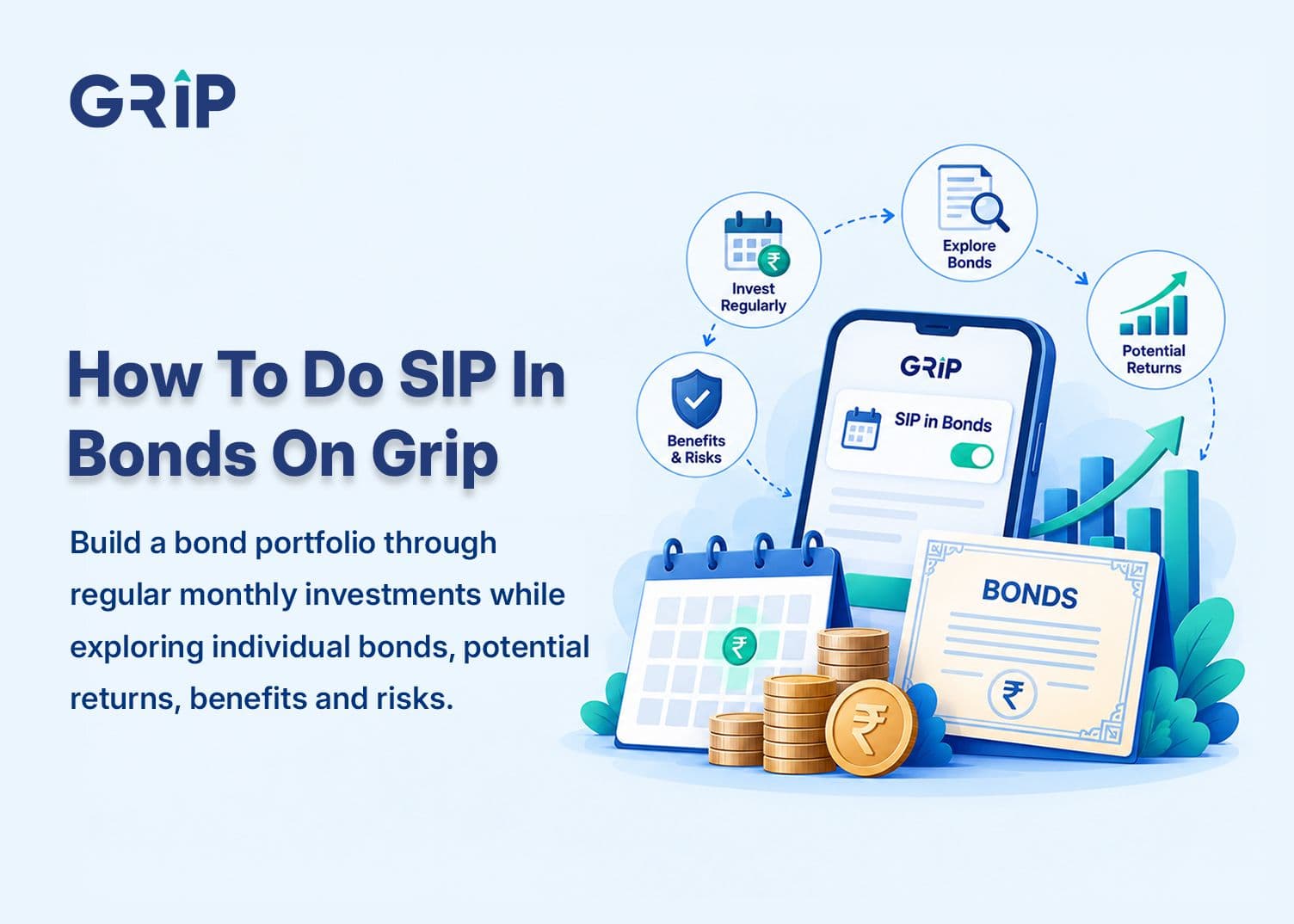
Investing in bonds can help diversify a portfolio and provide potential income through interest payments. However, choosing individual bonds every month may require time and research.
A SIP in bonds offers an alternative by allowing investors to invest in bonds at regular intervals. Instead of investing a lump sum, you contribute a set amount every month and gradually build a portfolio of individual bonds.
Keep reading to know more about SIP in bonds.
What Is SIP In Bonds?
A SIP in bonds is a method of investing in bonds through regular contributions, usually every month. Each instalment purchases individual bonds rather than units in a mutual fund.
To understand how it works, consider these key terms:
- Bond: A debt instrument through which an investor lends money to an issuer in exchange for interest and repayment of principal, subject to the bond's terms.
- Coupon Rate: The stated interest rate a bond pays on its face value.
- Maturity: The date when the bond's principal is scheduled to be repaid.
- Yield To Maturity (YTM): The estimated annualised return from holding a bond until maturity, assuming scheduled payments are made.
With a bond SIP, every monthly instalment can purchase a different bond (within the theme you have chosen). Over time, these investments can help build a portfolio across multiple issuers.
How Does SIP In Bonds Work On Grip Invest?
Grip Invest's Bond SIP allows investors to make recurring investments in individual bonds through a selected investment theme.
Here are the key features:
| Feature | How It Works |
| Curated Themes | Investors select a category with a defined investment amount range and a pool of available bond issuers. |
| Monthly Contributions | Investors choose a recurring amount and debit date within the theme’s permitted limits. |
| Automated Bond Selection | Grip selects a bond from the chosen theme for each instalment. |
| Issuer Diversification | Bonds rotate across issuers within the selected theme |
| Pre-Debit Review | Investors receive details of the assigned bond before the debit date and can pause or cancel within the available review window |
| Portfolio Tracking | Investors can view transaction history, SIP details and management options. |
Key Rules And Features Of Grip Invest’s Bond SIP
Grip Invest’s Bond SIP includes specific rules for issuer diversification, monthly debits and investment management. Here are a few additional details to know before starting:
1. Issuer Diversification: No single issuer can account for more than 20% of an investor’s Bond SIP portfolio, helping limit concentration in any one issuer.
2. Flexible Debit Date: Investors can choose a debit date between the 1st and 28th of each month. If the selected date is less than 10 days away when the SIP is set up, the first debit is scheduled for the following month.
3. Variable Debit Amount: The actual debit may differ slightly from the selected SIP amount because bond prices fluctuate. The debit amount can be up to INR 1,000 higher or lower than the SIP amount for SIPs up to INR 80,000, and up to INR 2,000 higher or lower for SIPs between INR 80,001 and INR 1,00,000.
4. Additional Returns On Select Themes: Some investment themes offer an additional return over and above the slab-based Yield To Maturity (YTM), subject to the applicable theme terms.
5. Failed Payments: If a scheduled debit fails, it is not automatically retried. The instalment for that month is skipped.
6. Changing The SIP Amount: Investors cannot currently change the amount of an existing Bond SIP. To invest a different amount, they need to cancel the existing SIP and create a new one.
Can You Pause Or Cancel A Bond SIP On Grip?
Yes. Grip's Bond SIP allows investors to pause or cancel their SIP, subject to the applicable process and terms.
- Pause: Skip upcoming instalments for a selected period. The SIP can resume automatically after the pause ends.
- Cancel: Stop future instalments. Bonds purchased through previous instalments remain in the investor's demat account.
Cancelling the SIP does not automatically cancel the associated auto-debit mandate. Investors should deactivate the mandate separately if required.
How Are Returns From SIP In Bonds Calculated?
Returns from a SIP in bonds depend on the terms and purchase price of each bond. Since every instalment may purchase a different bond, the overall portfolio may have multiple YTMs and maturity dates.
For example, consider a bond with a face value of INR 10,000 and an annual coupon rate of 8%. It would pay INR 800 in annual interest if the coupon is paid in full. However, its YTM may be different because it also depends on the purchase price and repayment at maturity.
On Grip, the YTM displayed for a Bond SIP theme depends on the available bonds and the applicable investment amount slab. The YTM is recalculated for each instalment and may change over time.
Who Should Consider SIP In Bonds?
A SIP in bonds may be worth exploring for investors who:
- Want to build a bond portfolio through regular monthly investments.
- Already invest in mutual funds or equities and want to explore fixed-income investments.
- Prefer investing in individual bonds rather than units of a pooled fund.
- Want an automated investment process with visibility into individual bond allocations.
Before starting, consider your investment horizon, liquidity requirements, risk tolerance and ability to assess bond issuers.
What Are The Benefits Of SIP In Bonds?
A SIP in bonds combines regular investing with direct ownership of individual bonds. Its key benefits include:
- Disciplined Investing: Regular contributions help establish a consistent investment habit.
- Convenience: Automated payments reduce the need to initiate every investment manually.
- Portfolio Diversification: Monthly investments can spread exposure across different bond issuers.
- Income Planning: Bonds with scheduled coupon payments can support cash flow planning, as these bonds may offer monthly, quarterly, half-yearly, or annual repayments.
- Investment Visibility: Investors can review the details of individual bonds held in their portfolios.
- Flexibility: Investors will be able to pause or cancel future instalments if they want to.
SIP In Bonds Vs Mutual Fund SIP: What’s The Difference?
Both investment methods allow regular contributions, but they differ in ownership, portfolio management and liquidity.
| Parameter | SIP In Bonds | Mutual Fund SIP |
| Investment | Individual bonds | Mutual fund units |
| Ownership | Direct ownership of allocated bonds | Units in a pooled investment fund |
| Portfolio management | Investor holds the allocated bonds | Fund manager manages the fund’s portfolio |
| Returns | Depend on bond terms, purchase price and payments received | Depend on the fund’s underlying investments and performance |
| Diversification | Builds through individual bond purchases | Depends on the fund’s portfolio |
| Liquidity | Depends on bond terms and secondary-market availability | Depends on the fund type and redemption rules |
What Are The Risks Of SIP In Bonds?
Although a bond SIP provides a systematic way to invest, it does not guarantee returns or protect your capital from losses.
The main risks include:
1. Credit Risk: An issuer may delay or default on interest or principal repayments. Grip Invest brings only investment-grade bonds on its platform. Additionally, you can choose themes with low-risk bonds to reduce credit risk.
2. Interest Rate Risk: Bond prices may fall when market interest rates rise.
3. Liquidity Risk: Selling a bond before maturity may be difficult or may require accepting a lower price. However, you can sell bonds anytime on Grip if you have purchased the bonds from Grip and you have a demat account with Grip. In case of no Grip demat account, you can sell bonds before maturity after a holding period of two months.
4. Reinvestment Risk: New instalments may be invested at different yields as market conditions change.
5. Return Variability: Each instalment may have a different YTM depending on the bond selected and its purchase price.
Conclusion
A SIP in bonds offers a systematic way to build a portfolio of individual bonds through recurring investments. It can simplify the investment process, encourage disciplined investing and spread exposure across issuers over time. However, returns and liquidity depend on the bonds selected and market conditions.
Investors should assess their financial goals, risk tolerance and investment horizon before starting. Grip Invest's Bond SIP provides a structured way to explore recurring bond investments, review assigned bonds and track the resulting portfolio.
FAQs

Want to stay at the top of your finances?
Join the community of 22 lakh+ investors and learn more about Grip Invest, the latest financial knick-knacks, and shenanigans in the world of investing.
Happy Investing!
Disclaimer - Investments in debt securities/municipal debt securities/securitised debt instruments are subject to risks including delay and/ or default in payment. Read all the offer related documents carefully. The investor is requested to take into consideration all the risk factors before the commencement of trading.
This communication is prepared by Grip Broking Private Limited (bearing SEBI Registration No. INZ000312836 and NSE ID 90319) and/or its affiliate/ group company(ies) (together referred to as “Grip”) and the contents of this disclaimer are applicable to this document and any and all written or oral communication(s) made by Grip or its directors, employees, associates, representatives and agents. This communication does not constitute advice relating to investing or otherwise dealing in securities and is not an offer or solicitation for the purchase or sale of any securities. Grip does not guarantee or assure any return on investments and accepts no liability for consequences of any actions taken based on the information provided. For more details, please visit www.gripinvest.in
Registered Address - 106, II F, New Asiatic Building, H Block, Connaught Place, New Delhi 110001


