

Fully Accessible Route Bonds: Meaning, Benefits And Investment Rules



Consider a hypothetical foreign pension fund planning to invest INR 500 crore in Indian government securities.
Under the General Route, its investment would be subject to the applicable foreign investment limits. However, if the fund invests in government securities designated under the Fully Accessible Route (FAR), these quantitative investment limits would not apply, provided the fund meets the relevant eligibility and regulatory requirements.
This difference makes FAR an important route for foreign investment in Indian government securities. It also supports India's participation in global bond indices. In June 2026, the RBI expanded the list of FAR-eligible securities to include additional maturities. Separately, the government introduced tax exemptions on interest income and capital gains from government securities for eligible foreign institutional investors, subject to applicable conditions.
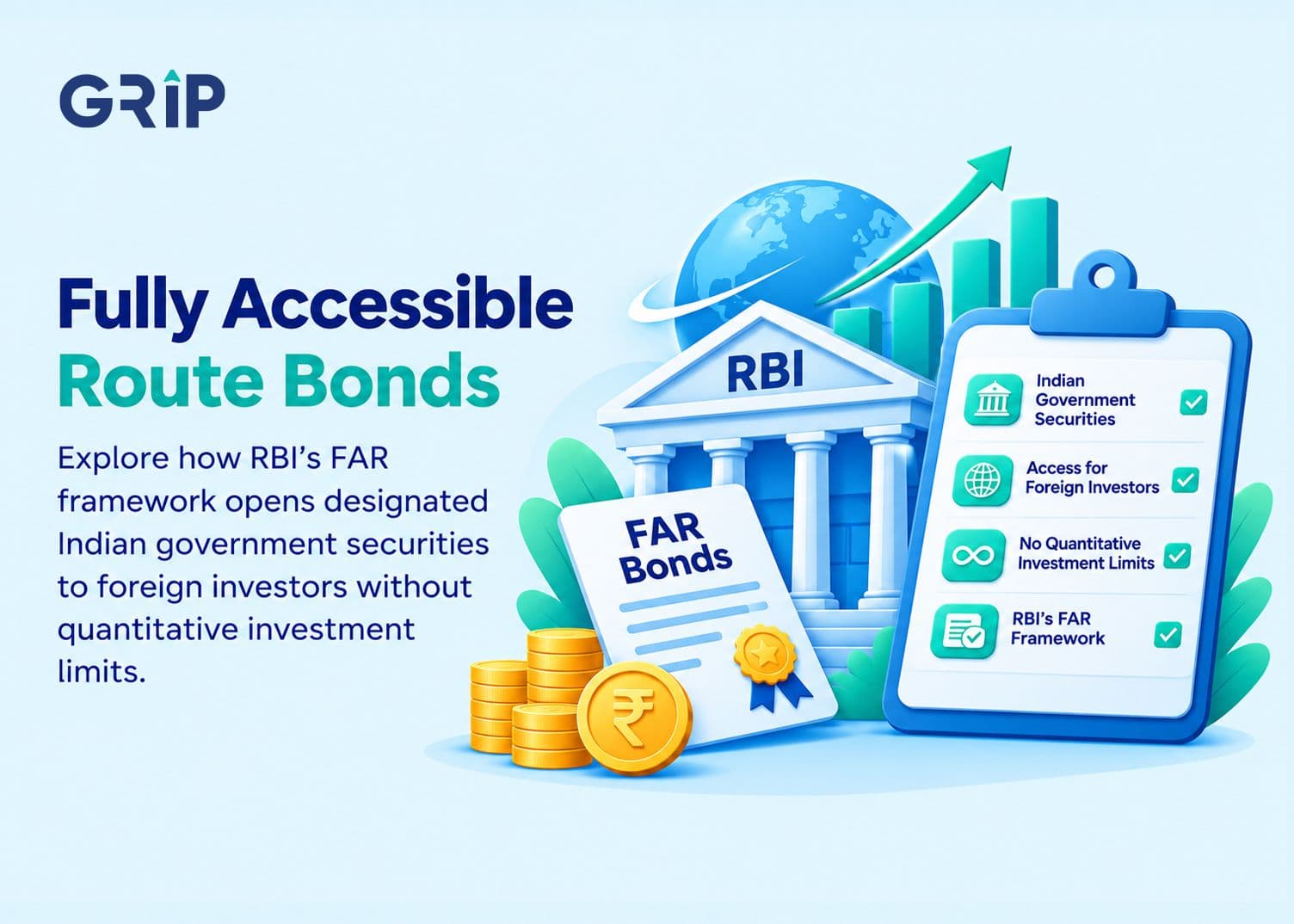
This guide explains the latest investment rules for Fully Accessible Route bonds, their key benefits and how foreign investors can access eligible Indian government securities through this route.
What Are Fully Accessible Route Bonds?
The Reserve Bank of India (RBI) introduced the Fully Accessible Route (FAR) through a circular issued on March 30, 2020, effective April 1, 2020.1 This route allows eligible non-resident investors to invest in designated Indian government securities without quantitative investment limits. FAR is not a separate category of bonds. Instead, it is a regulatory framework through which foreign investors can invest in government securities notified by the RBI as “specified securities”.
The core purpose of FAR is to attract overseas capital and broaden the investment base of India's government bond market. Increased foreign participation can also improve market liquidity and potentially reduce government borrowing costs, depending on market conditions.
How Does The Fully Accessible Route Work?
The RBI identifies government securities eligible for investment under the Fully Accessible Route. Once designated as “specified securities”, they remain eligible under FAR until maturity. Eligible investors include Foreign Portfolio Investors (FPIs), Non-Resident Indians (NRIs), Overseas Citizens of India (OCIs) and other non-resident investors permitted by the RBI. Investments in these securities are not subject to the quantitative limits applicable under the General Route. However, investors must comply with the relevant RBI, FEMA and SEBI regulations, as applicable.
Suppose an FPI purchases INR 300 crore worth of a FAR-designated government bond with a 10-year maturity. This investment would not count towards the General Route investment limit. However, if the FPI purchased a non-FAR Central Government security, the investment would count towards the applicable General Route limit, set at 6% of the outstanding stock of eligible Central Government securities for FY 2026–27.
The relevant RBI/SEBI framework sets eligibility criteria and operational conditions, including FPI registration, custody arrangements, and disclosures. Investors should review current regulations before investing.
Which Government Securities Are Eligible Under FAR?
The RBI notifies which government securities qualify for investment under FAR. In July 2024, it excluded new issuances of 14-year and 30-year government bonds, while previously designated securities remained eligible. Later that year, 10-year Sovereign Green Bonds were also included.
On June 5, 2026, the RBI expanded FAR eligibility to new 15-year, 30-year and 40-year government securities, along with Sovereign Green Bonds across eligible tenors and three specified existing securities. Currently, FAR covers designated government securities and new issuances in the 5-, 7-, 10-, 15-, 30- and 40-year tenors. Other securities, including Treasury Bills, may be available to eligible foreign investors under the General Route, subject to applicable regulations.
Feature | FAR securities | Other G-Secs (General Route) |
| Investment limit | No quantitative investment ceiling for eligible investors | Overall FPI limit of 6% of outstanding non-FAR Central Government securities (FY 2026–27) |
| Securities covered | RBI-designated specified Central Government securities, including eligible Sovereign Green Bonds | Central Government securities, including Treasury Bills, not designated under FAR |
| Eligible investors | FPIs, NRIs, OCIs and other non-residents permitted by the RBI | FPIs, subject to applicable regulations |
| June 2026 changes | Expanded to include new 15-, 30- and 40-year G-Secs, additional Sovereign Green Bonds and three existing securities | Short-term, concentration and security-wise investment limits removed |
| Global index inclusion | Certain FAR-eligible securities qualify for inclusion in major global bond indices | Eligibility depends on the methodology of each index |
Source: Reserve Bank of India, Master Direction – Non-resident Investment in Debt Instruments, 2025 (updated June 5, 2026), and RBI Circular No. 11 dated June 5, 2026.
Benefits Of FAR Bonds For Investors And India
The primary advantage for foreign investors is the ability to invest in FAR-designated government securities without quantitative investment limits.
On November 3, 2026, India's benchmark 10-year government bond yield stood at approximately 7.3%, although actual returns for foreign investors also depend on currency movements and other market factors. Separately, the government introduced tax exemptions on interest income and capital gains from government securities for eligible foreign institutional investors, effective April 1, 2026, subject to prescribed information-furnishing requirements.
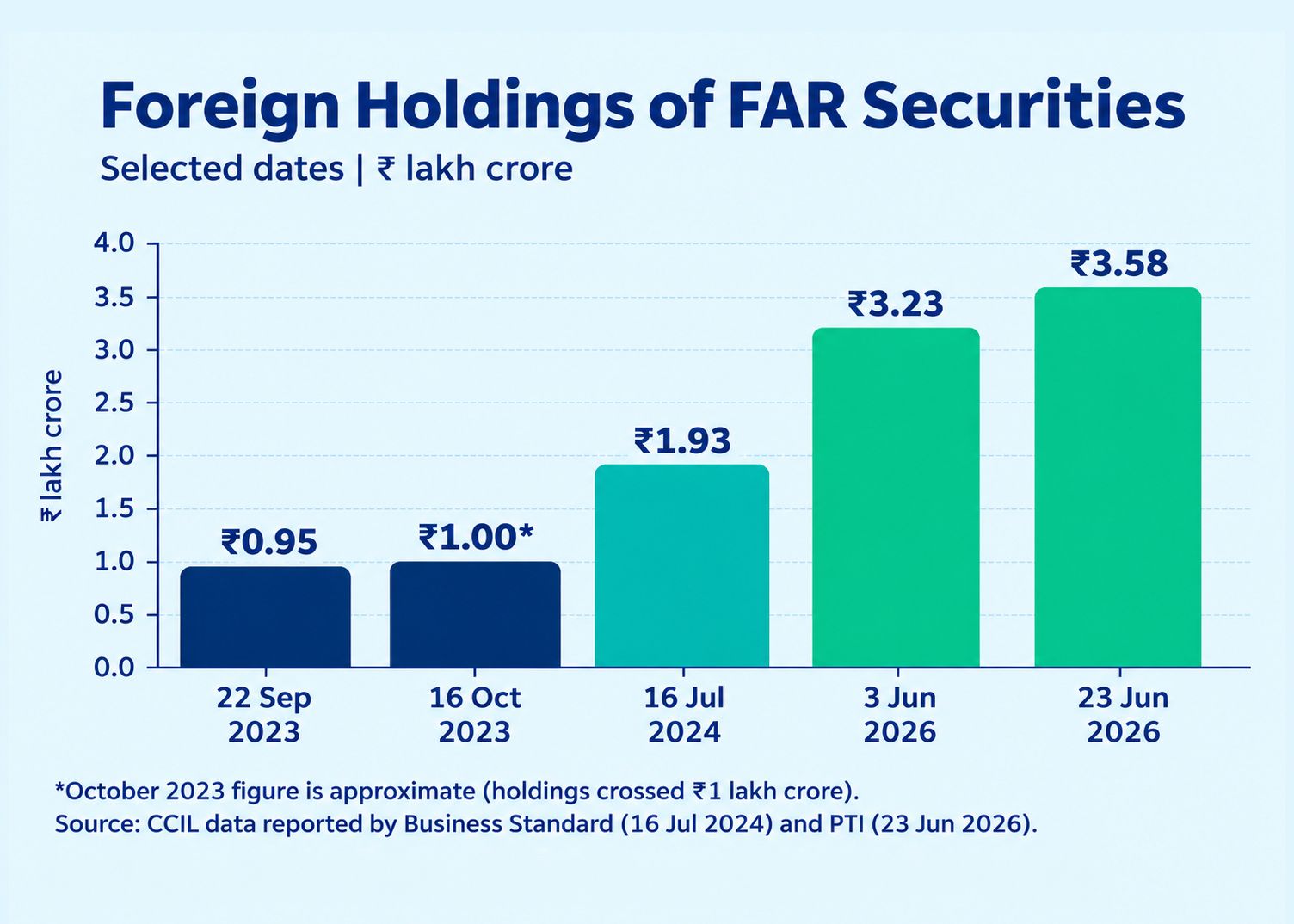
FAR is important for India as it supports the inclusion of Indian government bonds in global bond indices and encourages foreign investment. As of May 12, 2026, foreign portfolio investors held approximately INR 3.21 lakh crore in FAR-designated securities, accounting for 6.74% of the outstanding stock of FAR-eligible government securities.
Global index | Status for Indian FAR bonds (as of 4 November 2026) |
JPMorgan GBI-EM Global Diversified | Inclusion began June 28, 2024, with India's weight phased towards the 10% cap by March 2025 |
Bloomberg EM Local Currency Government Index | Inclusion began January 31, 2025, and was phased in over ten months |
FTSE Russell EMGBI | Inclusion began September 2025, phased in over six months |
Bloomberg Global Aggregate Index | Inclusion decision deferred in January and July 2026; review remains ongoing |
Table: Inclusion status of Indian FAR-eligible government securities in major global bond indices as of November 4, 2026.
Potential gains, such as lower borrowing costs, better liquidity in long-tenor bonds and rupee support, depend on market conditions and investor demand. They are not guaranteed outcomes.
Risks And Limitations Of Investing Through FAR
1. Interest-rate risk: An important consideration for investors in FAR-designated government securities.
2. RBI policy action: On 7 October 2026, the RBI raised the repo rate by 25 basis points to 5.50% and adopted a calibrated tightening stance.
3. Benchmark yield movement: India’s benchmark 10-year government bond yield was approximately 7.48% on 26 October, before declining to around 7.30% on 3 November.
4. Bond-price relationship: Bond prices generally move inversely to yields; when yields rise, bond prices typically fall, and vice versa.
5. Duration example: A hypothetical bond with a modified duration of 9 could see an approximate 4.5% price decline if its yield rose by 0.5 percentage points (50 basis points), assuming other factors remain unchanged.
6. Currency risk: Overseas investors also face currency risk, particularly where returns are measured in US dollars.
7. Rupee movement: The rupee had depreciated by approximately 5% against the US dollar in 2026 as of early November.
8. Foreign-investor flows: Foreign portfolio investor (FPI) flows can be volatile and may affect demand for FAR securities.
9. Recent outflows: FPIs withdrew INR 17,417 crore from FAR securities during September and October 2026.
10. Cumulative investment: Despite the recent outflows, cumulative net FPI investment in FAR securities remained positive for the calendar year through 3 November 2026.
11. Regulatory changes: The RBI revised the list of FAR-eligible securities in both 2024 and 2026.
12. What FAR is: FAR is a route that allows eligible non-resident investors to access specified government securities; it is not a separate retail investment product.
FAQs

Want to stay at the top of your finances?
Join the community of 22 lakh+ investors and learn more about Grip Invest, the latest financial knick-knacks, and shenanigans in the world of investing.
Happy Investing!
Disclaimer - Investments in debt securities/municipal debt securities/securitised debt instruments are subject to risks including delay and/ or default in payment. Read all the offer related documents carefully. The investor is requested to take into consideration all the risk factors before the commencement of trading.
This communication is prepared by Grip Broking Private Limited (bearing SEBI Registration No. INZ000312836 and NSE ID 90319) and/or its affiliate/ group company(ies) (together referred to as “Grip”) and the contents of this disclaimer are applicable to this document and any and all written or oral communication(s) made by Grip or its directors, employees, associates, representatives and agents. This communication does not constitute advice relating to investing or otherwise dealing in securities and is not an offer or solicitation for the purchase or sale of any securities. Grip does not guarantee or assure any return on investments and accepts no liability for consequences of any actions taken based on the information provided. For more details, please visit www.gripinvest.in
Registered Address - 106, II F, New Asiatic Building, H Block, Connaught Place, New Delhi 110001


