

How To Build A Bond Portfolio: Strategy, Allocation And Diversification



How to build a bond portfolio involves deciding which bonds to hold, in what proportion and for how long, so that the holdings meet a set income or savings goal.
The process generally covers setting goals, choosing a mix of government and corporate bonds, spreading money across issuers and maturities and reviewing the portfolio over time.
The right mix depends on the investor's objectives, risk tolerance, liquidity needs and horizon.
What Is A Bond Portfolio?
A bond portfolio refers to a group of bonds and other debt instruments held together by an investor to earn interest and preserve capital over a chosen period. Such a fixed income portfolio may include government bonds, state development loans, treasury bills, corporate bonds and debt mutual funds, held directly in a demat account or through funds.
Consequently, learning how to build a bond portfolio starts with accepting that a portfolio of bonds is not free of risk. It is exposed to credit risk, which is the chance that an issuer delays or misses a payment, interest rate risk, which is the fall in bond prices when market yields rise, and liquidity risk, which is the difficulty of selling a bond before maturity at a fair price. The mix of bonds chosen decides how much of each risk the investor carries, and that mix has to begin with the investor's own goals.
Define Your Bond Investment Goals
Bond investment goals refer to what the investor expects the portfolio to do, such as pay a regular income, fund a known expense or keep money stable for a few years. A clear goal helps
to decide the maturity, payout frequency and credit quality of the bonds, and it is therefore the first step of bond portfolio construction. The investor may consider the following:
- Risk Tolerance: An investor who cannot accept any delay in payment may prefer government securities and AAA rated bonds, while one who can accept some credit risk may add lower rated bonds for a higher income.
- Expected Cash Flows: Monthly, quarterly or annual payouts should match the investor's spending needs, which matters most for retirees living on interest.
- Horizon: Bonds maturing close to the date the money is needed reduce the need to sell early.
- Money That May Be Needed at Short Notice: This is better kept in treasury bills, liquid funds or bonds maturing within a year.
- Tax Slab: Interest on taxable bonds is added to income, so the post-tax return differs from one investor to another.
Suppose a retired investor needs INR 25,000 a month then the yearly requirement would be INR 3,00,000 (INR 25,000 × 12). At an assumed portfolio yield of 8% before tax, this would need a corpus of about INR 37.5 lakh (INR 3,00,000 ÷ 8%), and more once tax is considered. The figure changes sharply with the yield assumed, so a goal is better set with a margin than on the highest yield available.
Choose The Right Mix Of Bonds
The mix of bonds refers to the share of the portfolio placed in each type of bond, and it is the centre of any bond investment strategy. Government securities carry negligible default risk, while corporate bonds pay a credit spread over them in return for the risk of lending to a company.
As per the RBI Bulletin, 5-year AAA corporate bonds yielded 7.52% and 3-year AA bonds yielded 8.22% in March 2026, while the 10-year G-sec yield was about 7.22% on 4 November 2026. Hence the extra income from lower rated bonds comes with a higher chance of delay or default.
Comparing The Main Options
Each type of fixed income instrument plays a different role in a portfolio. The below table helps to distinguish them on risk, income, liquidity and horizon:
| Instrument | Risk | Income | Liquidity | Horizon |
| Central government securities | Negligible default risk; price moves with interest rates | Fixed coupon, usually half-yearly | Most traded bonds in India, though small lots may trade less often | Short to very long; some up to 40 years |
| Treasury bills | Negligible default risk | Issued at a discount, no coupon | High, with short maturity | 91, 182 or 364 days |
| State development loans | Low default risk | Half-yearly coupon, usually a little above G-secs | Lower than central G-secs | Medium to long |
| AAA and AA+ corporate bonds | Low but present credit risk | Coupon above G-secs by the credit spread | Moderate; depends on the issue | Usually 1 to 10 years |
| AA and A rated corporate bonds | Moderate to high credit risk | Higher coupon, often monthly | Lower, with fewer buyers | Mostly short to medium |
| Debt mutual funds | Depends on the fund's holdings | No fixed coupon; return through NAV | Redeemable on business days | Depends on the category |
| Corporate FDs | Issuer risk; no DICGC cover | Fixed rate | Premature withdrawal with penalty | 12 to 60 months for NBFC deposits |
A Hypothetical Allocation
The below example shows one possible bond allocation for an investor with INR 10,00,000 who wants a balance between income and risk. It is not a recommended allocation, as the appropriate mix depends on the investor's objectives, risk tolerance, liquidity needs and horizon. Using the illustrative yields, the portfolio may earn about INR 75,150 a year before tax, or roughly 7.5%:
Component | Share | Amount | Illustrative yearly income | Role in portfolio |
| G-secs and SDLs | 35% | INR 3,50,000 | INR 24,500 (at 7.0%) | Stability and low default risk |
| AAA and AA+ corporate bonds | 40% | INR 4,00,000 | INR 30,400 (at 7.6%) | Higher income at modest credit risk |
| AA and A rated corporate bonds | 15% | INR 1,50,000 | INR 14,250 (at 9.5%) | Extra income with higher credit risk |
| T-bills or liquid funds | 10% | INR 1,00,000 | INR 6,000 (at 6.0%) | Liquidity buffer |
Yields are assumptions for illustration and are not current quotes. Actual income would depend on the bonds bought, their prices and tax.
Diversify Your Bond Portfolio
Bond portfolio diversification means spreading money across issuers, sectors, ratings, maturities and instruments, so that a problem with one bond has a limited effect on the whole portfolio. Once the broad mix is fixed, diversification decides how that money is spread within each part of the mix. The choice is wide, as Grip's bond directory lists 28,415 listed bonds from 6,012 issuers. Investors may diversify in the following ways:
- Across Issuers: Limiting the amount placed with any single company reduces the damage from one default.
- Sector Spread: Holding bonds of NBFCs, PSUs, infrastructure and manufacturing companies avoids a portfolio that depends on one industry.
- Across Ratings: Pairing government and AAA bonds with a smaller share of lower rated bonds keeps the overall credit risk in check.
- Laddering Maturities: Bonds maturing in different years spread interest rate risk and give money back at regular intervals for reinvestment.
- Mixing Payout Frequencies: Monthly, quarterly and annual payers together can smooth the income received through the year.
- Spreading Purchases Over Time: Buying in instalments instead of all at once avoids putting the full amount in at one level of interest rates.
SIP In Bonds On Grip Invest
SIP in bonds refers to investing a fixed amount every month in individual bonds instead of making one large purchase. Each instalment can buy a different bond, so the portfolio gets spread across issuers and also across months with different interest rate levels.
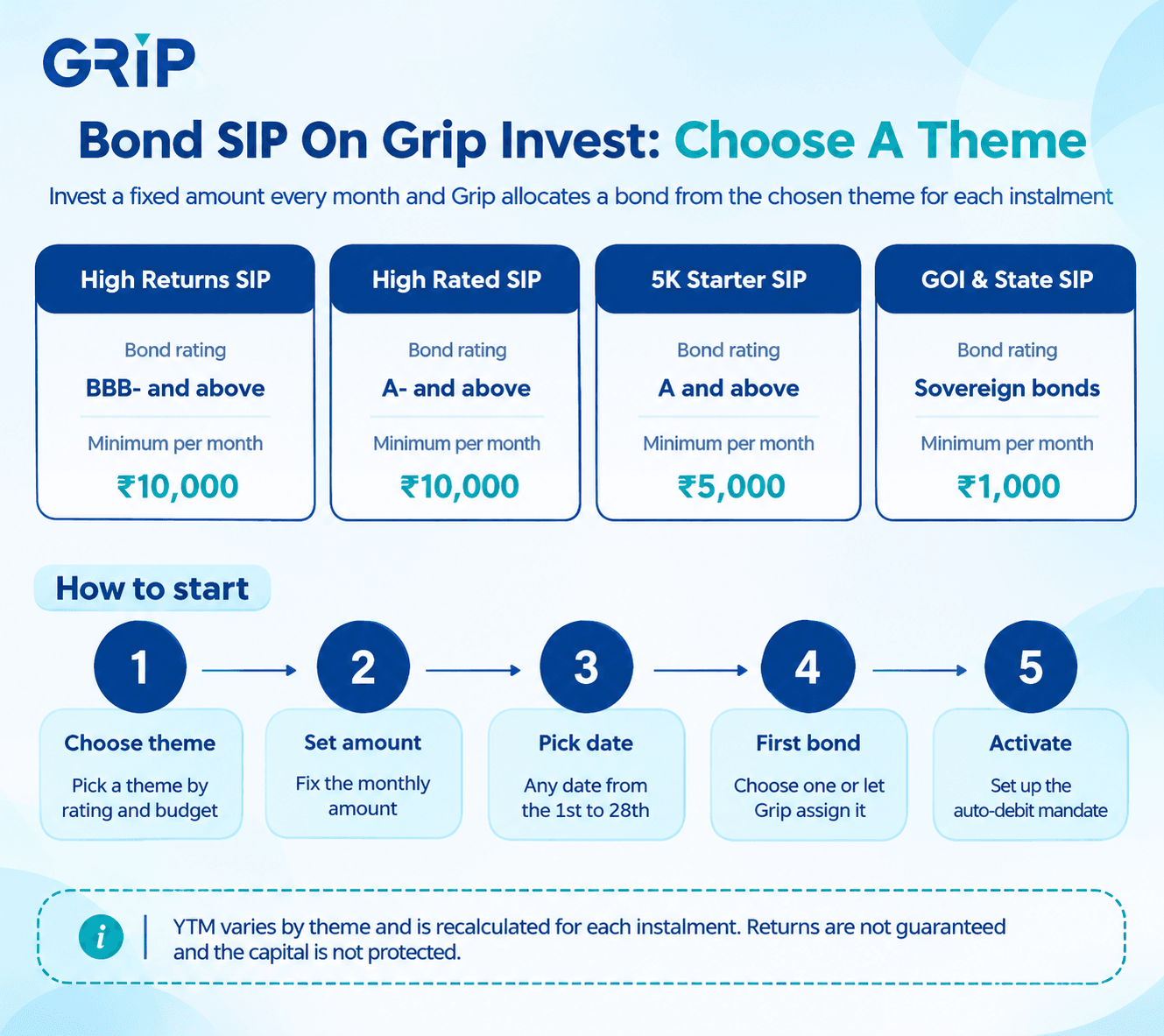
On Grip Invest, an investor can start a Bond SIP in a chosen theme, and Grip selects a bond from that theme for each instalment.
Grip currently offers four Bond SIP themes based on investment amount, credit rating and preference, with YTMs that vary across themes. These themes can be understood as per the points given below:
- High Returns SIP: Bonds rated BBB- and above, with a minimum of INR 10,000 a month.
- High Rated SIP: Bonds rated A- and above, with a minimum of INR 10,000 a month.
- 5K Starter SIP: Bonds rated A and above, from INR 5,000 a month.
- GOI & State SIP: Central and state government bonds, from INR 1,000 a month.
The diversification rule is built into the product itself. No single issuer can make up more than 20% of an investor's Bond SIP portfolio, and bonds rotate across issuers within the chosen theme. The investor picks a debit date between the 1st and 28th of the month, receives details of the allocated bond four days before the debit and can pause or cancel the SIP, while bonds already bought stay in the demat account. The amount debited may differ slightly from the SIP amount as the bond price includes interest accrued till the purchase date.
Suppose an investor runs a INR 10,000 monthly High Rated SIP for 12 months then INR 1,20,000 (INR 10,000 × 12) would be invested across several issuers. Even if one issuer reaches the 20% limit of INR 24,000 (INR 1,20,000 × 20%) and defaults with only half recovered, the loss would be about INR 12,000 (INR 24,000 × 50%), or 10% of the amount invested. The loss would be INR 60,000 if the whole INR 1,20,000 had been placed in that one bond with the same recovery.
The themes can also be matched with the mix chosen earlier. In the hypothetical allocation, the government share could be built through the GOI & State SIP and the highly rated share through the High Rated SIP, while a smaller share for extra income could go through the High Returns SIP. However the themes with lower rating floors carry more credit risk, the YTM is recalculated for each instalment and the returns are not guaranteed.
Investors who prefer to buy several bonds in one go can look at Grip Baskets, which offer theme-based sets of investment-grade bonds or SDIs from a minimum of INR 5,000 with monthly or quarterly payouts. Whether through a SIP or a basket, the investor should still check the sectors being added, as two months may bring bonds from similar businesses.
Understand Bond Portfolio Risks
Bond portfolio risks refer to the ways in which a portfolio may earn less than expected or lose part of its capital. A diversified portfolio still carries these risks, though in smaller and more spread out amounts. The main risks can be understood as per the points given below:
- Credit Risk: An issuer may delay or fail to pay, and a credit rating is only an opinion that can be cut when the company's position weakens.
- Interest Rate Risk: Bond prices fall when yields rise. Suppose a bond has a modified duration of 4 years and yields rise by 0.50% then its price may fall by about 2% (4 × 0.50%), which matters if it is sold before maturity.
- Liquidity: Many corporate bonds trade rarely, so selling early may take time or need a lower price.
- Reinvestment Risk: Coupons and maturing amounts may have to be reinvested at lower rates if rates fall.
- Call Risk: Some bonds allow the issuer to repay early, usually when rates have fallen, which cuts the income the investor expected.
- Inflation: A fixed coupon buys less over time if prices rise faster than expected.
- Concentration: Too much money with one issuer, sector or maturity year makes the portfolio depend on a single outcome.
Diversification is different from capital protection. Spreading money across bonds reduces the effect of any one default on the whole portfolio, but it does not ensure that the full amount invested will come back, and a broad fall in prices or several defaults at once can still cause a loss. Managing these risks therefore needs regular review and not only a well spread portfolio at the start.
How To Monitor And Rebalance A Bond Portfolio
Bond portfolio management also includes checking a portfolio at regular intervals and adjusting it so that it stays in line with the original goal. A corporate bond portfolio needs closer tracking of ratings and issuer news than a government bond portfolio, where the main variable is the interest rate. The sample allocation below can act as the target mix against which the portfolio is reviewed, both by type of instrument and by maturity bucket.
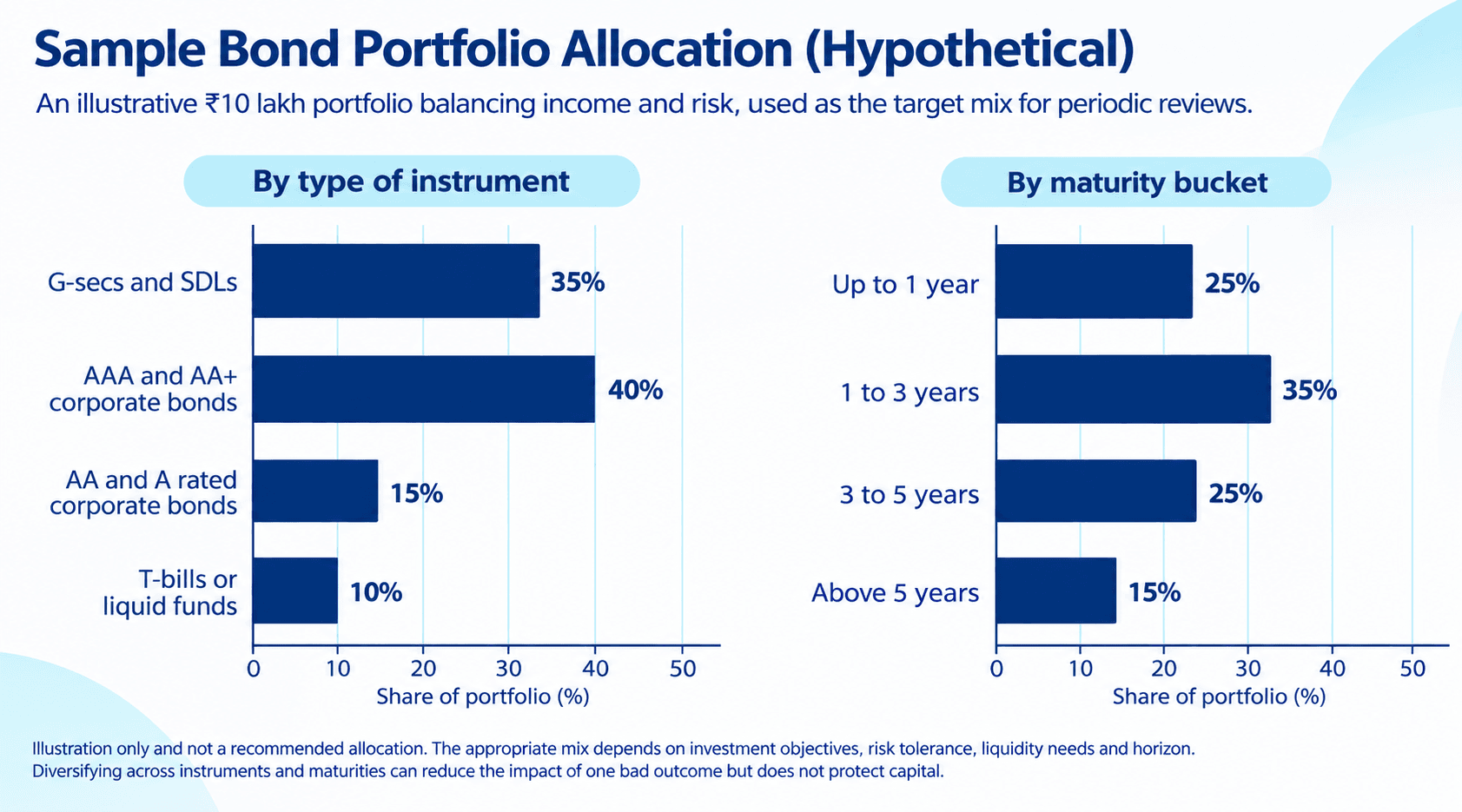
Rebalancing refers to bringing the portfolio back towards its target mix when it has drifted. A bond portfolio drifts on its own as bonds come closer to maturity, pay back principal or get downgraded. Suppose INR 2 lakh from the up to 1 year bucket matures then the investor may reinvest it in the 3 to 5 year bucket if that bucket has fallen below its target share. A review is generally done at least once a year and also after events like a rating downgrade or a sharp move in interest rates, and selling bonds early only to match a target may not always be worth the cost.
The below checklist can help to review a bond portfolio:
Item to Check | What to Check | Why It Matters |
| Issuer concentration | Share of the portfolio with each issuer and group company | Limits the loss from a single default |
| Maturity distribution | Amount maturing in each year or bucket against the target | Spreads interest rate and reinvestment risk |
| Credit quality | Current ratings, outlooks and any downgrades since purchase | Shows whether credit risk has risen |
| Liquidity | Share held in T-bills, liquid funds or bonds maturing within a year | Ensures money is available without forced sales |
| Expected cash flows | Interest and principal due in the next 12 months against spending needs | Confirms the portfolio still meets its income goal |
| Post-tax return | Interest received after tax at the investor's slab | Shows the actual income being earned |
FAQs

Want to stay at the top of your finances?
Join the community of 22 lakh+ investors and learn more about Grip Invest, the latest financial knick-knacks, and shenanigans in the world of investing.
Happy Investing!
Disclaimer - Investments in debt securities/municipal debt securities/securitised debt instruments are subject to risks including delay and/ or default in payment. Read all the offer related documents carefully. The investor is requested to take into consideration all the risk factors before the commencement of trading.
This communication is prepared by Grip Broking Private Limited (bearing SEBI Registration No. INZ000312836 and NSE ID 90319) and/or its affiliate/ group company(ies) (together referred to as “Grip”) and the contents of this disclaimer are applicable to this document and any and all written or oral communication(s) made by Grip or its directors, employees, associates, representatives and agents. This communication does not constitute advice relating to investing or otherwise dealing in securities and is not an offer or solicitation for the purchase or sale of any securities. Grip does not guarantee or assure any return on investments and accepts no liability for consequences of any actions taken based on the information provided. For more details, please visit www.gripinvest.in
Registered Address - 106, II F, New Asiatic Building, H Block, Connaught Place, New Delhi 110001


