

Fixed Deposit
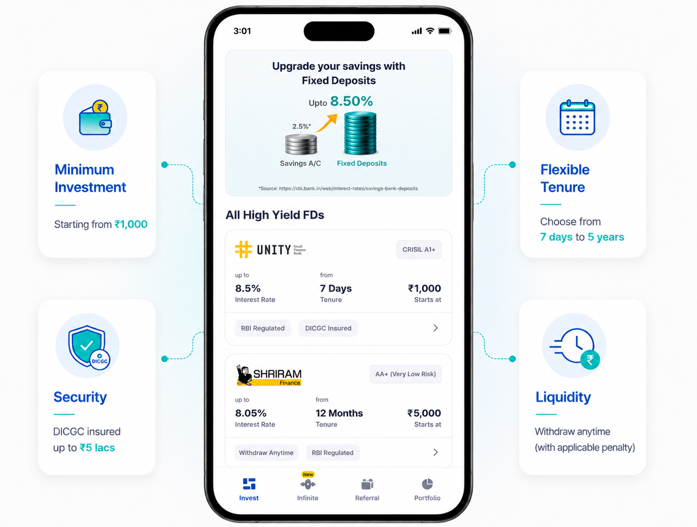
A Fixed Deposit (FD) is a debt investment where an individual deposits a lump sum amount for a fixed tenure at a predetermined interest rate. FD offers higher interest than a savings account.
An FD is a non-market-linked investment, and hence it offers predictable returns regardless of market conditions.
Fixed deposits are offered by different financial institutions, including regular banks, small finance banks, non-banking financial companies (NBFCs) and corporates.
Investors in India have a wide range of fixed deposits available with different tenures and interest rates, and they can choose the best fixed deposit plan according to their financial goals.
Before investing in an FD, investors must evaluate the FD on multiple factors such as tenure, liquidity, interest rate, taxation, payout frequency, etc.


Plan your FD investment
Estimate your FD returns with this fixed deposit calculator
Use our fixed deposit calculator to calculate the returns you will receive from an FD investment.
- Add your investment amount
- Select the desired tenure
- Pick the required interest rate
- See instant results
Disclaimer: This calculator is for illustration purposes only and does not guarantee or represent actual returns.
REASON AND BENEFITS

Assured Returns
Fixed deposit interest is fixed at the time of booking. It is a non-market-linked interest and hence remains unaffected by market swings.

Capital Safety
Fixed deposits are offered by regulated financial institutions such as national banks, small finance banks, and corporates and are also insured for up to INR 5 lakhs by DICGC.

Flexible Tenure
You get flexibility to choose the tenure of your FD investment starting from 7 days to 10 years, helping you plan your financial goals accordingly.

Extra For Seniors
Typically, issuers offer higher rates for senior citizens on fixed deposit bookings. It is usually 0.25% to 0.75% additional for senior citizens, depending on the issuer.

Easy Liquidity
You can get your funds easily if a cash emergency arises through premature withdrawal or a loan against your FD without breaking it.

How to Invest?


- Cumulative FD: The interest earned from a cumulative fixed deposit is reinvested and compounded annually, and the total amount, including principal and accumulated interest, is paid at maturity.
- Non-Cumulative FD: In a non-cumulative FD, your earned interest is paid to you on a periodic basis, such as monthly, quarterly, half-yearly, or yearly, depending on the terms of the fixed deposit.
- Tax-Saving FD: Tax-saving FDs come with a lock-in period of 5 years and offer tax exemption under section 80C of the Income Tax Act.
- Flexi Fixed Deposit: With a flexi FD, you get the automated sweep-in and sweep-out option in your savings account. Thus, it gives the high returns of an FD and the liquidity of a savings account.
- Corporate FD: These fixed deposits are issued by corporates and non-banking financial institutions (NBFCs), which usually offer higher interest rates.

OTHER OFFERINGS
Other Assets for you

Corporate Bonds
- Securities issued by corporates & NBFCs
- Up to 14% pre-tax YTM
- Start investing with Rs 1,000
- Exchange listed and credit rated

InvoiceX
- Loans backed by Invoice Discounting
- Up to 14% pre-tax YTM
- Start investing with Rs 1,00,000
- SEBI/RBI complaint and credit rated

LoanX
- Diverse pool of loans from top NBFCs
- Up to 14% pre-tax
- Start investing with Rs 1,00,000
- SEBI/RBI complaint and credit rated

Baskets
- Theme based investing
- Up to 14% pre-tax YTM
- Start investing with Rs 5,000
- SEBI/RBI complaint and credit rated

Corporate FDs
- High Yield Fixed Deposit Investments
- Up to 10% pre-tax
- Start investing with Rs 1,000
- SEBI/RBI compliant and credit rated
For your knowledge
Some of our partners


Market Insights
Latest Update on Fixed Deposit Rates

RBI announces big changes for FDs from October 1st 2026
The RBI has revised the FD framework for banks, with effect from October 1st, 2026. The big changes include a strict advance disclosure of deposit rates on the bank’s website, and ensuring that the rates are uniform across all the branches and for all customers. There shall be no discrimination in the matter of interest paid on the deposits, between one deposit and another deposit of similar amount, accepted on the same date, at any of its offices. However, for small finance banks specifically, the RBI has allowed differential interest rates on bulk deposits, for both resident and non-resident customers, provided the rules of the Liquidity Coverage Ratio (LCR) framework are not compromised.
Read MoreInsightful Blogs
Deepen Your Knowledge On Fixed Deposit
Insightful Videos
Watch & Learn More About Fixed Deposit in India
FD vs Debt Mutual Fund: Which Gives Better Returns After Tax?
How To Earn INR 50,000 More From Your FD | FD Laddering Explained
Don’t Invest in FDs Before Watching This!
To help you
Frequently Asked Questions
How to calculate fixed deposit interest?
If you have invested for a long tenure, use compound interest, and for a short tenure, use the simple interest formula. For compounding, the formula is A = P(1 + r/n)^(nt). The easiest method is to use our online fixed deposit calculator here.
Is a fixed deposit taxable?
Yes, interest earned from a fixed deposit is taxable and considered as income under the “Income from Other Sources”. The tax is applicable at slab rate.
What is the TDS applicable on interest earned from a fixed deposit?
The interest you earn from a bank FD is taxable at your slab rate, and TDS is applicable if the interest income exceeds INR 50,000 in a financial year (INR 1,00,000 for senior citizens). In case of an NBFC FD, the threshold amount of interest earned for TDS is INR 5,000.
What is the eligibility for investing in a fixed deposit?
Resident individuals, senior citizens, HUFs, minors (through a guardian), companies, trusts, and NRIs (via NRE/NRO accounts) can open fixed deposits. The exact eligibility criteria may vary slightly across banks and NBFCs. On Grip Invest, NRIs cannot invest in FD.
What are the documents required to invest in a fixed deposit?
On Grip Invest, you simply need to complete your KYC using your Aadhaar, PAN and Bank details. It takes less than 2 minutes to complete KYC. Once completed, you can start investing in fixed deposits.
What is the minimum amount required to invest in a fixed deposit?
On Grip Invest, you can start investing in a fixed deposit with an amount as low as INR 1,000.
Can I withdraw my fixed deposit before maturity?
Yes, you can withdraw the fixed deposit amount before maturity; however, a premature withdrawal penalty is applicable according to the issuer's terms and conditions. Read the complete details before investing.
Are senior citizens eligible for higher interest rates?
Yes, senior citizens get a higher interest rate than standard interest rates on FD bookings on Grip Invest. The additional rate depends on the issuer, and it is up to 0.50% extra.
Which bank is best for a fixed deposit?
There is no single bank that can be considered the best for fixed deposits. The right choice depends on your goals, tenure, issuer’s credibility and interest rate. Small finance banks and NBFCs offer higher interest rates than regular bank FDs; however, they come with a marginally higher risk too.
Which bank has the highest interest rate for a fixed deposit?
The interest rate keeps changing with the changing economic environment of the country. The highest interest rate on fixed deposits is usually from small finance banks or NBFCs. You get a 6-8% interest rate on regular bank FDs. On Grip Invest, you earn 8.5% on FDs.


