Top

Short-Term Bonds

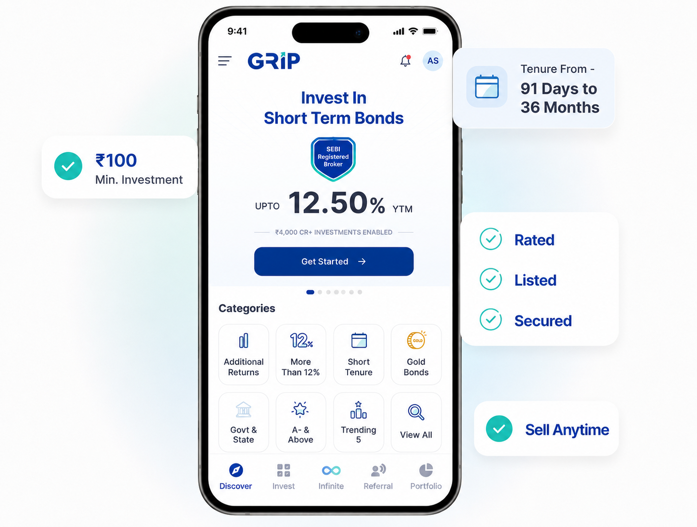
Explore short-term bonds in India with tenure starting from 91 days to 3 years and earn fixed returns of up to 12.5%. Start investing with just INR 100.

Short Term Bonds
  • Credit Rated Options
  • Listed On Exchange
  • Invest & Sell Anytime
AT A GLANCE
Bonds
₹ 4,000 Cr+
Investment Enabled
₹ 100
Minimum Investment
51,000+
Investors
ABOUT SHORT TERM BONDS

What Are Short Term Bonds?

  • Short-term bonds are fixed-income debt securities with maturities ranging from 91 days for Treasury Bills to around 1-3 years for many corporate bonds in India.

  • The short duration of these bonds increases liquidity and reduces interest rate risk, creating an opportunity for more stable returns than long-term bonds.

  • Short-term government bonds like Treasury Bills and Government Securities carry a sovereign guarantee, while short-term corporate bonds offer a higher return than them, depending on issuer quality and credit risk.

  • Compared with long-term bonds, short-term bonds are generally less sensitive to interest rate changes, which can make them easier to manage in a changing rate environment.

  • Investors can earn regular coupon payments while holding the bond or liquidate their investments on Grip Invest by selling anytime after a holding period of 2 months.

gripFDworks
Short-Term Bond
fdWorks
Regular Bank FD
YTM%
Up to 12.5%
6 to 7%
Repayment
Periodic
At Maturity
Liquidity
Yes
Limited
Tenure
91 days to 3 years
7 days to 10 years
Security Cover
Yes
Yes
Inflation Protection
Yes
No

Plan your short term investment

Estimate returns from short term investment in bonds

This bond calculator is designed to help you estimate your returns from a bond investment. For short-term bonds, set the tenure in months in the calculator and enter other required inputs to check the potential returns instantly.

  • Enter the investment amount
  • Add tenure, expected YTM & coupon frequency
  • See instant maturity value
Bond Return Calculator
24 mo
%
Total returns₹1,20,963
Interest₹20,963

Disclaimer: Please note that these calculators are for illustration only and do not represent actual returns.

REASON AND BENEFITS

Why Invest in Short-Term Bonds?

Financials.svg

Predictable Income

Investors can earn a fixed periodic income based on applicable coupon rates throughout the holding period, resulting in steady income.

grip

Greater Liquidity

Investors can get access to capital when needed by selling their bonds on Grip Invest at the prevailing market price before maturity.

AssetQuality.svg

Lower Interest Rate Risk

Due to their short maturity, the market price of these bonds is less sensitive to interest rate changes.

grip

Higher Yield Potential

Short-term bonds can offer greater returns than traditional short-term investments, like fixed deposits.

better_cash_management

Better Cash Management

Short-term bonds can be useful for parking surplus funds for a short period without keeping money idle in a savings account.

short_goals

Suitable For Short Goals

They may fit investors planning for near-term expenses, emergency reserves, or temporary capital deployment.

How to Invest?

It’s really simple with Grip

Find Your Deal
Investment Process
Visualize Returns
01.

Explore curated investment opportunities process

Find
your deal

Unique investment opportunities qualified through rigorous due diligence

02.

Complete KYC and investment process

Complete
KYC &
Investment

Seamless digital KYC, e-sign and payment experience

03.

Earn fixed returns with Grip

Returns per
pre-decided
schedule

Track your portfolio seamlessly while earning fixed returns

See if you are okay with this or want to propose something else

Key Features
Key Features of Short - Term Bonds
  • Short Maturity Period: Short-term bonds in India usually have shorter tenures, commonly around 1-3 years for corporate bonds, while Treasury Bills mature in 91, 182, or 364 days.
  • Fixed Coupon Rate: Many short-term bonds offer a fixed coupon, so investors can estimate expected income more easily.
  • Interest Rate Sensitivity: Shorter maturity of short-term or ultra short-term bonds reduces the impact of interest rate changes on their price.
  • Variety Of Issuers: Government bodies, PSUs, and corporates may issue short-term bonds, giving investors multiple risk-return options.
  • Market-Linked Pricing: If a bond is sold before maturity, its price can move based on interest rates and market demand.
logo

OTHER OFFERINGS

Other Secured Fixed-Income Products By Grip Invest

Corporate Bonds

Corporate Bonds

  • Securities issued by corporates & NBFCs
  • Up to 14% pre-tax YTM
  • Start investing with Rs 1,000
  • Exchange listed and credit rated
InvoiceX

InvoiceX

  • Loans backed by Invoice Discounting
  • Up to 14% pre-tax YTM
  • Start investing with Rs 1,00,000
  • SEBI/RBI complaint and credit rated
LoanX

LoanX

  • Diverse pool of loans from top NBFCs
  • Up to 14% pre-tax
  • Start investing with Rs 1,00,000
  • SEBI/RBI complaint and credit rated
Baskets

Baskets

  • Theme based investing
  • Up to 14% pre-tax YTM
  • Start investing with Rs 5,000
  • SEBI/RBI complaint and credit rated
Corporate FDs

Corporate FDs

  • High Yield Fixed Deposit Investments
  • Up to 10% pre-tax
  • Start investing with Rs 1,000
  • SEBI/RBI compliant and credit rated

For your knowledge

Risk Involved In Investing In Short - Term Bonds

  • Credit risk: Inability of bond issuers to make timely repayment of principal and/or interest due to financial difficulties.
  • Interest rate risk: Even short-term bonds can lose value if rates rise sharply before you sell.
  • Inflation risk: If inflation increases, it can reduce the real returns from the short-term bonds as the purchasing power gets reduced.
  • Reinvestment risk: When bonds mature, the prevailing market conditions might yield lower interest rates or an unfavourable bond market.
  • Market risk: Negative turn in economic conditions, market sentiments, or issuer-specific developments can affect bond performance and overall investment performance before maturity.

Some of our partners

ashika_group
ET Money
HSBC
Insurance dheko
mobikwik
paisa bazaar
stashfin
tata neu

Insightful Blogs

Learn More About Bond Investments In India

Insightful Videos

Watch & Learn More About Bonds In India

What is Yield in Bonds? Bond Yields Explained Simply

What Is Accrued Interest in Bonds: Simple Explanation

Current Yield vs YTM: What Smart Investors Should Know

To help you

Frequently Asked Questions

What is the main difference between short-term and long-term bonds?

Short-term bonds usually mature within 1-3 years and, in some cases, within 5 years, while long-term bonds have a maturity of over 10 years. Short-term bonds allow investors to park their short-term surplus in highly liquid assets to earn returns, but long-term bonds enable significantly higher long-term growth.
The safety of a bond depends on a variety of factors besides maturity, including issuer quality, credit rating, etc. While short-term bonds are usually considered safer than long-term bonds due to their higher liquidity and lower sensitivity to interest rate risk, the other factors must also be considered to analyse risk.
Long-term bonds are often considered riskier than short-term bonds due to their higher interest rate sensitivity and market risk. Given that funds are committed for a longer time horizon, the chances of market volatility and unfavourable interest rate changes become higher. However, risk depends on other factors as well, like issuer quality, credit rating, etc.
If a short-term bond in India is liquidated after 12 months or more, it is categorised as a long-term capital gain and taxed at 12.5%, without indexation; but for liquidation before 12 months, it is categorised as a short-term capital gain and taxed at the applicable tax slab. The interest from the bond is considered as income and taxed at the slab rate.


Yes, combining short-term and long-term bonds can aid diversification. Long-term bonds offer greater returns, but short-term bonds give stability and liquidity. The bonds can also mature at different tenures, enabling investors to meet fund requirements as and when they arise.
Yes, short-term bonds may offer better returns than fixed deposits, depending on the issuer, rating, and market conditions. However, returns are not guaranteed and can vary from one bond to another. On Grip Invest, short-term bonds can offer up to 12.5% fixed returns annually, while regular FDs offer 6-7%. Furthermore, FDs have limited liquidity compared to short-term bonds.
Yes, corporate and government short-term bonds offer reduced volatility, shorter maturity, and predictable returns. Investors who are going to start their investment journey can start investing in short-term bonds with just INR 100.
Grip Invest is a SEBI-registered bond platform that offers a range of short-term bonds in India with up to 12.5% fixed returns annually. Investors can compare and begin their investments with as low as INR 100.
Duration evaluates price sensitivity to rate changes. In comparison to long-term bonds, the shorter maturity of short-term bonds suggests that prices have less time to fluctuate when rates change. Hence, lowering interest-rate risk.
Yes, short-term bonds can be traded before maturity on the NSE and BSE. Unlike fixed deposits, which penalise early withdrawals, short-term bonds have secondary markets so that investors can leave early if necessary. You can also sell your short-term bonds purchased through Grip Invest on our platform after a holding period of 2 months.
Short-term bonds are direct debt securities issued by governments or companies, while short-duration bond funds are mutual funds that invest in a mix of fixed-income securities. The two differ in structure, liquidity, taxation, and risk profile.
Register on Grip Invest, complete your KYC in just a few minutes and start investing. A variety of short-term bonds are available on Grip from different issuers.
You can buy short-term bonds in India on Grip Invest, a SEBI-registered bond platform that allows investors to compare a range of short-term bonds with up to 12.5% YTM, starting with a minimum investment of just INR 100.

TESTIMONIALS

Wall of Love @ Grip