

SIF Investment Strategies In India: Types, Approaches And How They Work



SIF investment strategies are the seven investment approaches that a Specialised Investment Fund can follow under SEBI rules. They include equity, debt and hybrid strategies. Each strategy has its own limits on where the money can be invested, how much of it can be used to bet on a fall in prices and how often units can be redeemed.
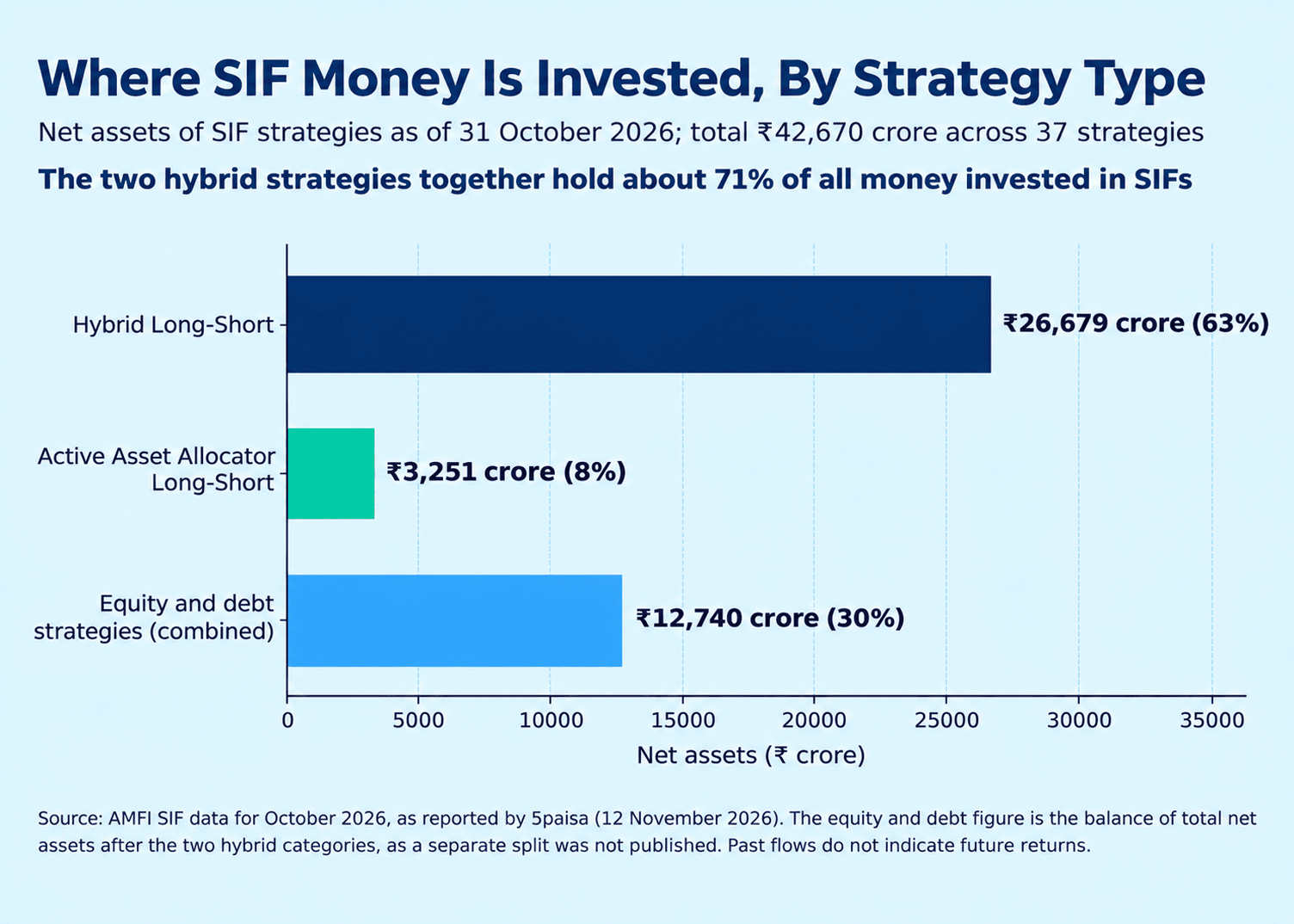
SIFs come in between mutual funds and portfolio management services, and the minimum investment is INR 10 lakh. As of 31 October 2026, SIFs had net assets of INR 42,670 crore spread over 37 strategies. Hence for an investor, picking the right strategy is as important as picking the fund house.
What Are The Different SIF Investment Strategies In India?
SEBI introduced SIFs through a circular dated 27 February 2025, and these rules now form part of its Master Circular for Mutual Funds. Seven strategies are allowed in all, three in equity, two in debt and two in hybrid. A fund house can launch only one scheme under each strategy.
Every strategy can take short positions through unhedged derivatives up to 25% of net assets, which is over and above derivatives used for hedging. Regular mutual funds are not allowed to do this.
Most of the money so far has gone into hybrid strategies, which means early investors have generally chosen lower swings over pure equity exposure. The way each group handles asset allocation, market exposure and investment opportunities is given below:
1. Equity Strategies
All three equity strategies keep most of the money in shares. Shorts are used to earn from stocks or sectors that the fund manager expects to fall. In case of an Equity Long-Short Fund, at least 80% has to be in equity, and the fund can pick stocks from the whole market. An Equity Ex-Top 100 Long-Short Fund has to keep at least 65% in companies outside the top 100 by size, so its focus is on mid and small companies.
A Sector Rotation Long-Short Fund is narrower. It puts at least 80% in not more than four sectors and keeps shifting between sectors as the economy moves. If it shorts a sector, it has to short all its stocks from that sector. Equity strategies can usually be redeemed every day, but a fund house is free to allow redemption less often.
2. Debt Strategies
The debt strategies invest in bonds and money market instruments. They use exchange-traded debt derivatives to take a view on where interest rates are going. A Debt Long-Short Fund can buy bonds of any maturity.
A Sectoral Debt Long-Short Fund has to spread the money over at least two sectors, and no single sector can have more than 75%. Units can be redeemed only once a week or less often, so these work more like interval funds than normal debt funds.
3. Hybrid Strategies
Hybrid strategies invest in more than one asset class. A Hybrid Long-Short Fund has to keep a minimum of 25% in equity and 25% in debt. An Active Asset Allocator Long-Short Fund has no such fixed split and can move between equity, debt, REITs and InvITs and commodity derivatives. Both can allow redemption up to twice a week.
The below table helps to compare the types of SIF funds on how they invest and the kind of market in which each may do better:
| Strategy | Investment approach | Asset exposure | Suitable market conditions |
| Equity Long-Short | Long on preferred stocks, short on weak ones | Minimum 80% equity; shorts up to 25% | Sideways or uneven markets where stock selection matters |
| Equity Ex-Top 100 Long-Short | Long and short positions beyond large companies | Minimum 65% outside top 100 stocks | Markets with wide gaps between mid and small company performance |
| Sector Rotation Long-Short | Moves money between a few sectors; shorts at sector level | Minimum 80% in up to four sectors | Clear sector cycles such as a shift from banks to manufacturing |
| Debt Long-Short | Holds bonds and takes rate views through debt derivatives | Debt across maturities | Periods of changing interest rates |
| Sectoral Debt Long-Short | Debt spread across sectors with sector-level shorts | At least two sectors; maximum 75% in one | Credit differences between sectors |
| Active Asset Allocator Long-Short | Shifts money across asset classes as views change | Equity, debt, REITs, InvITs and commodity derivatives | Uncertain markets where asset class leadership keeps changing |
| Hybrid Long-Short | Mixes equity, debt, arbitrage and limited shorts | Minimum 25% equity and 25% debt | Volatile markets where lower swings are preferred over full equity upside |
Based on SEBI circular SEBI/HO/IMD/IMD-PoD-1/P/CIR/2025/26 dated 27 February 2025. Market conditions are indicative and not a forecast of returns.
How Do Long-Short Strategies Work In SIFs?
Each of the strategies allow short positions, and this is the main thing that SIF long short strategies do differently from a regular fund. A long position makes money when the price goes up. A short position is taken through futures or options and makes money when the price goes down. So instead of just staying away from a stock it does not like, the fund can earn if that stock falls.
Suppose an SIF has INR 10 lakh, out of which INR 8 lakh is invested in stocks the manager likes and INR 2 lakh is a short on stocks expected to fall. If the whole market falls by 10% then the long side would lose INR 80,000 and the short side would gain INR 20,000.
The net loss would be INR 60,000, against INR 1 lakh in a fund fully invested in shares. In case the market rises by 10%, the gain would also be INR 60,000 and not INR 1 lakh, as the short side would lose INR 20,000. Shorts therefore cut both the fall and the rise, and a shorted stock that goes up can cause a separate loss.
Example: Altiva Hybrid Long-Short Fund
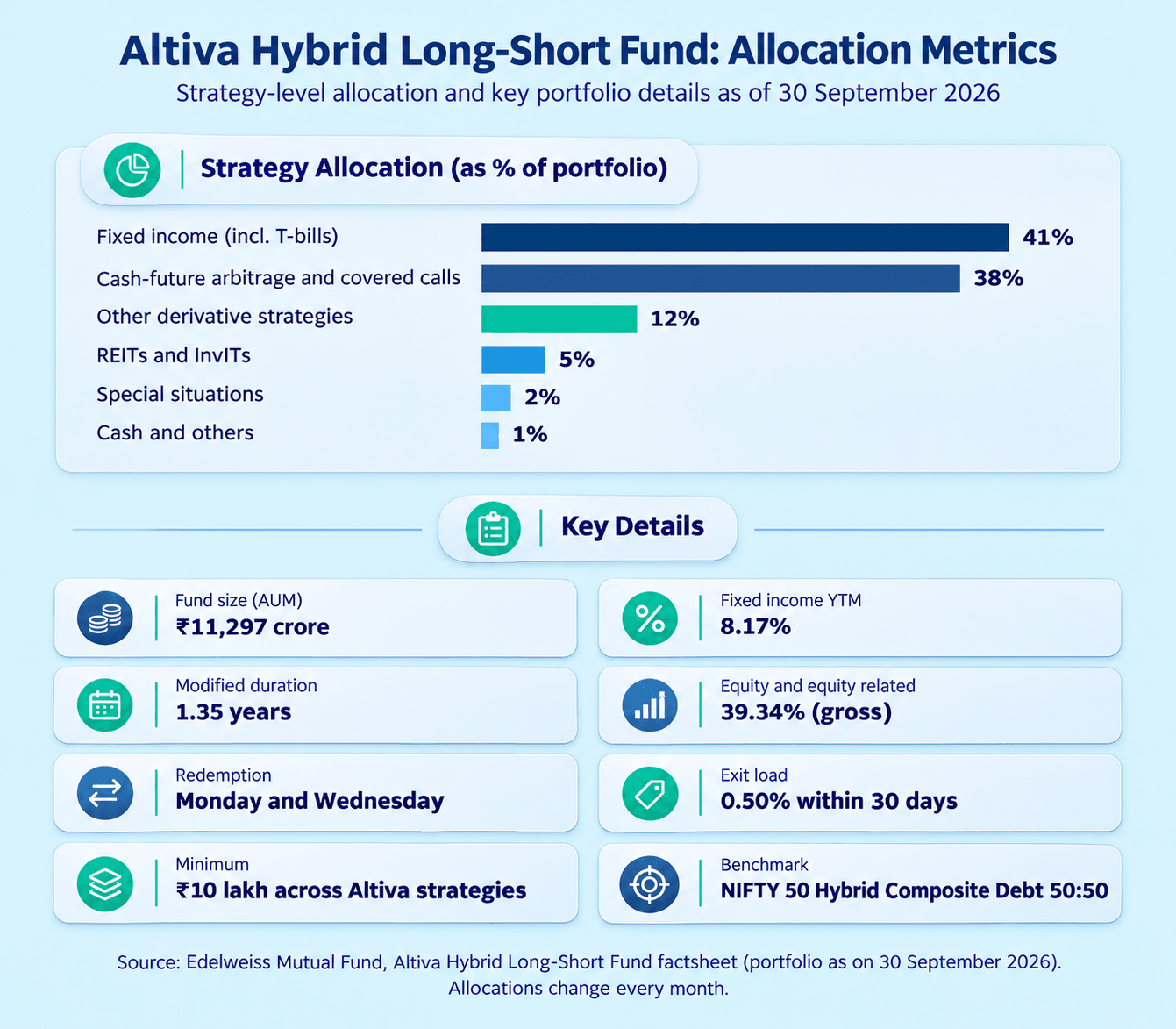
The Altiva Hybrid Long-Short Fund is offered by Edelweiss Mutual Fund and is available on Grip. It started on 20 October 2025 as India's first SIF in the hybrid category. The fund does not depend only on markets going up and earns from a few different sources:
- Cash-future arbitrage: The fund buys a stock and sells its future at a higher price at the same time, and keeps the difference.
- Covered calls: It sells the right to buy shares that it already holds and earns a premium for this.
- Fixed income: Bonds and T-bills in the portfolio earn interest.
- Other positions: A small share goes into derivative strategies, REITs and InvITs and special situations like buybacks and mergers.
As per the factsheet for September 2026, the direct growth plan has given 11.08% annualised since inception, while its benchmark gave minus 5.76%. In September 2026, the fund was down 0.72% when the benchmark fell 3.31%. However, past returns may not continue, and the fund can still lose money if its equity, debt and derivative positions go wrong together.
How Do SIF Investment Strategies Differ From Mutual Funds And PMS?
A regular mutual fund could not have built the Altiva portfolio, as most mutual funds are not allowed unhedged shorts. At the same time, an SIF is a pooled fund and not a portfolio made for one person like PMS. The SIF vs mutual funds comparison, along with PMS and AIFs, is given in the table below:
| Parameter | Mutual fund | SIF | PMS | AIF |
| Minimum investment | From about INR 500 (lower through some SIPs) | INR 10 lakh at PAN level per fund house | INR 50 lakh | INR 1 crore |
| Typical investor | Retail investors | Affluent investors and HNIs | HNIs and ultra HNIs | HNIs and ultra HNIs |
| Strategy | Mostly long-only | Long-short and tactical, within seven SEBI strategies | Customised, including long-short | Customised, including long-short |
| Short positions | Limited, mainly for hedging | Unhedged shorts up to 25% of net assets | As per the manager's mandate | Allowed, depending on the category |
| Structure | Pooled fund | Pooled fund under mutual fund rules | Securities held in the investor's own account | Pooled fund |
| Transparency | High, with monthly portfolio disclosure | High, with mutual fund style disclosure | Shared with the investor | Lower |
| Taxation | Taxed on redemption | Taxed on redemption, like mutual funds | Taxed on each trade in the investor's hands | Depends on the category |
Put simply, an SIF gets more freedom than a mutual fund but keeps the mutual fund structure, disclosure and tax rules, and the entry amount is one fifth of PMS.
Factors To Consider Before Choosing An SIF Strategy
Since every strategy behaves in its own way, the choice among the available SIF investment options should not be made on past returns alone. An investor may look at the following points:
1. Existing portfolio: Someone who already holds a lot of equity may find a hybrid or debt strategy more useful, while a person with mostly FDs may look at equity long-short for growth.
2. Redemption terms: If a strategy redeems only once or twice a week, money that may be needed suddenly should not be put in it.
3. Tax category: Tax depends on what the strategy actually holds and not on its name, and the scheme information document mentions the category.
4. Use of shorts: Some funds short mainly to protect the portfolio, while others short to bet on a fall, which can add to losses.
5. Track record: The oldest SIF strategies are only about a year old, so none of them has gone through a full market cycle yet.
6. Costs: Expense ratio and exit load reduce returns. As an example, Altiva's direct plan had an expense ratio of 0.56% in September 2026.
7. Who is selling it: From 21 September 2026, SIF distributors need the NISM Series V-D certification, so investors may check that the platform or distributor is eligible.
Suppose an investor puts INR 10 lakh in an SIF with an expense ratio of 1.24% a year then the cost would come to about INR 12,400 in a year (INR 10,00,000 × 1.24%). The strategy has to earn at least this much before the investor gains anything extra.
Are SIFs Suitable For Every Investor?
SIFs are not meant for every investor. With a INR 10 lakh minimum and the use of shorts, they suit people who already have a sizeable portfolio and are used to ups and downs in the market. A regular mutual fund is easier to understand, can be started with a small amount and can be redeemed on any working day.
Fixed-income products like corporate bonds and corporate FDs pay interest at a rate known in advance. No SIF strategy offers that, not even the debt and hybrid ones. So money needed for regular income may be kept in bonds or deposits, and only the part that can take market risk may go into an SIF.
FAQs

Want to stay at the top of your finances?
Join the community of 22 lakh+ investors and learn more about Grip Invest, the latest financial knick-knacks, and shenanigans in the world of investing.
Happy Investing!
Disclaimer - Investments in debt securities/municipal debt securities/securitised debt instruments are subject to risks including delay and/ or default in payment. Read all the offer related documents carefully. The investor is requested to take into consideration all the risk factors before the commencement of trading.
This communication is prepared by Grip Broking Private Limited (bearing SEBI Registration No. INZ000312836 and NSE ID 90319) and/or its affiliate/ group company(ies) (together referred to as “Grip”) and the contents of this disclaimer are applicable to this document and any and all written or oral communication(s) made by Grip or its directors, employees, associates, representatives and agents. This communication does not constitute advice relating to investing or otherwise dealing in securities and is not an offer or solicitation for the purchase or sale of any securities. Grip does not guarantee or assure any return on investments and accepts no liability for consequences of any actions taken based on the information provided. For more details, please visit www.gripinvest.in
Registered Address - 106, II F, New Asiatic Building, H Block, Connaught Place, New Delhi 110001


