

8th Pay Commission Pensioners: Expected Pension Hike, DR Changes And What Retirees Should Know


There is a lot of discussion among the retired employees regarding the 8th Pay Commission pension update. The discussion revolves around a lot of topics, including the increased payouts after the implementation of the pay commission, which will further result in better financial security, access to improved healthcare facilities, and a higher standard of living for 8th Pay Commission pensioners.
In the past, Pay Commissions have also introduced changes to employees' pay and fitment scales. Hence, the pension hike under 8th pay commission is creating high expectations for the retired employees of different government departments, defence services and various PSUs.
How Pension Revision Works In Pay Commissions
Pay Commissions are constituted periodically to review the salary, pension, and allowance structures of central government employees and pensioners.
The objective is to ensure that compensation remains aligned with inflation, changing economic conditions, and the overall cost of living.
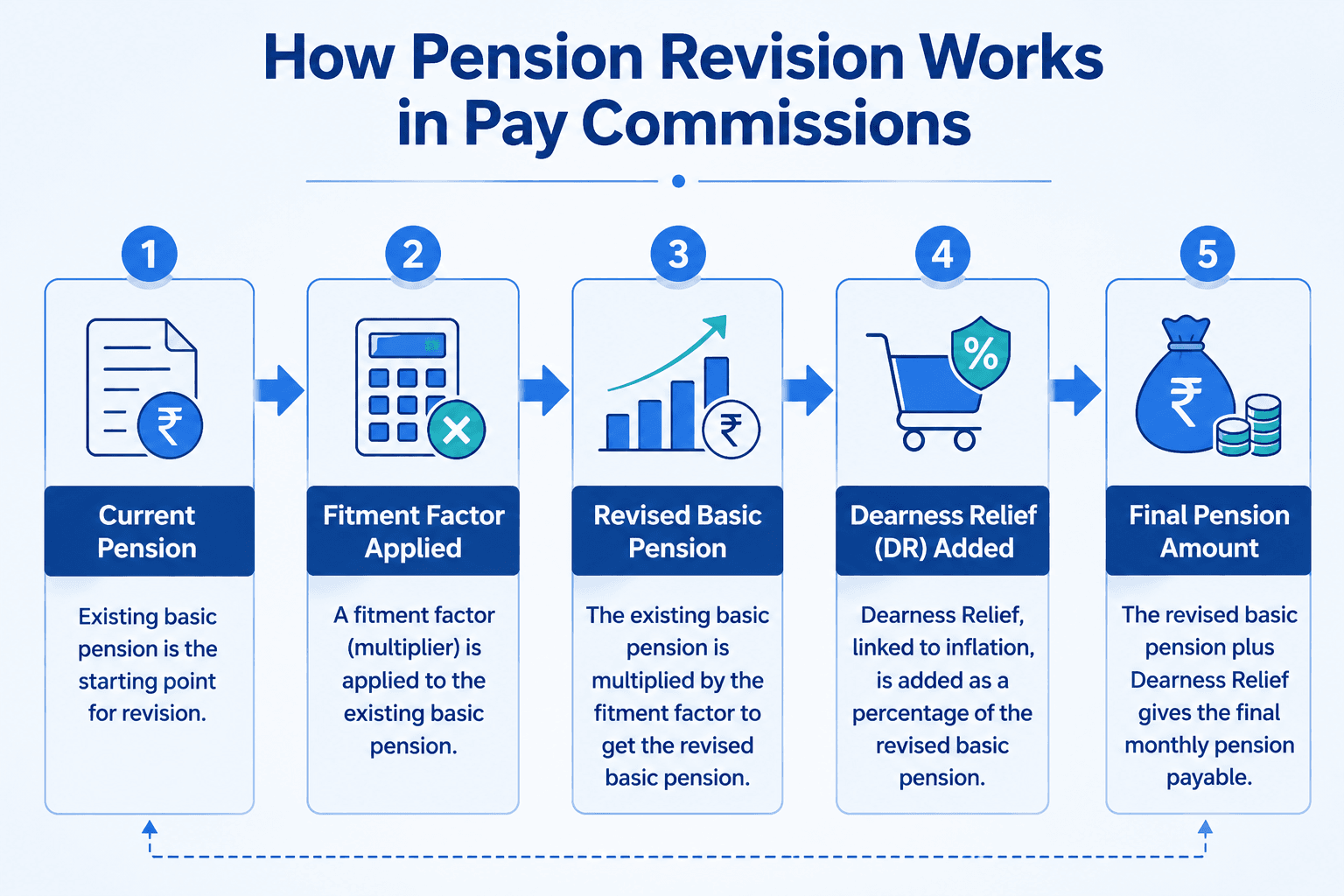
For pensioners, revisions are typically linked to changes in the basic pay structure recommended by the Pay Commission. A key component in this process is the fitment factor: a multiplier used to revise existing basic pay and pension amounts.
Under the 7th Pay Commission, a fitment factor of 2.57 was applied, and similar revisions are expected to play a central role in the 8th Pay Commission as well.
In addition to the fitment factor, pension revisions may also account for Dearness Relief (DR), inflation trends, and parity considerations between past and current retirees. However, the final methodology and revision structure under the 8th Pay Commission will only become clear after the government formally approves the Commission’s recommendations.
The 8th CPC pension revision is expected to provide major relief to the central government retirees. A pension revision usually includes the following:
- Evaluation of the current pension scheme
- Suggestion of revised fitment factor
- Approval of proposals by the Government
- Implementation of the revised pension amounts
- Revision in the benefit of Dearness Relief
This systematic revision aims to preserve and improve retirees’ purchasing power over time.
Current Pension Structure For Central Government Pensioners
It is important to understand the current pension structure before considering the possibilities of a pension hike under 8th Pay Commission.
The present pension system for central government retirees is basically made up of Basic pension, Family pension and Dearness Relief (DR). These add up to the total monthly pension received.
Basic Pension
Basic pension is the minimum (or fixed) amount of pension that a retiree is entitled to receive, before any inflation-related benefits. It serves as the benchmark for future pension revisions and the basis for pension calculations.
It will vary greatly based on:
- Last drawn salary
- Length of service
- Applicable pension rules
The expected pension increase in India calculations starts with the basic pension amount.
Family Pension
Financial assistance can be provided to the investor's family following the pensioner's death (called the family pension).
Family members who are eligible spouses or dependents under government guidelines for the family pension 8th pay commission may be considered beneficiaries.
Dearness Relief (DR)
The Dearness Relief is meant as an inflation adjustment for pensioners. DR changes for retirees can help them preserve their purchasing power as the cost of living goes up. Dearness relief is not a fixed pension amount; it is reviewed and adjusted over time in response to inflation.
Expected Pension Revision Under The 8th Pay Commission
While the exact revision or changes are not officially disclosed at present, experts believe that pensions would change in a manner consistent with previous trends.
One of the major areas of concern is a new fitment factor for pensioners, which would greatly increase the amount of pension.
This would result in:
- Higher minimum pension rates
- Increased retirement income per month
- Family pension enhancement
- Inflation-proofing through a new structure
Various reports suggest the new fitment factor can range from 2.28 to 3.83.1
The method of calculating the revised pension based on the 8th pay commission would be as follows:
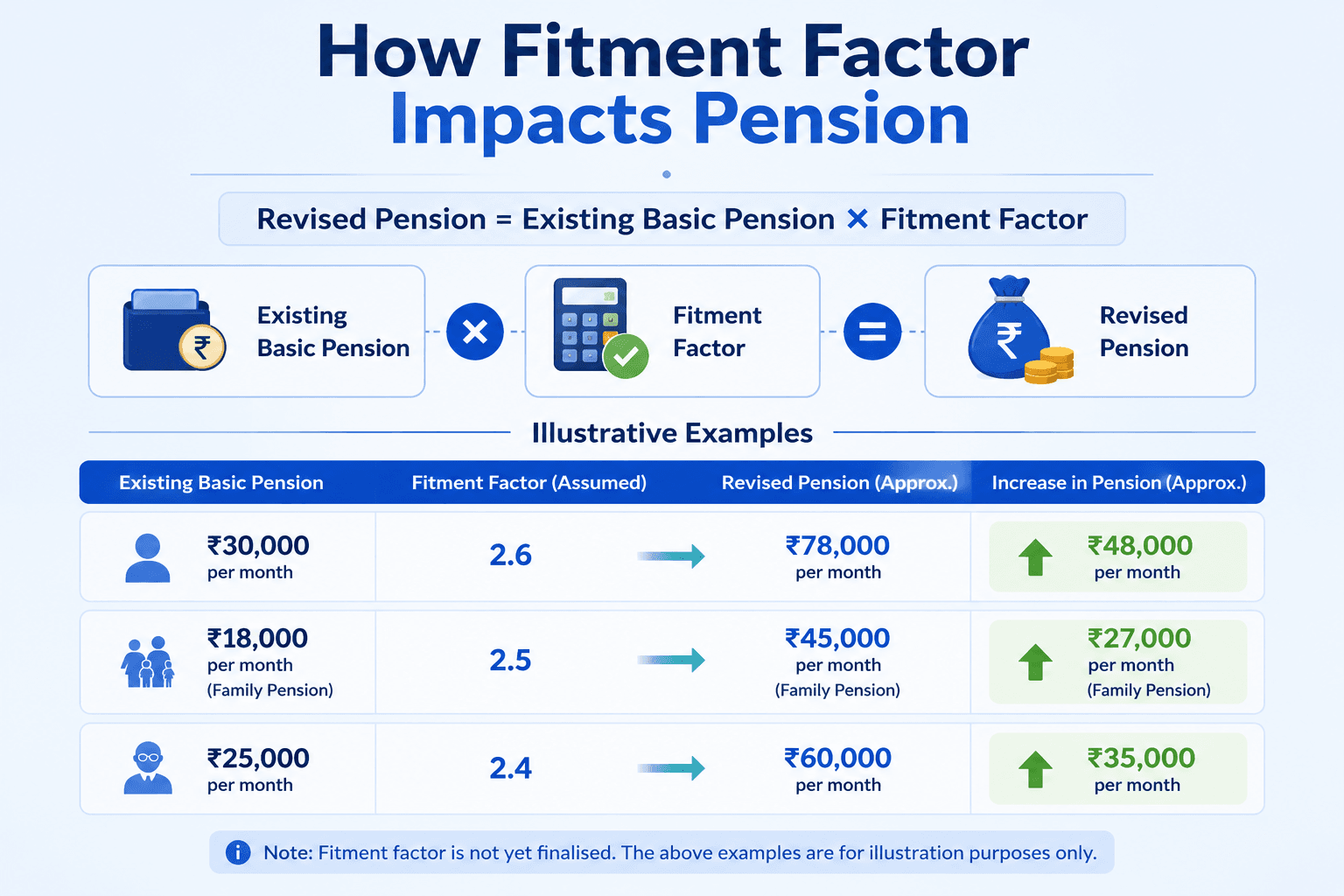
Existing Pension × New Fitment Factor = Revised Pension
(The figures will depend on the government's final decisions)
Let us find out how the fitment factor will be used in computing the new pension after the recommendations of the 8th pay commission are finalised.
How A Pension Could Be Calculated
While the government has not yet officially announced the final fitment factor for the 8th Central Pay Commission (8th CPC), several projections and estimates are currently being discussed across media reports and policy discussions.
As a result, many pensioners are trying to estimate how a revised fitment factor could impact their monthly pension income.
In most discussions, the proposed revision is calculated by multiplying the existing basic pension by the expected fitment factor.
The calculations below are purely illustrative and based on widely circulated assumptions.
For example:
A pensioner currently receiving a basic pension of INR 30,000 per month could see the following revision if a fitment factor of 2.6 is implemented:
30,000×2.6=78,000
This would result in an increase of INR 48,000 per month in the revised basic pension.
Similarly, if a family pensioner currently receives INR 18,000 per month and a fitment factor of 2.5 is applied, the revised pension could become:
18,000×2.5=45,000
In this case, the estimated increase would be INR 27,000 per month.
However, it is important to note that these figures are only indicative examples. The actual pension revision under the 8th CPC will depend on the final recommendations approved by the Government of India, including the official fitment factor, Dearness Relief adjustments, and other pension-related guidelines.
Illustrative Comparison Table:
Current Pension | Assumed Fitment Factor | Estimated Revised Pension |
INR 20,000 | 2.5 | INR 50,000 |
INR 30,000 | 2.6 | INR 78,000 |
INR 40,000 | 2.7 | INR 1,08,000 |
INR 50,000 | 2.8 | INR 1,40,000 |
Dearness Relief (DR): What Could Change?
Dearness Relief (DR) plays a crucial role in the income structure of central government pensioners, as it is designed to help offset the impact of inflation. Since pensioners do not receive periodic salary increments like serving employees, DR acts as a cost-of-living adjustment that helps maintain their purchasing power over time.
DR is revised periodically based on inflation trends and is calculated as a percentage of the basic pension. When inflation rises, higher DR rates can significantly increase the overall monthly pension payout, even if the basic pension amount remains unchanged.
Under the 8th Central Pay Commission (8th CPC), the government may review certain aspects of the DR framework as part of broader pension reforms.
While no official changes have been announced yet, discussions and reports suggest that revisions could potentially focus on:
- The frequency of DR revisions
- The inflation index or methodology used for calculation
- The formula used to determine DR hikes
- The percentage structure applied to DR increases
However, the core objective of DR is expected to remain unchanged: protecting pensioners from the rising cost of living and helping preserve their financial stability during retirement.
As inflation continues to affect household expenses, DR revisions are likely to remain a key focus in future pension updates and Pay Commission recommendations.
Expected Timeline And Government Outlook
The Government of India formally constituted the 8th Central Pay Commission (8th CPC) in November 2025, with the Commission expected to submit its recommendations within 18 months.
As per the official Terms of Reference, the revised pay and pension structure is proposed to take effect from 1 January 2026. However, based on previous Pay Commission timelines, the actual implementation may extend into late 2026 or 2027, with the possibility of arrears being paid retrospectively.
Pensioners are advised to rely only on official government notifications and verified updates, rather than speculative reports or unofficial pension estimates.
Conclusion
The 8th Pay Commission is expected to play a significant role in shaping the financial future of central government pensioners through possible revisions in pension structures, fitment factors, and Dearness Relief (DR). While several estimates suggest a notable pension hike under the 8th Pay Commission, the final revision framework will depend on official government recommendations and approvals. Until clear guidelines are announced, pensioners should stay updated through verified sources and avoid relying solely on speculative projections. Understanding how pension calculations, DR revisions, and fitment factors work can help retirees better prepare for potential financial changes ahead.
At Grip Invest, we believe informed financial decisions help retirees build greater stability and confidence for the future.
FAQs On 8th Pay Commission For Pensioners
Reference:
1. Live Mint, accessed from: https://www.livemint.com/money/personal-finance/8th-pay-commission-how-to-use-fitment-factor-calculator-to-estimate-your-revised-salary-11779419659902.html
 |
Author: Grip Invest Editorial Team The Grip Invest Editorial Team is a group of Chartered Accountants, MBA (Finance) graduates, and Qualified Research Analysts dedicated to helping you invest smarter. We dive deep into India's fixed income landscape to deliver content that is accurate, up-to-date, and easy to understand. Whether you're exploring bonds, fixed deposits, or other fixed income opportunities, our guides cut through the noise and give you the clarity to make better financial decisions. |
Want to stay at the top of your finances?
Join the community of 4 lakh+ investors and learn more about Grip Invest, the latest financial knick-knacks, and shenanigans in the world of investing.
Happy Investing!
Disclaimer - Investments in debt securities/municipal debt securities/securitised debt instruments are subject to risks including delay and/ or default in payment. Read all the offer related documents carefully. The investor is requested to take into consideration all the risk factors before the commencement of trading.
This communication is prepared by Grip Broking Private Limited (bearing SEBI Registration No. INZ000312836 and NSE ID 90319) and/or its affiliate/ group company(ies) (together referred to as “Grip”) and the contents of this disclaimer are applicable to this document and any and all written or oral communication(s) made by Grip or its directors, employees, associates, representatives and agents. This communication does not constitute advice relating to investing or otherwise dealing in securities and is not an offer or solicitation for the purchase or sale of any securities. Grip does not guarantee or assure any return on investments and accepts no liability for consequences of any actions taken based on the information provided. For more details, please visit www.gripinvest.in
Registered Address - 106, II F, New Asiatic Building, H Block, Connaught Place, New Delhi 110001


