

Artificial Intelligence In India: What The Recent AI Summit Means For Investors


The past week was all about the global AI summit in Delhi, where the participants included some of the biggest names in the AI and IT sectors. Social media and news were full of updates on the summit and on how India is at the forefront of the AI revolution.
Introduction To Artificial Intelligence In India
Artificial intelligence has become an undeniable reality of the world we exist in. From information technology to communication, education, and healthcare, it has become a dominant force across nearly every industry. In the wake of AI’s remarkable global rise, India has chosen not to remain a passive spectator to this technological revolution.
Instead, the country has embraced artificial intelligence proactively, investing in infrastructure, shaping policy frameworks, encouraging startups, and positioning itself as a serious participant in the global AI ecosystem. Artificial intelligence in India has become so central to the country’s economic and technological vision that it recently hosted a landmark AI Summit.
What Happened At The Recent AI Summit In India?
The AI Summit India 2026 in New Delhi was first of its kind global summit. The event was widely regarded as one of its kind in scale, ambition, and global participation. The summit brought together policymakers, global tech leaders, investors, researchers, and innovators, signalling that India is no longer merely reacting to global AI trends but actively shaping them.
- Key announcements
The government demonstrated a strong commitment to the new technology. Under expanded AI government initiatives India, the government committed to making affordable computing access available to startups, universities, and innovators. The government aims to democratize AI applications across healthcare, agriculture, education, and governance through AI startups in India. This aligns with the India AI ethics framework and broader AI regulation discussions, balancing innovation with responsible deployment.
- Government funding commitments
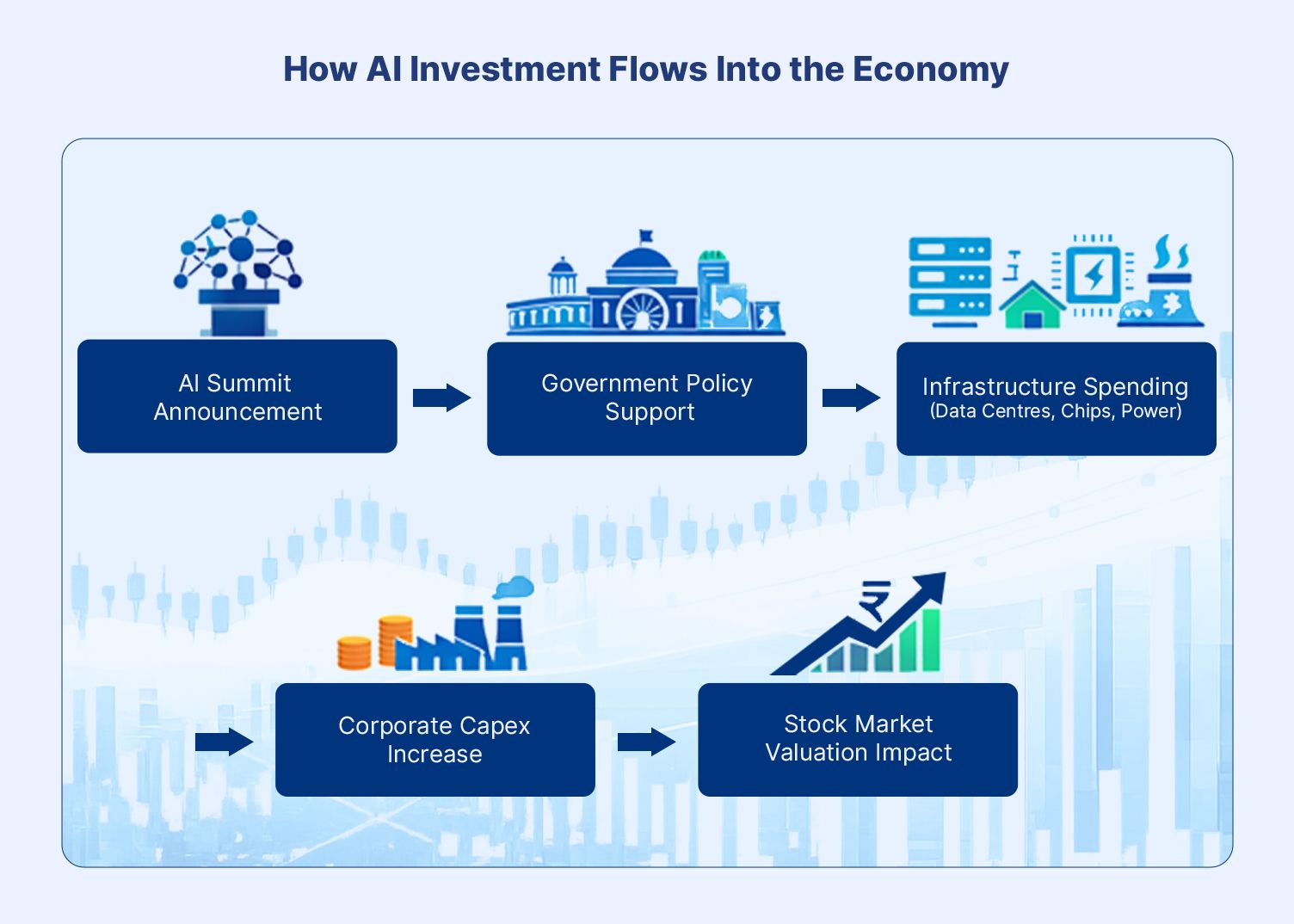
The AI summit India 2026 saw major investment commitments totalling over $200 billion expected across AI and deep-tech infrastructure over the next two years through several India AI policies. This includes data centres, semiconductor capacity, compute expansion, and AI ecosystem support. India also announced the addition of 20,000 GPUs to its national AI computer infrastructure, significantly strengthening its domestic research and startup capabilities.
- Semiconductor and AI infra push
A major highlight of the AI Summit India 2026 was the push for semiconductor and AI infrastructure. There were major investment commitments in AI data centres and chip ecosystems, indicating that India is looking beyond software to hardware enablement. This could support generative AI India capabilities and reduce reliance on foreign compute resources. For investors, this signals the beginning of a capital expenditure supercycle linked to AI infrastructure.
How AI Impacts Indian Markets
By placing AI at the heart of national strategy and international dialogue, India demonstrated that it views artificial intelligence not as a passing trend, but as a foundational pillar of its future growth and global competitiveness. The next big question is, how does this impact Indian markets
1. AI and stock valuations
Stock markets usually move based on expectations of future performance, not just current profits. Therefore, Summit India 2026, a landmark event, will have some impact on the Indian market. Companies in India connected to artificial intelligence, such as those in cloud services, data centres, semiconductors, and digital platforms, may see their stock prices rise even before they show strong earnings from AI. This is because investors believe these companies could benefit from long-term India AI market growth.
2. Capex cycle revival
A capex cycle begins when companies start spending heavily on building long-term infrastructure. AI development requires significant capital investments, including data centres, semiconductor facilities, high-power electrical systems, fibre networks, and advanced cooling equipment.
What this means is that the new India AI policy is not just a software story. It can restart large-scale capital spending across industries. That rise in investment activity is what economists call a capex cycle revival.
3. AI-linked ETFs and thematic funds
As AI becomes a major theme, investment products focused on artificial intelligence applications India may increase. This includes AI-focused ETFs and thematic mutual funds. These funds aim to give investors exposure to companies expected to benefit from AI.
However, investors should look carefully at what they are buying. Some companies may genuinely earn revenue from AI, while others may simply use the term “AI” in marketing without meaningful business impact.
Where Investors Should Be Cautious
While artificial intelligence presents exciting opportunities in India, it also carries some risks. Investors should therefore have a balanced approach and avoid getting carried away by excessive optimism.
1. AI hype vs earnings reality
While AI summit India 2026 created optimism, investors must separate long-term structural change from short-term speculative excess. Revenue from AI infrastructure projects may take years to realise. It is because companies currently announcing “AI integration” will face a value correction if they do not have clear monetisation pathways, leading to no earnings.
2. Bubble signals to watch
Historical technology cycles have shown that while AI adoption is transformative, it tends to unfold in phases rather than overnight. This means that investors should be on the lookout for bubble singles before making any big decision:
- Rapid IPOs of AI startups India without proven profitability
- Extreme price-to-earnings expansions disconnected from cash flows
- Overconcentration in AI-themed portfolios
Beyond Stocks: Fixed Income Opportunities In The AI Capex Cycle
AI growth does not create opportunities only in the stock market. The infrastructure required for artificial intelligence in India also opens doors in fixed income and alternative investments.
1. Corporate bonds funding infra
Large-scale AI infrastructure requires debt financing. Corporate bonds issued to fund data centres, semiconductor facilities, and digital infrastructure may offer relatively stable yield opportunities during the capex buildout phase. Fixed income can provide diversified exposure to the AI mission India 2026 without full equity volatility.
2. Alternative platforms
Alternative investment platforms like Grip Invest enable participation in asset-backed and structured opportunities tied to real-economy growth themes. As AI infrastructure expands, such platforms may become relevant for investors seeking yield-oriented exposure outside listed equities.
Conclusion
The recent AI summit in New Delhi reinforced that artificial intelligence is no longer a futuristic narrative for India but a structural economic theme. With strong policy backing, large infrastructure commitments, and growing global collaboration, AI is poised to influence multiple sectors ranging from technology and manufacturing to healthcare and governance.
For investors, this shift signals a mix of opportunity and caution. While AI-driven innovation may support long-term market growth, the investment cycle will unfold gradually as infrastructure is built, monetisation models mature, and earnings visibility improves. A balanced strategy that combines equities, fixed income exposure, that can help investors participate in the AI growth story without excessive concentration risk.
Ultimately, the AI transformation in India is less about short-term market excitement and more about a multi-year structural evolution that could reshape productivity, capital expenditure trends, and investment themes across the economy.
To explore yield-oriented opportunities emerging from real-economy growth themes like AI infrastructure, investors can consider diversified exposure through platforms such as Grip Invest.
FAQs On AI In India 2026
1. Is AI a good investment theme in India?
Artificial intelligence in India represents a long-term structural growth theme backed by policy support, infrastructure expansion, and global participation. However, disciplined valuation analysis is essential to avoid hype-driven risks.
2. Which Indian companies benefit from AI?
Companies involved in cloud services, semiconductors, data centers, digital transformation, AI healthcare India, AI agriculture India, and AI education India ecosystems are positioned to benefit directly or indirectly.
3. Is AI overvalued right now?
Stocks of some AI startups India and other AI-related companies may be pricing in aggressive growth assumptions. Investors should evaluate earnings visibility, order books, and capex timelines before allocating capital.
Want to stay at the top of your finances?
Join the community of 4 lakh+ investors and learn more about Grip Invest, the latest financial knick-knacks, and shenanigans in the world of investing.
Happy Investing!
Disclaimer - Investments in debt securities/municipal debt securities/securitised debt instruments are subject to risks including delay and/ or default in payment. Read all the offer related documents carefully. The investor is requested to take into consideration all the risk factors before the commencement of trading.
This communication is prepared by Grip Broking Private Limited (bearing SEBI Registration No. INZ000312836 and NSE ID 90319) and/or its affiliate/ group company(ies) (together referred to as “Grip”) and the contents of this disclaimer are applicable to this document and any and all written or oral communication(s) made by Grip or its directors, employees, associates, representatives and agents. This communication does not constitute advice relating to investing or otherwise dealing in securities and is not an offer or solicitation for the purchase or sale of any securities. Grip does not guarantee or assure any return on investments and accepts no liability for consequences of any actions taken based on the information provided. For more details, please visit www.gripinvest.in
Registered Address - 106, II F, New Asiatic Building, H Block, Connaught Place, New Delhi 110001


