

Avience Biomedicals IPO Analysis 2026: GMP, Financials, Risks And Key Details


Avience Biomedicals IPO brings a healthcare-linked SME issue to the NSE Emerge platform. The company is raising fresh capital, with no offer for sale.
The IPO is a book built fresh issue of 14,53,800 equity shares of face value INR 10 each. The price band is INR 196 to INR 208 per share, taking the issue size to INR 30.24 crore at the upper price band.1
Here is the tentative IPO timeline for Avience Biomedicals:
Event | Date |
IPO opens | 18 June 2026 |
IPO closes | 22 June 2026 |
Basis of allotment | 23 June 2026 |
Refund initiation | 24 June 2026 |
Credit of shares to demat | 24 June 2026 |
Tentative listing date | 25 June 2026 |
Since the IPO is fully a fresh issue, the company will receive the proceeds. This makes the use of funds important because the money is linked to expansion and working capital needs.
Object of the issue | Amount |
Part-financing capital expenditure for a new manufacturing unit in Uttar Pradesh | INR 1,595.53 lakh |
Funding working capital requirements | INR 825.00 lakh |
General corporate purposes | - |
With the IPO structure and fund use clear, the next step is to understand the Avience Biomedicals company details and how its healthcare linked business operates.
Avience Biomedicals: Company Overview
Avience Biomedicals operates across medical consumables, in-vitro diagnostics and medical devices, with a product range linked to testing, laboratory use and healthcare facilities.
The company began as Avience Biomedicals Private Limited on 23 December 2019 and became a public limited company on 3 September 2024. It has its registered office in New Delhi and runs its manufacturing facility from Noida, Uttar Pradesh.
Its portfolio includes rapid diagnostic test kits for COVID-19, HIV, malaria, dengue and HBsAg. The company also deals in serology products, biochemistry analysers, biochemistry reagents, culture media and other medical consumables used by laboratories and healthcare providers.
Avience serves pathology labs, microbiology labs, hospitals, research centres, government bodies and distributors. It also has export exposure across Dubai, Ethiopia, Ghana, Somalia, Nepal and Zambia.
The company is promoted by Mr Dharam Deo Choudhary, Mr Ram Nagina Choudhary, Mr Janardan Pal and Ms Deepa Choudhary. After the IPO, promoter holding is expected to reduce from 87.89% to 64.59%.
Business Model Analysis
The business model is not limited to manufacturing. Avience earns from a mix of own products, distribution, trading and institutional sales.
The following table explains how the revenue model works:
Revenue area | What it means | Why it matters |
Diagnostic kits | Own and traded test kits for diseases | Supports repeat demand from labs and hospitals |
Medical devices | Analysers, equipment and related products | Adds higher-ticket institutional sales |
Reagents and consumables | Biochemistry reagents, culture media and lab items | Can create recurring order flow |
Distribution and trading | Third-party medical devices and equipment | Helps scale, but may carry supplier risk |
Government and institutional supply | Sales to public and large buyers | Can bring volume but may stretch receivables |
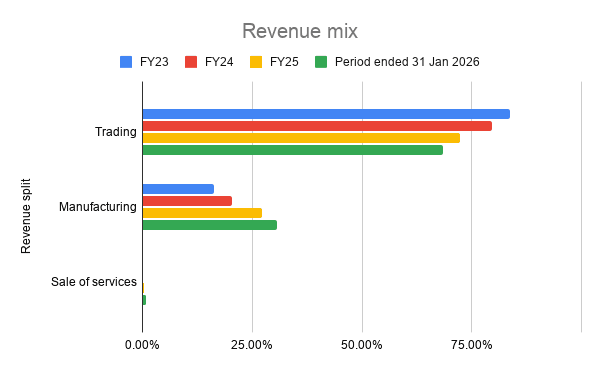
A closer look at the revenue split shows that trading still contributes the largest share.
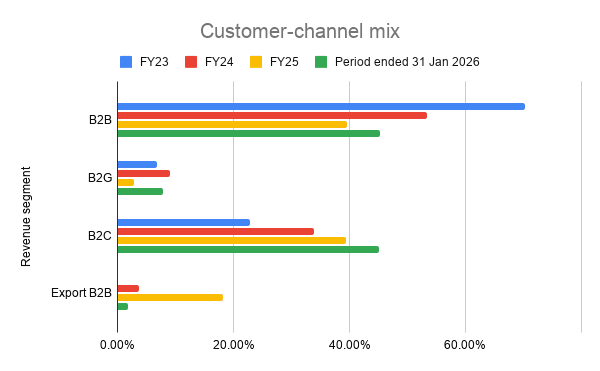
The company’s business mix has also shifted. B2B revenue share reportedly moved from 70.25% in FY23 to 39.53% in FY25, as B2C and B2G channels grew. This matters because each channel has a different risk profile.
B2B sales can support distributor-led reach, while B2C sales show direct demand from hospitals, laboratories and healthcare facilities. B2G revenue can bring institutional volumes, but tender-linked payments may take longer.
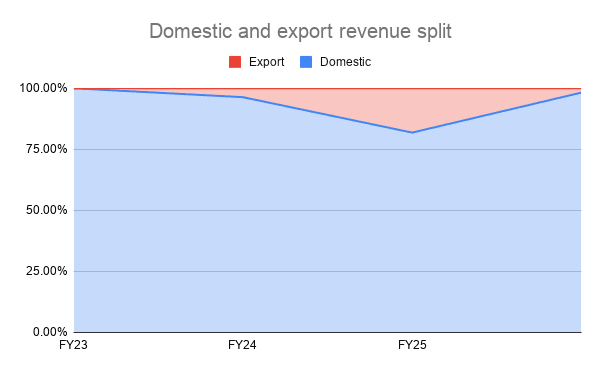
Export exposure also moved sharply. Export revenue stood at 0% in FY23, increased to 18.15% in FY25, and then stood at 1.76% for the period ended 31 January 2026.
The IPO proceeds are linked to this business direction. Avience plans to use part of the fresh issue for a new manufacturing unit at Industrial Plot No. 70, Sector 28, Medical Device Park under YEIDA, Gautam Buddha Nagar, Uttar Pradesh.
This makes the industry backdrop relevant. The company’s growth will not depend only on its own product mix, but also on wider demand for diagnostics, medical devices, healthcare infrastructure and regulated biomedical products in India.2
Biomedical And Healthcare Industry Outlook
India’s medical devices sector is expected to expand from USD 15.2 billion in 2025 to USD 50.1 billion by 2030.3 The National Medical Devices Policy, 2023 sets a similar direction, with a target to grow the market from nearly USD 11 billion to USD 50 billion by 2030.4
For Avience, this wider growth matters through a narrower lens. Its products are linked to diagnostics, laboratory testing, consumables and hospital usage. Items such as rapid test kits, biochemistry reagents and culture media can see repeat demand when labs and healthcare providers expand testing volumes.
Regulation remains a key part of this sector. Medical devices and in-vitro diagnostic products come under the Medical Devices Rules, 2017.5 So, licences, product quality, labelling and compliance systems are not just formal requirements. For an SME company, they can directly affect customer confidence, scalability and future orders.
Avience Biomedicals Financial Analysis
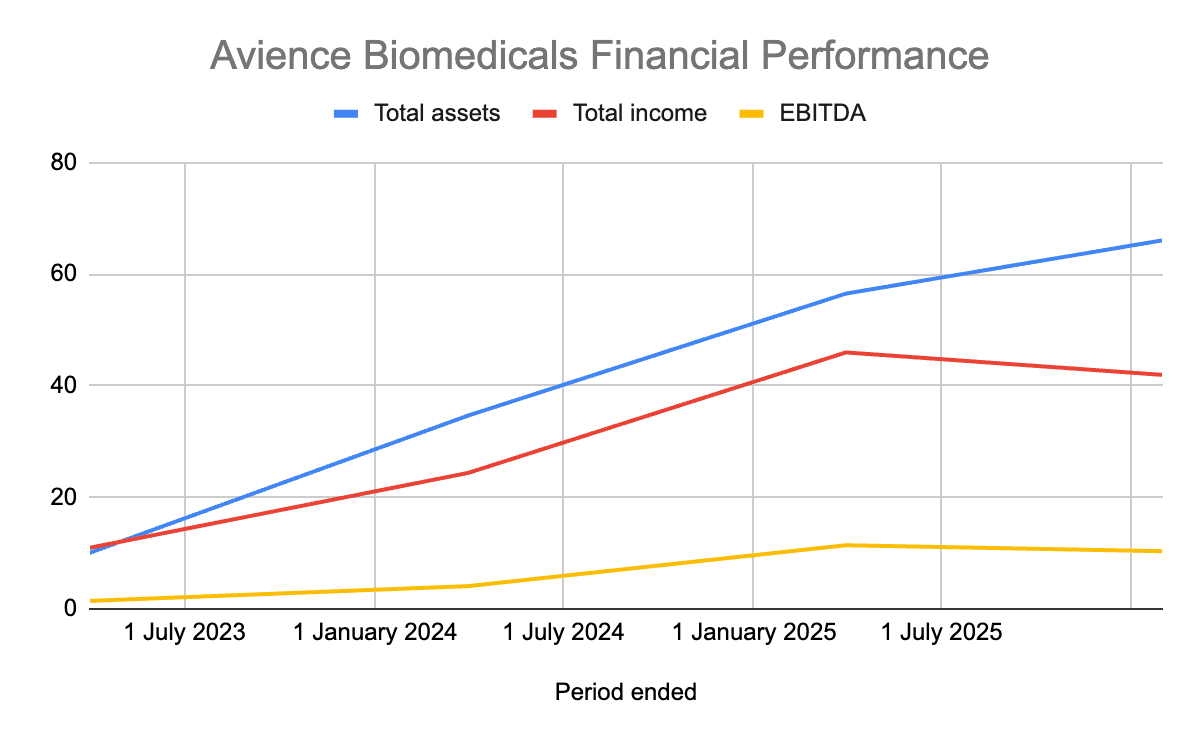
Avience Biomedicals financials shows how the business has grown before entering the public market. The numbers also help readers separate growth from profitability and leverage.
Here is the restated consolidated financial trend:
Period ended (INR Crore) | Total assets | Total income | EBITDA | PAT | Net worth |
31 March 2023 | 10.02 | 10.93 | 1.43 | 0.71 | 4.07 |
31 March 2024 | 34.65 | 24.37 | 4.08 | 2.14 | 6.21 |
31 March 2025 | 56.52 | 45.97 | 11.41 | 7.23 | 22.78 |
31 January 2026 | 66.07 | 41.94 | 10.34 | 5.74 | 28.52 |
Total income increased from INR 24.37 crore in FY24 to INR 45.97 crore in FY25. However, borrowings also increased from INR 15.13 crore in FY24 to INR 22.16 crore in FY25. This is important because the company is also raising IPO money for working capital.
The KPI table adds more context:
Period ended | ROE | ROCE | Debt-equity | RoNW | PAT margin | EBITDA margin | EPS |
31 March 2024 | 34.47% | 17.97% | 2.44 | 34.47% | 8.83% | 17.01% | INR 6.52 |
31 March 2025 | 49.89% | 24.88% | 0.97 | 49.89% | 15.86% | 25.22% | INR 19.06 |
31 January 2026 | 22.38% | 16.99% | 0.94 | 22.38% | 13.68% | 24.70% | INR 14.24 |
These numbers show better margins, but also point to funding and execution needs. That makes the risks important before forming a view on the IPO.6
Risks To Consider Before Investing
SME IPOs in India can move sharply after listing, and smaller healthcare companies may face operational pressure while scaling.
The following risks are important:
- Working capital pressure: Total borrowings increased to INR 17.17 crore by 31 January 2026. The IPO also allocates INR 8.25 crore for working capital, which shows that inventory and receivables are important to operations.
- Regulatory risk: The company operates in medical devices and in-vitro diagnostics. Any delay in licences, certification, product approvals or quality compliance can affect business.
- Supplier dependence: A concentrated supplier base can affect procurement, pricing and availability of raw materials or traded devices.
- Execution risk in new facility: The proposed YEIDA unit needs construction, equipment, approvals and stable demand. Any delay can affect projected growth.
- Employee churn: Reported employee churn stood at 40% in FY25, which may affect continuity in a technical business.
- Board experience: The company has disclosed that none of its directors had prior experience as a director of a listed company.
- SME liquidity risk: NSE SME shares may have lower trading volumes than mainboard stocks after listing.
These risks do not remove the company’s opportunity. They simply show why the healthcare IPO analysis should be reviewed through financial strength, compliance readiness and execution capacity.
Building A Balanced Investment Portfolio
Avience Biomedicals IPO offers exposure to India’s medical devices and diagnostics supply chain. The company has grown income and profit, but it is also expanding in a regulated sector that needs working capital and operational discipline.
The key point is balance. A recent SME IPO may attract attention because of issue timelines, subscription data and listing expectations. Still, the investment decision should depend on business quality, valuation, debt, cash flow, risks and portfolio fit.
IPO investing can add equity growth exposure, but it should not become the only driver of a portfolio. Investors can compare SME IPO exposure with other assets, including listed fixed-income products and corporate bonds, based on their risk appetite and time horizon.
| Investment Option | What it offers | Suitable for investors looking for |
| SME IPOs like Avience Biomedicals | Equity exposure to growing companies with potential capital appreciation | Investors comfortable with higher volatility and business-specific risks |
| Listed stocks | Direct ownership in companies with market-linked returns | Long-term wealth creation through equity markets |
| Mutual funds | Diversified exposure across stocks, bonds, or other assets through professional management | Investors seeking diversification without selecting individual securities |
| Fixed deposits | Predetermined interest rates with relatively stable returns | Investors prioritizing capital stability and predictable income |
| Corporate bonds | Fixed income exposure with defined maturity and interest payments | Investors looking to balance equity risk with debt investments |
| Government securities | Sovereign-backed fixed income instruments | Investors seeking lower credit risk options |
| Gold and other alternatives | Diversification beyond traditional financial assets | Investors looking to spread risk across asset classes |
Conclusion
Avience Biomedicals IPO provides investors an opportunity to participate in India’s growing medical devices and diagnostics ecosystem. The company has shown growth in revenue, profitability and product expansion, while the proposed manufacturing facility could support its future capacity plans.
However, the IPO also comes with factors that need attention, including working capital requirements, regulatory compliance, supplier dependence and the execution challenges of scaling in a healthcare focused industry. As an SME IPO, investors should also consider liquidity and volatility before making an investment decision.
A well planned investment approach focuses on more than just individual opportunities. While equity investments such as IPOs can provide growth potential, maintaining exposure across different asset classes can help manage portfolio risk. Investors can evaluate a mix of equity, fixed income and alternative investments based on their goals, investment horizon and risk appetite.
Ultimately, the Avience Biomedicals IPO decision should be based on understanding the business, financial performance, valuation and how it fits within an overall investment strategy.
FAQs On Avience Biomedicals IPO
 |
Author: Grip Invest Editorial Team The Grip Invest Editorial Team is a group of Chartered Accountants, MBA (Finance) graduates, and Qualified Research Analysts dedicated to helping you invest smarter. We dive deep into India's fixed income landscape to deliver content that is accurate, up-to-date, and easy to understand. Whether you're exploring bonds, fixed deposits, or other fixed income opportunities, our guides cut through the noise and give you the clarity to make better financial decisions. |
Want to stay at the top of your finances?
Join the community of 4 lakh+ investors and learn more about Grip Invest, the latest financial knick-knacks, and shenanigans in the world of investing.
Happy Investing!
Disclaimer - Investments in debt securities/municipal debt securities/securitised debt instruments are subject to risks including delay and/ or default in payment. Read all the offer related documents carefully. The investor is requested to take into consideration all the risk factors before the commencement of trading.
This communication is prepared by Grip Broking Private Limited (bearing SEBI Registration No. INZ000312836 and NSE ID 90319) and/or its affiliate/ group company(ies) (together referred to as “Grip”) and the contents of this disclaimer are applicable to this document and any and all written or oral communication(s) made by Grip or its directors, employees, associates, representatives and agents. This communication does not constitute advice relating to investing or otherwise dealing in securities and is not an offer or solicitation for the purchase or sale of any securities. Grip does not guarantee or assure any return on investments and accepts no liability for consequences of any actions taken based on the information provided. For more details, please visit www.gripinvest.in
Registered Address - 106, II F, New Asiatic Building, H Block, Connaught Place, New Delhi 110001


